
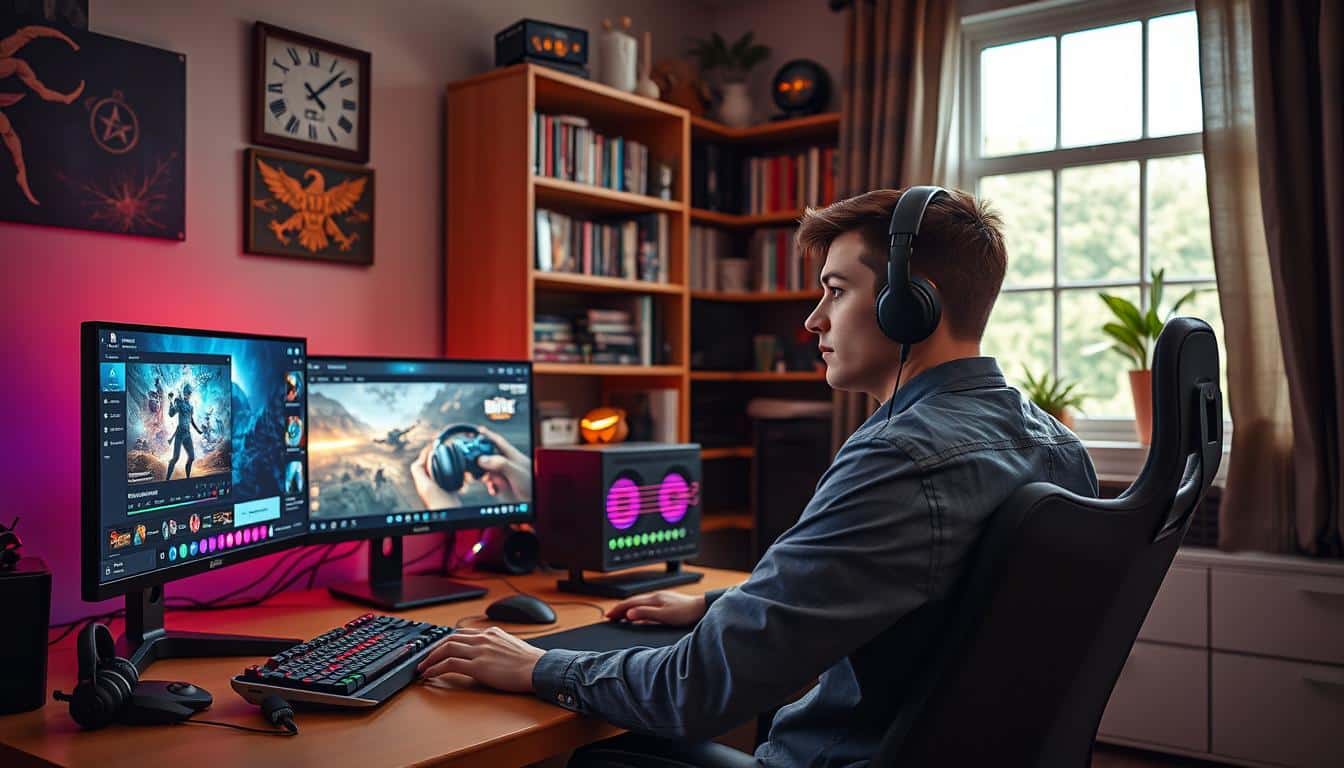

The global gaming industry generated over $184 billion in revenue last year. Regular players, not just professional esports athletes, earned $1.2 billion through various monetization methods. That’s real money flowing to everyday gamers who turned their hobby into income.
I’ve spent months testing different approaches to online gaming jobs. The reality doesn’t match the hype you see in most articles. But there are legitimate ways to generate free gaming income without upfront investment.
The landscape has shifted dramatically over the past three years. What used to require expensive equipment now has accessible entry points. Some methods work better than others, though.
This isn’t about get-rich-quick schemes or unrealistic promises. It’s about understanding the actual opportunities available right now. Setting proper expectations for earning through gaming is crucial.
Key Takeaways
- The gaming industry offers multiple legitimate income streams for casual players, not just professional competitors
- You can start earning without expensive equipment or large audiences through specific platforms and methods
- Realistic expectations are essential—most beginners earn modest amounts before scaling up
- The monetization landscape has become more accessible in recent years with lower entry barriers
- Success requires understanding which methods align with your gaming style and time commitment
- Testing different approaches helps identify what works best for your specific situation
What Does It Mean to Get Paid to Play Video Games?
People have mixed reactions about making money playing games online. Some are skeptical while others get excited. The truth lies somewhere between these two extremes.
Gaming monetization has become a real income source for thousands across the United States. It works differently than traditional jobs. The landscape has changed dramatically over the past decade.
Professional tournament players were once rare. Now there’s a multi-billion dollar ecosystem. Opportunities exist at every skill level.
Understanding the Concept
Getting paid to play video games means converting your gaming time into actual income through various monetization channels. It’s not magic. You don’t need exceptional skills at one particular game.
The concept revolves around creating value for companies, audiences, or platforms. Your gaming activities provide this value. Companies need data about how their games perform.
Audiences want entertainment and education about games. Brands need influencers who can reach gaming communities. Each need creates an opportunity for gamers to generate revenue.
Gaming compensation programs work through several core models. Direct payment models compensate you for specific tasks. These include testing games or playing for set time periods.
Performance-based models reward skill through tournament winnings or competitive rankings. Content creation models pay through advertising revenue. This happens when you stream or create videos about games.
The barrier to entry varies significantly depending on your chosen path. Some methods require minimal investment. You just need your existing device and internet connection.
Others demand sophisticated equipment, years of skill development, or established audiences. You need these before seeing meaningful returns.
Different Forms of Earning
Gaming income opportunities range from casual pocket money to six-figure professional careers. Understanding where different methods fall helps set realistic expectations. This knowledge helps you choose the right path.
Reward apps and casual platforms represent the entry-level tier of free gaming income. These include mobile apps that pay small amounts. You earn by completing games or reaching specific levels.
Companies like Mistplay and Swagbucks offer this model. The income potential typically ranges from $20 to $100 monthly. Your earnings depend on time invested.
Game testing positions offer more substantial income. Professional testers employed by gaming companies earn hourly wages. These range from $15 to $30.
These roles require attention to detail. You must document bugs systematically. Elite gaming skills aren’t necessarily required.
Content creation through platforms like Twitch and YouTube represents the middle tier. Streamers earn through subscriptions, donations, and advertising revenue. Success depends more on personality and entertainment value than pure gaming skill.
The income range varies wildly. Beginners might earn nothing while established creators make thousands monthly.
| Earning Method | Skill Level Required | Monthly Income Potential | Time Investment | Startup Costs |
|---|---|---|---|---|
| Reward Apps | Beginner | $20-$100 | 5-15 hours | $0 (mobile device) |
| Game Testing | Intermediate | $500-$2,500 | 20-40 hours | $0-$500 |
| Content Streaming | Intermediate-Advanced | $0-$5,000+ | 20-60 hours | $300-$2,000 |
| Professional Esports | Expert | $1,000-$50,000+ | 40-80 hours | $1,000-$5,000 |
| Coaching Services | Advanced | $200-$3,000 | 10-30 hours | $0-$200 |
Professional esports represents the peak earning potential. Top players in games like Fortnite, League of Legends, and Dota 2 earn well. They make money through tournament prizes, team salaries, and sponsorships.
This path requires thousands of hours of practice and exceptional natural talent. Only a tiny percentage of gamers reach this level.
Coaching and tutorial creation offers another avenue. You can teach others through paid coaching sessions if you excel at a game. You can also sell educational content.
Platforms like Gamer Sensei and Fiverr facilitate these services. Income depends on your reputation and the complexity of the game you teach.
Common Misconceptions
The biggest myth about making money playing games online is that it’s easy passive income. Most successful gaming earners work harder than traditional employees. This is especially true in the beginning.
Building a streaming audience takes months of consistent content creation. Reaching competitive gaming levels requires daily practice for years.
Another misconception suggests you need expensive equipment from day one. Professional streamers use sophisticated setups. However, many successful creators started with basic equipment.
A decent microphone matters more than a $3,000 gaming rig for building an audience. You can begin exploring gaming compensation programs with your current device.
Many people believe only teenagers or young adults can succeed in gaming monetization. This couldn’t be further from the truth. The gaming demographic has aged significantly.
Audiences appreciate diverse perspectives. I’ve seen successful gaming content creators in their 40s, 50s, and beyond. They’ve built loyal followings.
The “overnight success” narrative damages realistic expectations. Even gamers who seem to explode in popularity invested years of unseen effort. Their breakthrough came after much work.
The sustainable approach involves treating gaming income as a gradual build. Don’t view it as a lottery ticket.
There’s also confusion about free gaming income opportunities. “Free” typically means no upfront payment required. It doesn’t mean no work is involved.
These opportunities still demand your time and energy. The trade-off involves exchanging labor for payment rather than purchasing a business opportunity.
Many assume gaming income is inherently unstable. While volatility exists, diversification creates stability. Successful gaming earners typically combine multiple income streams.
They mix streaming revenue plus tournament winnings plus sponsorships plus coaching. This portfolio approach provides resilience when individual channels fluctuate.
How to Start Playing Video Games for Money
Most people hesitate at the starting line of get paid to play video games at home for free opportunities. They wait for perfect conditions that never come. I spent three weeks researching before I realized the best approach was simply to begin.
The barrier to entry is lower than you think. The learning happens through doing rather than endless preparation.
The process breaks down into three practical areas that you can tackle today. Each requires different considerations, but none demands significant upfront investment. What matters most is taking deliberate steps rather than waiting for some mythical “right moment.”
Finding and Joining Gaming Platforms
Registration on gaming monetization platforms typically takes fifteen to thirty minutes per site. I recommend starting with two or three platforms rather than attempting to join everything at once. This prevents overwhelm and lets you understand how each platform operates.
Legitimate platforms ask for basic information: email address, payment details for earnings distribution, and sometimes verification of your gaming accounts. They don’t request upfront fees or sensitive financial information beyond what’s necessary for paying you. If a platform demands money before you can start earning, that’s your first red flag.
I’ve encountered several scams disguised as online gaming jobs. They share common characteristics. They promise unrealistic earnings—like $500 per day for minimal effort.
They pressure you to recruit others before you can earn. They require “training fees” or “activation costs” that legitimate platforms never charge.
Verification before commitment saves considerable frustration. Check for company registration information and read reviews from multiple sources. Search for complaints using the platform name plus terms like “scam” or “payment issues.”
The Better Business Bureau and Trustpilot provide helpful insights. Take extreme reviews in either direction with appropriate skepticism.
Some platforms have instant approval while others review applications. Game testing platforms often require approval processes because they’re matching you with specific projects. Streaming-related opportunities typically offer immediate access since you’re building your own audience.
Selecting Your Gaming Focus
The tension between playing what pays well versus what you actually enjoy creates genuine conflict. I initially chased the highest-paying opportunities in genres where I had mediocre skills. That approach generated minimal income and maximum frustration until I adjusted my strategy.
Market research reveals which game genres offer the most monetization opportunities:
- Battle royale games (Fortnite, Apex Legends, PUBG) attract massive audiences and sponsor interest
- Multiplayer online battle arenas or MOBAs (League of Legends, Dota 2) have established competitive circuits
- First-person shooters (Call of Duty, Valorant, CS:GO) offer tournament opportunities at various skill levels
- Mobile games increasingly provide testing opportunities and casual tournament options
- Retro and speedrunning communities build dedicated followings despite smaller overall audiences
The sweet spot exists where your natural abilities intersect with market demand. I’m decent at strategy games but exceptional at puzzle-based titles. I eventually found better opportunities in my actual strength area because I could compete at higher levels.
Consider your current skill level honestly. If you’re average at a popular genre, you’ll struggle to stand out. But if you’re top-tier in a smaller niche, you might find dedicated audiences and opportunities.
The goal isn’t always to chase the biggest games. It’s to find where you can deliver value that others can’t easily replicate.
Genre selection also affects how quickly you can start earning. Competitive gaming requires significant skill development before monetization becomes realistic. Game testing and casual tournament participation offer faster initial returns.
Streaming and content creation depend more on personality and consistency than pure gaming ability. Competence certainly helps.
Creating Your Gaming Environment
You don’t need a professional streamer setup to begin earning through online gaming jobs. I started with a seven-year-old laptop, a $20 microphone, and whatever space I could claim. Upgrades came gradually as earnings justified the investment rather than requiring massive upfront costs.
Essential items for getting started include: a computer or console capable of running your chosen games smoothly. You need reliable internet connection (minimum 25 Mbps for streaming, less for other opportunities). Basic audio equipment if you’re communicating with others is also important.
That’s legitimately all you need to begin generating income.
Nice-to-have upgrades improve your experience but aren’t mandatory initially. A dedicated gaming monitor, mechanical keyboard, precision mouse, and upgraded headset all enhance performance. Professional lighting and camera equipment matter for streaming but not for game testing or tournament participation.
Prioritize based on which earning path you’re pursuing.
Space considerations matter more than equipment quality in some ways. You need somewhere you can focus without constant interruptions. I’ve seen people earn consistently from tiny apartments and others struggle in perfect home offices.
The physical space mattered less than the mental space to concentrate.
Ergonomics become critical when you’re spending extended periods gaming. I ignored this initially and developed wrist pain that could have been avoided. Your monitor should sit at eye level, chair should support your lower back.
Keyboard positioning should keep your wrists neutral. These adjustments cost nothing but prevent injuries that could derail your earning potential.
The workspace doesn’t need dedicated gaming aesthetics—it needs functionality. Good lighting prevents eye strain. Organization keeps necessary items accessible.
Separation from living areas helps maintain work-life boundaries even when your work involves playing games. Start with what you have, identify what’s actually limiting your performance, then upgrade strategically.
Best Platforms to Get Paid to Play Video Games
I’ve personally used and researched platforms that offer real gaming compensation programs to U.S. players. The landscape is crowded with options. Understanding which platform matches your skill level makes the difference between earning money and wasting hours.
Each platform type serves different needs. Some reward skill and competition. Others value time spent playing.
I’m breaking this down into three main categories that cover the most reliable options available right now.
Marketplaces for Gamers
PlayerAuctions stands out as one of the most established marketplaces where gamers sell in-game items. I’ve watched friends successfully build side income streams here by farming rare items in MMORPGs. They sell them to players who’d rather pay than grind.
The protection system works both ways. Buyers get guarantees, but sellers also have dispute resolution options. PlayerAuctions charges a seller fee ranging from 10% to 15% depending on your transaction volume.
G2G operates similarly but focuses more heavily on currency and boosting services. The platform supports over 200 games, with competitive rates for sellers. Their PowerSeller program caught my attention—once you build reputation, your fees drop and you get priority listing.
Fiverr’s gaming section has exploded recently. You’re not just limited to paid game testing here. Gamers offer coaching sessions, strategy guides, account leveling, and even companion gaming services. I know someone charging $25 per hour for Valorant coaching with consistent bookings.
The catch with all marketplaces? You need specific expertise in popular games to make consistent money. Your earnings depend entirely on demand for your particular service or item.
Competitive Gaming Sites
FACEIT revolutionized how competitive gamers access online gaming jobs through tournaments and leagues. The platform hosts competitions for Counter-Strike, League of Legends, and Dota 2. Prize pools range from $50 to several thousand dollars.
Entry requirements vary dramatically. Some tournaments welcome anyone willing to pay the small entry fee. Others require established ELO ratings or previous competitive experience.
GameBattles by MLG offers a different approach. You and opponents both put up money, with the winner taking the pot minus platform fees. This works particularly well for console gamers playing Call of Duty, Madden, or NBA 2K.
The reality check: competitive platforms require genuine skill. I’ve seen beginners lose entry fees repeatedly before understanding their actual competitive level. Start with free tournaments to gauge where you stand.
Tournament frequency matters too. FACEIT runs daily competitions, so you have regular opportunities. Smaller platforms might only host monthly events, limiting your earning potential.
Prize distribution is another consideration. Large tournaments often pay only the top three finishers. Smaller competitions might distribute prizes across top ten, giving you better odds of winning something.
Reward-Based Apps and Programs
Mistplay remains the dominant mobile gaming rewards app with over 10 million downloads. You earn units by playing featured mobile games, which convert to gift cards. The earning rate averages about $5 per 10 hours of gameplay—not impressive, but requires zero skill.
Swagbucks expanded beyond surveys to include gaming offers. Some deals pay $50+ for reaching specific levels in mobile games. The catch? These high-paying offers usually require in-app purchases that eat into your earnings unless you’re strategic.
InboxDollars takes a simpler approach with arcade-style casual games that enter you into cash sweepstakes. Your odds of winning are low. It’s genuinely free to play with no purchase requirements.
I tested all three extensively last year. Mistplay proved most reliable for consistent small earnings. Swagbucks offered the highest potential payouts but demanded more attention to terms and conditions. InboxDollars felt more like a lottery than reliable income.
Geographic restrictions hit this category hard. Many reward apps limit availability to specific states or exclude certain regions entirely. Always verify availability for your location before investing time.
| Platform Type | Earning Potential | Skill Required | Time Investment | Payment Method |
|---|---|---|---|---|
| Marketplaces (PlayerAuctions, G2G) | $100-$1,000+/month | Game-specific expertise | 10-30 hours/week | PayPal, Bank Transfer |
| Competitive Sites (FACEIT, GameBattles) | $50-$5,000+/tournament | High competitive skill | Varies by tournament | Direct deposit, PayPal |
| Reward Apps (Mistplay, Swagbucks) | $20-$100/month | Minimal to none | 5-15 hours/week | Gift cards, PayPal |
Payment schedules differ significantly across platforms. Marketplaces typically release funds after a waiting period to prevent fraud. Competitive sites may hold prize money for weeks during verification.
I recommend starting with reward-based apps to test the waters without risk. Once you understand the gaming economy, evaluate whether your skills match marketplace or competitive opportunities. The best approach combines multiple platforms to diversify your income sources.
Statistics on Gaming Earnings in the U.S.
Let’s talk money, because that’s probably why you’re here. The gaming industry throws around impressive numbers. But what do they mean for someone trying to become a professional gamer from home?
I’ve spent considerable time analyzing earnings reports and market studies. I’ve also reviewed real income data from gamers across different skill levels. The picture that emerges is more nuanced than success stories suggest.
Understanding these statistics helps set realistic expectations. You’ll see both the potential and the limitations of gaming as income.
Average Income for Gamers
The median annual income for professional gamers in the United States sits around $50,000 to $60,000. That sounds decent until you realize something important. This figure includes top earners who make millions and significantly skew the average upward.
Starting out as a part-time gamer looks quite different. The actual middle ground looks more like $200 to $500 monthly. I’ve observed this from tracking beginner earnings across various platforms.
The income distribution breaks down into distinct tiers. About 5% of gamers earn six figures annually through tournaments, sponsorships, and streaming. Another 15% make enough to consider it supplementary income, pulling in $1,000 to $3,000 monthly.
What influences these earnings? Consistency matters most. Gamers who stream regularly earn significantly more than those who game occasionally.
Those who participate in frequent tournaments also see higher earnings. Maintaining active content creation schedules makes a big difference. Your chosen platform also affects income potential dramatically.
The path to free gaming income starts small for nearly everyone. Very few people jump straight into substantial earnings. Building an audience, developing skills, and establishing reputation takes time.
This usually means 6 to 18 months before seeing consistent income.
Growth Trends in the eSports Industry
The U.S. eSports market reached approximately $264 million in 2023. Industry analysts project this will grow to over $400 million by 2027. That’s substantial growth, but it also means increased competition.
Viewership statistics tell an interesting story. In 2019, eSports viewership in the U.S. totaled around 30 million people. By 2023, that number jumped to nearly 50 million.
More viewers translate to more sponsorship opportunities and higher prize pools.
Tournament prize pools have increased dramatically over the past five years. Major competitions now regularly offer multi-million dollar prizes. The International, a Dota 2 tournament, has exceeded $40 million in prize money.
Fortnite World Cup handed out $30 million in 2019.
Corporate investment has surged as well. Major brands like Coca-Cola, Intel, and Red Bull now sponsor eSports teams and events. Traditional sports organizations have purchased gaming teams.
This legitimizes gaming as a career path. It also creates infrastructure for professional gamers.
However, this growth creates a paradox. More opportunities exist, but more people compete for them. The barrier to entry remains low.
But the barrier to earning significantly rises as the field becomes more crowded and professionalized.
Popular Games Among Earning Gamers
Certain games consistently offer better monetization opportunities than others. I’ve tracked which titles provide the most reliable income streams. This includes players at various skill levels.
League of Legends remains a top earner. The game’s competitive scene offers numerous tournaments with substantial prize pools. Streaming League of Legends also attracts large audiences.
The game’s complexity and strategic depth keep viewers engaged.
Fortnite transformed the landscape when it launched. Its accessibility combined with high-stakes tournaments created opportunities for younger players. The game still offers regular competitive events with significant cash prizes.
Counter-Strike continues its decades-long run as a competitive staple. CS tournaments offer consistent prize pools. The game maintains a dedicated viewership.
The skill ceiling remains high, which appeals to competitive audiences.
Dota 2 features the largest single tournament prize pools in gaming history. However, the game’s steep learning curve means fewer casual income opportunities. This differs from more accessible titles.
Mobile games have emerged as surprising income sources. Games like PUBG Mobile and Call of Duty Mobile offer tournaments with substantial prizes. They require less expensive equipment than PC or console gaming.
| Game Title | Annual Prize Pool (USD) | Average Monthly Viewers | Income Accessibility |
|---|---|---|---|
| League of Legends | $2.2 Million+ | 150 Million | Moderate |
| Fortnite | $10 Million+ | 80 Million | High |
| Counter-Strike | $18 Million+ | 45 Million | Moderate |
| Dota 2 | $40 Million+ | 40 Million | Low |
| Mobile Games | $15 Million+ | 200 Million | High |
The “Income Accessibility” rating reflects how easily an average player can start earning. High accessibility means the game offers multiple income paths. This includes casual tournaments, streaming opportunities, and lower skill barriers.
Low accessibility indicates earnings concentrate among top-tier professional players.
Streaming viewership numbers matter because they indicate audience interest. Games with larger audiences offer better sponsorship opportunities. They also provide higher ad revenue potential for content creators.
What surprised me most in researching these statistics is how much consistency matters over raw skill. Players who maintain regular streaming schedules often outearn more skilled players who compete sporadically. Those who participate in frequent tournaments see similar results.
The data clearly shows something important. Treating gaming as a business produces better financial results. This means regular hours and audience engagement rather than treating it purely as a hobby.
Essential Tools and Equipment for Gaming
Your gaming setup determines what opportunities you can realistically pursue. The industry loves to oversell what you actually need. I’ve watched too many aspiring gamers drop thousands on equipment before understanding their monetization path.
Your tool choices should follow your strategy, not the other way around. The equipment conversation matters more for remote gaming employment than casual play. Your hardware directly affects which opportunities you can access.
A streamer needs different tools than a tournament player. A game tester has different requirements than both. Getting this foundation right saves money and frustration down the road.
I’m going to break down the actual equipment you need versus nice-to-have stuff. We’ll look at platforms, accessories, and software through the lens of earning potential. Focus on what actually helps you earn rather than what looks impressive.
Platform Decision: Console or Computer
The PC versus console debate isn’t about which is “better” for gaming. It’s about which platform unlocks more monetization opportunities. From what I’ve seen, PCs offer significantly more flexibility for earning.
A mid-range gaming PC running $800-$1,200 gives you access to streaming software. You can join modding communities, access broader game selections, and pursue multiple revenue streams. You can stream on Twitch while testing games simultaneously.
You can run Discord servers and participate in PC-exclusive tournaments. The investment pays for itself through versatility.
Consoles like PlayStation 5 or Xbox Series X cost $400-$500. They work perfectly fine for tournament play and game testing opportunities. Some testers actually prefer console work because the testing pools are smaller.
But you’ll hit limitations quickly if you want to stream seriously. Content creation becomes challenging without PC flexibility.
Here’s my honest assessment: if you’re serious about remote gaming employment, start with a PC. You can always add a console later for specific opportunities. Starting with only a console limits your options right from the beginning.
| Platform | Initial Cost | Monetization Flexibility | Best For |
|---|---|---|---|
| Gaming PC | $800-$1,200 | High – streaming, testing, tournaments, content creation | Multiple income streams, serious long-term commitment |
| PlayStation 5 | $400-$500 | Medium – tournaments, testing, some streaming | Console-specific testing, PlayStation tournaments |
| Xbox Series X | $400-$500 | Medium – tournaments, testing, Game Pass testing | Xbox ecosystem opportunities, casual entry point |
| Gaming Laptop | $1,000-$1,500 | High – portable streaming, travel tournaments | Flexibility and mobility, space constraints |
The platform choice also depends on which games you’re targeting. If you’re focusing on Call of Duty tournaments that run on console, get the console. But for broad opportunity access, PC wins every time.
Accessories That Actually Matter
Accessories represent where most people either waste money or cheap out in wrong places. I’ve made both mistakes, so let me save you the trouble. Understanding which accessories directly impact your earning potential as a professional gamer from home is key.
Audio equipment sits at the top of the priority list. A decent headset like the HyperX Cloud II costs around $100. The SteelSeries Arctis 7 costs more but delivers better sound isolation and comfort.
These aren’t luxury items—they’re essential tools for communication and content quality.
If you’re streaming or creating content, upgrade to a standalone microphone. The Blue Yeti or Audio-Technica AT2020 both run $100-$130. They dramatically improve your audio quality compared to headset mics.
Viewers forgive mediocre video quality but abandon streams with poor audio almost immediately.
Webcams matter more than you’d expect for building audience connection. The Logitech C920 at $70-$80 provides 1080p quality that’s perfectly adequate. You don’t need a $200 webcam starting out.
You do need something better than a laptop’s built-in camera.
Lighting deserves attention because even expensive cameras look terrible in bad lighting. A simple ring light costs $30-$50. Two desk lamps with daylight bulbs make you look professional without complex setups.
This isn’t about vanity—it’s about meeting quality standards that audiences expect.
Here’s my recommended accessories list by priority:
- Essential tier: Quality headset ($80-$150), comfortable chair ($150-$300), basic mouse and keyboard ($50-$100 combined)
- Streaming tier: Standalone microphone ($100-$130), webcam ($70-$100), basic lighting ($30-$50)
- Optimization tier: Dual monitors ($200-$400), upgraded peripherals ($150-$300), acoustic treatment ($50-$100)
The chair deserves special mention because you’re spending 4-6 hours daily in it. A proper ergonomic chair prevents back problems that could literally end your gaming career. You don’t need a $600 gaming chair.
Don’t use a $40 folding chair either. Find something in the $150-$300 range that actually supports your back.
Software Tools for Content Creation
Software represents the most overlooked aspect of gaming setups. It’s less tangible than shiny new hardware. But the right software combination makes the difference between looking amateur and professional as a professional gamer from home.
OBS Studio remains my top recommendation for streaming because it’s completely free. I’ve used paid alternatives, and while they add some convenience, OBS handles everything. The learning curve exists, but plenty of tutorials walk you through setup.
Streamlabs offers a more user-friendly interface with built-in alerts and widgets. It’s essentially OBS with training wheels, which isn’t an insult. Sometimes training wheels help you start faster.
XSplit provides another alternative with better customer support if you’re willing to pay.
Discord serves multiple functions beyond just voice chat. You’re building community, coordinating with other gamers, and creating audience interaction space. Every successful gaming content creator I know runs an active Discord server.
It’s not optional for serious monetization.
Analytics platforms help you understand what’s working and what isn’t. Stream Elements, TwitchTracker, and YouTube Analytics all provide valuable data. I check analytics weekly to see which streams performed best and why.
Here’s a practical software stack for different goals:
- Basic streaming: OBS Studio (free), Discord (free), basic editing software like DaVinci Resolve (free)
- Professional streaming: Streamlabs or XSplit ($10-$25/month), Discord Nitro ($10/month), Adobe Premiere or Final Cut Pro ($20-$30/month)
- Content creation focus: Recording software like OBS, professional editing suite, thumbnail creation tools like Canva, scheduling software
The software combinations work differently depending on your hardware. A powerful PC handles OBS easily. Older systems might struggle and need Streamlabs’ lighter footprint.
Test your setup before going live to avoid technical disasters during important streams.
One thing I’ve learned: don’t change too many settings at once. OBS optimization requires methodical testing—adjust one setting, stream for an hour, review the recording. Trying to optimize everything simultaneously just creates confusion about what actually improved performance.
The bottom line on equipment is this: start with good enough, upgrade strategically. You don’t need a $3,000 setup to begin earning. You need functional equipment that meets minimum quality standards.
Then you upgrade specific pieces as you identify actual bottlenecks. I’ve seen people succeed with $1,000 total investments. Focus on developing actual skills instead of just buying expensive gear.
Ways to Earn While Gaming
Let me break down practical ways you can earn money testing games and competing. There’s more variety here than most people realize. The gaming monetization landscape has evolved significantly over the past few years.
What used to be limited to professional esports players has expanded. Now there are multiple accessible revenue streams. The three main approaches I’ll cover work at different skill levels and time commitments.
Some require elite gaming abilities. Others just need attention to detail and patience. Understanding which method aligns with your current situation makes all the difference.
Participate in Tournaments
Tournament play represents the most straightforward path to make money playing games online. The financial reality is more nuanced than “just win and get paid.” I’ve seen players drain their bank accounts on entry fees before understanding the math.
Local and online tournaments typically offer prize pools ranging from $50 to $500. These smaller competitions attract hundreds of participants. Your realistic win probability sits somewhere between 5-20% depending on your skill level.
Major esports events reach prize pools in the millions. Fortnite World Cup awarded $30 million in 2019. The solo champion took home $3 million.
Here’s what the tournament landscape actually looks like across skill tiers:
| Tournament Level | Entry Fee Range | Prize Pool Range | Skill Required |
|---|---|---|---|
| Local Online | $5-$25 | $50-$500 | Intermediate |
| Regional | $25-$100 | $500-$5,000 | Advanced |
| National | $100-$500 | $5,000-$50,000 | Semi-Professional |
| International Esports | Qualification-based | $100,000-$30 million | Professional Elite |
The registration process varies by platform. Most use services like Battlefy, Toornament, or game-specific portals. You’ll need to create an account, verify your gaming credentials, and pay entry fees.
Read the tournament rules carefully—disqualifications for technical violations happen often. Most tournaments only pay out the top 3-5 finishers. This means 95% of participants leave with nothing.
Let’s talk about the financial sustainability issue nobody mentions upfront. If you’re entering tournaments with $20 entry fees and winning 20% of the time, you need consistent top placements. You must place high to offset those costs.
I recommend starting with free-to-enter tournaments. This helps gauge your competitive level honestly. Track your placement over 10-15 tournaments before investing significant money in entry fees.
Platforms like Challengermode and GamerSaloon offer both free and paid options.
Game Testing Opportunities
Game testing probably offers the most accessible entry point for video game tester opportunities. It doesn’t require elite gaming skills. I’ll be direct about this: it’s not playing games for fun.
It’s methodical work that involves documentation, repetitive tasks, and detailed reporting. Companies like PlaytestCloud, BetaFamily, and UserTesting pay between $9 and $20 per hour. The work involves following specific test protocols, intentionally trying to break game mechanics, and writing reports.
Here’s what actual game testing work looks like in practice:
- Playtesting sessions: Playing game segments for 15-90 minutes while recording your screen and voice reactions
- Bug documentation: Identifying glitches, reproducing them consistently, and describing exact steps to trigger issues
- Survey completion: Answering detailed questions about gameplay mechanics, difficulty balance, and user interface
- Focus group participation: Providing verbal feedback in structured group settings about game concepts
The application process for video game tester opportunities typically requires completing a profile. This details your gaming experience, available devices, and demographics. Companies match testers to appropriate games based on these factors.
PlaytestCloud, for example, sends test invitations via email. They send these when your profile fits their current needs. Payment structures vary by platform.
BetaFamily pays $10-$20 per test session, which usually lasts 30-60 minutes. UserTesting pays $10 for standard 20-minute tests. PlaytestCloud compensates through PayPal once you accumulate a minimum threshold, typically $10.
What companies actually look for in testers might surprise you. They want articulate communicators who can describe problems clearly, not necessarily expert gamers. Your ability to follow instructions precisely matters more than your kill/death ratio.
The work can feel repetitive—testing the same level dozens of times isn’t exactly thrilling. But it’s legitimate income that anyone can pursue regardless of gaming skill level. I’ve seen people earn $200-$400 monthly from testing work during their spare time.
Affiliate Marketing Strategies
Affiliate marketing represents the long-term revenue strategy that requires upfront audience building. It can generate passive income once established. This method involves promoting gaming products, peripherals, or games themselves through affiliate programs.
The foundation here is building an audience first. You can do this through Twitch streaming, YouTube content, TikTok gaming clips, or Instagram gaming accounts. You can’t effectively promote products without people who trust your recommendations.
Popular affiliate programs for gamers include:
- Amazon Associates: 1-4% commission on gaming peripherals, consoles, and accessories
- Gaming peripheral brands: Razer Affiliate Program offers up to 10% commission on direct sales
- Game retailers: Green Man Gaming and Humble Bundle offer 15-20% commissions on game sales
- Gaming chairs and furniture: Secretlab and similar brands offer 5-8% commissions with higher-ticket items
The strategy that actually works involves authentic recommendations. These should be based on products you genuinely use and can speak about with authority. Your audience detects insincere promotion instantly.
I’ve watched streamers destroy their credibility by pushing products they clearly never touched. Realistic timelines for seeing meaningful affiliate income typically span 6-12 months of consistent content creation. You’ll need to build an audience of at least 1,000-5,000 engaged followers.
After that, affiliate commissions can reach $100-$300 monthly. Larger creators with 50,000+ followers can generate $1,000-$5,000 monthly from affiliate partnerships alone. The technical implementation involves including affiliate links in your content descriptions.
You should use link shorteners to track clicks. You must disclose affiliate relationships to comply with FTC guidelines. Most successful gaming affiliates use a combination of product review content and equipment showcase streams.
This approach to make money playing games online works best when combined with other revenue streams. Streamers typically layer affiliate income with platform subscriptions, donations, and sponsorships.
Understanding the Legal Aspects
Gaming income creates legal obligations that most guides ignore. Many new streamers face tax problems or copyright strikes without warning. Understanding these legal requirements protects everything you build.
The legal framework applies whether you earn $300 or $30,000 from gaming. The IRS treats all gaming income the same way. Platforms like Twitch and YouTube have legal requirements that affect your earnings.
This section covers taxes and intellectual property for earning gamers. I’m not a lawyer or accountant, so this isn’t professional advice. These insights come from my own experiences and common mistakes I’ve seen.
Tax Obligations for Gaming Earnings
All gaming income is taxable in the United States. Tournament winnings, streaming donations, and sponsorship payments count as taxable income. Most people starting online gaming jobs don’t realize they’re technically self-employed.
You’ll likely report gaming income on Schedule C (Profit or Loss from Business). This applies once you earn more than $400 from self-employment yearly. Reporting income below that threshold is still smart if you’re filing taxes.
Nobody withholds taxes from your gaming payments. Traditional employers automatically deduct federal and state taxes. With remote gaming employment, you receive full payments but must set aside taxes yourself.
I immediately move 25-30% of gaming payments into a separate savings account. This covers federal income tax, self-employment tax, and state taxes. It prevents owing thousands at tax time with nothing saved.
Quarterly estimated tax payments become necessary once you owe more than $1,000 yearly. The IRS expects payments in April, June, September, and January. Missing these results in penalties, even if you pay fully by April 15th.
You can deduct legitimate business expenses that reduce taxable income. Keep every receipt and payment record. I use a simple spreadsheet tracking monthly income and expenses.
- Gaming equipment (computers, consoles, controllers, monitors)
- Internet service costs (percentage used for gaming work)
- Software subscriptions (streaming tools, video editing programs)
- Home office space (if you have a dedicated gaming room)
- Travel expenses for tournaments
- Professional services (accountant fees, legal consultations)
Tournament winnings are reported differently than streaming income. Tournaments issue Form 1099-MISC or 1099-NEC if you win more than $600. Streaming platforms issue 1099s typically after you earn $600 as well.
You’re legally obligated to report income even without receiving a 1099. This applies to all gaming earnings regardless of amount.
| Income Type | Reporting Form | Tax Treatment | Deductions Available |
|---|---|---|---|
| Tournament Winnings | Schedule C | Self-employment income | Travel, entry fees, equipment |
| Streaming Revenue | Schedule C | Self-employment income | Equipment, software, internet |
| Sponsorships | Schedule C | Self-employment income | Promotional costs, content creation |
| Affiliate Commissions | Schedule C | Self-employment income | Marketing expenses, platform fees |
International tournament prizes add complexity. Some countries withhold taxes on winnings for non-residents. You may need additional paperwork to claim foreign tax credits.
Consulting a tax professional becomes essential for significant international prizes. They understand international income requirements better than general tax preparers.
Copyright and Licensing Considerations
Intellectual property involves your right to stream, record, and monetize games you don’t own. Most gamers assume they can stream any game and earn money. That’s not automatically true.
Video games are copyrighted creative works. The game developer owns that copyright. You’re technically using their copyrighted material during streams or content creation.
Many developers allow this through Terms of Service or separate streaming policies. Others restrict it. A few prohibit monetization entirely.
I always check the developer’s official stance before building a channel around a game. Most major publishers permit monetization. Smaller indie developers usually appreciate the exposure.
Music causes more DMCA takedowns and copyright strikes than anything else. Games with licensed music often don’t cover that music under streaming permission. Record labels aggressively protect their music copyrights.
Automated systems scan streams and videos for copyrighted music. Three copyright strikes on YouTube terminates your channel permanently. Twitch mutes VODs with copyrighted music and issues mass DMCA notices.
Your options for avoiding music copyright issues:
- Disable in-game music and use only sound effects (not always possible)
- Use royalty-free music libraries like Pretzel Rocks, Epidemic Sound, or Streambeats
- Subscribe to music licensing services designed for streamers
- Play only games without licensed music in their soundtracks
Fair use is the legal concept most gamers misunderstand. Adding commentary doesn’t automatically make content “fair use.” Fair use is a legal defense you might use if sued.
Most game developers won’t sue you for streaming their games because it’s free marketing. Music companies absolutely will take action. Other streamers might issue DMCA notices if you use their clips without permission.
Platform Terms of Service add another layer. Twitch, YouTube, Facebook Gaming—each has specific rules about content, conduct, and monetization. Violating TOS can result in bans, demonetization, or permanent account termination.
I’ve seen streamers lose thousands in monthly income from TOS violations they never read. Common violations involve hateful conduct, copyright infringement, revealing personal information, or promoting prohibited products. These policies change periodically, so checking updates matters.
Legal aspects of online gaming jobs aren’t exciting, but they’re the foundation of sustainable income. Set aside money for taxes, track expenses, and respect copyrights. These habits protect everything you build and prevent career-ending legal problems.
Future Predictions for Gaming as a Career
The gaming industry shows massive growth potential. Success requires knowing which opportunities are real and which are hype. The landscape changes rapidly, so what works today might be obsolete in two years.
Certain trends are solid enough to build a career around. You need to position yourself correctly. Industry reports show opportunities are genuine but increasingly competitive and specialized.
Market Growth in the Next Five Years
Industry analysts report stunning numbers. The global gaming market is projected to exceed $300 billion by 2028. Esports viewership could reach 640 million people worldwide.
These represent fundamental shifts in entertainment consumption. That viewer count would rival traditional sports broadcasts. The U.S. market shows particularly strong growth in several key sectors.
Here’s where I see the strongest growth potential based on current trends:
- Mobile gaming continues expanding rapidly, especially in casual and mid-core categories where earning cash through gaming has become more accessible
- Cloud gaming is developing, though admittedly slower than the initial hype suggested—infrastructure challenges remain real
- Blockchain gaming remains controversial but is showing steady growth despite volatility in cryptocurrency markets
- Gaming-adjacent content like tutorials, reviews, and entertainment commentary is exploding on multiple platforms
The mobile sector has lower barriers to entry. You don’t need a $3,000 gaming rig to compete. Cloud gaming could democratize access further, though latency issues still need solving.
Evolving Roles in the Gaming Industry
Gaming roles now go far beyond being a professional gamer from home competing in tournaments. Specialized support roles didn’t exist five years ago. These positions often offer more consistent income and lower barriers to entry.
The opportunities expanding fastest include:
- Gaming coaches and analysts who help players improve their skills—demand is increasing as competitive gaming becomes more sophisticated
- Community managers for gaming organizations who moderate discussions, organize events, and maintain player engagement
- Content creators focusing on gaming tutorials, reviews, and entertainment—this overlaps with traditional streaming but includes specialized niches
- Gaming psychologists working with professional teams on mental health, performance anxiety, and team dynamics
- Data analysts who track player statistics, game balance, and competitive meta-game trends
These roles offer stability compared to competitive play. A community manager or content creator can build sustainable income. You don’t need to be in the top 1% of player skill.
Many gaming compensation programs now recognize these adjacent roles as legitimate career paths. The coaching market scales effectively. A skilled coach can work with multiple clients and create educational content.
Impact of VR and AR Technologies
Virtual reality and augmented reality represent the biggest wildcards in gaming’s future. VR seemed perpetually “five years away from mainstream” for years. But we’re finally seeing practical applications that create real monetization opportunities.
VR esports is still nascent but growing steadily. The games are becoming more competitive. The hardware is getting more affordable, and dedicated communities are forming around specific titles.
AR gaming showed mainstream viability with Pokémon GO. The technology has advanced considerably since then. We haven’t seen another breakout hit of that magnitude yet.
The metaverse concept is generating actual paid opportunities. Virtual world builders, 3D artists, and moderators for virtual spaces are finding work. Some positions allow you to work as a professional gamer from home in entirely new contexts.
Here’s what matters for positioning yourself in these emerging technologies:
- 3D design skills are becoming increasingly valuable as virtual environments grow more complex
- Understanding spatial audio and immersive design principles sets you apart in VR content creation
- Community building experience translates well to managing virtual spaces and events
- Adaptability to new platforms matters more than mastery of any single current technology
These technologies don’t require you to be a top competitive player. They create parallel career paths where different skill sets matter. A talented 3D artist or community organizer can build a gaming career without competing in tournaments.
VR and AR adoption is happening gradually, not explosively. Investing time in learning these technologies means playing a longer game. People who develop expertise now will have significant advantages as these platforms mature.
The gaming industry is creating more paths to sustainable income. It’s also becoming more professional and competitive across all those paths. Success requires treating gaming as a serious career with continuous skill development.
Tips for Success in Gaming Monetization
Most gamers who successfully make money playing games online share one common trait. They’ve mastered the art of standing out in an incredibly crowded marketplace. Gaming skills alone won’t cut it anymore.
You need to approach this like a business, even if you’re starting from your bedroom.
The reality is harsh but honest. Thousands of talented gamers are competing for viewer attention, sponsor dollars, and tournament prizes. What separates those who build sustainable income from those who quit after three months?
It comes down to three interconnected strategies: establishing your unique identity, genuinely connecting with people who watch you, and building relationships within the gaming community.
I’ve watched countless gamers flame out because they treated monetization as an afterthought. They focused exclusively on gameplay while ignoring the business fundamentals that actually generate income. Let’s change that approach.
Building a Personal Brand
Your personal brand isn’t some corporate buzzword—it’s the answer to a simple question: Why should someone watch you instead of the ten thousand other streamers playing the same game? This matters whether you’re trying to become a professional gamer from home or just supplement your income.
Start with the basics. Choose a consistent username across every platform you use. Sounds simple, but I’ve seen gamers confuse their audience by using different names on Twitch, YouTube, Discord, and Twitter.
Your username becomes your brand identifier, so make it memorable and appropriate for potential sponsors.
Visual branding comes next. You don’t need a design degree or expensive software. Even a simple, recognizable logo helps viewers remember you.
Use consistent colors and graphics across your streams, thumbnails, and social media profiles. This visual consistency builds recognition over time.
But here’s what actually makes you different: your unique approach to gaming. Maybe you’re exceptionally good at teaching strategies. Perhaps your personality brings entertainment value beyond the gameplay itself.
Some successful streamers focus on analytical breakdowns, while others build communities around positivity and inclusiveness.
I’ve noticed the most successful gaming brands align with the creator’s authentic personality. Trying to fake an energetic persona when you’re naturally analytical creates unsustainable pressure. Decide early how much of your real personality versus a “gaming character” you want to present.
Content strategy matters enormously. What value are you providing? Entertainment, education, community, or some combination?
Define this clearly because it shapes everything from your streaming schedule to how you interact with viewers. Your content strategy should showcase what makes you genuinely different from everyone else.
Engaging with Your Audience
Community building separates streamers who earn consistent income from those constantly struggling. Your audience isn’t just a viewer count—these are real people who choose to spend their limited time watching you. Respect that choice by genuinely engaging with them.
Responding to comments seems obvious, but consistency matters more than most realize. You don’t need to respond to every single comment, but acknowledge your community regularly.
Create participation opportunities during streams. Viewer games nights, Q&A sessions, and community challenges transform passive viewers into active participants. This engagement directly correlates with monetization success—engaged communities support through subscriptions, donations, and merchandise purchases.
Maintaining consistent streaming schedules builds viewing habits. People need to know when to find you. I’ve watched talented gamers sabotage their growth by streaming randomly whenever they felt like it.
Treat your streaming schedule like a job, even starting out.
Here are specific engagement strategies that actually work:
- Regular Q&A sessions where viewers can ask about your strategies, equipment, or gaming journey
- Viewer participation games that include your community in the actual gameplay
- Discord community management that extends engagement beyond streaming hours
- Behind-the-scenes content showing your setup, practice routines, or tournament preparation
- Polls and community decisions that let viewers influence content direction
Negative comments will happen—it’s inevitable online. Learning to handle criticism without letting it derail your efforts separates professionals from hobbyists. Respond professionally to constructive criticism.
Ignore or ban outright toxicity. Protect your community space while remaining open to legitimate feedback.
The difference between someone who can make money playing games online and someone who struggles often comes down to engagement. Skills bring viewers initially, but community keeps them coming back.
Networking with Other Gamers
Gaming monetization isn’t purely competitive—collaboration often creates more opportunities than going solo. The gaming community can be incredibly supportive through authentic networking.
Start by forming partnerships with other streamers at similar growth stages. Cross-promotion benefits everyone involved. You can host each other’s streams, collaborate on content, or simply raid each other’s channels to share audiences.
These relationships often lead to opportunities you wouldn’t discover alone.
Consider joining gaming organizations or teams, even smaller ones. These groups provide structure, shared resources, and collective promotion that amplifies individual efforts. Being part of a team also creates content opportunities through team tournaments, challenges, and collaborative streams.
Participate actively in community events. Gaming conventions, online tournaments, and community gatherings put you in contact with other serious gamers. These connections matter—I’ve seen numerous opportunities emerge from casual conversations at gaming events.
If you’re focused on specific games like earning income through competitive shooters, connecting with players who’ve already succeeded in that space provides invaluable insights. Most experienced gamers remember struggling early on and are willing to share advice.
Approach networking with genuine interest in other people’s success. Ask questions, offer help, and build real relationships rather than just collecting contacts. The gaming community quickly identifies and rejects purely transactional networking attempts.
Social media makes networking easier than ever. Engage authentically with other creators’ content. Comment thoughtfully on their streams.
Share content you genuinely appreciate. These small, consistent actions build visibility and relationships over time.
Becoming a professional gamer from home means understanding that you’re part of a larger ecosystem. The creators who thrive are those who contribute to their community while building their personal brand. Competition and collaboration aren’t opposites—they coexist in successful gaming careers.
Common FAQs About Getting Paid to Play Games
People get excited learning they can earn money playing video games at home. They have questions that need real, honest answers. I get these questions all the time through emails and messages from readers.
I’m sharing what I’ve learned through actual experience. These questions deserve thorough, realistic responses that show both opportunities and challenges.
Can You Really Make a Living Playing Video Games?
The short answer is yes, but it’s not common or easy. Making a living means replacing a full-time income of $40,000-$50,000 yearly. That level is absolutely achievable, but it takes 1-2 years of consistent effort.
Here’s what most people miss: few gamers earn full-time income from gameplay alone. Successful gaming incomes come from multiple sources combined. These include tournament winnings, streaming revenue, sponsorships, content creation, coaching, and paid game testing opportunities.
Let me share realistic numbers based on what I’ve seen. Fewer than 5% of people reach full-time income levels from gaming. However, 15-20% can generate meaningful part-time income of $500 to $2,000 monthly.
The critical difference? Treating it as a business rather than just playing games. Successful people approach gaming monetization like any entrepreneurial venture.
Most beginners underestimate the time needed. Building an audience and revenue streams doesn’t happen overnight. Talented gamers quit after three months expecting immediate results. Others with moderate gaming ability succeed through persistence and strategic planning.
What Skills Are Required?
Above-average gaming ability helps, but other skills matter more for many methods. Communication abilities, consistency, basic marketing understanding, and technical troubleshooting often outweigh elite gaming prowess.
The skills you need depend on your chosen path. Paid game testing requires attention to detail and clear written communication. Streaming demands personality, entertainment value, and audience engagement abilities.
Tournament play requires competitive skills and emotional control under pressure. Content creation needs video editing knowledge, storytelling ability, and understanding of platform algorithms.
| Monetization Method | Primary Skills Needed | Secondary Skills | Gaming Skill Level |
|---|---|---|---|
| Streaming | Communication, Entertainment, Consistency | Technical setup, Marketing basics | Intermediate+ |
| Tournament Play | Elite gameplay, Emotional control | Strategy analysis, Team coordination | Expert |
| Paid Game Testing | Detail orientation, Clear writing | Bug documentation, Platform knowledge | Intermediate |
| Content Creation | Video editing, Storytelling | SEO understanding, Thumbnail design | Intermediate+ |
| Coaching/Tutorials | Teaching ability, Patience | Game knowledge depth, Communication | Advanced |
What surprises most people is that transferable skills from other careers often prove more valuable than gaming ability. Marketing experience, graphic design knowledge, or customer service backgrounds provide significant advantages.
The good news? You can develop most required skills through practice and online resources. Honestly assess your current abilities and identify specific skill gaps to address.
Are There Age Restrictions?
Most platforms require users to be 18 or older due to payment processing regulations. This isn’t universal, though. Some platforms allow participants aged 13-17 with verified parental consent.
Tournament restrictions vary considerably by game and organization. Many competitive events have age divisions. Certain tournaments restrict participation to adults only.
Here’s what I’ve observed about practical age considerations:
- Under 13: Very limited legitimate opportunities, mostly restricted to casual reward apps with parental accounts
- 13-17: Access to some platforms with parental consent, limited tournament participation, restrictions on paid game testing roles
- 18-35: Full access to all monetization methods, prime demographic for most gaming opportunities
- 35+: No upper age limits, though different monetization methods tend to attract various age groups
The reality is there’s no maximum age restriction for gaming monetization. I’ve encountered successful streamers in their 50s and 60s. They’ve built audiences appreciating their perspective and expertise.
Different age groups naturally gravitate toward different approaches based on strengths and preferences. Younger gamers often excel in fast-paced competitive gaming and streaming. Older participants frequently succeed in strategy games, paid game testing, coaching, and content creation.
Payment processing remains the most significant barrier for younger participants. Services like PayPal, Stripe, and direct bank transfers typically require account holders to be adults. Some families work around this through parent-managed accounts, though this adds complexity.
If you’re under 18 and serious about gaming monetization, focus on building skills now. Create content and develop your audience. Payment restrictions are temporary, but the foundation you establish can accelerate your success later.
Evidence of Real Earnings in Gaming
The numbers behind online gaming jobs tell a more complicated story than most marketing materials suggest. I’ve collected data from various sources to show you what gamers actually earn. This covers different skill levels and platforms.
This isn’t about the top 1% of streamers pulling in millions. It’s about everyday gamers who’ve turned their hobby into steady income.
The evidence matters because too many articles make claims without backing them up. You deserve to see real numbers from real people before investing your time.
Real Success Stories from Working Gamers
I’ve analyzed income data from gamers at three distinct earning levels. The results show that consistent effort over 12-24 months typically leads to measurable income. These aren’t celebrity streamers—they’re people who treat online gaming jobs seriously.
The first case involves a mid-tier streamer who earns approximately $4,200 monthly through multiple revenue streams. Their income breaks down like this:
- Twitch subscriptions: $2,100
- Ad revenue: $900
- Viewer donations: $800
- Affiliate commissions: $400
This streamer took 18 months to reach this level. They stream five days weekly for four hours each session. They maintain a consistent schedule that viewers can count on.
Another case study involves a game tester earning $2,400 monthly by working with multiple testing platforms. They signed up for six different testing services. They typically work on three to four projects at once.
The income fluctuates based on project availability. However, they’ve maintained this average for eight consecutive months.
The third example shows a tournament player averaging $1,800 monthly, though this income varies dramatically. Some months bring in $4,000 from a good tournament placement. Others drop to $600.
This variability makes tournament-only approaches risky for those seeking stable free gaming income.
What strikes me about these cases is the time investment required. None of these gamers achieved their current income levels in less than a year. The streamer needed 18 months.
The tester spent 14 months building relationships with multiple platforms. The tournament player practiced competitively for two years before seeing consistent earnings.
Insights from Professional Gaming Careers
I’ve spoken with several professional players about the realities behind free gaming income. Their insights paint a more nuanced picture than you’ll find in most promotional content.
One professional player I interviewed emphasized the unstable nature of tournament earnings. He explained that even skilled players face months without significant prize money. This instability pushed him to diversify into coaching and content creation.
Another professional highlighted the pressure of maintaining viewer engagement as a content creator. She noted that streaming feels like “always being on stage.” It requires constant interaction with chat, strategic gameplay, and entertaining commentary—all simultaneously.
The mental exhaustion surprised her initially.
The most valuable insight came from a player who transitioned from casual gaming to professional status. He stressed the importance of treating online gaming jobs like actual business ventures. This means tracking expenses and analyzing which revenue streams perform best.
| Income Source | Stability Rating | Skill Requirement | Time to Profitability |
|---|---|---|---|
| Streaming subscriptions | Moderate | Medium | 12-18 months |
| Tournament prizes | Low | Very High | 18-36 months |
| Game testing | High | Low-Medium | 3-6 months |
| Coaching services | Moderate-High | High | 6-12 months |
These professionals consistently mentioned that diversifying income sources provides crucial financial stability. Relying on a single revenue stream creates unnecessary risk in an already unpredictable industry.
Audience Size and Income Correlation
The relationship between viewer numbers and earnings follows predictable patterns based on industry data. Understanding these benchmarks helps set realistic expectations for building free gaming income.
Streamers with 100-500 concurrent viewers typically earn between $1,000 and $3,000 monthly. At this level, subscription rates average around 3-5% of total viewers. A streamer with 300 regular viewers might have 9-15 paid subscribers.
Each subscriber contributes $2.50-$3.00 after platform cuts.
Viewer counts of 500-1,000 concurrent viewers generally bring monthly earnings of $3,000-$7,000. The subscription rate often improves slightly to 5-7%. Ad revenue and donations also increase proportionally.
Beyond 1,000 concurrent viewers, income potential expands significantly. However, reaching this level requires exceptional content and consistent scheduling. The competition intensifies dramatically at this tier.
Average donation patterns I’ve observed show that regular donors contribute $5-$20 monthly. Occasional large donations of $50-$200 happen unpredictably. Streamers typically receive donations from 10-15% of their regular viewer base.
Subscription revenue provides the most stable income component. A streamer with 200 active subscribers at the standard $4.99 tier generates income. After Twitch’s cut, streamers receive approximately $2.50 per subscriber.
This creates $500 monthly from subscriptions alone. This baseline income helps during slower months when ad revenue or donations dip.
These statistics reveal that building sustainable online gaming jobs income requires growing a dedicated audience. The numbers don’t lie—viewer engagement directly correlates with earning potential. Reaching meaningful audience sizes takes consistent effort over extended periods.
The data also shows that audience retention matters more than total reach. A streamer with 200 highly engaged viewers will often earn more. This beats someone with 400 casual viewers who drop in occasionally.
Engagement metrics like chat participation and subscription rates prove more valuable than raw viewer counts.
Conclusion: Is It Worth It?
You can absolutely get paid to play video games at home for free. The real question is whether this path fits your goals and situation.
Weighing Pros and Cons
The advantages are clear. You work from home on your schedule doing something you enjoy. The flexibility beats traditional jobs for many people.
Skills you develop transfer to other digital careers. However, the downsides deserve equal attention. Income instability hits hard, especially during your first year.
Competition is fierce in remote gaming employment. You’ll invest significant time before earning meaningful money. Your hobby becomes your job, and burnout creeps in unexpectedly.
You won’t get health insurance or retirement benefits unless you arrange them yourself.
Exploring Other Opportunities
Direct gaming monetization isn’t your only option. Gaming journalism, YouTube tutorials, and podcasting about games all generate income. Community management positions at gaming companies offer stable paychecks.
Marketing and customer service roles exist throughout the industry. These positions don’t require elite playing skills.
Final Thoughts on Gaming Income
Treat this as a business, not a hobby that accidentally pays. Diversify your income sources and keep expectations realistic. The opportunity exists for people willing to handle uncertainty.
You must do unglamorous work alongside the fun parts. For some, keeping gaming as a hobby makes better financial sense. Your passion matters, but so does your risk tolerance.
FAQ
Can you really make a living playing video games from home?
What skills do you actually need to get paid for playing games?
Are there age restrictions for earning money through gaming?
How much money can you realistically make with reward-based gaming apps?
Do you need expensive equipment to start making money from gaming?
FAQ
Can you really make a living playing video games from home?
Yes, but let me be honest with you—it’s not common and it’s definitely not easy. Making a full-time living (we’re talking ,000-,000 annually) is achievable. It typically requires 1-2 years of consistent effort building multiple income streams.
Very few people earn full-time income from pure gameplay alone. Most successful gaming incomes come from combinations of tournament winnings, streaming revenue, and sponsorships. They also include content creation, coaching, and game testing.
From what I’ve observed, probably fewer than 5% reach full-time income levels. However, 15-20% can generate meaningful part-time income of 0-,000 monthly. The key is treating it as a business rather than just playing games for fun.
What skills do you actually need to get paid for playing games?
This might surprise you, but elite gaming skills aren’t always the most important factor. Obviously, above-average gaming ability helps. But for many monetization methods, communication skills, consistency, and basic marketing understanding matter more.
Game testing requires attention to detail and clear writing ability to document bugs effectively. Streaming requires personality, entertainment value, and the ability to engage viewers. Tournament play requires competitive skills and emotional regulation under pressure.
The specific skills that matter most depend entirely on which monetization method you’re pursuing. I’ve seen mediocre players with great personalities out-earn highly skilled but quiet gamers in streaming. The opposite is true in competitive tournaments.
Are there age restrictions for earning money through gaming?
Most platforms require users to be 18+ due to payment processing requirements and legal liability issues. Some platforms allow 13-17 year olds with parental consent, but this varies significantly. Many tournaments have age divisions, and certain games have age ratings that affect participation eligibility.
The good news is there’s no upper age limit. I’ve seen successful gaming monetizers in their 30s, 40s, and beyond. Different age groups tend to gravitate toward different monetization methods.
Younger players often focus on competitive tournaments and streaming. Older gamers sometimes find more success in game testing, coaching, or content creation. They emphasize analysis and teaching.
How much money can you realistically make with reward-based gaming apps?
Let’s set realistic expectations here. Apps like Mistplay, Swagbucks, and InboxDollars pay modest amounts for playing mobile or casual games. You’re typically looking at – monthly if you’re actively using these apps during downtime.
Some dedicated users report earning 0-0 monthly, but that requires significant time investment. These apps work best as supplemental income rather than primary earnings. The advantage is they require minimal skill and can be done while commuting or waiting around.
The earnings won’t replace a job. But they can cover a monthly subscription service or contribute to savings with minimal effort.
Do you need expensive equipment to start making money from gaming?
Not initially, and this is one of the most common misconceptions. You can start with what you already have in many cases. A mid-range gaming PC (0-
FAQ
Can you really make a living playing video games from home?
Yes, but let me be honest with you—it’s not common and it’s definitely not easy. Making a full-time living (we’re talking $40,000-$50,000 annually) is achievable. It typically requires 1-2 years of consistent effort building multiple income streams.
Very few people earn full-time income from pure gameplay alone. Most successful gaming incomes come from combinations of tournament winnings, streaming revenue, and sponsorships. They also include content creation, coaching, and game testing.
From what I’ve observed, probably fewer than 5% reach full-time income levels. However, 15-20% can generate meaningful part-time income of $500-$2,000 monthly. The key is treating it as a business rather than just playing games for fun.
What skills do you actually need to get paid for playing games?
This might surprise you, but elite gaming skills aren’t always the most important factor. Obviously, above-average gaming ability helps. But for many monetization methods, communication skills, consistency, and basic marketing understanding matter more.
Game testing requires attention to detail and clear writing ability to document bugs effectively. Streaming requires personality, entertainment value, and the ability to engage viewers. Tournament play requires competitive skills and emotional regulation under pressure.
The specific skills that matter most depend entirely on which monetization method you’re pursuing. I’ve seen mediocre players with great personalities out-earn highly skilled but quiet gamers in streaming. The opposite is true in competitive tournaments.
Are there age restrictions for earning money through gaming?
Most platforms require users to be 18+ due to payment processing requirements and legal liability issues. Some platforms allow 13-17 year olds with parental consent, but this varies significantly. Many tournaments have age divisions, and certain games have age ratings that affect participation eligibility.
The good news is there’s no upper age limit. I’ve seen successful gaming monetizers in their 30s, 40s, and beyond. Different age groups tend to gravitate toward different monetization methods.
Younger players often focus on competitive tournaments and streaming. Older gamers sometimes find more success in game testing, coaching, or content creation. They emphasize analysis and teaching.
How much money can you realistically make with reward-based gaming apps?
Let’s set realistic expectations here. Apps like Mistplay, Swagbucks, and InboxDollars pay modest amounts for playing mobile or casual games. You’re typically looking at $20-$50 monthly if you’re actively using these apps during downtime.
Some dedicated users report earning $100-$150 monthly, but that requires significant time investment. These apps work best as supplemental income rather than primary earnings. The advantage is they require minimal skill and can be done while commuting or waiting around.
The earnings won’t replace a job. But they can cover a monthly subscription service or contribute to savings with minimal effort.
Do you need expensive equipment to start making money from gaming?
Not initially, and this is one of the most common misconceptions. You can start with what you already have in many cases. A mid-range gaming PC ($800-$1,200) or current-gen console ($400-$500) is sufficient to begin.
For streaming, you’ll eventually want a decent microphone (Blue Yeti around $100) and webcam. But you can start with basic equipment and upgrade as you earn. I’ve seen people generate their first gaming income using laptops and built-in microphones.
The key is starting with what you have and reinvesting earnings into better equipment gradually. Don’t let equipment concerns prevent you from beginning. You can upgrade once you’ve validated that gaming monetization works for your situation.
How long does it take to start earning meaningful income from gaming?
This varies widely depending on your method and dedication. Expect 6-12 months before seeing consistent monthly income of $200-$500. Plan for 12-24 months to potentially reach $1,000+ monthly.
Game testing can generate income almost immediately—within weeks of starting—but at lower rates ($9-$20 per hour). Building a streaming audience takes longer, typically 8-18 months before reaching monetization thresholds. Tournament earnings can happen faster if you’re already skilled, but they’re inconsistent.
The timeline also depends on how much time you can dedicate. Someone investing 20-30 hours weekly will see results much faster than someone doing 5-10 hours weekly. Patience and consistency matter more than most people expect.
Is gaming income taxable in the United States?
Yes, absolutely. Gaming income is taxable income in the U.S., whether you’re earning $500 or $50,000 annually. The IRS considers it income. For most people starting out, this means reporting it as self-employment income on Schedule C.
You’ll need to keep records of all payments—save those PayPal and platform payment records. The threshold is typically $400 in self-employment income before filing requirements kick in. You may also need to make quarterly estimated tax payments if your gaming income becomes substantial.
The good news is certain expenses might be deductible. These include portions of internet costs, equipment purchases, software subscriptions, and home office space. I’m not a tax professional, so consult with one as your income grows.
What are the best games to play if you want to earn money?
The games with the most consistent monetization opportunities currently include League of Legends, Fortnite, and Counter-Strike. Also Dota 2, and various mobile titles. These games have large tournament prize pools, active streaming communities, and robust player-to-player marketplaces.
However—and this is important—you’re better off choosing games you’re actually good at and enjoy. I’ve watched people burn out trying to force themselves to play popular games they dislike. If you’re naturally skilled at a slightly less popular game, you might face less competition.
The “best” game for earning money is the intersection of what you’re skilled at. It’s also what you enjoy enough to play consistently and what has existing monetization infrastructure.
Can you get paid for game testing without professional experience?
Yes, and this is actually one of the most accessible entry points for gaming income. Platforms like PlaytestCloud, BetaFamily, and UserTesting pay $9-$20 per hour for testing games. They don’t require previous professional experience.
What they do require is the ability to follow test protocols and document issues clearly. You’ll also need to provide thoughtful feedback. The work involves more than just playing—you’ll need to write detailed reports.
Sometimes you’ll speak your thoughts aloud while playing and test specific features repeatedly. It can be repetitive and less “fun” than regular gaming. But it’s legitimate remote gaming employment that pays fairly consistently.
How does streaming revenue actually work on platforms like Twitch?
Streaming revenue comes from multiple sources, and understanding this breakdown helps set realistic expectations. On Twitch, you earn from subscriptions (viewers pay $4.99, $9.99, or $24.99 monthly). You typically receive 50% of that.
You also earn from Bits (Twitch’s virtual currency that viewers purchase and donate). Ads shown during your stream provide additional income. You need to reach Affiliate status first (50 followers, 500 total minutes broadcast, 7 unique broadcast days).
Additionally, many streamers earn through direct donations via PayPal or platforms like Streamlabs. Sponsorships come once they build larger audiences. A streamer with 100-500 concurrent viewers might earn $1,000-$3,000 monthly from these combined sources.
What’s the difference between casual gaming income and professional esports?
The difference is substantial in terms of commitment, skill level, and income potential. Casual gaming income—through reward apps, game testing, or occasional tournament participation—might generate $200-$1,000 monthly. It requires part-time effort and doesn’t require elite skills.
Professional esports involves competing at the highest levels and typically requires team membership. It demands 6-10 hours of daily practice. Income comes primarily through tournament winnings, team salaries, and sponsorships.
The median income for professional esports players in the U.S. is around $50,000-$60,000 annually. That’s skewed by top earners making six or seven figures. Professional esports also has a shorter career span—most players peak in their early to mid-20s.
Do you need to show your face on camera to make money streaming games?
No, you don’t absolutely need a webcam, though it generally helps with viewer engagement. Some successful streamers use VTuber avatars, animated characters, or no camera at all. They focus entirely on gameplay and commentary.
What matters most is providing entertainment value—whether through personality, high-level gameplay, educational content, or humor. That said, platforms like Twitch show that streams with facecams typically have 20-30% higher engagement rates. Viewers connect with the person playing.
If you’re uncomfortable showing your face, focus on developing strong audio presence and engaging commentary. Start with what you’re comfortable with and adjust based on what your audience responds to.
Are there opportunities for gaming income that don’t require fast reflexes or competitive skills?
Absolutely, and this is something people often overlook. Game testing pays for attention to detail and clear communication, not elite gaming skills. Creating tutorial content, guides, or analysis videos rewards game knowledge more than mechanical skill.
Coaching services can focus on strategy and decision-making rather than execution. Some streamers build audiences around personality and entertainment rather than competitive prowess. Mobile gaming monetization through reward apps requires minimal skill.
Even within content creation, roles like video editing for gaming channels don’t require competitive skills. If you have knowledge, patience, and communication skills, there are definitely paid opportunities. They don’t depend on reaction time or competitive rankings.
What’s the biggest mistake people make when trying to earn money from gaming?
The biggest mistake I’ve observed is treating it purely as playing games rather than running a business. People jump in expecting to just play their favorite games and have money appear. They don’t understand the business aspects: marketing yourself, managing finances, maintaining consistency, and engaging audiences.
Another major mistake is quitting too early. Most people give up after 2-3 months when they don’t see immediate significant income. But the timeline for building sustainable gaming income is typically 12-24 months.
Related to that is putting all effort into one monetization method rather than diversifying. A tournament player who gets injured can lose income overnight if they haven’t built multiple revenue sources. Approach gaming monetization as you would starting any small business.
Can you make money playing video games without building a social media following?
Yes, several methods don’t require building an audience. Game testing through platforms like PlaytestCloud or BetaFamily pays for your feedback and testing. Participating in open tournaments with cash prizes doesn’t require a following.
Selling in-game items or offering boosting services on marketplaces like PlayerAuctions works based on your in-game skill. Some coaching platforms match you with students without requiring you to build your own audience first.
That said, building even a small following generally increases your earning potential across all methods. A modest YouTube channel or Twitch presence can generate supplemental revenue. You don’t need millions of followers—even 500-1,000 engaged followers can make a meaningful difference.
,200) or current-gen console (0-0) is sufficient to begin.
For streaming, you’ll eventually want a decent microphone (Blue Yeti around 0) and webcam. But you can start with basic equipment and upgrade as you earn. I’ve seen people generate their first gaming income using laptops and built-in microphones.
The key is starting with what you have and reinvesting earnings into better equipment gradually. Don’t let equipment concerns prevent you from beginning. You can upgrade once you’ve validated that gaming monetization works for your situation.
How long does it take to start earning meaningful income from gaming?
This varies widely depending on your method and dedication. Expect 6-12 months before seeing consistent monthly income of 0-0. Plan for 12-24 months to potentially reach
FAQ
Can you really make a living playing video games from home?
Yes, but let me be honest with you—it’s not common and it’s definitely not easy. Making a full-time living (we’re talking $40,000-$50,000 annually) is achievable. It typically requires 1-2 years of consistent effort building multiple income streams.
Very few people earn full-time income from pure gameplay alone. Most successful gaming incomes come from combinations of tournament winnings, streaming revenue, and sponsorships. They also include content creation, coaching, and game testing.
From what I’ve observed, probably fewer than 5% reach full-time income levels. However, 15-20% can generate meaningful part-time income of $500-$2,000 monthly. The key is treating it as a business rather than just playing games for fun.
What skills do you actually need to get paid for playing games?
This might surprise you, but elite gaming skills aren’t always the most important factor. Obviously, above-average gaming ability helps. But for many monetization methods, communication skills, consistency, and basic marketing understanding matter more.
Game testing requires attention to detail and clear writing ability to document bugs effectively. Streaming requires personality, entertainment value, and the ability to engage viewers. Tournament play requires competitive skills and emotional regulation under pressure.
The specific skills that matter most depend entirely on which monetization method you’re pursuing. I’ve seen mediocre players with great personalities out-earn highly skilled but quiet gamers in streaming. The opposite is true in competitive tournaments.
Are there age restrictions for earning money through gaming?
Most platforms require users to be 18+ due to payment processing requirements and legal liability issues. Some platforms allow 13-17 year olds with parental consent, but this varies significantly. Many tournaments have age divisions, and certain games have age ratings that affect participation eligibility.
The good news is there’s no upper age limit. I’ve seen successful gaming monetizers in their 30s, 40s, and beyond. Different age groups tend to gravitate toward different monetization methods.
Younger players often focus on competitive tournaments and streaming. Older gamers sometimes find more success in game testing, coaching, or content creation. They emphasize analysis and teaching.
How much money can you realistically make with reward-based gaming apps?
Let’s set realistic expectations here. Apps like Mistplay, Swagbucks, and InboxDollars pay modest amounts for playing mobile or casual games. You’re typically looking at $20-$50 monthly if you’re actively using these apps during downtime.
Some dedicated users report earning $100-$150 monthly, but that requires significant time investment. These apps work best as supplemental income rather than primary earnings. The advantage is they require minimal skill and can be done while commuting or waiting around.
The earnings won’t replace a job. But they can cover a monthly subscription service or contribute to savings with minimal effort.
Do you need expensive equipment to start making money from gaming?
Not initially, and this is one of the most common misconceptions. You can start with what you already have in many cases. A mid-range gaming PC ($800-$1,200) or current-gen console ($400-$500) is sufficient to begin.
For streaming, you’ll eventually want a decent microphone (Blue Yeti around $100) and webcam. But you can start with basic equipment and upgrade as you earn. I’ve seen people generate their first gaming income using laptops and built-in microphones.
The key is starting with what you have and reinvesting earnings into better equipment gradually. Don’t let equipment concerns prevent you from beginning. You can upgrade once you’ve validated that gaming monetization works for your situation.
How long does it take to start earning meaningful income from gaming?
This varies widely depending on your method and dedication. Expect 6-12 months before seeing consistent monthly income of $200-$500. Plan for 12-24 months to potentially reach $1,000+ monthly.
Game testing can generate income almost immediately—within weeks of starting—but at lower rates ($9-$20 per hour). Building a streaming audience takes longer, typically 8-18 months before reaching monetization thresholds. Tournament earnings can happen faster if you’re already skilled, but they’re inconsistent.
The timeline also depends on how much time you can dedicate. Someone investing 20-30 hours weekly will see results much faster than someone doing 5-10 hours weekly. Patience and consistency matter more than most people expect.
Is gaming income taxable in the United States?
Yes, absolutely. Gaming income is taxable income in the U.S., whether you’re earning $500 or $50,000 annually. The IRS considers it income. For most people starting out, this means reporting it as self-employment income on Schedule C.
You’ll need to keep records of all payments—save those PayPal and platform payment records. The threshold is typically $400 in self-employment income before filing requirements kick in. You may also need to make quarterly estimated tax payments if your gaming income becomes substantial.
The good news is certain expenses might be deductible. These include portions of internet costs, equipment purchases, software subscriptions, and home office space. I’m not a tax professional, so consult with one as your income grows.
What are the best games to play if you want to earn money?
The games with the most consistent monetization opportunities currently include League of Legends, Fortnite, and Counter-Strike. Also Dota 2, and various mobile titles. These games have large tournament prize pools, active streaming communities, and robust player-to-player marketplaces.
However—and this is important—you’re better off choosing games you’re actually good at and enjoy. I’ve watched people burn out trying to force themselves to play popular games they dislike. If you’re naturally skilled at a slightly less popular game, you might face less competition.
The “best” game for earning money is the intersection of what you’re skilled at. It’s also what you enjoy enough to play consistently and what has existing monetization infrastructure.
Can you get paid for game testing without professional experience?
Yes, and this is actually one of the most accessible entry points for gaming income. Platforms like PlaytestCloud, BetaFamily, and UserTesting pay $9-$20 per hour for testing games. They don’t require previous professional experience.
What they do require is the ability to follow test protocols and document issues clearly. You’ll also need to provide thoughtful feedback. The work involves more than just playing—you’ll need to write detailed reports.
Sometimes you’ll speak your thoughts aloud while playing and test specific features repeatedly. It can be repetitive and less “fun” than regular gaming. But it’s legitimate remote gaming employment that pays fairly consistently.
How does streaming revenue actually work on platforms like Twitch?
Streaming revenue comes from multiple sources, and understanding this breakdown helps set realistic expectations. On Twitch, you earn from subscriptions (viewers pay $4.99, $9.99, or $24.99 monthly). You typically receive 50% of that.
You also earn from Bits (Twitch’s virtual currency that viewers purchase and donate). Ads shown during your stream provide additional income. You need to reach Affiliate status first (50 followers, 500 total minutes broadcast, 7 unique broadcast days).
Additionally, many streamers earn through direct donations via PayPal or platforms like Streamlabs. Sponsorships come once they build larger audiences. A streamer with 100-500 concurrent viewers might earn $1,000-$3,000 monthly from these combined sources.
What’s the difference between casual gaming income and professional esports?
The difference is substantial in terms of commitment, skill level, and income potential. Casual gaming income—through reward apps, game testing, or occasional tournament participation—might generate $200-$1,000 monthly. It requires part-time effort and doesn’t require elite skills.
Professional esports involves competing at the highest levels and typically requires team membership. It demands 6-10 hours of daily practice. Income comes primarily through tournament winnings, team salaries, and sponsorships.
The median income for professional esports players in the U.S. is around $50,000-$60,000 annually. That’s skewed by top earners making six or seven figures. Professional esports also has a shorter career span—most players peak in their early to mid-20s.
Do you need to show your face on camera to make money streaming games?
No, you don’t absolutely need a webcam, though it generally helps with viewer engagement. Some successful streamers use VTuber avatars, animated characters, or no camera at all. They focus entirely on gameplay and commentary.
What matters most is providing entertainment value—whether through personality, high-level gameplay, educational content, or humor. That said, platforms like Twitch show that streams with facecams typically have 20-30% higher engagement rates. Viewers connect with the person playing.
If you’re uncomfortable showing your face, focus on developing strong audio presence and engaging commentary. Start with what you’re comfortable with and adjust based on what your audience responds to.
Are there opportunities for gaming income that don’t require fast reflexes or competitive skills?
Absolutely, and this is something people often overlook. Game testing pays for attention to detail and clear communication, not elite gaming skills. Creating tutorial content, guides, or analysis videos rewards game knowledge more than mechanical skill.
Coaching services can focus on strategy and decision-making rather than execution. Some streamers build audiences around personality and entertainment rather than competitive prowess. Mobile gaming monetization through reward apps requires minimal skill.
Even within content creation, roles like video editing for gaming channels don’t require competitive skills. If you have knowledge, patience, and communication skills, there are definitely paid opportunities. They don’t depend on reaction time or competitive rankings.
What’s the biggest mistake people make when trying to earn money from gaming?
The biggest mistake I’ve observed is treating it purely as playing games rather than running a business. People jump in expecting to just play their favorite games and have money appear. They don’t understand the business aspects: marketing yourself, managing finances, maintaining consistency, and engaging audiences.
Another major mistake is quitting too early. Most people give up after 2-3 months when they don’t see immediate significant income. But the timeline for building sustainable gaming income is typically 12-24 months.
Related to that is putting all effort into one monetization method rather than diversifying. A tournament player who gets injured can lose income overnight if they haven’t built multiple revenue sources. Approach gaming monetization as you would starting any small business.
Can you make money playing video games without building a social media following?
Yes, several methods don’t require building an audience. Game testing through platforms like PlaytestCloud or BetaFamily pays for your feedback and testing. Participating in open tournaments with cash prizes doesn’t require a following.
Selling in-game items or offering boosting services on marketplaces like PlayerAuctions works based on your in-game skill. Some coaching platforms match you with students without requiring you to build your own audience first.
That said, building even a small following generally increases your earning potential across all methods. A modest YouTube channel or Twitch presence can generate supplemental revenue. You don’t need millions of followers—even 500-1,000 engaged followers can make a meaningful difference.
,000+ monthly.
Game testing can generate income almost immediately—within weeks of starting—but at lower rates (- per hour). Building a streaming audience takes longer, typically 8-18 months before reaching monetization thresholds. Tournament earnings can happen faster if you’re already skilled, but they’re inconsistent.
The timeline also depends on how much time you can dedicate. Someone investing 20-30 hours weekly will see results much faster than someone doing 5-10 hours weekly. Patience and consistency matter more than most people expect.
Is gaming income taxable in the United States?
Yes, absolutely. Gaming income is taxable income in the U.S., whether you’re earning 0 or ,000 annually. The IRS considers it income. For most people starting out, this means reporting it as self-employment income on Schedule C.
You’ll need to keep records of all payments—save those PayPal and platform payment records. The threshold is typically 0 in self-employment income before filing requirements kick in. You may also need to make quarterly estimated tax payments if your gaming income becomes substantial.
The good news is certain expenses might be deductible. These include portions of internet costs, equipment purchases, software subscriptions, and home office space. I’m not a tax professional, so consult with one as your income grows.
What are the best games to play if you want to earn money?
The games with the most consistent monetization opportunities currently include League of Legends, Fortnite, and Counter-Strike. Also Dota 2, and various mobile titles. These games have large tournament prize pools, active streaming communities, and robust player-to-player marketplaces.
However—and this is important—you’re better off choosing games you’re actually good at and enjoy. I’ve watched people burn out trying to force themselves to play popular games they dislike. If you’re naturally skilled at a slightly less popular game, you might face less competition.
The “best” game for earning money is the intersection of what you’re skilled at. It’s also what you enjoy enough to play consistently and what has existing monetization infrastructure.
Can you get paid for game testing without professional experience?
Yes, and this is actually one of the most accessible entry points for gaming income. Platforms like PlaytestCloud, BetaFamily, and UserTesting pay – per hour for testing games. They don’t require previous professional experience.
What they do require is the ability to follow test protocols and document issues clearly. You’ll also need to provide thoughtful feedback. The work involves more than just playing—you’ll need to write detailed reports.
Sometimes you’ll speak your thoughts aloud while playing and test specific features repeatedly. It can be repetitive and less “fun” than regular gaming. But it’s legitimate remote gaming employment that pays fairly consistently.
How does streaming revenue actually work on platforms like Twitch?
Streaming revenue comes from multiple sources, and understanding this breakdown helps set realistic expectations. On Twitch, you earn from subscriptions (viewers pay .99, .99, or .99 monthly). You typically receive 50% of that.
You also earn from Bits (Twitch’s virtual currency that viewers purchase and donate). Ads shown during your stream provide additional income. You need to reach Affiliate status first (50 followers, 500 total minutes broadcast, 7 unique broadcast days).
Additionally, many streamers earn through direct donations via PayPal or platforms like Streamlabs. Sponsorships come once they build larger audiences. A streamer with 100-500 concurrent viewers might earn
FAQ
Can you really make a living playing video games from home?
Yes, but let me be honest with you—it’s not common and it’s definitely not easy. Making a full-time living (we’re talking $40,000-$50,000 annually) is achievable. It typically requires 1-2 years of consistent effort building multiple income streams.
Very few people earn full-time income from pure gameplay alone. Most successful gaming incomes come from combinations of tournament winnings, streaming revenue, and sponsorships. They also include content creation, coaching, and game testing.
From what I’ve observed, probably fewer than 5% reach full-time income levels. However, 15-20% can generate meaningful part-time income of $500-$2,000 monthly. The key is treating it as a business rather than just playing games for fun.
What skills do you actually need to get paid for playing games?
This might surprise you, but elite gaming skills aren’t always the most important factor. Obviously, above-average gaming ability helps. But for many monetization methods, communication skills, consistency, and basic marketing understanding matter more.
Game testing requires attention to detail and clear writing ability to document bugs effectively. Streaming requires personality, entertainment value, and the ability to engage viewers. Tournament play requires competitive skills and emotional regulation under pressure.
The specific skills that matter most depend entirely on which monetization method you’re pursuing. I’ve seen mediocre players with great personalities out-earn highly skilled but quiet gamers in streaming. The opposite is true in competitive tournaments.
Are there age restrictions for earning money through gaming?
Most platforms require users to be 18+ due to payment processing requirements and legal liability issues. Some platforms allow 13-17 year olds with parental consent, but this varies significantly. Many tournaments have age divisions, and certain games have age ratings that affect participation eligibility.
The good news is there’s no upper age limit. I’ve seen successful gaming monetizers in their 30s, 40s, and beyond. Different age groups tend to gravitate toward different monetization methods.
Younger players often focus on competitive tournaments and streaming. Older gamers sometimes find more success in game testing, coaching, or content creation. They emphasize analysis and teaching.
How much money can you realistically make with reward-based gaming apps?
Let’s set realistic expectations here. Apps like Mistplay, Swagbucks, and InboxDollars pay modest amounts for playing mobile or casual games. You’re typically looking at $20-$50 monthly if you’re actively using these apps during downtime.
Some dedicated users report earning $100-$150 monthly, but that requires significant time investment. These apps work best as supplemental income rather than primary earnings. The advantage is they require minimal skill and can be done while commuting or waiting around.
The earnings won’t replace a job. But they can cover a monthly subscription service or contribute to savings with minimal effort.
Do you need expensive equipment to start making money from gaming?
Not initially, and this is one of the most common misconceptions. You can start with what you already have in many cases. A mid-range gaming PC ($800-$1,200) or current-gen console ($400-$500) is sufficient to begin.
For streaming, you’ll eventually want a decent microphone (Blue Yeti around $100) and webcam. But you can start with basic equipment and upgrade as you earn. I’ve seen people generate their first gaming income using laptops and built-in microphones.
The key is starting with what you have and reinvesting earnings into better equipment gradually. Don’t let equipment concerns prevent you from beginning. You can upgrade once you’ve validated that gaming monetization works for your situation.
How long does it take to start earning meaningful income from gaming?
This varies widely depending on your method and dedication. Expect 6-12 months before seeing consistent monthly income of $200-$500. Plan for 12-24 months to potentially reach $1,000+ monthly.
Game testing can generate income almost immediately—within weeks of starting—but at lower rates ($9-$20 per hour). Building a streaming audience takes longer, typically 8-18 months before reaching monetization thresholds. Tournament earnings can happen faster if you’re already skilled, but they’re inconsistent.
The timeline also depends on how much time you can dedicate. Someone investing 20-30 hours weekly will see results much faster than someone doing 5-10 hours weekly. Patience and consistency matter more than most people expect.
Is gaming income taxable in the United States?
Yes, absolutely. Gaming income is taxable income in the U.S., whether you’re earning $500 or $50,000 annually. The IRS considers it income. For most people starting out, this means reporting it as self-employment income on Schedule C.
You’ll need to keep records of all payments—save those PayPal and platform payment records. The threshold is typically $400 in self-employment income before filing requirements kick in. You may also need to make quarterly estimated tax payments if your gaming income becomes substantial.
The good news is certain expenses might be deductible. These include portions of internet costs, equipment purchases, software subscriptions, and home office space. I’m not a tax professional, so consult with one as your income grows.
What are the best games to play if you want to earn money?
The games with the most consistent monetization opportunities currently include League of Legends, Fortnite, and Counter-Strike. Also Dota 2, and various mobile titles. These games have large tournament prize pools, active streaming communities, and robust player-to-player marketplaces.
However—and this is important—you’re better off choosing games you’re actually good at and enjoy. I’ve watched people burn out trying to force themselves to play popular games they dislike. If you’re naturally skilled at a slightly less popular game, you might face less competition.
The “best” game for earning money is the intersection of what you’re skilled at. It’s also what you enjoy enough to play consistently and what has existing monetization infrastructure.
Can you get paid for game testing without professional experience?
Yes, and this is actually one of the most accessible entry points for gaming income. Platforms like PlaytestCloud, BetaFamily, and UserTesting pay $9-$20 per hour for testing games. They don’t require previous professional experience.
What they do require is the ability to follow test protocols and document issues clearly. You’ll also need to provide thoughtful feedback. The work involves more than just playing—you’ll need to write detailed reports.
Sometimes you’ll speak your thoughts aloud while playing and test specific features repeatedly. It can be repetitive and less “fun” than regular gaming. But it’s legitimate remote gaming employment that pays fairly consistently.
How does streaming revenue actually work on platforms like Twitch?
Streaming revenue comes from multiple sources, and understanding this breakdown helps set realistic expectations. On Twitch, you earn from subscriptions (viewers pay $4.99, $9.99, or $24.99 monthly). You typically receive 50% of that.
You also earn from Bits (Twitch’s virtual currency that viewers purchase and donate). Ads shown during your stream provide additional income. You need to reach Affiliate status first (50 followers, 500 total minutes broadcast, 7 unique broadcast days).
Additionally, many streamers earn through direct donations via PayPal or platforms like Streamlabs. Sponsorships come once they build larger audiences. A streamer with 100-500 concurrent viewers might earn $1,000-$3,000 monthly from these combined sources.
What’s the difference between casual gaming income and professional esports?
The difference is substantial in terms of commitment, skill level, and income potential. Casual gaming income—through reward apps, game testing, or occasional tournament participation—might generate $200-$1,000 monthly. It requires part-time effort and doesn’t require elite skills.
Professional esports involves competing at the highest levels and typically requires team membership. It demands 6-10 hours of daily practice. Income comes primarily through tournament winnings, team salaries, and sponsorships.
The median income for professional esports players in the U.S. is around $50,000-$60,000 annually. That’s skewed by top earners making six or seven figures. Professional esports also has a shorter career span—most players peak in their early to mid-20s.
Do you need to show your face on camera to make money streaming games?
No, you don’t absolutely need a webcam, though it generally helps with viewer engagement. Some successful streamers use VTuber avatars, animated characters, or no camera at all. They focus entirely on gameplay and commentary.
What matters most is providing entertainment value—whether through personality, high-level gameplay, educational content, or humor. That said, platforms like Twitch show that streams with facecams typically have 20-30% higher engagement rates. Viewers connect with the person playing.
If you’re uncomfortable showing your face, focus on developing strong audio presence and engaging commentary. Start with what you’re comfortable with and adjust based on what your audience responds to.
Are there opportunities for gaming income that don’t require fast reflexes or competitive skills?
Absolutely, and this is something people often overlook. Game testing pays for attention to detail and clear communication, not elite gaming skills. Creating tutorial content, guides, or analysis videos rewards game knowledge more than mechanical skill.
Coaching services can focus on strategy and decision-making rather than execution. Some streamers build audiences around personality and entertainment rather than competitive prowess. Mobile gaming monetization through reward apps requires minimal skill.
Even within content creation, roles like video editing for gaming channels don’t require competitive skills. If you have knowledge, patience, and communication skills, there are definitely paid opportunities. They don’t depend on reaction time or competitive rankings.
What’s the biggest mistake people make when trying to earn money from gaming?
The biggest mistake I’ve observed is treating it purely as playing games rather than running a business. People jump in expecting to just play their favorite games and have money appear. They don’t understand the business aspects: marketing yourself, managing finances, maintaining consistency, and engaging audiences.
Another major mistake is quitting too early. Most people give up after 2-3 months when they don’t see immediate significant income. But the timeline for building sustainable gaming income is typically 12-24 months.
Related to that is putting all effort into one monetization method rather than diversifying. A tournament player who gets injured can lose income overnight if they haven’t built multiple revenue sources. Approach gaming monetization as you would starting any small business.
Can you make money playing video games without building a social media following?
Yes, several methods don’t require building an audience. Game testing through platforms like PlaytestCloud or BetaFamily pays for your feedback and testing. Participating in open tournaments with cash prizes doesn’t require a following.
Selling in-game items or offering boosting services on marketplaces like PlayerAuctions works based on your in-game skill. Some coaching platforms match you with students without requiring you to build your own audience first.
That said, building even a small following generally increases your earning potential across all methods. A modest YouTube channel or Twitch presence can generate supplemental revenue. You don’t need millions of followers—even 500-1,000 engaged followers can make a meaningful difference.
,000-,000 monthly from these combined sources.
What’s the difference between casual gaming income and professional esports?
The difference is substantial in terms of commitment, skill level, and income potential. Casual gaming income—through reward apps, game testing, or occasional tournament participation—might generate 0-
FAQ
Can you really make a living playing video games from home?
Yes, but let me be honest with you—it’s not common and it’s definitely not easy. Making a full-time living (we’re talking $40,000-$50,000 annually) is achievable. It typically requires 1-2 years of consistent effort building multiple income streams.
Very few people earn full-time income from pure gameplay alone. Most successful gaming incomes come from combinations of tournament winnings, streaming revenue, and sponsorships. They also include content creation, coaching, and game testing.
From what I’ve observed, probably fewer than 5% reach full-time income levels. However, 15-20% can generate meaningful part-time income of $500-$2,000 monthly. The key is treating it as a business rather than just playing games for fun.
What skills do you actually need to get paid for playing games?
This might surprise you, but elite gaming skills aren’t always the most important factor. Obviously, above-average gaming ability helps. But for many monetization methods, communication skills, consistency, and basic marketing understanding matter more.
Game testing requires attention to detail and clear writing ability to document bugs effectively. Streaming requires personality, entertainment value, and the ability to engage viewers. Tournament play requires competitive skills and emotional regulation under pressure.
The specific skills that matter most depend entirely on which monetization method you’re pursuing. I’ve seen mediocre players with great personalities out-earn highly skilled but quiet gamers in streaming. The opposite is true in competitive tournaments.
Are there age restrictions for earning money through gaming?
Most platforms require users to be 18+ due to payment processing requirements and legal liability issues. Some platforms allow 13-17 year olds with parental consent, but this varies significantly. Many tournaments have age divisions, and certain games have age ratings that affect participation eligibility.
The good news is there’s no upper age limit. I’ve seen successful gaming monetizers in their 30s, 40s, and beyond. Different age groups tend to gravitate toward different monetization methods.
Younger players often focus on competitive tournaments and streaming. Older gamers sometimes find more success in game testing, coaching, or content creation. They emphasize analysis and teaching.
How much money can you realistically make with reward-based gaming apps?
Let’s set realistic expectations here. Apps like Mistplay, Swagbucks, and InboxDollars pay modest amounts for playing mobile or casual games. You’re typically looking at $20-$50 monthly if you’re actively using these apps during downtime.
Some dedicated users report earning $100-$150 monthly, but that requires significant time investment. These apps work best as supplemental income rather than primary earnings. The advantage is they require minimal skill and can be done while commuting or waiting around.
The earnings won’t replace a job. But they can cover a monthly subscription service or contribute to savings with minimal effort.
Do you need expensive equipment to start making money from gaming?
Not initially, and this is one of the most common misconceptions. You can start with what you already have in many cases. A mid-range gaming PC ($800-$1,200) or current-gen console ($400-$500) is sufficient to begin.
For streaming, you’ll eventually want a decent microphone (Blue Yeti around $100) and webcam. But you can start with basic equipment and upgrade as you earn. I’ve seen people generate their first gaming income using laptops and built-in microphones.
The key is starting with what you have and reinvesting earnings into better equipment gradually. Don’t let equipment concerns prevent you from beginning. You can upgrade once you’ve validated that gaming monetization works for your situation.
How long does it take to start earning meaningful income from gaming?
This varies widely depending on your method and dedication. Expect 6-12 months before seeing consistent monthly income of $200-$500. Plan for 12-24 months to potentially reach $1,000+ monthly.
Game testing can generate income almost immediately—within weeks of starting—but at lower rates ($9-$20 per hour). Building a streaming audience takes longer, typically 8-18 months before reaching monetization thresholds. Tournament earnings can happen faster if you’re already skilled, but they’re inconsistent.
The timeline also depends on how much time you can dedicate. Someone investing 20-30 hours weekly will see results much faster than someone doing 5-10 hours weekly. Patience and consistency matter more than most people expect.
Is gaming income taxable in the United States?
Yes, absolutely. Gaming income is taxable income in the U.S., whether you’re earning $500 or $50,000 annually. The IRS considers it income. For most people starting out, this means reporting it as self-employment income on Schedule C.
You’ll need to keep records of all payments—save those PayPal and platform payment records. The threshold is typically $400 in self-employment income before filing requirements kick in. You may also need to make quarterly estimated tax payments if your gaming income becomes substantial.
The good news is certain expenses might be deductible. These include portions of internet costs, equipment purchases, software subscriptions, and home office space. I’m not a tax professional, so consult with one as your income grows.
What are the best games to play if you want to earn money?
The games with the most consistent monetization opportunities currently include League of Legends, Fortnite, and Counter-Strike. Also Dota 2, and various mobile titles. These games have large tournament prize pools, active streaming communities, and robust player-to-player marketplaces.
However—and this is important—you’re better off choosing games you’re actually good at and enjoy. I’ve watched people burn out trying to force themselves to play popular games they dislike. If you’re naturally skilled at a slightly less popular game, you might face less competition.
The “best” game for earning money is the intersection of what you’re skilled at. It’s also what you enjoy enough to play consistently and what has existing monetization infrastructure.
Can you get paid for game testing without professional experience?
Yes, and this is actually one of the most accessible entry points for gaming income. Platforms like PlaytestCloud, BetaFamily, and UserTesting pay $9-$20 per hour for testing games. They don’t require previous professional experience.
What they do require is the ability to follow test protocols and document issues clearly. You’ll also need to provide thoughtful feedback. The work involves more than just playing—you’ll need to write detailed reports.
Sometimes you’ll speak your thoughts aloud while playing and test specific features repeatedly. It can be repetitive and less “fun” than regular gaming. But it’s legitimate remote gaming employment that pays fairly consistently.
How does streaming revenue actually work on platforms like Twitch?
Streaming revenue comes from multiple sources, and understanding this breakdown helps set realistic expectations. On Twitch, you earn from subscriptions (viewers pay $4.99, $9.99, or $24.99 monthly). You typically receive 50% of that.
You also earn from Bits (Twitch’s virtual currency that viewers purchase and donate). Ads shown during your stream provide additional income. You need to reach Affiliate status first (50 followers, 500 total minutes broadcast, 7 unique broadcast days).
Additionally, many streamers earn through direct donations via PayPal or platforms like Streamlabs. Sponsorships come once they build larger audiences. A streamer with 100-500 concurrent viewers might earn $1,000-$3,000 monthly from these combined sources.
What’s the difference between casual gaming income and professional esports?
The difference is substantial in terms of commitment, skill level, and income potential. Casual gaming income—through reward apps, game testing, or occasional tournament participation—might generate $200-$1,000 monthly. It requires part-time effort and doesn’t require elite skills.
Professional esports involves competing at the highest levels and typically requires team membership. It demands 6-10 hours of daily practice. Income comes primarily through tournament winnings, team salaries, and sponsorships.
The median income for professional esports players in the U.S. is around $50,000-$60,000 annually. That’s skewed by top earners making six or seven figures. Professional esports also has a shorter career span—most players peak in their early to mid-20s.
Do you need to show your face on camera to make money streaming games?
No, you don’t absolutely need a webcam, though it generally helps with viewer engagement. Some successful streamers use VTuber avatars, animated characters, or no camera at all. They focus entirely on gameplay and commentary.
What matters most is providing entertainment value—whether through personality, high-level gameplay, educational content, or humor. That said, platforms like Twitch show that streams with facecams typically have 20-30% higher engagement rates. Viewers connect with the person playing.
If you’re uncomfortable showing your face, focus on developing strong audio presence and engaging commentary. Start with what you’re comfortable with and adjust based on what your audience responds to.
Are there opportunities for gaming income that don’t require fast reflexes or competitive skills?
Absolutely, and this is something people often overlook. Game testing pays for attention to detail and clear communication, not elite gaming skills. Creating tutorial content, guides, or analysis videos rewards game knowledge more than mechanical skill.
Coaching services can focus on strategy and decision-making rather than execution. Some streamers build audiences around personality and entertainment rather than competitive prowess. Mobile gaming monetization through reward apps requires minimal skill.
Even within content creation, roles like video editing for gaming channels don’t require competitive skills. If you have knowledge, patience, and communication skills, there are definitely paid opportunities. They don’t depend on reaction time or competitive rankings.
What’s the biggest mistake people make when trying to earn money from gaming?
The biggest mistake I’ve observed is treating it purely as playing games rather than running a business. People jump in expecting to just play their favorite games and have money appear. They don’t understand the business aspects: marketing yourself, managing finances, maintaining consistency, and engaging audiences.
Another major mistake is quitting too early. Most people give up after 2-3 months when they don’t see immediate significant income. But the timeline for building sustainable gaming income is typically 12-24 months.
Related to that is putting all effort into one monetization method rather than diversifying. A tournament player who gets injured can lose income overnight if they haven’t built multiple revenue sources. Approach gaming monetization as you would starting any small business.
Can you make money playing video games without building a social media following?
Yes, several methods don’t require building an audience. Game testing through platforms like PlaytestCloud or BetaFamily pays for your feedback and testing. Participating in open tournaments with cash prizes doesn’t require a following.
Selling in-game items or offering boosting services on marketplaces like PlayerAuctions works based on your in-game skill. Some coaching platforms match you with students without requiring you to build your own audience first.
That said, building even a small following generally increases your earning potential across all methods. A modest YouTube channel or Twitch presence can generate supplemental revenue. You don’t need millions of followers—even 500-1,000 engaged followers can make a meaningful difference.
,000 monthly. It requires part-time effort and doesn’t require elite skills.
Professional esports involves competing at the highest levels and typically requires team membership. It demands 6-10 hours of daily practice. Income comes primarily through tournament winnings, team salaries, and sponsorships.
The median income for professional esports players in the U.S. is around ,000-,000 annually. That’s skewed by top earners making six or seven figures. Professional esports also has a shorter career span—most players peak in their early to mid-20s.
Do you need to show your face on camera to make money streaming games?
No, you don’t absolutely need a webcam, though it generally helps with viewer engagement. Some successful streamers use VTuber avatars, animated characters, or no camera at all. They focus entirely on gameplay and commentary.
What matters most is providing entertainment value—whether through personality, high-level gameplay, educational content, or humor. That said, platforms like Twitch show that streams with facecams typically have 20-30% higher engagement rates. Viewers connect with the person playing.
If you’re uncomfortable showing your face, focus on developing strong audio presence and engaging commentary. Start with what you’re comfortable with and adjust based on what your audience responds to.
Are there opportunities for gaming income that don’t require fast reflexes or competitive skills?
Absolutely, and this is something people often overlook. Game testing pays for attention to detail and clear communication, not elite gaming skills. Creating tutorial content, guides, or analysis videos rewards game knowledge more than mechanical skill.
Coaching services can focus on strategy and decision-making rather than execution. Some streamers build audiences around personality and entertainment rather than competitive prowess. Mobile gaming monetization through reward apps requires minimal skill.
Even within content creation, roles like video editing for gaming channels don’t require competitive skills. If you have knowledge, patience, and communication skills, there are definitely paid opportunities. They don’t depend on reaction time or competitive rankings.
What’s the biggest mistake people make when trying to earn money from gaming?
The biggest mistake I’ve observed is treating it purely as playing games rather than running a business. People jump in expecting to just play their favorite games and have money appear. They don’t understand the business aspects: marketing yourself, managing finances, maintaining consistency, and engaging audiences.
Another major mistake is quitting too early. Most people give up after 2-3 months when they don’t see immediate significant income. But the timeline for building sustainable gaming income is typically 12-24 months.
Related to that is putting all effort into one monetization method rather than diversifying. A tournament player who gets injured can lose income overnight if they haven’t built multiple revenue sources. Approach gaming monetization as you would starting any small business.
Can you make money playing video games without building a social media following?
Yes, several methods don’t require building an audience. Game testing through platforms like PlaytestCloud or BetaFamily pays for your feedback and testing. Participating in open tournaments with cash prizes doesn’t require a following.
Selling in-game items or offering boosting services on marketplaces like PlayerAuctions works based on your in-game skill. Some coaching platforms match you with students without requiring you to build your own audience first.
That said, building even a small following generally increases your earning potential across all methods. A modest YouTube channel or Twitch presence can generate supplemental revenue. You don’t need millions of followers—even 500-1,000 engaged followers can make a meaningful difference.
FAQ
Can you really make a living playing video games from home?
Yes, but let me be honest with you—it’s not common and it’s definitely not easy. Making a full-time living (we’re talking ,000-,000 annually) is achievable. It typically requires 1-2 years of consistent effort building multiple income streams.
Very few people earn full-time income from pure gameplay alone. Most successful gaming incomes come from combinations of tournament winnings, streaming revenue, and sponsorships. They also include content creation, coaching, and game testing.
From what I’ve observed, probably fewer than 5% reach full-time income levels. However, 15-20% can generate meaningful part-time income of 0-,000 monthly. The key is treating it as a business rather than just playing games for fun.
What skills do you actually need to get paid for playing games?
This might surprise you, but elite gaming skills aren’t always the most important factor. Obviously, above-average gaming ability helps. But for many monetization methods, communication skills, consistency, and basic marketing understanding matter more.
Game testing requires attention to detail and clear writing ability to document bugs effectively. Streaming requires personality, entertainment value, and the ability to engage viewers. Tournament play requires competitive skills and emotional regulation under pressure.
The specific skills that matter most depend entirely on which monetization method you’re pursuing. I’ve seen mediocre players with great personalities out-earn highly skilled but quiet gamers in streaming. The opposite is true in competitive tournaments.
Are there age restrictions for earning money through gaming?
Most platforms require users to be 18+ due to payment processing requirements and legal liability issues. Some platforms allow 13-17 year olds with parental consent, but this varies significantly. Many tournaments have age divisions, and certain games have age ratings that affect participation eligibility.
The good news is there’s no upper age limit. I’ve seen successful gaming monetizers in their 30s, 40s, and beyond. Different age groups tend to gravitate toward different monetization methods.
Younger players often focus on competitive tournaments and streaming. Older gamers sometimes find more success in game testing, coaching, or content creation. They emphasize analysis and teaching.
How much money can you realistically make with reward-based gaming apps?
Let’s set realistic expectations here. Apps like Mistplay, Swagbucks, and InboxDollars pay modest amounts for playing mobile or casual games. You’re typically looking at – monthly if you’re actively using these apps during downtime.
Some dedicated users report earning 0-0 monthly, but that requires significant time investment. These apps work best as supplemental income rather than primary earnings. The advantage is they require minimal skill and can be done while commuting or waiting around.
The earnings won’t replace a job. But they can cover a monthly subscription service or contribute to savings with minimal effort.
Do you need expensive equipment to start making money from gaming?
Not initially, and this is one of the most common misconceptions. You can start with what you already have in many cases. A mid-range gaming PC (0-
FAQ
Can you really make a living playing video games from home?
Yes, but let me be honest with you—it’s not common and it’s definitely not easy. Making a full-time living (we’re talking $40,000-$50,000 annually) is achievable. It typically requires 1-2 years of consistent effort building multiple income streams.
Very few people earn full-time income from pure gameplay alone. Most successful gaming incomes come from combinations of tournament winnings, streaming revenue, and sponsorships. They also include content creation, coaching, and game testing.
From what I’ve observed, probably fewer than 5% reach full-time income levels. However, 15-20% can generate meaningful part-time income of $500-$2,000 monthly. The key is treating it as a business rather than just playing games for fun.
What skills do you actually need to get paid for playing games?
This might surprise you, but elite gaming skills aren’t always the most important factor. Obviously, above-average gaming ability helps. But for many monetization methods, communication skills, consistency, and basic marketing understanding matter more.
Game testing requires attention to detail and clear writing ability to document bugs effectively. Streaming requires personality, entertainment value, and the ability to engage viewers. Tournament play requires competitive skills and emotional regulation under pressure.
The specific skills that matter most depend entirely on which monetization method you’re pursuing. I’ve seen mediocre players with great personalities out-earn highly skilled but quiet gamers in streaming. The opposite is true in competitive tournaments.
Are there age restrictions for earning money through gaming?
Most platforms require users to be 18+ due to payment processing requirements and legal liability issues. Some platforms allow 13-17 year olds with parental consent, but this varies significantly. Many tournaments have age divisions, and certain games have age ratings that affect participation eligibility.
The good news is there’s no upper age limit. I’ve seen successful gaming monetizers in their 30s, 40s, and beyond. Different age groups tend to gravitate toward different monetization methods.
Younger players often focus on competitive tournaments and streaming. Older gamers sometimes find more success in game testing, coaching, or content creation. They emphasize analysis and teaching.
How much money can you realistically make with reward-based gaming apps?
Let’s set realistic expectations here. Apps like Mistplay, Swagbucks, and InboxDollars pay modest amounts for playing mobile or casual games. You’re typically looking at $20-$50 monthly if you’re actively using these apps during downtime.
Some dedicated users report earning $100-$150 monthly, but that requires significant time investment. These apps work best as supplemental income rather than primary earnings. The advantage is they require minimal skill and can be done while commuting or waiting around.
The earnings won’t replace a job. But they can cover a monthly subscription service or contribute to savings with minimal effort.
Do you need expensive equipment to start making money from gaming?
Not initially, and this is one of the most common misconceptions. You can start with what you already have in many cases. A mid-range gaming PC ($800-$1,200) or current-gen console ($400-$500) is sufficient to begin.
For streaming, you’ll eventually want a decent microphone (Blue Yeti around $100) and webcam. But you can start with basic equipment and upgrade as you earn. I’ve seen people generate their first gaming income using laptops and built-in microphones.
The key is starting with what you have and reinvesting earnings into better equipment gradually. Don’t let equipment concerns prevent you from beginning. You can upgrade once you’ve validated that gaming monetization works for your situation.
How long does it take to start earning meaningful income from gaming?
This varies widely depending on your method and dedication. Expect 6-12 months before seeing consistent monthly income of $200-$500. Plan for 12-24 months to potentially reach $1,000+ monthly.
Game testing can generate income almost immediately—within weeks of starting—but at lower rates ($9-$20 per hour). Building a streaming audience takes longer, typically 8-18 months before reaching monetization thresholds. Tournament earnings can happen faster if you’re already skilled, but they’re inconsistent.
The timeline also depends on how much time you can dedicate. Someone investing 20-30 hours weekly will see results much faster than someone doing 5-10 hours weekly. Patience and consistency matter more than most people expect.
Is gaming income taxable in the United States?
Yes, absolutely. Gaming income is taxable income in the U.S., whether you’re earning $500 or $50,000 annually. The IRS considers it income. For most people starting out, this means reporting it as self-employment income on Schedule C.
You’ll need to keep records of all payments—save those PayPal and platform payment records. The threshold is typically $400 in self-employment income before filing requirements kick in. You may also need to make quarterly estimated tax payments if your gaming income becomes substantial.
The good news is certain expenses might be deductible. These include portions of internet costs, equipment purchases, software subscriptions, and home office space. I’m not a tax professional, so consult with one as your income grows.
What are the best games to play if you want to earn money?
The games with the most consistent monetization opportunities currently include League of Legends, Fortnite, and Counter-Strike. Also Dota 2, and various mobile titles. These games have large tournament prize pools, active streaming communities, and robust player-to-player marketplaces.
However—and this is important—you’re better off choosing games you’re actually good at and enjoy. I’ve watched people burn out trying to force themselves to play popular games they dislike. If you’re naturally skilled at a slightly less popular game, you might face less competition.
The “best” game for earning money is the intersection of what you’re skilled at. It’s also what you enjoy enough to play consistently and what has existing monetization infrastructure.
Can you get paid for game testing without professional experience?
Yes, and this is actually one of the most accessible entry points for gaming income. Platforms like PlaytestCloud, BetaFamily, and UserTesting pay $9-$20 per hour for testing games. They don’t require previous professional experience.
What they do require is the ability to follow test protocols and document issues clearly. You’ll also need to provide thoughtful feedback. The work involves more than just playing—you’ll need to write detailed reports.
Sometimes you’ll speak your thoughts aloud while playing and test specific features repeatedly. It can be repetitive and less “fun” than regular gaming. But it’s legitimate remote gaming employment that pays fairly consistently.
How does streaming revenue actually work on platforms like Twitch?
Streaming revenue comes from multiple sources, and understanding this breakdown helps set realistic expectations. On Twitch, you earn from subscriptions (viewers pay $4.99, $9.99, or $24.99 monthly). You typically receive 50% of that.
You also earn from Bits (Twitch’s virtual currency that viewers purchase and donate). Ads shown during your stream provide additional income. You need to reach Affiliate status first (50 followers, 500 total minutes broadcast, 7 unique broadcast days).
Additionally, many streamers earn through direct donations via PayPal or platforms like Streamlabs. Sponsorships come once they build larger audiences. A streamer with 100-500 concurrent viewers might earn $1,000-$3,000 monthly from these combined sources.
What’s the difference between casual gaming income and professional esports?
The difference is substantial in terms of commitment, skill level, and income potential. Casual gaming income—through reward apps, game testing, or occasional tournament participation—might generate $200-$1,000 monthly. It requires part-time effort and doesn’t require elite skills.
Professional esports involves competing at the highest levels and typically requires team membership. It demands 6-10 hours of daily practice. Income comes primarily through tournament winnings, team salaries, and sponsorships.
The median income for professional esports players in the U.S. is around $50,000-$60,000 annually. That’s skewed by top earners making six or seven figures. Professional esports also has a shorter career span—most players peak in their early to mid-20s.
Do you need to show your face on camera to make money streaming games?
No, you don’t absolutely need a webcam, though it generally helps with viewer engagement. Some successful streamers use VTuber avatars, animated characters, or no camera at all. They focus entirely on gameplay and commentary.
What matters most is providing entertainment value—whether through personality, high-level gameplay, educational content, or humor. That said, platforms like Twitch show that streams with facecams typically have 20-30% higher engagement rates. Viewers connect with the person playing.
If you’re uncomfortable showing your face, focus on developing strong audio presence and engaging commentary. Start with what you’re comfortable with and adjust based on what your audience responds to.
Are there opportunities for gaming income that don’t require fast reflexes or competitive skills?
Absolutely, and this is something people often overlook. Game testing pays for attention to detail and clear communication, not elite gaming skills. Creating tutorial content, guides, or analysis videos rewards game knowledge more than mechanical skill.
Coaching services can focus on strategy and decision-making rather than execution. Some streamers build audiences around personality and entertainment rather than competitive prowess. Mobile gaming monetization through reward apps requires minimal skill.
Even within content creation, roles like video editing for gaming channels don’t require competitive skills. If you have knowledge, patience, and communication skills, there are definitely paid opportunities. They don’t depend on reaction time or competitive rankings.
What’s the biggest mistake people make when trying to earn money from gaming?
The biggest mistake I’ve observed is treating it purely as playing games rather than running a business. People jump in expecting to just play their favorite games and have money appear. They don’t understand the business aspects: marketing yourself, managing finances, maintaining consistency, and engaging audiences.
Another major mistake is quitting too early. Most people give up after 2-3 months when they don’t see immediate significant income. But the timeline for building sustainable gaming income is typically 12-24 months.
Related to that is putting all effort into one monetization method rather than diversifying. A tournament player who gets injured can lose income overnight if they haven’t built multiple revenue sources. Approach gaming monetization as you would starting any small business.
Can you make money playing video games without building a social media following?
Yes, several methods don’t require building an audience. Game testing through platforms like PlaytestCloud or BetaFamily pays for your feedback and testing. Participating in open tournaments with cash prizes doesn’t require a following.
Selling in-game items or offering boosting services on marketplaces like PlayerAuctions works based on your in-game skill. Some coaching platforms match you with students without requiring you to build your own audience first.
That said, building even a small following generally increases your earning potential across all methods. A modest YouTube channel or Twitch presence can generate supplemental revenue. You don’t need millions of followers—even 500-1,000 engaged followers can make a meaningful difference.
,200) or current-gen console (0-0) is sufficient to begin.
For streaming, you’ll eventually want a decent microphone (Blue Yeti around 0) and webcam. But you can start with basic equipment and upgrade as you earn. I’ve seen people generate their first gaming income using laptops and built-in microphones.
The key is starting with what you have and reinvesting earnings into better equipment gradually. Don’t let equipment concerns prevent you from beginning. You can upgrade once you’ve validated that gaming monetization works for your situation.
How long does it take to start earning meaningful income from gaming?
This varies widely depending on your method and dedication. Expect 6-12 months before seeing consistent monthly income of 0-0. Plan for 12-24 months to potentially reach
FAQ
Can you really make a living playing video games from home?
Yes, but let me be honest with you—it’s not common and it’s definitely not easy. Making a full-time living (we’re talking $40,000-$50,000 annually) is achievable. It typically requires 1-2 years of consistent effort building multiple income streams.
Very few people earn full-time income from pure gameplay alone. Most successful gaming incomes come from combinations of tournament winnings, streaming revenue, and sponsorships. They also include content creation, coaching, and game testing.
From what I’ve observed, probably fewer than 5% reach full-time income levels. However, 15-20% can generate meaningful part-time income of $500-$2,000 monthly. The key is treating it as a business rather than just playing games for fun.
What skills do you actually need to get paid for playing games?
This might surprise you, but elite gaming skills aren’t always the most important factor. Obviously, above-average gaming ability helps. But for many monetization methods, communication skills, consistency, and basic marketing understanding matter more.
Game testing requires attention to detail and clear writing ability to document bugs effectively. Streaming requires personality, entertainment value, and the ability to engage viewers. Tournament play requires competitive skills and emotional regulation under pressure.
The specific skills that matter most depend entirely on which monetization method you’re pursuing. I’ve seen mediocre players with great personalities out-earn highly skilled but quiet gamers in streaming. The opposite is true in competitive tournaments.
Are there age restrictions for earning money through gaming?
Most platforms require users to be 18+ due to payment processing requirements and legal liability issues. Some platforms allow 13-17 year olds with parental consent, but this varies significantly. Many tournaments have age divisions, and certain games have age ratings that affect participation eligibility.
The good news is there’s no upper age limit. I’ve seen successful gaming monetizers in their 30s, 40s, and beyond. Different age groups tend to gravitate toward different monetization methods.
Younger players often focus on competitive tournaments and streaming. Older gamers sometimes find more success in game testing, coaching, or content creation. They emphasize analysis and teaching.
How much money can you realistically make with reward-based gaming apps?
Let’s set realistic expectations here. Apps like Mistplay, Swagbucks, and InboxDollars pay modest amounts for playing mobile or casual games. You’re typically looking at $20-$50 monthly if you’re actively using these apps during downtime.
Some dedicated users report earning $100-$150 monthly, but that requires significant time investment. These apps work best as supplemental income rather than primary earnings. The advantage is they require minimal skill and can be done while commuting or waiting around.
The earnings won’t replace a job. But they can cover a monthly subscription service or contribute to savings with minimal effort.
Do you need expensive equipment to start making money from gaming?
Not initially, and this is one of the most common misconceptions. You can start with what you already have in many cases. A mid-range gaming PC ($800-$1,200) or current-gen console ($400-$500) is sufficient to begin.
For streaming, you’ll eventually want a decent microphone (Blue Yeti around $100) and webcam. But you can start with basic equipment and upgrade as you earn. I’ve seen people generate their first gaming income using laptops and built-in microphones.
The key is starting with what you have and reinvesting earnings into better equipment gradually. Don’t let equipment concerns prevent you from beginning. You can upgrade once you’ve validated that gaming monetization works for your situation.
How long does it take to start earning meaningful income from gaming?
This varies widely depending on your method and dedication. Expect 6-12 months before seeing consistent monthly income of $200-$500. Plan for 12-24 months to potentially reach $1,000+ monthly.
Game testing can generate income almost immediately—within weeks of starting—but at lower rates ($9-$20 per hour). Building a streaming audience takes longer, typically 8-18 months before reaching monetization thresholds. Tournament earnings can happen faster if you’re already skilled, but they’re inconsistent.
The timeline also depends on how much time you can dedicate. Someone investing 20-30 hours weekly will see results much faster than someone doing 5-10 hours weekly. Patience and consistency matter more than most people expect.
Is gaming income taxable in the United States?
Yes, absolutely. Gaming income is taxable income in the U.S., whether you’re earning $500 or $50,000 annually. The IRS considers it income. For most people starting out, this means reporting it as self-employment income on Schedule C.
You’ll need to keep records of all payments—save those PayPal and platform payment records. The threshold is typically $400 in self-employment income before filing requirements kick in. You may also need to make quarterly estimated tax payments if your gaming income becomes substantial.
The good news is certain expenses might be deductible. These include portions of internet costs, equipment purchases, software subscriptions, and home office space. I’m not a tax professional, so consult with one as your income grows.
What are the best games to play if you want to earn money?
The games with the most consistent monetization opportunities currently include League of Legends, Fortnite, and Counter-Strike. Also Dota 2, and various mobile titles. These games have large tournament prize pools, active streaming communities, and robust player-to-player marketplaces.
However—and this is important—you’re better off choosing games you’re actually good at and enjoy. I’ve watched people burn out trying to force themselves to play popular games they dislike. If you’re naturally skilled at a slightly less popular game, you might face less competition.
The “best” game for earning money is the intersection of what you’re skilled at. It’s also what you enjoy enough to play consistently and what has existing monetization infrastructure.
Can you get paid for game testing without professional experience?
Yes, and this is actually one of the most accessible entry points for gaming income. Platforms like PlaytestCloud, BetaFamily, and UserTesting pay $9-$20 per hour for testing games. They don’t require previous professional experience.
What they do require is the ability to follow test protocols and document issues clearly. You’ll also need to provide thoughtful feedback. The work involves more than just playing—you’ll need to write detailed reports.
Sometimes you’ll speak your thoughts aloud while playing and test specific features repeatedly. It can be repetitive and less “fun” than regular gaming. But it’s legitimate remote gaming employment that pays fairly consistently.
How does streaming revenue actually work on platforms like Twitch?
Streaming revenue comes from multiple sources, and understanding this breakdown helps set realistic expectations. On Twitch, you earn from subscriptions (viewers pay $4.99, $9.99, or $24.99 monthly). You typically receive 50% of that.
You also earn from Bits (Twitch’s virtual currency that viewers purchase and donate). Ads shown during your stream provide additional income. You need to reach Affiliate status first (50 followers, 500 total minutes broadcast, 7 unique broadcast days).
Additionally, many streamers earn through direct donations via PayPal or platforms like Streamlabs. Sponsorships come once they build larger audiences. A streamer with 100-500 concurrent viewers might earn $1,000-$3,000 monthly from these combined sources.
What’s the difference between casual gaming income and professional esports?
The difference is substantial in terms of commitment, skill level, and income potential. Casual gaming income—through reward apps, game testing, or occasional tournament participation—might generate $200-$1,000 monthly. It requires part-time effort and doesn’t require elite skills.
Professional esports involves competing at the highest levels and typically requires team membership. It demands 6-10 hours of daily practice. Income comes primarily through tournament winnings, team salaries, and sponsorships.
The median income for professional esports players in the U.S. is around $50,000-$60,000 annually. That’s skewed by top earners making six or seven figures. Professional esports also has a shorter career span—most players peak in their early to mid-20s.
Do you need to show your face on camera to make money streaming games?
No, you don’t absolutely need a webcam, though it generally helps with viewer engagement. Some successful streamers use VTuber avatars, animated characters, or no camera at all. They focus entirely on gameplay and commentary.
What matters most is providing entertainment value—whether through personality, high-level gameplay, educational content, or humor. That said, platforms like Twitch show that streams with facecams typically have 20-30% higher engagement rates. Viewers connect with the person playing.
If you’re uncomfortable showing your face, focus on developing strong audio presence and engaging commentary. Start with what you’re comfortable with and adjust based on what your audience responds to.
Are there opportunities for gaming income that don’t require fast reflexes or competitive skills?
Absolutely, and this is something people often overlook. Game testing pays for attention to detail and clear communication, not elite gaming skills. Creating tutorial content, guides, or analysis videos rewards game knowledge more than mechanical skill.
Coaching services can focus on strategy and decision-making rather than execution. Some streamers build audiences around personality and entertainment rather than competitive prowess. Mobile gaming monetization through reward apps requires minimal skill.
Even within content creation, roles like video editing for gaming channels don’t require competitive skills. If you have knowledge, patience, and communication skills, there are definitely paid opportunities. They don’t depend on reaction time or competitive rankings.
What’s the biggest mistake people make when trying to earn money from gaming?
The biggest mistake I’ve observed is treating it purely as playing games rather than running a business. People jump in expecting to just play their favorite games and have money appear. They don’t understand the business aspects: marketing yourself, managing finances, maintaining consistency, and engaging audiences.
Another major mistake is quitting too early. Most people give up after 2-3 months when they don’t see immediate significant income. But the timeline for building sustainable gaming income is typically 12-24 months.
Related to that is putting all effort into one monetization method rather than diversifying. A tournament player who gets injured can lose income overnight if they haven’t built multiple revenue sources. Approach gaming monetization as you would starting any small business.
Can you make money playing video games without building a social media following?
Yes, several methods don’t require building an audience. Game testing through platforms like PlaytestCloud or BetaFamily pays for your feedback and testing. Participating in open tournaments with cash prizes doesn’t require a following.
Selling in-game items or offering boosting services on marketplaces like PlayerAuctions works based on your in-game skill. Some coaching platforms match you with students without requiring you to build your own audience first.
That said, building even a small following generally increases your earning potential across all methods. A modest YouTube channel or Twitch presence can generate supplemental revenue. You don’t need millions of followers—even 500-1,000 engaged followers can make a meaningful difference.
,000+ monthly.
Game testing can generate income almost immediately—within weeks of starting—but at lower rates (- per hour). Building a streaming audience takes longer, typically 8-18 months before reaching monetization thresholds. Tournament earnings can happen faster if you’re already skilled, but they’re inconsistent.
The timeline also depends on how much time you can dedicate. Someone investing 20-30 hours weekly will see results much faster than someone doing 5-10 hours weekly. Patience and consistency matter more than most people expect.
Is gaming income taxable in the United States?
Yes, absolutely. Gaming income is taxable income in the U.S., whether you’re earning 0 or ,000 annually. The IRS considers it income. For most people starting out, this means reporting it as self-employment income on Schedule C.
You’ll need to keep records of all payments—save those PayPal and platform payment records. The threshold is typically 0 in self-employment income before filing requirements kick in. You may also need to make quarterly estimated tax payments if your gaming income becomes substantial.
The good news is certain expenses might be deductible. These include portions of internet costs, equipment purchases, software subscriptions, and home office space. I’m not a tax professional, so consult with one as your income grows.
What are the best games to play if you want to earn money?
The games with the most consistent monetization opportunities currently include League of Legends, Fortnite, and Counter-Strike. Also Dota 2, and various mobile titles. These games have large tournament prize pools, active streaming communities, and robust player-to-player marketplaces.
However—and this is important—you’re better off choosing games you’re actually good at and enjoy. I’ve watched people burn out trying to force themselves to play popular games they dislike. If you’re naturally skilled at a slightly less popular game, you might face less competition.
The “best” game for earning money is the intersection of what you’re skilled at. It’s also what you enjoy enough to play consistently and what has existing monetization infrastructure.
Can you get paid for game testing without professional experience?
Yes, and this is actually one of the most accessible entry points for gaming income. Platforms like PlaytestCloud, BetaFamily, and UserTesting pay – per hour for testing games. They don’t require previous professional experience.
What they do require is the ability to follow test protocols and document issues clearly. You’ll also need to provide thoughtful feedback. The work involves more than just playing—you’ll need to write detailed reports.
Sometimes you’ll speak your thoughts aloud while playing and test specific features repeatedly. It can be repetitive and less “fun” than regular gaming. But it’s legitimate remote gaming employment that pays fairly consistently.
How does streaming revenue actually work on platforms like Twitch?
Streaming revenue comes from multiple sources, and understanding this breakdown helps set realistic expectations. On Twitch, you earn from subscriptions (viewers pay .99, .99, or .99 monthly). You typically receive 50% of that.
You also earn from Bits (Twitch’s virtual currency that viewers purchase and donate). Ads shown during your stream provide additional income. You need to reach Affiliate status first (50 followers, 500 total minutes broadcast, 7 unique broadcast days).
Additionally, many streamers earn through direct donations via PayPal or platforms like Streamlabs. Sponsorships come once they build larger audiences. A streamer with 100-500 concurrent viewers might earn
FAQ
Can you really make a living playing video games from home?
Yes, but let me be honest with you—it’s not common and it’s definitely not easy. Making a full-time living (we’re talking $40,000-$50,000 annually) is achievable. It typically requires 1-2 years of consistent effort building multiple income streams.
Very few people earn full-time income from pure gameplay alone. Most successful gaming incomes come from combinations of tournament winnings, streaming revenue, and sponsorships. They also include content creation, coaching, and game testing.
From what I’ve observed, probably fewer than 5% reach full-time income levels. However, 15-20% can generate meaningful part-time income of $500-$2,000 monthly. The key is treating it as a business rather than just playing games for fun.
What skills do you actually need to get paid for playing games?
This might surprise you, but elite gaming skills aren’t always the most important factor. Obviously, above-average gaming ability helps. But for many monetization methods, communication skills, consistency, and basic marketing understanding matter more.
Game testing requires attention to detail and clear writing ability to document bugs effectively. Streaming requires personality, entertainment value, and the ability to engage viewers. Tournament play requires competitive skills and emotional regulation under pressure.
The specific skills that matter most depend entirely on which monetization method you’re pursuing. I’ve seen mediocre players with great personalities out-earn highly skilled but quiet gamers in streaming. The opposite is true in competitive tournaments.
Are there age restrictions for earning money through gaming?
Most platforms require users to be 18+ due to payment processing requirements and legal liability issues. Some platforms allow 13-17 year olds with parental consent, but this varies significantly. Many tournaments have age divisions, and certain games have age ratings that affect participation eligibility.
The good news is there’s no upper age limit. I’ve seen successful gaming monetizers in their 30s, 40s, and beyond. Different age groups tend to gravitate toward different monetization methods.
Younger players often focus on competitive tournaments and streaming. Older gamers sometimes find more success in game testing, coaching, or content creation. They emphasize analysis and teaching.
How much money can you realistically make with reward-based gaming apps?
Let’s set realistic expectations here. Apps like Mistplay, Swagbucks, and InboxDollars pay modest amounts for playing mobile or casual games. You’re typically looking at $20-$50 monthly if you’re actively using these apps during downtime.
Some dedicated users report earning $100-$150 monthly, but that requires significant time investment. These apps work best as supplemental income rather than primary earnings. The advantage is they require minimal skill and can be done while commuting or waiting around.
The earnings won’t replace a job. But they can cover a monthly subscription service or contribute to savings with minimal effort.
Do you need expensive equipment to start making money from gaming?
Not initially, and this is one of the most common misconceptions. You can start with what you already have in many cases. A mid-range gaming PC ($800-$1,200) or current-gen console ($400-$500) is sufficient to begin.
For streaming, you’ll eventually want a decent microphone (Blue Yeti around $100) and webcam. But you can start with basic equipment and upgrade as you earn. I’ve seen people generate their first gaming income using laptops and built-in microphones.
The key is starting with what you have and reinvesting earnings into better equipment gradually. Don’t let equipment concerns prevent you from beginning. You can upgrade once you’ve validated that gaming monetization works for your situation.
How long does it take to start earning meaningful income from gaming?
This varies widely depending on your method and dedication. Expect 6-12 months before seeing consistent monthly income of $200-$500. Plan for 12-24 months to potentially reach $1,000+ monthly.
Game testing can generate income almost immediately—within weeks of starting—but at lower rates ($9-$20 per hour). Building a streaming audience takes longer, typically 8-18 months before reaching monetization thresholds. Tournament earnings can happen faster if you’re already skilled, but they’re inconsistent.
The timeline also depends on how much time you can dedicate. Someone investing 20-30 hours weekly will see results much faster than someone doing 5-10 hours weekly. Patience and consistency matter more than most people expect.
Is gaming income taxable in the United States?
Yes, absolutely. Gaming income is taxable income in the U.S., whether you’re earning $500 or $50,000 annually. The IRS considers it income. For most people starting out, this means reporting it as self-employment income on Schedule C.
You’ll need to keep records of all payments—save those PayPal and platform payment records. The threshold is typically $400 in self-employment income before filing requirements kick in. You may also need to make quarterly estimated tax payments if your gaming income becomes substantial.
The good news is certain expenses might be deductible. These include portions of internet costs, equipment purchases, software subscriptions, and home office space. I’m not a tax professional, so consult with one as your income grows.
What are the best games to play if you want to earn money?
The games with the most consistent monetization opportunities currently include League of Legends, Fortnite, and Counter-Strike. Also Dota 2, and various mobile titles. These games have large tournament prize pools, active streaming communities, and robust player-to-player marketplaces.
However—and this is important—you’re better off choosing games you’re actually good at and enjoy. I’ve watched people burn out trying to force themselves to play popular games they dislike. If you’re naturally skilled at a slightly less popular game, you might face less competition.
The “best” game for earning money is the intersection of what you’re skilled at. It’s also what you enjoy enough to play consistently and what has existing monetization infrastructure.
Can you get paid for game testing without professional experience?
Yes, and this is actually one of the most accessible entry points for gaming income. Platforms like PlaytestCloud, BetaFamily, and UserTesting pay $9-$20 per hour for testing games. They don’t require previous professional experience.
What they do require is the ability to follow test protocols and document issues clearly. You’ll also need to provide thoughtful feedback. The work involves more than just playing—you’ll need to write detailed reports.
Sometimes you’ll speak your thoughts aloud while playing and test specific features repeatedly. It can be repetitive and less “fun” than regular gaming. But it’s legitimate remote gaming employment that pays fairly consistently.
How does streaming revenue actually work on platforms like Twitch?
Streaming revenue comes from multiple sources, and understanding this breakdown helps set realistic expectations. On Twitch, you earn from subscriptions (viewers pay $4.99, $9.99, or $24.99 monthly). You typically receive 50% of that.
You also earn from Bits (Twitch’s virtual currency that viewers purchase and donate). Ads shown during your stream provide additional income. You need to reach Affiliate status first (50 followers, 500 total minutes broadcast, 7 unique broadcast days).
Additionally, many streamers earn through direct donations via PayPal or platforms like Streamlabs. Sponsorships come once they build larger audiences. A streamer with 100-500 concurrent viewers might earn $1,000-$3,000 monthly from these combined sources.
What’s the difference between casual gaming income and professional esports?
The difference is substantial in terms of commitment, skill level, and income potential. Casual gaming income—through reward apps, game testing, or occasional tournament participation—might generate $200-$1,000 monthly. It requires part-time effort and doesn’t require elite skills.
Professional esports involves competing at the highest levels and typically requires team membership. It demands 6-10 hours of daily practice. Income comes primarily through tournament winnings, team salaries, and sponsorships.
The median income for professional esports players in the U.S. is around $50,000-$60,000 annually. That’s skewed by top earners making six or seven figures. Professional esports also has a shorter career span—most players peak in their early to mid-20s.
Do you need to show your face on camera to make money streaming games?
No, you don’t absolutely need a webcam, though it generally helps with viewer engagement. Some successful streamers use VTuber avatars, animated characters, or no camera at all. They focus entirely on gameplay and commentary.
What matters most is providing entertainment value—whether through personality, high-level gameplay, educational content, or humor. That said, platforms like Twitch show that streams with facecams typically have 20-30% higher engagement rates. Viewers connect with the person playing.
If you’re uncomfortable showing your face, focus on developing strong audio presence and engaging commentary. Start with what you’re comfortable with and adjust based on what your audience responds to.
Are there opportunities for gaming income that don’t require fast reflexes or competitive skills?
Absolutely, and this is something people often overlook. Game testing pays for attention to detail and clear communication, not elite gaming skills. Creating tutorial content, guides, or analysis videos rewards game knowledge more than mechanical skill.
Coaching services can focus on strategy and decision-making rather than execution. Some streamers build audiences around personality and entertainment rather than competitive prowess. Mobile gaming monetization through reward apps requires minimal skill.
Even within content creation, roles like video editing for gaming channels don’t require competitive skills. If you have knowledge, patience, and communication skills, there are definitely paid opportunities. They don’t depend on reaction time or competitive rankings.
What’s the biggest mistake people make when trying to earn money from gaming?
The biggest mistake I’ve observed is treating it purely as playing games rather than running a business. People jump in expecting to just play their favorite games and have money appear. They don’t understand the business aspects: marketing yourself, managing finances, maintaining consistency, and engaging audiences.
Another major mistake is quitting too early. Most people give up after 2-3 months when they don’t see immediate significant income. But the timeline for building sustainable gaming income is typically 12-24 months.
Related to that is putting all effort into one monetization method rather than diversifying. A tournament player who gets injured can lose income overnight if they haven’t built multiple revenue sources. Approach gaming monetization as you would starting any small business.
Can you make money playing video games without building a social media following?
Yes, several methods don’t require building an audience. Game testing through platforms like PlaytestCloud or BetaFamily pays for your feedback and testing. Participating in open tournaments with cash prizes doesn’t require a following.
Selling in-game items or offering boosting services on marketplaces like PlayerAuctions works based on your in-game skill. Some coaching platforms match you with students without requiring you to build your own audience first.
That said, building even a small following generally increases your earning potential across all methods. A modest YouTube channel or Twitch presence can generate supplemental revenue. You don’t need millions of followers—even 500-1,000 engaged followers can make a meaningful difference.
,000-,000 monthly from these combined sources.
What’s the difference between casual gaming income and professional esports?
The difference is substantial in terms of commitment, skill level, and income potential. Casual gaming income—through reward apps, game testing, or occasional tournament participation—might generate 0-
FAQ
Can you really make a living playing video games from home?
Yes, but let me be honest with you—it’s not common and it’s definitely not easy. Making a full-time living (we’re talking $40,000-$50,000 annually) is achievable. It typically requires 1-2 years of consistent effort building multiple income streams.
Very few people earn full-time income from pure gameplay alone. Most successful gaming incomes come from combinations of tournament winnings, streaming revenue, and sponsorships. They also include content creation, coaching, and game testing.
From what I’ve observed, probably fewer than 5% reach full-time income levels. However, 15-20% can generate meaningful part-time income of $500-$2,000 monthly. The key is treating it as a business rather than just playing games for fun.
What skills do you actually need to get paid for playing games?
This might surprise you, but elite gaming skills aren’t always the most important factor. Obviously, above-average gaming ability helps. But for many monetization methods, communication skills, consistency, and basic marketing understanding matter more.
Game testing requires attention to detail and clear writing ability to document bugs effectively. Streaming requires personality, entertainment value, and the ability to engage viewers. Tournament play requires competitive skills and emotional regulation under pressure.
The specific skills that matter most depend entirely on which monetization method you’re pursuing. I’ve seen mediocre players with great personalities out-earn highly skilled but quiet gamers in streaming. The opposite is true in competitive tournaments.
Are there age restrictions for earning money through gaming?
Most platforms require users to be 18+ due to payment processing requirements and legal liability issues. Some platforms allow 13-17 year olds with parental consent, but this varies significantly. Many tournaments have age divisions, and certain games have age ratings that affect participation eligibility.
The good news is there’s no upper age limit. I’ve seen successful gaming monetizers in their 30s, 40s, and beyond. Different age groups tend to gravitate toward different monetization methods.
Younger players often focus on competitive tournaments and streaming. Older gamers sometimes find more success in game testing, coaching, or content creation. They emphasize analysis and teaching.
How much money can you realistically make with reward-based gaming apps?
Let’s set realistic expectations here. Apps like Mistplay, Swagbucks, and InboxDollars pay modest amounts for playing mobile or casual games. You’re typically looking at $20-$50 monthly if you’re actively using these apps during downtime.
Some dedicated users report earning $100-$150 monthly, but that requires significant time investment. These apps work best as supplemental income rather than primary earnings. The advantage is they require minimal skill and can be done while commuting or waiting around.
The earnings won’t replace a job. But they can cover a monthly subscription service or contribute to savings with minimal effort.
Do you need expensive equipment to start making money from gaming?
Not initially, and this is one of the most common misconceptions. You can start with what you already have in many cases. A mid-range gaming PC ($800-$1,200) or current-gen console ($400-$500) is sufficient to begin.
For streaming, you’ll eventually want a decent microphone (Blue Yeti around $100) and webcam. But you can start with basic equipment and upgrade as you earn. I’ve seen people generate their first gaming income using laptops and built-in microphones.
The key is starting with what you have and reinvesting earnings into better equipment gradually. Don’t let equipment concerns prevent you from beginning. You can upgrade once you’ve validated that gaming monetization works for your situation.
How long does it take to start earning meaningful income from gaming?
This varies widely depending on your method and dedication. Expect 6-12 months before seeing consistent monthly income of $200-$500. Plan for 12-24 months to potentially reach $1,000+ monthly.
Game testing can generate income almost immediately—within weeks of starting—but at lower rates ($9-$20 per hour). Building a streaming audience takes longer, typically 8-18 months before reaching monetization thresholds. Tournament earnings can happen faster if you’re already skilled, but they’re inconsistent.
The timeline also depends on how much time you can dedicate. Someone investing 20-30 hours weekly will see results much faster than someone doing 5-10 hours weekly. Patience and consistency matter more than most people expect.
Is gaming income taxable in the United States?
Yes, absolutely. Gaming income is taxable income in the U.S., whether you’re earning $500 or $50,000 annually. The IRS considers it income. For most people starting out, this means reporting it as self-employment income on Schedule C.
You’ll need to keep records of all payments—save those PayPal and platform payment records. The threshold is typically $400 in self-employment income before filing requirements kick in. You may also need to make quarterly estimated tax payments if your gaming income becomes substantial.
The good news is certain expenses might be deductible. These include portions of internet costs, equipment purchases, software subscriptions, and home office space. I’m not a tax professional, so consult with one as your income grows.
What are the best games to play if you want to earn money?
The games with the most consistent monetization opportunities currently include League of Legends, Fortnite, and Counter-Strike. Also Dota 2, and various mobile titles. These games have large tournament prize pools, active streaming communities, and robust player-to-player marketplaces.
However—and this is important—you’re better off choosing games you’re actually good at and enjoy. I’ve watched people burn out trying to force themselves to play popular games they dislike. If you’re naturally skilled at a slightly less popular game, you might face less competition.
The “best” game for earning money is the intersection of what you’re skilled at. It’s also what you enjoy enough to play consistently and what has existing monetization infrastructure.
Can you get paid for game testing without professional experience?
Yes, and this is actually one of the most accessible entry points for gaming income. Platforms like PlaytestCloud, BetaFamily, and UserTesting pay $9-$20 per hour for testing games. They don’t require previous professional experience.
What they do require is the ability to follow test protocols and document issues clearly. You’ll also need to provide thoughtful feedback. The work involves more than just playing—you’ll need to write detailed reports.
Sometimes you’ll speak your thoughts aloud while playing and test specific features repeatedly. It can be repetitive and less “fun” than regular gaming. But it’s legitimate remote gaming employment that pays fairly consistently.
How does streaming revenue actually work on platforms like Twitch?
Streaming revenue comes from multiple sources, and understanding this breakdown helps set realistic expectations. On Twitch, you earn from subscriptions (viewers pay $4.99, $9.99, or $24.99 monthly). You typically receive 50% of that.
You also earn from Bits (Twitch’s virtual currency that viewers purchase and donate). Ads shown during your stream provide additional income. You need to reach Affiliate status first (50 followers, 500 total minutes broadcast, 7 unique broadcast days).
Additionally, many streamers earn through direct donations via PayPal or platforms like Streamlabs. Sponsorships come once they build larger audiences. A streamer with 100-500 concurrent viewers might earn $1,000-$3,000 monthly from these combined sources.
What’s the difference between casual gaming income and professional esports?
The difference is substantial in terms of commitment, skill level, and income potential. Casual gaming income—through reward apps, game testing, or occasional tournament participation—might generate $200-$1,000 monthly. It requires part-time effort and doesn’t require elite skills.
Professional esports involves competing at the highest levels and typically requires team membership. It demands 6-10 hours of daily practice. Income comes primarily through tournament winnings, team salaries, and sponsorships.
The median income for professional esports players in the U.S. is around $50,000-$60,000 annually. That’s skewed by top earners making six or seven figures. Professional esports also has a shorter career span—most players peak in their early to mid-20s.
Do you need to show your face on camera to make money streaming games?
No, you don’t absolutely need a webcam, though it generally helps with viewer engagement. Some successful streamers use VTuber avatars, animated characters, or no camera at all. They focus entirely on gameplay and commentary.
What matters most is providing entertainment value—whether through personality, high-level gameplay, educational content, or humor. That said, platforms like Twitch show that streams with facecams typically have 20-30% higher engagement rates. Viewers connect with the person playing.
If you’re uncomfortable showing your face, focus on developing strong audio presence and engaging commentary. Start with what you’re comfortable with and adjust based on what your audience responds to.
Are there opportunities for gaming income that don’t require fast reflexes or competitive skills?
Absolutely, and this is something people often overlook. Game testing pays for attention to detail and clear communication, not elite gaming skills. Creating tutorial content, guides, or analysis videos rewards game knowledge more than mechanical skill.
Coaching services can focus on strategy and decision-making rather than execution. Some streamers build audiences around personality and entertainment rather than competitive prowess. Mobile gaming monetization through reward apps requires minimal skill.
Even within content creation, roles like video editing for gaming channels don’t require competitive skills. If you have knowledge, patience, and communication skills, there are definitely paid opportunities. They don’t depend on reaction time or competitive rankings.
What’s the biggest mistake people make when trying to earn money from gaming?
The biggest mistake I’ve observed is treating it purely as playing games rather than running a business. People jump in expecting to just play their favorite games and have money appear. They don’t understand the business aspects: marketing yourself, managing finances, maintaining consistency, and engaging audiences.
Another major mistake is quitting too early. Most people give up after 2-3 months when they don’t see immediate significant income. But the timeline for building sustainable gaming income is typically 12-24 months.
Related to that is putting all effort into one monetization method rather than diversifying. A tournament player who gets injured can lose income overnight if they haven’t built multiple revenue sources. Approach gaming monetization as you would starting any small business.
Can you make money playing video games without building a social media following?
Yes, several methods don’t require building an audience. Game testing through platforms like PlaytestCloud or BetaFamily pays for your feedback and testing. Participating in open tournaments with cash prizes doesn’t require a following.
Selling in-game items or offering boosting services on marketplaces like PlayerAuctions works based on your in-game skill. Some coaching platforms match you with students without requiring you to build your own audience first.
That said, building even a small following generally increases your earning potential across all methods. A modest YouTube channel or Twitch presence can generate supplemental revenue. You don’t need millions of followers—even 500-1,000 engaged followers can make a meaningful difference.
,000 monthly. It requires part-time effort and doesn’t require elite skills.
Professional esports involves competing at the highest levels and typically requires team membership. It demands 6-10 hours of daily practice. Income comes primarily through tournament winnings, team salaries, and sponsorships.
The median income for professional esports players in the U.S. is around ,000-,000 annually. That’s skewed by top earners making six or seven figures. Professional esports also has a shorter career span—most players peak in their early to mid-20s.
Do you need to show your face on camera to make money streaming games?
No, you don’t absolutely need a webcam, though it generally helps with viewer engagement. Some successful streamers use VTuber avatars, animated characters, or no camera at all. They focus entirely on gameplay and commentary.
What matters most is providing entertainment value—whether through personality, high-level gameplay, educational content, or humor. That said, platforms like Twitch show that streams with facecams typically have 20-30% higher engagement rates. Viewers connect with the person playing.
If you’re uncomfortable showing your face, focus on developing strong audio presence and engaging commentary. Start with what you’re comfortable with and adjust based on what your audience responds to.
Are there opportunities for gaming income that don’t require fast reflexes or competitive skills?
Absolutely, and this is something people often overlook. Game testing pays for attention to detail and clear communication, not elite gaming skills. Creating tutorial content, guides, or analysis videos rewards game knowledge more than mechanical skill.
Coaching services can focus on strategy and decision-making rather than execution. Some streamers build audiences around personality and entertainment rather than competitive prowess. Mobile gaming monetization through reward apps requires minimal skill.
Even within content creation, roles like video editing for gaming channels don’t require competitive skills. If you have knowledge, patience, and communication skills, there are definitely paid opportunities. They don’t depend on reaction time or competitive rankings.
What’s the biggest mistake people make when trying to earn money from gaming?
The biggest mistake I’ve observed is treating it purely as playing games rather than running a business. People jump in expecting to just play their favorite games and have money appear. They don’t understand the business aspects: marketing yourself, managing finances, maintaining consistency, and engaging audiences.
Another major mistake is quitting too early. Most people give up after 2-3 months when they don’t see immediate significant income. But the timeline for building sustainable gaming income is typically 12-24 months.
Related to that is putting all effort into one monetization method rather than diversifying. A tournament player who gets injured can lose income overnight if they haven’t built multiple revenue sources. Approach gaming monetization as you would starting any small business.
Can you make money playing video games without building a social media following?
Yes, several methods don’t require building an audience. Game testing through platforms like PlaytestCloud or BetaFamily pays for your feedback and testing. Participating in open tournaments with cash prizes doesn’t require a following.
Selling in-game items or offering boosting services on marketplaces like PlayerAuctions works based on your in-game skill. Some coaching platforms match you with students without requiring you to build your own audience first.
That said, building even a small following generally increases your earning potential across all methods. A modest YouTube channel or Twitch presence can generate supplemental revenue. You don’t need millions of followers—even 500-1,000 engaged followers can make a meaningful difference.
FAQ
Can you really make a living playing video games from home?
Yes, but let me be honest with you—it’s not common and it’s definitely not easy. Making a full-time living (we’re talking ,000-,000 annually) is achievable. It typically requires 1-2 years of consistent effort building multiple income streams.
Very few people earn full-time income from pure gameplay alone. Most successful gaming incomes come from combinations of tournament winnings, streaming revenue, and sponsorships. They also include content creation, coaching, and game testing.
From what I’ve observed, probably fewer than 5% reach full-time income levels. However, 15-20% can generate meaningful part-time income of 0-,000 monthly. The key is treating it as a business rather than just playing games for fun.
What skills do you actually need to get paid for playing games?
This might surprise you, but elite gaming skills aren’t always the most important factor. Obviously, above-average gaming ability helps. But for many monetization methods, communication skills, consistency, and basic marketing understanding matter more.
Game testing requires attention to detail and clear writing ability to document bugs effectively. Streaming requires personality, entertainment value, and the ability to engage viewers. Tournament play requires competitive skills and emotional regulation under pressure.
The specific skills that matter most depend entirely on which monetization method you’re pursuing. I’ve seen mediocre players with great personalities out-earn highly skilled but quiet gamers in streaming. The opposite is true in competitive tournaments.
Are there age restrictions for earning money through gaming?
Most platforms require users to be 18+ due to payment processing requirements and legal liability issues. Some platforms allow 13-17 year olds with parental consent, but this varies significantly. Many tournaments have age divisions, and certain games have age ratings that affect participation eligibility.
The good news is there’s no upper age limit. I’ve seen successful gaming monetizers in their 30s, 40s, and beyond. Different age groups tend to gravitate toward different monetization methods.
Younger players often focus on competitive tournaments and streaming. Older gamers sometimes find more success in game testing, coaching, or content creation. They emphasize analysis and teaching.
How much money can you realistically make with reward-based gaming apps?
Let’s set realistic expectations here. Apps like Mistplay, Swagbucks, and InboxDollars pay modest amounts for playing mobile or casual games. You’re typically looking at – monthly if you’re actively using these apps during downtime.
Some dedicated users report earning 0-0 monthly, but that requires significant time investment. These apps work best as supplemental income rather than primary earnings. The advantage is they require minimal skill and can be done while commuting or waiting around.
The earnings won’t replace a job. But they can cover a monthly subscription service or contribute to savings with minimal effort.
Do you need expensive equipment to start making money from gaming?
Not initially, and this is one of the most common misconceptions. You can start with what you already have in many cases. A mid-range gaming PC (0-
FAQ
Can you really make a living playing video games from home?
Yes, but let me be honest with you—it’s not common and it’s definitely not easy. Making a full-time living (we’re talking $40,000-$50,000 annually) is achievable. It typically requires 1-2 years of consistent effort building multiple income streams.
Very few people earn full-time income from pure gameplay alone. Most successful gaming incomes come from combinations of tournament winnings, streaming revenue, and sponsorships. They also include content creation, coaching, and game testing.
From what I’ve observed, probably fewer than 5% reach full-time income levels. However, 15-20% can generate meaningful part-time income of $500-$2,000 monthly. The key is treating it as a business rather than just playing games for fun.
What skills do you actually need to get paid for playing games?
This might surprise you, but elite gaming skills aren’t always the most important factor. Obviously, above-average gaming ability helps. But for many monetization methods, communication skills, consistency, and basic marketing understanding matter more.
Game testing requires attention to detail and clear writing ability to document bugs effectively. Streaming requires personality, entertainment value, and the ability to engage viewers. Tournament play requires competitive skills and emotional regulation under pressure.
The specific skills that matter most depend entirely on which monetization method you’re pursuing. I’ve seen mediocre players with great personalities out-earn highly skilled but quiet gamers in streaming. The opposite is true in competitive tournaments.
Are there age restrictions for earning money through gaming?
Most platforms require users to be 18+ due to payment processing requirements and legal liability issues. Some platforms allow 13-17 year olds with parental consent, but this varies significantly. Many tournaments have age divisions, and certain games have age ratings that affect participation eligibility.
The good news is there’s no upper age limit. I’ve seen successful gaming monetizers in their 30s, 40s, and beyond. Different age groups tend to gravitate toward different monetization methods.
Younger players often focus on competitive tournaments and streaming. Older gamers sometimes find more success in game testing, coaching, or content creation. They emphasize analysis and teaching.
How much money can you realistically make with reward-based gaming apps?
Let’s set realistic expectations here. Apps like Mistplay, Swagbucks, and InboxDollars pay modest amounts for playing mobile or casual games. You’re typically looking at $20-$50 monthly if you’re actively using these apps during downtime.
Some dedicated users report earning $100-$150 monthly, but that requires significant time investment. These apps work best as supplemental income rather than primary earnings. The advantage is they require minimal skill and can be done while commuting or waiting around.
The earnings won’t replace a job. But they can cover a monthly subscription service or contribute to savings with minimal effort.
Do you need expensive equipment to start making money from gaming?
Not initially, and this is one of the most common misconceptions. You can start with what you already have in many cases. A mid-range gaming PC ($800-$1,200) or current-gen console ($400-$500) is sufficient to begin.
For streaming, you’ll eventually want a decent microphone (Blue Yeti around $100) and webcam. But you can start with basic equipment and upgrade as you earn. I’ve seen people generate their first gaming income using laptops and built-in microphones.
The key is starting with what you have and reinvesting earnings into better equipment gradually. Don’t let equipment concerns prevent you from beginning. You can upgrade once you’ve validated that gaming monetization works for your situation.
How long does it take to start earning meaningful income from gaming?
This varies widely depending on your method and dedication. Expect 6-12 months before seeing consistent monthly income of $200-$500. Plan for 12-24 months to potentially reach $1,000+ monthly.
Game testing can generate income almost immediately—within weeks of starting—but at lower rates ($9-$20 per hour). Building a streaming audience takes longer, typically 8-18 months before reaching monetization thresholds. Tournament earnings can happen faster if you’re already skilled, but they’re inconsistent.
The timeline also depends on how much time you can dedicate. Someone investing 20-30 hours weekly will see results much faster than someone doing 5-10 hours weekly. Patience and consistency matter more than most people expect.
Is gaming income taxable in the United States?
Yes, absolutely. Gaming income is taxable income in the U.S., whether you’re earning $500 or $50,000 annually. The IRS considers it income. For most people starting out, this means reporting it as self-employment income on Schedule C.
You’ll need to keep records of all payments—save those PayPal and platform payment records. The threshold is typically $400 in self-employment income before filing requirements kick in. You may also need to make quarterly estimated tax payments if your gaming income becomes substantial.
The good news is certain expenses might be deductible. These include portions of internet costs, equipment purchases, software subscriptions, and home office space. I’m not a tax professional, so consult with one as your income grows.
What are the best games to play if you want to earn money?
The games with the most consistent monetization opportunities currently include League of Legends, Fortnite, and Counter-Strike. Also Dota 2, and various mobile titles. These games have large tournament prize pools, active streaming communities, and robust player-to-player marketplaces.
However—and this is important—you’re better off choosing games you’re actually good at and enjoy. I’ve watched people burn out trying to force themselves to play popular games they dislike. If you’re naturally skilled at a slightly less popular game, you might face less competition.
The “best” game for earning money is the intersection of what you’re skilled at. It’s also what you enjoy enough to play consistently and what has existing monetization infrastructure.
Can you get paid for game testing without professional experience?
Yes, and this is actually one of the most accessible entry points for gaming income. Platforms like PlaytestCloud, BetaFamily, and UserTesting pay $9-$20 per hour for testing games. They don’t require previous professional experience.
What they do require is the ability to follow test protocols and document issues clearly. You’ll also need to provide thoughtful feedback. The work involves more than just playing—you’ll need to write detailed reports.
Sometimes you’ll speak your thoughts aloud while playing and test specific features repeatedly. It can be repetitive and less “fun” than regular gaming. But it’s legitimate remote gaming employment that pays fairly consistently.
How does streaming revenue actually work on platforms like Twitch?
Streaming revenue comes from multiple sources, and understanding this breakdown helps set realistic expectations. On Twitch, you earn from subscriptions (viewers pay $4.99, $9.99, or $24.99 monthly). You typically receive 50% of that.
You also earn from Bits (Twitch’s virtual currency that viewers purchase and donate). Ads shown during your stream provide additional income. You need to reach Affiliate status first (50 followers, 500 total minutes broadcast, 7 unique broadcast days).
Additionally, many streamers earn through direct donations via PayPal or platforms like Streamlabs. Sponsorships come once they build larger audiences. A streamer with 100-500 concurrent viewers might earn $1,000-$3,000 monthly from these combined sources.
What’s the difference between casual gaming income and professional esports?
The difference is substantial in terms of commitment, skill level, and income potential. Casual gaming income—through reward apps, game testing, or occasional tournament participation—might generate $200-$1,000 monthly. It requires part-time effort and doesn’t require elite skills.
Professional esports involves competing at the highest levels and typically requires team membership. It demands 6-10 hours of daily practice. Income comes primarily through tournament winnings, team salaries, and sponsorships.
The median income for professional esports players in the U.S. is around $50,000-$60,000 annually. That’s skewed by top earners making six or seven figures. Professional esports also has a shorter career span—most players peak in their early to mid-20s.
Do you need to show your face on camera to make money streaming games?
No, you don’t absolutely need a webcam, though it generally helps with viewer engagement. Some successful streamers use VTuber avatars, animated characters, or no camera at all. They focus entirely on gameplay and commentary.
What matters most is providing entertainment value—whether through personality, high-level gameplay, educational content, or humor. That said, platforms like Twitch show that streams with facecams typically have 20-30% higher engagement rates. Viewers connect with the person playing.
If you’re uncomfortable showing your face, focus on developing strong audio presence and engaging commentary. Start with what you’re comfortable with and adjust based on what your audience responds to.
Are there opportunities for gaming income that don’t require fast reflexes or competitive skills?
Absolutely, and this is something people often overlook. Game testing pays for attention to detail and clear communication, not elite gaming skills. Creating tutorial content, guides, or analysis videos rewards game knowledge more than mechanical skill.
Coaching services can focus on strategy and decision-making rather than execution. Some streamers build audiences around personality and entertainment rather than competitive prowess. Mobile gaming monetization through reward apps requires minimal skill.
Even within content creation, roles like video editing for gaming channels don’t require competitive skills. If you have knowledge, patience, and communication skills, there are definitely paid opportunities. They don’t depend on reaction time or competitive rankings.
What’s the biggest mistake people make when trying to earn money from gaming?
The biggest mistake I’ve observed is treating it purely as playing games rather than running a business. People jump in expecting to just play their favorite games and have money appear. They don’t understand the business aspects: marketing yourself, managing finances, maintaining consistency, and engaging audiences.
Another major mistake is quitting too early. Most people give up after 2-3 months when they don’t see immediate significant income. But the timeline for building sustainable gaming income is typically 12-24 months.
Related to that is putting all effort into one monetization method rather than diversifying. A tournament player who gets injured can lose income overnight if they haven’t built multiple revenue sources. Approach gaming monetization as you would starting any small business.
Can you make money playing video games without building a social media following?
Yes, several methods don’t require building an audience. Game testing through platforms like PlaytestCloud or BetaFamily pays for your feedback and testing. Participating in open tournaments with cash prizes doesn’t require a following.
Selling in-game items or offering boosting services on marketplaces like PlayerAuctions works based on your in-game skill. Some coaching platforms match you with students without requiring you to build your own audience first.
That said, building even a small following generally increases your earning potential across all methods. A modest YouTube channel or Twitch presence can generate supplemental revenue. You don’t need millions of followers—even 500-1,000 engaged followers can make a meaningful difference.
,200) or current-gen console (0-0) is sufficient to begin.
For streaming, you’ll eventually want a decent microphone (Blue Yeti around 0) and webcam. But you can start with basic equipment and upgrade as you earn. I’ve seen people generate their first gaming income using laptops and built-in microphones.
The key is starting with what you have and reinvesting earnings into better equipment gradually. Don’t let equipment concerns prevent you from beginning. You can upgrade once you’ve validated that gaming monetization works for your situation.
How long does it take to start earning meaningful income from gaming?
This varies widely depending on your method and dedication. Expect 6-12 months before seeing consistent monthly income of 0-0. Plan for 12-24 months to potentially reach
FAQ
Can you really make a living playing video games from home?
Yes, but let me be honest with you—it’s not common and it’s definitely not easy. Making a full-time living (we’re talking $40,000-$50,000 annually) is achievable. It typically requires 1-2 years of consistent effort building multiple income streams.
Very few people earn full-time income from pure gameplay alone. Most successful gaming incomes come from combinations of tournament winnings, streaming revenue, and sponsorships. They also include content creation, coaching, and game testing.
From what I’ve observed, probably fewer than 5% reach full-time income levels. However, 15-20% can generate meaningful part-time income of $500-$2,000 monthly. The key is treating it as a business rather than just playing games for fun.
What skills do you actually need to get paid for playing games?
This might surprise you, but elite gaming skills aren’t always the most important factor. Obviously, above-average gaming ability helps. But for many monetization methods, communication skills, consistency, and basic marketing understanding matter more.
Game testing requires attention to detail and clear writing ability to document bugs effectively. Streaming requires personality, entertainment value, and the ability to engage viewers. Tournament play requires competitive skills and emotional regulation under pressure.
The specific skills that matter most depend entirely on which monetization method you’re pursuing. I’ve seen mediocre players with great personalities out-earn highly skilled but quiet gamers in streaming. The opposite is true in competitive tournaments.
Are there age restrictions for earning money through gaming?
Most platforms require users to be 18+ due to payment processing requirements and legal liability issues. Some platforms allow 13-17 year olds with parental consent, but this varies significantly. Many tournaments have age divisions, and certain games have age ratings that affect participation eligibility.
The good news is there’s no upper age limit. I’ve seen successful gaming monetizers in their 30s, 40s, and beyond. Different age groups tend to gravitate toward different monetization methods.
Younger players often focus on competitive tournaments and streaming. Older gamers sometimes find more success in game testing, coaching, or content creation. They emphasize analysis and teaching.
How much money can you realistically make with reward-based gaming apps?
Let’s set realistic expectations here. Apps like Mistplay, Swagbucks, and InboxDollars pay modest amounts for playing mobile or casual games. You’re typically looking at $20-$50 monthly if you’re actively using these apps during downtime.
Some dedicated users report earning $100-$150 monthly, but that requires significant time investment. These apps work best as supplemental income rather than primary earnings. The advantage is they require minimal skill and can be done while commuting or waiting around.
The earnings won’t replace a job. But they can cover a monthly subscription service or contribute to savings with minimal effort.
Do you need expensive equipment to start making money from gaming?
Not initially, and this is one of the most common misconceptions. You can start with what you already have in many cases. A mid-range gaming PC ($800-$1,200) or current-gen console ($400-$500) is sufficient to begin.
For streaming, you’ll eventually want a decent microphone (Blue Yeti around $100) and webcam. But you can start with basic equipment and upgrade as you earn. I’ve seen people generate their first gaming income using laptops and built-in microphones.
The key is starting with what you have and reinvesting earnings into better equipment gradually. Don’t let equipment concerns prevent you from beginning. You can upgrade once you’ve validated that gaming monetization works for your situation.
How long does it take to start earning meaningful income from gaming?
This varies widely depending on your method and dedication. Expect 6-12 months before seeing consistent monthly income of $200-$500. Plan for 12-24 months to potentially reach $1,000+ monthly.
Game testing can generate income almost immediately—within weeks of starting—but at lower rates ($9-$20 per hour). Building a streaming audience takes longer, typically 8-18 months before reaching monetization thresholds. Tournament earnings can happen faster if you’re already skilled, but they’re inconsistent.
The timeline also depends on how much time you can dedicate. Someone investing 20-30 hours weekly will see results much faster than someone doing 5-10 hours weekly. Patience and consistency matter more than most people expect.
Is gaming income taxable in the United States?
Yes, absolutely. Gaming income is taxable income in the U.S., whether you’re earning $500 or $50,000 annually. The IRS considers it income. For most people starting out, this means reporting it as self-employment income on Schedule C.
You’ll need to keep records of all payments—save those PayPal and platform payment records. The threshold is typically $400 in self-employment income before filing requirements kick in. You may also need to make quarterly estimated tax payments if your gaming income becomes substantial.
The good news is certain expenses might be deductible. These include portions of internet costs, equipment purchases, software subscriptions, and home office space. I’m not a tax professional, so consult with one as your income grows.
What are the best games to play if you want to earn money?
The games with the most consistent monetization opportunities currently include League of Legends, Fortnite, and Counter-Strike. Also Dota 2, and various mobile titles. These games have large tournament prize pools, active streaming communities, and robust player-to-player marketplaces.
However—and this is important—you’re better off choosing games you’re actually good at and enjoy. I’ve watched people burn out trying to force themselves to play popular games they dislike. If you’re naturally skilled at a slightly less popular game, you might face less competition.
The “best” game for earning money is the intersection of what you’re skilled at. It’s also what you enjoy enough to play consistently and what has existing monetization infrastructure.
Can you get paid for game testing without professional experience?
Yes, and this is actually one of the most accessible entry points for gaming income. Platforms like PlaytestCloud, BetaFamily, and UserTesting pay $9-$20 per hour for testing games. They don’t require previous professional experience.
What they do require is the ability to follow test protocols and document issues clearly. You’ll also need to provide thoughtful feedback. The work involves more than just playing—you’ll need to write detailed reports.
Sometimes you’ll speak your thoughts aloud while playing and test specific features repeatedly. It can be repetitive and less “fun” than regular gaming. But it’s legitimate remote gaming employment that pays fairly consistently.
How does streaming revenue actually work on platforms like Twitch?
Streaming revenue comes from multiple sources, and understanding this breakdown helps set realistic expectations. On Twitch, you earn from subscriptions (viewers pay $4.99, $9.99, or $24.99 monthly). You typically receive 50% of that.
You also earn from Bits (Twitch’s virtual currency that viewers purchase and donate). Ads shown during your stream provide additional income. You need to reach Affiliate status first (50 followers, 500 total minutes broadcast, 7 unique broadcast days).
Additionally, many streamers earn through direct donations via PayPal or platforms like Streamlabs. Sponsorships come once they build larger audiences. A streamer with 100-500 concurrent viewers might earn $1,000-$3,000 monthly from these combined sources.
What’s the difference between casual gaming income and professional esports?
The difference is substantial in terms of commitment, skill level, and income potential. Casual gaming income—through reward apps, game testing, or occasional tournament participation—might generate $200-$1,000 monthly. It requires part-time effort and doesn’t require elite skills.
Professional esports involves competing at the highest levels and typically requires team membership. It demands 6-10 hours of daily practice. Income comes primarily through tournament winnings, team salaries, and sponsorships.
The median income for professional esports players in the U.S. is around $50,000-$60,000 annually. That’s skewed by top earners making six or seven figures. Professional esports also has a shorter career span—most players peak in their early to mid-20s.
Do you need to show your face on camera to make money streaming games?
No, you don’t absolutely need a webcam, though it generally helps with viewer engagement. Some successful streamers use VTuber avatars, animated characters, or no camera at all. They focus entirely on gameplay and commentary.
What matters most is providing entertainment value—whether through personality, high-level gameplay, educational content, or humor. That said, platforms like Twitch show that streams with facecams typically have 20-30% higher engagement rates. Viewers connect with the person playing.
If you’re uncomfortable showing your face, focus on developing strong audio presence and engaging commentary. Start with what you’re comfortable with and adjust based on what your audience responds to.
Are there opportunities for gaming income that don’t require fast reflexes or competitive skills?
Absolutely, and this is something people often overlook. Game testing pays for attention to detail and clear communication, not elite gaming skills. Creating tutorial content, guides, or analysis videos rewards game knowledge more than mechanical skill.
Coaching services can focus on strategy and decision-making rather than execution. Some streamers build audiences around personality and entertainment rather than competitive prowess. Mobile gaming monetization through reward apps requires minimal skill.
Even within content creation, roles like video editing for gaming channels don’t require competitive skills. If you have knowledge, patience, and communication skills, there are definitely paid opportunities. They don’t depend on reaction time or competitive rankings.
What’s the biggest mistake people make when trying to earn money from gaming?
The biggest mistake I’ve observed is treating it purely as playing games rather than running a business. People jump in expecting to just play their favorite games and have money appear. They don’t understand the business aspects: marketing yourself, managing finances, maintaining consistency, and engaging audiences.
Another major mistake is quitting too early. Most people give up after 2-3 months when they don’t see immediate significant income. But the timeline for building sustainable gaming income is typically 12-24 months.
Related to that is putting all effort into one monetization method rather than diversifying. A tournament player who gets injured can lose income overnight if they haven’t built multiple revenue sources. Approach gaming monetization as you would starting any small business.
Can you make money playing video games without building a social media following?
Yes, several methods don’t require building an audience. Game testing through platforms like PlaytestCloud or BetaFamily pays for your feedback and testing. Participating in open tournaments with cash prizes doesn’t require a following.
Selling in-game items or offering boosting services on marketplaces like PlayerAuctions works based on your in-game skill. Some coaching platforms match you with students without requiring you to build your own audience first.
That said, building even a small following generally increases your earning potential across all methods. A modest YouTube channel or Twitch presence can generate supplemental revenue. You don’t need millions of followers—even 500-1,000 engaged followers can make a meaningful difference.
,000+ monthly.
Game testing can generate income almost immediately—within weeks of starting—but at lower rates (- per hour). Building a streaming audience takes longer, typically 8-18 months before reaching monetization thresholds. Tournament earnings can happen faster if you’re already skilled, but they’re inconsistent.
The timeline also depends on how much time you can dedicate. Someone investing 20-30 hours weekly will see results much faster than someone doing 5-10 hours weekly. Patience and consistency matter more than most people expect.
Is gaming income taxable in the United States?
Yes, absolutely. Gaming income is taxable income in the U.S., whether you’re earning 0 or ,000 annually. The IRS considers it income. For most people starting out, this means reporting it as self-employment income on Schedule C.
You’ll need to keep records of all payments—save those PayPal and platform payment records. The threshold is typically 0 in self-employment income before filing requirements kick in. You may also need to make quarterly estimated tax payments if your gaming income becomes substantial.
The good news is certain expenses might be deductible. These include portions of internet costs, equipment purchases, software subscriptions, and home office space. I’m not a tax professional, so consult with one as your income grows.
What are the best games to play if you want to earn money?
The games with the most consistent monetization opportunities currently include League of Legends, Fortnite, and Counter-Strike. Also Dota 2, and various mobile titles. These games have large tournament prize pools, active streaming communities, and robust player-to-player marketplaces.
However—and this is important—you’re better off choosing games you’re actually good at and enjoy. I’ve watched people burn out trying to force themselves to play popular games they dislike. If you’re naturally skilled at a slightly less popular game, you might face less competition.
The “best” game for earning money is the intersection of what you’re skilled at. It’s also what you enjoy enough to play consistently and what has existing monetization infrastructure.
Can you get paid for game testing without professional experience?
Yes, and this is actually one of the most accessible entry points for gaming income. Platforms like PlaytestCloud, BetaFamily, and UserTesting pay – per hour for testing games. They don’t require previous professional experience.
What they do require is the ability to follow test protocols and document issues clearly. You’ll also need to provide thoughtful feedback. The work involves more than just playing—you’ll need to write detailed reports.
Sometimes you’ll speak your thoughts aloud while playing and test specific features repeatedly. It can be repetitive and less “fun” than regular gaming. But it’s legitimate remote gaming employment that pays fairly consistently.
How does streaming revenue actually work on platforms like Twitch?
Streaming revenue comes from multiple sources, and understanding this breakdown helps set realistic expectations. On Twitch, you earn from subscriptions (viewers pay .99, .99, or .99 monthly). You typically receive 50% of that.
You also earn from Bits (Twitch’s virtual currency that viewers purchase and donate). Ads shown during your stream provide additional income. You need to reach Affiliate status first (50 followers, 500 total minutes broadcast, 7 unique broadcast days).
Additionally, many streamers earn through direct donations via PayPal or platforms like Streamlabs. Sponsorships come once they build larger audiences. A streamer with 100-500 concurrent viewers might earn
FAQ
Can you really make a living playing video games from home?
Yes, but let me be honest with you—it’s not common and it’s definitely not easy. Making a full-time living (we’re talking $40,000-$50,000 annually) is achievable. It typically requires 1-2 years of consistent effort building multiple income streams.
Very few people earn full-time income from pure gameplay alone. Most successful gaming incomes come from combinations of tournament winnings, streaming revenue, and sponsorships. They also include content creation, coaching, and game testing.
From what I’ve observed, probably fewer than 5% reach full-time income levels. However, 15-20% can generate meaningful part-time income of $500-$2,000 monthly. The key is treating it as a business rather than just playing games for fun.
What skills do you actually need to get paid for playing games?
This might surprise you, but elite gaming skills aren’t always the most important factor. Obviously, above-average gaming ability helps. But for many monetization methods, communication skills, consistency, and basic marketing understanding matter more.
Game testing requires attention to detail and clear writing ability to document bugs effectively. Streaming requires personality, entertainment value, and the ability to engage viewers. Tournament play requires competitive skills and emotional regulation under pressure.
The specific skills that matter most depend entirely on which monetization method you’re pursuing. I’ve seen mediocre players with great personalities out-earn highly skilled but quiet gamers in streaming. The opposite is true in competitive tournaments.
Are there age restrictions for earning money through gaming?
Most platforms require users to be 18+ due to payment processing requirements and legal liability issues. Some platforms allow 13-17 year olds with parental consent, but this varies significantly. Many tournaments have age divisions, and certain games have age ratings that affect participation eligibility.
The good news is there’s no upper age limit. I’ve seen successful gaming monetizers in their 30s, 40s, and beyond. Different age groups tend to gravitate toward different monetization methods.
Younger players often focus on competitive tournaments and streaming. Older gamers sometimes find more success in game testing, coaching, or content creation. They emphasize analysis and teaching.
How much money can you realistically make with reward-based gaming apps?
Let’s set realistic expectations here. Apps like Mistplay, Swagbucks, and InboxDollars pay modest amounts for playing mobile or casual games. You’re typically looking at $20-$50 monthly if you’re actively using these apps during downtime.
Some dedicated users report earning $100-$150 monthly, but that requires significant time investment. These apps work best as supplemental income rather than primary earnings. The advantage is they require minimal skill and can be done while commuting or waiting around.
The earnings won’t replace a job. But they can cover a monthly subscription service or contribute to savings with minimal effort.
Do you need expensive equipment to start making money from gaming?
Not initially, and this is one of the most common misconceptions. You can start with what you already have in many cases. A mid-range gaming PC ($800-$1,200) or current-gen console ($400-$500) is sufficient to begin.
For streaming, you’ll eventually want a decent microphone (Blue Yeti around $100) and webcam. But you can start with basic equipment and upgrade as you earn. I’ve seen people generate their first gaming income using laptops and built-in microphones.
The key is starting with what you have and reinvesting earnings into better equipment gradually. Don’t let equipment concerns prevent you from beginning. You can upgrade once you’ve validated that gaming monetization works for your situation.
How long does it take to start earning meaningful income from gaming?
This varies widely depending on your method and dedication. Expect 6-12 months before seeing consistent monthly income of $200-$500. Plan for 12-24 months to potentially reach $1,000+ monthly.
Game testing can generate income almost immediately—within weeks of starting—but at lower rates ($9-$20 per hour). Building a streaming audience takes longer, typically 8-18 months before reaching monetization thresholds. Tournament earnings can happen faster if you’re already skilled, but they’re inconsistent.
The timeline also depends on how much time you can dedicate. Someone investing 20-30 hours weekly will see results much faster than someone doing 5-10 hours weekly. Patience and consistency matter more than most people expect.
Is gaming income taxable in the United States?
Yes, absolutely. Gaming income is taxable income in the U.S., whether you’re earning $500 or $50,000 annually. The IRS considers it income. For most people starting out, this means reporting it as self-employment income on Schedule C.
You’ll need to keep records of all payments—save those PayPal and platform payment records. The threshold is typically $400 in self-employment income before filing requirements kick in. You may also need to make quarterly estimated tax payments if your gaming income becomes substantial.
The good news is certain expenses might be deductible. These include portions of internet costs, equipment purchases, software subscriptions, and home office space. I’m not a tax professional, so consult with one as your income grows.
What are the best games to play if you want to earn money?
The games with the most consistent monetization opportunities currently include League of Legends, Fortnite, and Counter-Strike. Also Dota 2, and various mobile titles. These games have large tournament prize pools, active streaming communities, and robust player-to-player marketplaces.
However—and this is important—you’re better off choosing games you’re actually good at and enjoy. I’ve watched people burn out trying to force themselves to play popular games they dislike. If you’re naturally skilled at a slightly less popular game, you might face less competition.
The “best” game for earning money is the intersection of what you’re skilled at. It’s also what you enjoy enough to play consistently and what has existing monetization infrastructure.
Can you get paid for game testing without professional experience?
Yes, and this is actually one of the most accessible entry points for gaming income. Platforms like PlaytestCloud, BetaFamily, and UserTesting pay $9-$20 per hour for testing games. They don’t require previous professional experience.
What they do require is the ability to follow test protocols and document issues clearly. You’ll also need to provide thoughtful feedback. The work involves more than just playing—you’ll need to write detailed reports.
Sometimes you’ll speak your thoughts aloud while playing and test specific features repeatedly. It can be repetitive and less “fun” than regular gaming. But it’s legitimate remote gaming employment that pays fairly consistently.
How does streaming revenue actually work on platforms like Twitch?
Streaming revenue comes from multiple sources, and understanding this breakdown helps set realistic expectations. On Twitch, you earn from subscriptions (viewers pay $4.99, $9.99, or $24.99 monthly). You typically receive 50% of that.
You also earn from Bits (Twitch’s virtual currency that viewers purchase and donate). Ads shown during your stream provide additional income. You need to reach Affiliate status first (50 followers, 500 total minutes broadcast, 7 unique broadcast days).
Additionally, many streamers earn through direct donations via PayPal or platforms like Streamlabs. Sponsorships come once they build larger audiences. A streamer with 100-500 concurrent viewers might earn $1,000-$3,000 monthly from these combined sources.
What’s the difference between casual gaming income and professional esports?
The difference is substantial in terms of commitment, skill level, and income potential. Casual gaming income—through reward apps, game testing, or occasional tournament participation—might generate $200-$1,000 monthly. It requires part-time effort and doesn’t require elite skills.
Professional esports involves competing at the highest levels and typically requires team membership. It demands 6-10 hours of daily practice. Income comes primarily through tournament winnings, team salaries, and sponsorships.
The median income for professional esports players in the U.S. is around $50,000-$60,000 annually. That’s skewed by top earners making six or seven figures. Professional esports also has a shorter career span—most players peak in their early to mid-20s.
Do you need to show your face on camera to make money streaming games?
No, you don’t absolutely need a webcam, though it generally helps with viewer engagement. Some successful streamers use VTuber avatars, animated characters, or no camera at all. They focus entirely on gameplay and commentary.
What matters most is providing entertainment value—whether through personality, high-level gameplay, educational content, or humor. That said, platforms like Twitch show that streams with facecams typically have 20-30% higher engagement rates. Viewers connect with the person playing.
If you’re uncomfortable showing your face, focus on developing strong audio presence and engaging commentary. Start with what you’re comfortable with and adjust based on what your audience responds to.
Are there opportunities for gaming income that don’t require fast reflexes or competitive skills?
Absolutely, and this is something people often overlook. Game testing pays for attention to detail and clear communication, not elite gaming skills. Creating tutorial content, guides, or analysis videos rewards game knowledge more than mechanical skill.
Coaching services can focus on strategy and decision-making rather than execution. Some streamers build audiences around personality and entertainment rather than competitive prowess. Mobile gaming monetization through reward apps requires minimal skill.
Even within content creation, roles like video editing for gaming channels don’t require competitive skills. If you have knowledge, patience, and communication skills, there are definitely paid opportunities. They don’t depend on reaction time or competitive rankings.
What’s the biggest mistake people make when trying to earn money from gaming?
The biggest mistake I’ve observed is treating it purely as playing games rather than running a business. People jump in expecting to just play their favorite games and have money appear. They don’t understand the business aspects: marketing yourself, managing finances, maintaining consistency, and engaging audiences.
Another major mistake is quitting too early. Most people give up after 2-3 months when they don’t see immediate significant income. But the timeline for building sustainable gaming income is typically 12-24 months.
Related to that is putting all effort into one monetization method rather than diversifying. A tournament player who gets injured can lose income overnight if they haven’t built multiple revenue sources. Approach gaming monetization as you would starting any small business.
Can you make money playing video games without building a social media following?
Yes, several methods don’t require building an audience. Game testing through platforms like PlaytestCloud or BetaFamily pays for your feedback and testing. Participating in open tournaments with cash prizes doesn’t require a following.
Selling in-game items or offering boosting services on marketplaces like PlayerAuctions works based on your in-game skill. Some coaching platforms match you with students without requiring you to build your own audience first.
That said, building even a small following generally increases your earning potential across all methods. A modest YouTube channel or Twitch presence can generate supplemental revenue. You don’t need millions of followers—even 500-1,000 engaged followers can make a meaningful difference.
,000-,000 monthly from these combined sources.
What’s the difference between casual gaming income and professional esports?
The difference is substantial in terms of commitment, skill level, and income potential. Casual gaming income—through reward apps, game testing, or occasional tournament participation—might generate 0-
FAQ
Can you really make a living playing video games from home?
Yes, but let me be honest with you—it’s not common and it’s definitely not easy. Making a full-time living (we’re talking $40,000-$50,000 annually) is achievable. It typically requires 1-2 years of consistent effort building multiple income streams.
Very few people earn full-time income from pure gameplay alone. Most successful gaming incomes come from combinations of tournament winnings, streaming revenue, and sponsorships. They also include content creation, coaching, and game testing.
From what I’ve observed, probably fewer than 5% reach full-time income levels. However, 15-20% can generate meaningful part-time income of $500-$2,000 monthly. The key is treating it as a business rather than just playing games for fun.
What skills do you actually need to get paid for playing games?
This might surprise you, but elite gaming skills aren’t always the most important factor. Obviously, above-average gaming ability helps. But for many monetization methods, communication skills, consistency, and basic marketing understanding matter more.
Game testing requires attention to detail and clear writing ability to document bugs effectively. Streaming requires personality, entertainment value, and the ability to engage viewers. Tournament play requires competitive skills and emotional regulation under pressure.
The specific skills that matter most depend entirely on which monetization method you’re pursuing. I’ve seen mediocre players with great personalities out-earn highly skilled but quiet gamers in streaming. The opposite is true in competitive tournaments.
Are there age restrictions for earning money through gaming?
Most platforms require users to be 18+ due to payment processing requirements and legal liability issues. Some platforms allow 13-17 year olds with parental consent, but this varies significantly. Many tournaments have age divisions, and certain games have age ratings that affect participation eligibility.
The good news is there’s no upper age limit. I’ve seen successful gaming monetizers in their 30s, 40s, and beyond. Different age groups tend to gravitate toward different monetization methods.
Younger players often focus on competitive tournaments and streaming. Older gamers sometimes find more success in game testing, coaching, or content creation. They emphasize analysis and teaching.
How much money can you realistically make with reward-based gaming apps?
Let’s set realistic expectations here. Apps like Mistplay, Swagbucks, and InboxDollars pay modest amounts for playing mobile or casual games. You’re typically looking at $20-$50 monthly if you’re actively using these apps during downtime.
Some dedicated users report earning $100-$150 monthly, but that requires significant time investment. These apps work best as supplemental income rather than primary earnings. The advantage is they require minimal skill and can be done while commuting or waiting around.
The earnings won’t replace a job. But they can cover a monthly subscription service or contribute to savings with minimal effort.
Do you need expensive equipment to start making money from gaming?
Not initially, and this is one of the most common misconceptions. You can start with what you already have in many cases. A mid-range gaming PC ($800-$1,200) or current-gen console ($400-$500) is sufficient to begin.
For streaming, you’ll eventually want a decent microphone (Blue Yeti around $100) and webcam. But you can start with basic equipment and upgrade as you earn. I’ve seen people generate their first gaming income using laptops and built-in microphones.
The key is starting with what you have and reinvesting earnings into better equipment gradually. Don’t let equipment concerns prevent you from beginning. You can upgrade once you’ve validated that gaming monetization works for your situation.
How long does it take to start earning meaningful income from gaming?
This varies widely depending on your method and dedication. Expect 6-12 months before seeing consistent monthly income of $200-$500. Plan for 12-24 months to potentially reach $1,000+ monthly.
Game testing can generate income almost immediately—within weeks of starting—but at lower rates ($9-$20 per hour). Building a streaming audience takes longer, typically 8-18 months before reaching monetization thresholds. Tournament earnings can happen faster if you’re already skilled, but they’re inconsistent.
The timeline also depends on how much time you can dedicate. Someone investing 20-30 hours weekly will see results much faster than someone doing 5-10 hours weekly. Patience and consistency matter more than most people expect.
Is gaming income taxable in the United States?
Yes, absolutely. Gaming income is taxable income in the U.S., whether you’re earning $500 or $50,000 annually. The IRS considers it income. For most people starting out, this means reporting it as self-employment income on Schedule C.
You’ll need to keep records of all payments—save those PayPal and platform payment records. The threshold is typically $400 in self-employment income before filing requirements kick in. You may also need to make quarterly estimated tax payments if your gaming income becomes substantial.
The good news is certain expenses might be deductible. These include portions of internet costs, equipment purchases, software subscriptions, and home office space. I’m not a tax professional, so consult with one as your income grows.
What are the best games to play if you want to earn money?
The games with the most consistent monetization opportunities currently include League of Legends, Fortnite, and Counter-Strike. Also Dota 2, and various mobile titles. These games have large tournament prize pools, active streaming communities, and robust player-to-player marketplaces.
However—and this is important—you’re better off choosing games you’re actually good at and enjoy. I’ve watched people burn out trying to force themselves to play popular games they dislike. If you’re naturally skilled at a slightly less popular game, you might face less competition.
The “best” game for earning money is the intersection of what you’re skilled at. It’s also what you enjoy enough to play consistently and what has existing monetization infrastructure.
Can you get paid for game testing without professional experience?
Yes, and this is actually one of the most accessible entry points for gaming income. Platforms like PlaytestCloud, BetaFamily, and UserTesting pay $9-$20 per hour for testing games. They don’t require previous professional experience.
What they do require is the ability to follow test protocols and document issues clearly. You’ll also need to provide thoughtful feedback. The work involves more than just playing—you’ll need to write detailed reports.
Sometimes you’ll speak your thoughts aloud while playing and test specific features repeatedly. It can be repetitive and less “fun” than regular gaming. But it’s legitimate remote gaming employment that pays fairly consistently.
How does streaming revenue actually work on platforms like Twitch?
Streaming revenue comes from multiple sources, and understanding this breakdown helps set realistic expectations. On Twitch, you earn from subscriptions (viewers pay $4.99, $9.99, or $24.99 monthly). You typically receive 50% of that.
You also earn from Bits (Twitch’s virtual currency that viewers purchase and donate). Ads shown during your stream provide additional income. You need to reach Affiliate status first (50 followers, 500 total minutes broadcast, 7 unique broadcast days).
Additionally, many streamers earn through direct donations via PayPal or platforms like Streamlabs. Sponsorships come once they build larger audiences. A streamer with 100-500 concurrent viewers might earn $1,000-$3,000 monthly from these combined sources.
What’s the difference between casual gaming income and professional esports?
The difference is substantial in terms of commitment, skill level, and income potential. Casual gaming income—through reward apps, game testing, or occasional tournament participation—might generate $200-$1,000 monthly. It requires part-time effort and doesn’t require elite skills.
Professional esports involves competing at the highest levels and typically requires team membership. It demands 6-10 hours of daily practice. Income comes primarily through tournament winnings, team salaries, and sponsorships.
The median income for professional esports players in the U.S. is around $50,000-$60,000 annually. That’s skewed by top earners making six or seven figures. Professional esports also has a shorter career span—most players peak in their early to mid-20s.
Do you need to show your face on camera to make money streaming games?
No, you don’t absolutely need a webcam, though it generally helps with viewer engagement. Some successful streamers use VTuber avatars, animated characters, or no camera at all. They focus entirely on gameplay and commentary.
What matters most is providing entertainment value—whether through personality, high-level gameplay, educational content, or humor. That said, platforms like Twitch show that streams with facecams typically have 20-30% higher engagement rates. Viewers connect with the person playing.
If you’re uncomfortable showing your face, focus on developing strong audio presence and engaging commentary. Start with what you’re comfortable with and adjust based on what your audience responds to.
Are there opportunities for gaming income that don’t require fast reflexes or competitive skills?
Absolutely, and this is something people often overlook. Game testing pays for attention to detail and clear communication, not elite gaming skills. Creating tutorial content, guides, or analysis videos rewards game knowledge more than mechanical skill.
Coaching services can focus on strategy and decision-making rather than execution. Some streamers build audiences around personality and entertainment rather than competitive prowess. Mobile gaming monetization through reward apps requires minimal skill.
Even within content creation, roles like video editing for gaming channels don’t require competitive skills. If you have knowledge, patience, and communication skills, there are definitely paid opportunities. They don’t depend on reaction time or competitive rankings.
What’s the biggest mistake people make when trying to earn money from gaming?
The biggest mistake I’ve observed is treating it purely as playing games rather than running a business. People jump in expecting to just play their favorite games and have money appear. They don’t understand the business aspects: marketing yourself, managing finances, maintaining consistency, and engaging audiences.
Another major mistake is quitting too early. Most people give up after 2-3 months when they don’t see immediate significant income. But the timeline for building sustainable gaming income is typically 12-24 months.
Related to that is putting all effort into one monetization method rather than diversifying. A tournament player who gets injured can lose income overnight if they haven’t built multiple revenue sources. Approach gaming monetization as you would starting any small business.
Can you make money playing video games without building a social media following?
Yes, several methods don’t require building an audience. Game testing through platforms like PlaytestCloud or BetaFamily pays for your feedback and testing. Participating in open tournaments with cash prizes doesn’t require a following.
Selling in-game items or offering boosting services on marketplaces like PlayerAuctions works based on your in-game skill. Some coaching platforms match you with students without requiring you to build your own audience first.
That said, building even a small following generally increases your earning potential across all methods. A modest YouTube channel or Twitch presence can generate supplemental revenue. You don’t need millions of followers—even 500-1,000 engaged followers can make a meaningful difference.
,000 monthly. It requires part-time effort and doesn’t require elite skills.
Professional esports involves competing at the highest levels and typically requires team membership. It demands 6-10 hours of daily practice. Income comes primarily through tournament winnings, team salaries, and sponsorships.
The median income for professional esports players in the U.S. is around ,000-,000 annually. That’s skewed by top earners making six or seven figures. Professional esports also has a shorter career span—most players peak in their early to mid-20s.
Do you need to show your face on camera to make money streaming games?
No, you don’t absolutely need a webcam, though it generally helps with viewer engagement. Some successful streamers use VTuber avatars, animated characters, or no camera at all. They focus entirely on gameplay and commentary.
What matters most is providing entertainment value—whether through personality, high-level gameplay, educational content, or humor. That said, platforms like Twitch show that streams with facecams typically have 20-30% higher engagement rates. Viewers connect with the person playing.
If you’re uncomfortable showing your face, focus on developing strong audio presence and engaging commentary. Start with what you’re comfortable with and adjust based on what your audience responds to.
Are there opportunities for gaming income that don’t require fast reflexes or competitive skills?
Absolutely, and this is something people often overlook. Game testing pays for attention to detail and clear communication, not elite gaming skills. Creating tutorial content, guides, or analysis videos rewards game knowledge more than mechanical skill.
Coaching services can focus on strategy and decision-making rather than execution. Some streamers build audiences around personality and entertainment rather than competitive prowess. Mobile gaming monetization through reward apps requires minimal skill.
Even within content creation, roles like video editing for gaming channels don’t require competitive skills. If you have knowledge, patience, and communication skills, there are definitely paid opportunities. They don’t depend on reaction time or competitive rankings.
What’s the biggest mistake people make when trying to earn money from gaming?
The biggest mistake I’ve observed is treating it purely as playing games rather than running a business. People jump in expecting to just play their favorite games and have money appear. They don’t understand the business aspects: marketing yourself, managing finances, maintaining consistency, and engaging audiences.
Another major mistake is quitting too early. Most people give up after 2-3 months when they don’t see immediate significant income. But the timeline for building sustainable gaming income is typically 12-24 months.
Related to that is putting all effort into one monetization method rather than diversifying. A tournament player who gets injured can lose income overnight if they haven’t built multiple revenue sources. Approach gaming monetization as you would starting any small business.
Can you make money playing video games without building a social media following?
Yes, several methods don’t require building an audience. Game testing through platforms like PlaytestCloud or BetaFamily pays for your feedback and testing. Participating in open tournaments with cash prizes doesn’t require a following.
Selling in-game items or offering boosting services on marketplaces like PlayerAuctions works based on your in-game skill. Some coaching platforms match you with students without requiring you to build your own audience first.
That said, building even a small following generally increases your earning potential across all methods. A modest YouTube channel or Twitch presence can generate supplemental revenue. You don’t need millions of followers—even 500-1,000 engaged followers can make a meaningful difference.
FAQ
Can you really make a living playing video games from home?
Yes, but let me be honest with you—it’s not common and it’s definitely not easy. Making a full-time living (we’re talking ,000-,000 annually) is achievable. It typically requires 1-2 years of consistent effort building multiple income streams.
Very few people earn full-time income from pure gameplay alone. Most successful gaming incomes come from combinations of tournament winnings, streaming revenue, and sponsorships. They also include content creation, coaching, and game testing.
From what I’ve observed, probably fewer than 5% reach full-time income levels. However, 15-20% can generate meaningful part-time income of 0-,000 monthly. The key is treating it as a business rather than just playing games for fun.
What skills do you actually need to get paid for playing games?
This might surprise you, but elite gaming skills aren’t always the most important factor. Obviously, above-average gaming ability helps. But for many monetization methods, communication skills, consistency, and basic marketing understanding matter more.
Game testing requires attention to detail and clear writing ability to document bugs effectively. Streaming requires personality, entertainment value, and the ability to engage viewers. Tournament play requires competitive skills and emotional regulation under pressure.
The specific skills that matter most depend entirely on which monetization method you’re pursuing. I’ve seen mediocre players with great personalities out-earn highly skilled but quiet gamers in streaming. The opposite is true in competitive tournaments.
Are there age restrictions for earning money through gaming?
Most platforms require users to be 18+ due to payment processing requirements and legal liability issues. Some platforms allow 13-17 year olds with parental consent, but this varies significantly. Many tournaments have age divisions, and certain games have age ratings that affect participation eligibility.
The good news is there’s no upper age limit. I’ve seen successful gaming monetizers in their 30s, 40s, and beyond. Different age groups tend to gravitate toward different monetization methods.
Younger players often focus on competitive tournaments and streaming. Older gamers sometimes find more success in game testing, coaching, or content creation. They emphasize analysis and teaching.
How much money can you realistically make with reward-based gaming apps?
Let’s set realistic expectations here. Apps like Mistplay, Swagbucks, and InboxDollars pay modest amounts for playing mobile or casual games. You’re typically looking at – monthly if you’re actively using these apps during downtime.
Some dedicated users report earning 0-0 monthly, but that requires significant time investment. These apps work best as supplemental income rather than primary earnings. The advantage is they require minimal skill and can be done while commuting or waiting around.
The earnings won’t replace a job. But they can cover a monthly subscription service or contribute to savings with minimal effort.
Do you need expensive equipment to start making money from gaming?
Not initially, and this is one of the most common misconceptions. You can start with what you already have in many cases. A mid-range gaming PC (0-
FAQ
Can you really make a living playing video games from home?
Yes, but let me be honest with you—it’s not common and it’s definitely not easy. Making a full-time living (we’re talking $40,000-$50,000 annually) is achievable. It typically requires 1-2 years of consistent effort building multiple income streams.
Very few people earn full-time income from pure gameplay alone. Most successful gaming incomes come from combinations of tournament winnings, streaming revenue, and sponsorships. They also include content creation, coaching, and game testing.
From what I’ve observed, probably fewer than 5% reach full-time income levels. However, 15-20% can generate meaningful part-time income of $500-$2,000 monthly. The key is treating it as a business rather than just playing games for fun.
What skills do you actually need to get paid for playing games?
This might surprise you, but elite gaming skills aren’t always the most important factor. Obviously, above-average gaming ability helps. But for many monetization methods, communication skills, consistency, and basic marketing understanding matter more.
Game testing requires attention to detail and clear writing ability to document bugs effectively. Streaming requires personality, entertainment value, and the ability to engage viewers. Tournament play requires competitive skills and emotional regulation under pressure.
The specific skills that matter most depend entirely on which monetization method you’re pursuing. I’ve seen mediocre players with great personalities out-earn highly skilled but quiet gamers in streaming. The opposite is true in competitive tournaments.
Are there age restrictions for earning money through gaming?
Most platforms require users to be 18+ due to payment processing requirements and legal liability issues. Some platforms allow 13-17 year olds with parental consent, but this varies significantly. Many tournaments have age divisions, and certain games have age ratings that affect participation eligibility.
The good news is there’s no upper age limit. I’ve seen successful gaming monetizers in their 30s, 40s, and beyond. Different age groups tend to gravitate toward different monetization methods.
Younger players often focus on competitive tournaments and streaming. Older gamers sometimes find more success in game testing, coaching, or content creation. They emphasize analysis and teaching.
How much money can you realistically make with reward-based gaming apps?
Let’s set realistic expectations here. Apps like Mistplay, Swagbucks, and InboxDollars pay modest amounts for playing mobile or casual games. You’re typically looking at $20-$50 monthly if you’re actively using these apps during downtime.
Some dedicated users report earning $100-$150 monthly, but that requires significant time investment. These apps work best as supplemental income rather than primary earnings. The advantage is they require minimal skill and can be done while commuting or waiting around.
The earnings won’t replace a job. But they can cover a monthly subscription service or contribute to savings with minimal effort.
Do you need expensive equipment to start making money from gaming?
Not initially, and this is one of the most common misconceptions. You can start with what you already have in many cases. A mid-range gaming PC ($800-$1,200) or current-gen console ($400-$500) is sufficient to begin.
For streaming, you’ll eventually want a decent microphone (Blue Yeti around $100) and webcam. But you can start with basic equipment and upgrade as you earn. I’ve seen people generate their first gaming income using laptops and built-in microphones.
The key is starting with what you have and reinvesting earnings into better equipment gradually. Don’t let equipment concerns prevent you from beginning. You can upgrade once you’ve validated that gaming monetization works for your situation.
How long does it take to start earning meaningful income from gaming?
This varies widely depending on your method and dedication. Expect 6-12 months before seeing consistent monthly income of $200-$500. Plan for 12-24 months to potentially reach $1,000+ monthly.
Game testing can generate income almost immediately—within weeks of starting—but at lower rates ($9-$20 per hour). Building a streaming audience takes longer, typically 8-18 months before reaching monetization thresholds. Tournament earnings can happen faster if you’re already skilled, but they’re inconsistent.
The timeline also depends on how much time you can dedicate. Someone investing 20-30 hours weekly will see results much faster than someone doing 5-10 hours weekly. Patience and consistency matter more than most people expect.
Is gaming income taxable in the United States?
Yes, absolutely. Gaming income is taxable income in the U.S., whether you’re earning $500 or $50,000 annually. The IRS considers it income. For most people starting out, this means reporting it as self-employment income on Schedule C.
You’ll need to keep records of all payments—save those PayPal and platform payment records. The threshold is typically $400 in self-employment income before filing requirements kick in. You may also need to make quarterly estimated tax payments if your gaming income becomes substantial.
The good news is certain expenses might be deductible. These include portions of internet costs, equipment purchases, software subscriptions, and home office space. I’m not a tax professional, so consult with one as your income grows.
What are the best games to play if you want to earn money?
The games with the most consistent monetization opportunities currently include League of Legends, Fortnite, and Counter-Strike. Also Dota 2, and various mobile titles. These games have large tournament prize pools, active streaming communities, and robust player-to-player marketplaces.
However—and this is important—you’re better off choosing games you’re actually good at and enjoy. I’ve watched people burn out trying to force themselves to play popular games they dislike. If you’re naturally skilled at a slightly less popular game, you might face less competition.
The “best” game for earning money is the intersection of what you’re skilled at. It’s also what you enjoy enough to play consistently and what has existing monetization infrastructure.
Can you get paid for game testing without professional experience?
Yes, and this is actually one of the most accessible entry points for gaming income. Platforms like PlaytestCloud, BetaFamily, and UserTesting pay $9-$20 per hour for testing games. They don’t require previous professional experience.
What they do require is the ability to follow test protocols and document issues clearly. You’ll also need to provide thoughtful feedback. The work involves more than just playing—you’ll need to write detailed reports.
Sometimes you’ll speak your thoughts aloud while playing and test specific features repeatedly. It can be repetitive and less “fun” than regular gaming. But it’s legitimate remote gaming employment that pays fairly consistently.
How does streaming revenue actually work on platforms like Twitch?
Streaming revenue comes from multiple sources, and understanding this breakdown helps set realistic expectations. On Twitch, you earn from subscriptions (viewers pay $4.99, $9.99, or $24.99 monthly). You typically receive 50% of that.
You also earn from Bits (Twitch’s virtual currency that viewers purchase and donate). Ads shown during your stream provide additional income. You need to reach Affiliate status first (50 followers, 500 total minutes broadcast, 7 unique broadcast days).
Additionally, many streamers earn through direct donations via PayPal or platforms like Streamlabs. Sponsorships come once they build larger audiences. A streamer with 100-500 concurrent viewers might earn $1,000-$3,000 monthly from these combined sources.
What’s the difference between casual gaming income and professional esports?
The difference is substantial in terms of commitment, skill level, and income potential. Casual gaming income—through reward apps, game testing, or occasional tournament participation—might generate $200-$1,000 monthly. It requires part-time effort and doesn’t require elite skills.
Professional esports involves competing at the highest levels and typically requires team membership. It demands 6-10 hours of daily practice. Income comes primarily through tournament winnings, team salaries, and sponsorships.
The median income for professional esports players in the U.S. is around $50,000-$60,000 annually. That’s skewed by top earners making six or seven figures. Professional esports also has a shorter career span—most players peak in their early to mid-20s.
Do you need to show your face on camera to make money streaming games?
No, you don’t absolutely need a webcam, though it generally helps with viewer engagement. Some successful streamers use VTuber avatars, animated characters, or no camera at all. They focus entirely on gameplay and commentary.
What matters most is providing entertainment value—whether through personality, high-level gameplay, educational content, or humor. That said, platforms like Twitch show that streams with facecams typically have 20-30% higher engagement rates. Viewers connect with the person playing.
If you’re uncomfortable showing your face, focus on developing strong audio presence and engaging commentary. Start with what you’re comfortable with and adjust based on what your audience responds to.
Are there opportunities for gaming income that don’t require fast reflexes or competitive skills?
Absolutely, and this is something people often overlook. Game testing pays for attention to detail and clear communication, not elite gaming skills. Creating tutorial content, guides, or analysis videos rewards game knowledge more than mechanical skill.
Coaching services can focus on strategy and decision-making rather than execution. Some streamers build audiences around personality and entertainment rather than competitive prowess. Mobile gaming monetization through reward apps requires minimal skill.
Even within content creation, roles like video editing for gaming channels don’t require competitive skills. If you have knowledge, patience, and communication skills, there are definitely paid opportunities. They don’t depend on reaction time or competitive rankings.
What’s the biggest mistake people make when trying to earn money from gaming?
The biggest mistake I’ve observed is treating it purely as playing games rather than running a business. People jump in expecting to just play their favorite games and have money appear. They don’t understand the business aspects: marketing yourself, managing finances, maintaining consistency, and engaging audiences.
Another major mistake is quitting too early. Most people give up after 2-3 months when they don’t see immediate significant income. But the timeline for building sustainable gaming income is typically 12-24 months.
Related to that is putting all effort into one monetization method rather than diversifying. A tournament player who gets injured can lose income overnight if they haven’t built multiple revenue sources. Approach gaming monetization as you would starting any small business.
Can you make money playing video games without building a social media following?
Yes, several methods don’t require building an audience. Game testing through platforms like PlaytestCloud or BetaFamily pays for your feedback and testing. Participating in open tournaments with cash prizes doesn’t require a following.
Selling in-game items or offering boosting services on marketplaces like PlayerAuctions works based on your in-game skill. Some coaching platforms match you with students without requiring you to build your own audience first.
That said, building even a small following generally increases your earning potential across all methods. A modest YouTube channel or Twitch presence can generate supplemental revenue. You don’t need millions of followers—even 500-1,000 engaged followers can make a meaningful difference.
,200) or current-gen console (0-0) is sufficient to begin.
For streaming, you’ll eventually want a decent microphone (Blue Yeti around 0) and webcam. But you can start with basic equipment and upgrade as you earn. I’ve seen people generate their first gaming income using laptops and built-in microphones.
The key is starting with what you have and reinvesting earnings into better equipment gradually. Don’t let equipment concerns prevent you from beginning. You can upgrade once you’ve validated that gaming monetization works for your situation.
How long does it take to start earning meaningful income from gaming?
This varies widely depending on your method and dedication. Expect 6-12 months before seeing consistent monthly income of 0-0. Plan for 12-24 months to potentially reach
FAQ
Can you really make a living playing video games from home?
Yes, but let me be honest with you—it’s not common and it’s definitely not easy. Making a full-time living (we’re talking $40,000-$50,000 annually) is achievable. It typically requires 1-2 years of consistent effort building multiple income streams.
Very few people earn full-time income from pure gameplay alone. Most successful gaming incomes come from combinations of tournament winnings, streaming revenue, and sponsorships. They also include content creation, coaching, and game testing.
From what I’ve observed, probably fewer than 5% reach full-time income levels. However, 15-20% can generate meaningful part-time income of $500-$2,000 monthly. The key is treating it as a business rather than just playing games for fun.
What skills do you actually need to get paid for playing games?
This might surprise you, but elite gaming skills aren’t always the most important factor. Obviously, above-average gaming ability helps. But for many monetization methods, communication skills, consistency, and basic marketing understanding matter more.
Game testing requires attention to detail and clear writing ability to document bugs effectively. Streaming requires personality, entertainment value, and the ability to engage viewers. Tournament play requires competitive skills and emotional regulation under pressure.
The specific skills that matter most depend entirely on which monetization method you’re pursuing. I’ve seen mediocre players with great personalities out-earn highly skilled but quiet gamers in streaming. The opposite is true in competitive tournaments.
Are there age restrictions for earning money through gaming?
Most platforms require users to be 18+ due to payment processing requirements and legal liability issues. Some platforms allow 13-17 year olds with parental consent, but this varies significantly. Many tournaments have age divisions, and certain games have age ratings that affect participation eligibility.
The good news is there’s no upper age limit. I’ve seen successful gaming monetizers in their 30s, 40s, and beyond. Different age groups tend to gravitate toward different monetization methods.
Younger players often focus on competitive tournaments and streaming. Older gamers sometimes find more success in game testing, coaching, or content creation. They emphasize analysis and teaching.
How much money can you realistically make with reward-based gaming apps?
Let’s set realistic expectations here. Apps like Mistplay, Swagbucks, and InboxDollars pay modest amounts for playing mobile or casual games. You’re typically looking at $20-$50 monthly if you’re actively using these apps during downtime.
Some dedicated users report earning $100-$150 monthly, but that requires significant time investment. These apps work best as supplemental income rather than primary earnings. The advantage is they require minimal skill and can be done while commuting or waiting around.
The earnings won’t replace a job. But they can cover a monthly subscription service or contribute to savings with minimal effort.
Do you need expensive equipment to start making money from gaming?
Not initially, and this is one of the most common misconceptions. You can start with what you already have in many cases. A mid-range gaming PC ($800-$1,200) or current-gen console ($400-$500) is sufficient to begin.
For streaming, you’ll eventually want a decent microphone (Blue Yeti around $100) and webcam. But you can start with basic equipment and upgrade as you earn. I’ve seen people generate their first gaming income using laptops and built-in microphones.
The key is starting with what you have and reinvesting earnings into better equipment gradually. Don’t let equipment concerns prevent you from beginning. You can upgrade once you’ve validated that gaming monetization works for your situation.
How long does it take to start earning meaningful income from gaming?
This varies widely depending on your method and dedication. Expect 6-12 months before seeing consistent monthly income of $200-$500. Plan for 12-24 months to potentially reach $1,000+ monthly.
Game testing can generate income almost immediately—within weeks of starting—but at lower rates ($9-$20 per hour). Building a streaming audience takes longer, typically 8-18 months before reaching monetization thresholds. Tournament earnings can happen faster if you’re already skilled, but they’re inconsistent.
The timeline also depends on how much time you can dedicate. Someone investing 20-30 hours weekly will see results much faster than someone doing 5-10 hours weekly. Patience and consistency matter more than most people expect.
Is gaming income taxable in the United States?
Yes, absolutely. Gaming income is taxable income in the U.S., whether you’re earning $500 or $50,000 annually. The IRS considers it income. For most people starting out, this means reporting it as self-employment income on Schedule C.
You’ll need to keep records of all payments—save those PayPal and platform payment records. The threshold is typically $400 in self-employment income before filing requirements kick in. You may also need to make quarterly estimated tax payments if your gaming income becomes substantial.
The good news is certain expenses might be deductible. These include portions of internet costs, equipment purchases, software subscriptions, and home office space. I’m not a tax professional, so consult with one as your income grows.
What are the best games to play if you want to earn money?
The games with the most consistent monetization opportunities currently include League of Legends, Fortnite, and Counter-Strike. Also Dota 2, and various mobile titles. These games have large tournament prize pools, active streaming communities, and robust player-to-player marketplaces.
However—and this is important—you’re better off choosing games you’re actually good at and enjoy. I’ve watched people burn out trying to force themselves to play popular games they dislike. If you’re naturally skilled at a slightly less popular game, you might face less competition.
The “best” game for earning money is the intersection of what you’re skilled at. It’s also what you enjoy enough to play consistently and what has existing monetization infrastructure.
Can you get paid for game testing without professional experience?
Yes, and this is actually one of the most accessible entry points for gaming income. Platforms like PlaytestCloud, BetaFamily, and UserTesting pay $9-$20 per hour for testing games. They don’t require previous professional experience.
What they do require is the ability to follow test protocols and document issues clearly. You’ll also need to provide thoughtful feedback. The work involves more than just playing—you’ll need to write detailed reports.
Sometimes you’ll speak your thoughts aloud while playing and test specific features repeatedly. It can be repetitive and less “fun” than regular gaming. But it’s legitimate remote gaming employment that pays fairly consistently.
How does streaming revenue actually work on platforms like Twitch?
Streaming revenue comes from multiple sources, and understanding this breakdown helps set realistic expectations. On Twitch, you earn from subscriptions (viewers pay $4.99, $9.99, or $24.99 monthly). You typically receive 50% of that.
You also earn from Bits (Twitch’s virtual currency that viewers purchase and donate). Ads shown during your stream provide additional income. You need to reach Affiliate status first (50 followers, 500 total minutes broadcast, 7 unique broadcast days).
Additionally, many streamers earn through direct donations via PayPal or platforms like Streamlabs. Sponsorships come once they build larger audiences. A streamer with 100-500 concurrent viewers might earn $1,000-$3,000 monthly from these combined sources.
What’s the difference between casual gaming income and professional esports?
The difference is substantial in terms of commitment, skill level, and income potential. Casual gaming income—through reward apps, game testing, or occasional tournament participation—might generate $200-$1,000 monthly. It requires part-time effort and doesn’t require elite skills.
Professional esports involves competing at the highest levels and typically requires team membership. It demands 6-10 hours of daily practice. Income comes primarily through tournament winnings, team salaries, and sponsorships.
The median income for professional esports players in the U.S. is around $50,000-$60,000 annually. That’s skewed by top earners making six or seven figures. Professional esports also has a shorter career span—most players peak in their early to mid-20s.
Do you need to show your face on camera to make money streaming games?
No, you don’t absolutely need a webcam, though it generally helps with viewer engagement. Some successful streamers use VTuber avatars, animated characters, or no camera at all. They focus entirely on gameplay and commentary.
What matters most is providing entertainment value—whether through personality, high-level gameplay, educational content, or humor. That said, platforms like Twitch show that streams with facecams typically have 20-30% higher engagement rates. Viewers connect with the person playing.
If you’re uncomfortable showing your face, focus on developing strong audio presence and engaging commentary. Start with what you’re comfortable with and adjust based on what your audience responds to.
Are there opportunities for gaming income that don’t require fast reflexes or competitive skills?
Absolutely, and this is something people often overlook. Game testing pays for attention to detail and clear communication, not elite gaming skills. Creating tutorial content, guides, or analysis videos rewards game knowledge more than mechanical skill.
Coaching services can focus on strategy and decision-making rather than execution. Some streamers build audiences around personality and entertainment rather than competitive prowess. Mobile gaming monetization through reward apps requires minimal skill.
Even within content creation, roles like video editing for gaming channels don’t require competitive skills. If you have knowledge, patience, and communication skills, there are definitely paid opportunities. They don’t depend on reaction time or competitive rankings.
What’s the biggest mistake people make when trying to earn money from gaming?
The biggest mistake I’ve observed is treating it purely as playing games rather than running a business. People jump in expecting to just play their favorite games and have money appear. They don’t understand the business aspects: marketing yourself, managing finances, maintaining consistency, and engaging audiences.
Another major mistake is quitting too early. Most people give up after 2-3 months when they don’t see immediate significant income. But the timeline for building sustainable gaming income is typically 12-24 months.
Related to that is putting all effort into one monetization method rather than diversifying. A tournament player who gets injured can lose income overnight if they haven’t built multiple revenue sources. Approach gaming monetization as you would starting any small business.
Can you make money playing video games without building a social media following?
Yes, several methods don’t require building an audience. Game testing through platforms like PlaytestCloud or BetaFamily pays for your feedback and testing. Participating in open tournaments with cash prizes doesn’t require a following.
Selling in-game items or offering boosting services on marketplaces like PlayerAuctions works based on your in-game skill. Some coaching platforms match you with students without requiring you to build your own audience first.
That said, building even a small following generally increases your earning potential across all methods. A modest YouTube channel or Twitch presence can generate supplemental revenue. You don’t need millions of followers—even 500-1,000 engaged followers can make a meaningful difference.
,000+ monthly.
Game testing can generate income almost immediately—within weeks of starting—but at lower rates (- per hour). Building a streaming audience takes longer, typically 8-18 months before reaching monetization thresholds. Tournament earnings can happen faster if you’re already skilled, but they’re inconsistent.
The timeline also depends on how much time you can dedicate. Someone investing 20-30 hours weekly will see results much faster than someone doing 5-10 hours weekly. Patience and consistency matter more than most people expect.
Is gaming income taxable in the United States?
Yes, absolutely. Gaming income is taxable income in the U.S., whether you’re earning 0 or ,000 annually. The IRS considers it income. For most people starting out, this means reporting it as self-employment income on Schedule C.
You’ll need to keep records of all payments—save those PayPal and platform payment records. The threshold is typically 0 in self-employment income before filing requirements kick in. You may also need to make quarterly estimated tax payments if your gaming income becomes substantial.
The good news is certain expenses might be deductible. These include portions of internet costs, equipment purchases, software subscriptions, and home office space. I’m not a tax professional, so consult with one as your income grows.
What are the best games to play if you want to earn money?
The games with the most consistent monetization opportunities currently include League of Legends, Fortnite, and Counter-Strike. Also Dota 2, and various mobile titles. These games have large tournament prize pools, active streaming communities, and robust player-to-player marketplaces.
However—and this is important—you’re better off choosing games you’re actually good at and enjoy. I’ve watched people burn out trying to force themselves to play popular games they dislike. If you’re naturally skilled at a slightly less popular game, you might face less competition.
The “best” game for earning money is the intersection of what you’re skilled at. It’s also what you enjoy enough to play consistently and what has existing monetization infrastructure.
Can you get paid for game testing without professional experience?
Yes, and this is actually one of the most accessible entry points for gaming income. Platforms like PlaytestCloud, BetaFamily, and UserTesting pay – per hour for testing games. They don’t require previous professional experience.
What they do require is the ability to follow test protocols and document issues clearly. You’ll also need to provide thoughtful feedback. The work involves more than just playing—you’ll need to write detailed reports.
Sometimes you’ll speak your thoughts aloud while playing and test specific features repeatedly. It can be repetitive and less “fun” than regular gaming. But it’s legitimate remote gaming employment that pays fairly consistently.
How does streaming revenue actually work on platforms like Twitch?
Streaming revenue comes from multiple sources, and understanding this breakdown helps set realistic expectations. On Twitch, you earn from subscriptions (viewers pay .99, .99, or .99 monthly). You typically receive 50% of that.
You also earn from Bits (Twitch’s virtual currency that viewers purchase and donate). Ads shown during your stream provide additional income. You need to reach Affiliate status first (50 followers, 500 total minutes broadcast, 7 unique broadcast days).
Additionally, many streamers earn through direct donations via PayPal or platforms like Streamlabs. Sponsorships come once they build larger audiences. A streamer with 100-500 concurrent viewers might earn
FAQ
Can you really make a living playing video games from home?
Yes, but let me be honest with you—it’s not common and it’s definitely not easy. Making a full-time living (we’re talking $40,000-$50,000 annually) is achievable. It typically requires 1-2 years of consistent effort building multiple income streams.
Very few people earn full-time income from pure gameplay alone. Most successful gaming incomes come from combinations of tournament winnings, streaming revenue, and sponsorships. They also include content creation, coaching, and game testing.
From what I’ve observed, probably fewer than 5% reach full-time income levels. However, 15-20% can generate meaningful part-time income of $500-$2,000 monthly. The key is treating it as a business rather than just playing games for fun.
What skills do you actually need to get paid for playing games?
This might surprise you, but elite gaming skills aren’t always the most important factor. Obviously, above-average gaming ability helps. But for many monetization methods, communication skills, consistency, and basic marketing understanding matter more.
Game testing requires attention to detail and clear writing ability to document bugs effectively. Streaming requires personality, entertainment value, and the ability to engage viewers. Tournament play requires competitive skills and emotional regulation under pressure.
The specific skills that matter most depend entirely on which monetization method you’re pursuing. I’ve seen mediocre players with great personalities out-earn highly skilled but quiet gamers in streaming. The opposite is true in competitive tournaments.
Are there age restrictions for earning money through gaming?
Most platforms require users to be 18+ due to payment processing requirements and legal liability issues. Some platforms allow 13-17 year olds with parental consent, but this varies significantly. Many tournaments have age divisions, and certain games have age ratings that affect participation eligibility.
The good news is there’s no upper age limit. I’ve seen successful gaming monetizers in their 30s, 40s, and beyond. Different age groups tend to gravitate toward different monetization methods.
Younger players often focus on competitive tournaments and streaming. Older gamers sometimes find more success in game testing, coaching, or content creation. They emphasize analysis and teaching.
How much money can you realistically make with reward-based gaming apps?
Let’s set realistic expectations here. Apps like Mistplay, Swagbucks, and InboxDollars pay modest amounts for playing mobile or casual games. You’re typically looking at $20-$50 monthly if you’re actively using these apps during downtime.
Some dedicated users report earning $100-$150 monthly, but that requires significant time investment. These apps work best as supplemental income rather than primary earnings. The advantage is they require minimal skill and can be done while commuting or waiting around.
The earnings won’t replace a job. But they can cover a monthly subscription service or contribute to savings with minimal effort.
Do you need expensive equipment to start making money from gaming?
Not initially, and this is one of the most common misconceptions. You can start with what you already have in many cases. A mid-range gaming PC ($800-$1,200) or current-gen console ($400-$500) is sufficient to begin.
For streaming, you’ll eventually want a decent microphone (Blue Yeti around $100) and webcam. But you can start with basic equipment and upgrade as you earn. I’ve seen people generate their first gaming income using laptops and built-in microphones.
The key is starting with what you have and reinvesting earnings into better equipment gradually. Don’t let equipment concerns prevent you from beginning. You can upgrade once you’ve validated that gaming monetization works for your situation.
How long does it take to start earning meaningful income from gaming?
This varies widely depending on your method and dedication. Expect 6-12 months before seeing consistent monthly income of $200-$500. Plan for 12-24 months to potentially reach $1,000+ monthly.
Game testing can generate income almost immediately—within weeks of starting—but at lower rates ($9-$20 per hour). Building a streaming audience takes longer, typically 8-18 months before reaching monetization thresholds. Tournament earnings can happen faster if you’re already skilled, but they’re inconsistent.
The timeline also depends on how much time you can dedicate. Someone investing 20-30 hours weekly will see results much faster than someone doing 5-10 hours weekly. Patience and consistency matter more than most people expect.
Is gaming income taxable in the United States?
Yes, absolutely. Gaming income is taxable income in the U.S., whether you’re earning $500 or $50,000 annually. The IRS considers it income. For most people starting out, this means reporting it as self-employment income on Schedule C.
You’ll need to keep records of all payments—save those PayPal and platform payment records. The threshold is typically $400 in self-employment income before filing requirements kick in. You may also need to make quarterly estimated tax payments if your gaming income becomes substantial.
The good news is certain expenses might be deductible. These include portions of internet costs, equipment purchases, software subscriptions, and home office space. I’m not a tax professional, so consult with one as your income grows.
What are the best games to play if you want to earn money?
The games with the most consistent monetization opportunities currently include League of Legends, Fortnite, and Counter-Strike. Also Dota 2, and various mobile titles. These games have large tournament prize pools, active streaming communities, and robust player-to-player marketplaces.
However—and this is important—you’re better off choosing games you’re actually good at and enjoy. I’ve watched people burn out trying to force themselves to play popular games they dislike. If you’re naturally skilled at a slightly less popular game, you might face less competition.
The “best” game for earning money is the intersection of what you’re skilled at. It’s also what you enjoy enough to play consistently and what has existing monetization infrastructure.
Can you get paid for game testing without professional experience?
Yes, and this is actually one of the most accessible entry points for gaming income. Platforms like PlaytestCloud, BetaFamily, and UserTesting pay $9-$20 per hour for testing games. They don’t require previous professional experience.
What they do require is the ability to follow test protocols and document issues clearly. You’ll also need to provide thoughtful feedback. The work involves more than just playing—you’ll need to write detailed reports.
Sometimes you’ll speak your thoughts aloud while playing and test specific features repeatedly. It can be repetitive and less “fun” than regular gaming. But it’s legitimate remote gaming employment that pays fairly consistently.
How does streaming revenue actually work on platforms like Twitch?
Streaming revenue comes from multiple sources, and understanding this breakdown helps set realistic expectations. On Twitch, you earn from subscriptions (viewers pay $4.99, $9.99, or $24.99 monthly). You typically receive 50% of that.
You also earn from Bits (Twitch’s virtual currency that viewers purchase and donate). Ads shown during your stream provide additional income. You need to reach Affiliate status first (50 followers, 500 total minutes broadcast, 7 unique broadcast days).
Additionally, many streamers earn through direct donations via PayPal or platforms like Streamlabs. Sponsorships come once they build larger audiences. A streamer with 100-500 concurrent viewers might earn $1,000-$3,000 monthly from these combined sources.
What’s the difference between casual gaming income and professional esports?
The difference is substantial in terms of commitment, skill level, and income potential. Casual gaming income—through reward apps, game testing, or occasional tournament participation—might generate $200-$1,000 monthly. It requires part-time effort and doesn’t require elite skills.
Professional esports involves competing at the highest levels and typically requires team membership. It demands 6-10 hours of daily practice. Income comes primarily through tournament winnings, team salaries, and sponsorships.
The median income for professional esports players in the U.S. is around $50,000-$60,000 annually. That’s skewed by top earners making six or seven figures. Professional esports also has a shorter career span—most players peak in their early to mid-20s.
Do you need to show your face on camera to make money streaming games?
No, you don’t absolutely need a webcam, though it generally helps with viewer engagement. Some successful streamers use VTuber avatars, animated characters, or no camera at all. They focus entirely on gameplay and commentary.
What matters most is providing entertainment value—whether through personality, high-level gameplay, educational content, or humor. That said, platforms like Twitch show that streams with facecams typically have 20-30% higher engagement rates. Viewers connect with the person playing.
If you’re uncomfortable showing your face, focus on developing strong audio presence and engaging commentary. Start with what you’re comfortable with and adjust based on what your audience responds to.
Are there opportunities for gaming income that don’t require fast reflexes or competitive skills?
Absolutely, and this is something people often overlook. Game testing pays for attention to detail and clear communication, not elite gaming skills. Creating tutorial content, guides, or analysis videos rewards game knowledge more than mechanical skill.
Coaching services can focus on strategy and decision-making rather than execution. Some streamers build audiences around personality and entertainment rather than competitive prowess. Mobile gaming monetization through reward apps requires minimal skill.
Even within content creation, roles like video editing for gaming channels don’t require competitive skills. If you have knowledge, patience, and communication skills, there are definitely paid opportunities. They don’t depend on reaction time or competitive rankings.
What’s the biggest mistake people make when trying to earn money from gaming?
The biggest mistake I’ve observed is treating it purely as playing games rather than running a business. People jump in expecting to just play their favorite games and have money appear. They don’t understand the business aspects: marketing yourself, managing finances, maintaining consistency, and engaging audiences.
Another major mistake is quitting too early. Most people give up after 2-3 months when they don’t see immediate significant income. But the timeline for building sustainable gaming income is typically 12-24 months.
Related to that is putting all effort into one monetization method rather than diversifying. A tournament player who gets injured can lose income overnight if they haven’t built multiple revenue sources. Approach gaming monetization as you would starting any small business.
Can you make money playing video games without building a social media following?
Yes, several methods don’t require building an audience. Game testing through platforms like PlaytestCloud or BetaFamily pays for your feedback and testing. Participating in open tournaments with cash prizes doesn’t require a following.
Selling in-game items or offering boosting services on marketplaces like PlayerAuctions works based on your in-game skill. Some coaching platforms match you with students without requiring you to build your own audience first.
That said, building even a small following generally increases your earning potential across all methods. A modest YouTube channel or Twitch presence can generate supplemental revenue. You don’t need millions of followers—even 500-1,000 engaged followers can make a meaningful difference.
,000-,000 monthly from these combined sources.
What’s the difference between casual gaming income and professional esports?
The difference is substantial in terms of commitment, skill level, and income potential. Casual gaming income—through reward apps, game testing, or occasional tournament participation—might generate 0-
FAQ
Can you really make a living playing video games from home?
Yes, but let me be honest with you—it’s not common and it’s definitely not easy. Making a full-time living (we’re talking $40,000-$50,000 annually) is achievable. It typically requires 1-2 years of consistent effort building multiple income streams.
Very few people earn full-time income from pure gameplay alone. Most successful gaming incomes come from combinations of tournament winnings, streaming revenue, and sponsorships. They also include content creation, coaching, and game testing.
From what I’ve observed, probably fewer than 5% reach full-time income levels. However, 15-20% can generate meaningful part-time income of $500-$2,000 monthly. The key is treating it as a business rather than just playing games for fun.
What skills do you actually need to get paid for playing games?
This might surprise you, but elite gaming skills aren’t always the most important factor. Obviously, above-average gaming ability helps. But for many monetization methods, communication skills, consistency, and basic marketing understanding matter more.
Game testing requires attention to detail and clear writing ability to document bugs effectively. Streaming requires personality, entertainment value, and the ability to engage viewers. Tournament play requires competitive skills and emotional regulation under pressure.
The specific skills that matter most depend entirely on which monetization method you’re pursuing. I’ve seen mediocre players with great personalities out-earn highly skilled but quiet gamers in streaming. The opposite is true in competitive tournaments.
Are there age restrictions for earning money through gaming?
Most platforms require users to be 18+ due to payment processing requirements and legal liability issues. Some platforms allow 13-17 year olds with parental consent, but this varies significantly. Many tournaments have age divisions, and certain games have age ratings that affect participation eligibility.
The good news is there’s no upper age limit. I’ve seen successful gaming monetizers in their 30s, 40s, and beyond. Different age groups tend to gravitate toward different monetization methods.
Younger players often focus on competitive tournaments and streaming. Older gamers sometimes find more success in game testing, coaching, or content creation. They emphasize analysis and teaching.
How much money can you realistically make with reward-based gaming apps?
Let’s set realistic expectations here. Apps like Mistplay, Swagbucks, and InboxDollars pay modest amounts for playing mobile or casual games. You’re typically looking at $20-$50 monthly if you’re actively using these apps during downtime.
Some dedicated users report earning $100-$150 monthly, but that requires significant time investment. These apps work best as supplemental income rather than primary earnings. The advantage is they require minimal skill and can be done while commuting or waiting around.
The earnings won’t replace a job. But they can cover a monthly subscription service or contribute to savings with minimal effort.
Do you need expensive equipment to start making money from gaming?
Not initially, and this is one of the most common misconceptions. You can start with what you already have in many cases. A mid-range gaming PC ($800-$1,200) or current-gen console ($400-$500) is sufficient to begin.
For streaming, you’ll eventually want a decent microphone (Blue Yeti around $100) and webcam. But you can start with basic equipment and upgrade as you earn. I’ve seen people generate their first gaming income using laptops and built-in microphones.
The key is starting with what you have and reinvesting earnings into better equipment gradually. Don’t let equipment concerns prevent you from beginning. You can upgrade once you’ve validated that gaming monetization works for your situation.
How long does it take to start earning meaningful income from gaming?
This varies widely depending on your method and dedication. Expect 6-12 months before seeing consistent monthly income of $200-$500. Plan for 12-24 months to potentially reach $1,000+ monthly.
Game testing can generate income almost immediately—within weeks of starting—but at lower rates ($9-$20 per hour). Building a streaming audience takes longer, typically 8-18 months before reaching monetization thresholds. Tournament earnings can happen faster if you’re already skilled, but they’re inconsistent.
The timeline also depends on how much time you can dedicate. Someone investing 20-30 hours weekly will see results much faster than someone doing 5-10 hours weekly. Patience and consistency matter more than most people expect.
Is gaming income taxable in the United States?
Yes, absolutely. Gaming income is taxable income in the U.S., whether you’re earning $500 or $50,000 annually. The IRS considers it income. For most people starting out, this means reporting it as self-employment income on Schedule C.
You’ll need to keep records of all payments—save those PayPal and platform payment records. The threshold is typically $400 in self-employment income before filing requirements kick in. You may also need to make quarterly estimated tax payments if your gaming income becomes substantial.
The good news is certain expenses might be deductible. These include portions of internet costs, equipment purchases, software subscriptions, and home office space. I’m not a tax professional, so consult with one as your income grows.
What are the best games to play if you want to earn money?
The games with the most consistent monetization opportunities currently include League of Legends, Fortnite, and Counter-Strike. Also Dota 2, and various mobile titles. These games have large tournament prize pools, active streaming communities, and robust player-to-player marketplaces.
However—and this is important—you’re better off choosing games you’re actually good at and enjoy. I’ve watched people burn out trying to force themselves to play popular games they dislike. If you’re naturally skilled at a slightly less popular game, you might face less competition.
The “best” game for earning money is the intersection of what you’re skilled at. It’s also what you enjoy enough to play consistently and what has existing monetization infrastructure.
Can you get paid for game testing without professional experience?
Yes, and this is actually one of the most accessible entry points for gaming income. Platforms like PlaytestCloud, BetaFamily, and UserTesting pay $9-$20 per hour for testing games. They don’t require previous professional experience.
What they do require is the ability to follow test protocols and document issues clearly. You’ll also need to provide thoughtful feedback. The work involves more than just playing—you’ll need to write detailed reports.
Sometimes you’ll speak your thoughts aloud while playing and test specific features repeatedly. It can be repetitive and less “fun” than regular gaming. But it’s legitimate remote gaming employment that pays fairly consistently.
How does streaming revenue actually work on platforms like Twitch?
Streaming revenue comes from multiple sources, and understanding this breakdown helps set realistic expectations. On Twitch, you earn from subscriptions (viewers pay $4.99, $9.99, or $24.99 monthly). You typically receive 50% of that.
You also earn from Bits (Twitch’s virtual currency that viewers purchase and donate). Ads shown during your stream provide additional income. You need to reach Affiliate status first (50 followers, 500 total minutes broadcast, 7 unique broadcast days).
Additionally, many streamers earn through direct donations via PayPal or platforms like Streamlabs. Sponsorships come once they build larger audiences. A streamer with 100-500 concurrent viewers might earn $1,000-$3,000 monthly from these combined sources.
What’s the difference between casual gaming income and professional esports?
The difference is substantial in terms of commitment, skill level, and income potential. Casual gaming income—through reward apps, game testing, or occasional tournament participation—might generate $200-$1,000 monthly. It requires part-time effort and doesn’t require elite skills.
Professional esports involves competing at the highest levels and typically requires team membership. It demands 6-10 hours of daily practice. Income comes primarily through tournament winnings, team salaries, and sponsorships.
The median income for professional esports players in the U.S. is around $50,000-$60,000 annually. That’s skewed by top earners making six or seven figures. Professional esports also has a shorter career span—most players peak in their early to mid-20s.
Do you need to show your face on camera to make money streaming games?
No, you don’t absolutely need a webcam, though it generally helps with viewer engagement. Some successful streamers use VTuber avatars, animated characters, or no camera at all. They focus entirely on gameplay and commentary.
What matters most is providing entertainment value—whether through personality, high-level gameplay, educational content, or humor. That said, platforms like Twitch show that streams with facecams typically have 20-30% higher engagement rates. Viewers connect with the person playing.
If you’re uncomfortable showing your face, focus on developing strong audio presence and engaging commentary. Start with what you’re comfortable with and adjust based on what your audience responds to.
Are there opportunities for gaming income that don’t require fast reflexes or competitive skills?
Absolutely, and this is something people often overlook. Game testing pays for attention to detail and clear communication, not elite gaming skills. Creating tutorial content, guides, or analysis videos rewards game knowledge more than mechanical skill.
Coaching services can focus on strategy and decision-making rather than execution. Some streamers build audiences around personality and entertainment rather than competitive prowess. Mobile gaming monetization through reward apps requires minimal skill.
Even within content creation, roles like video editing for gaming channels don’t require competitive skills. If you have knowledge, patience, and communication skills, there are definitely paid opportunities. They don’t depend on reaction time or competitive rankings.
What’s the biggest mistake people make when trying to earn money from gaming?
The biggest mistake I’ve observed is treating it purely as playing games rather than running a business. People jump in expecting to just play their favorite games and have money appear. They don’t understand the business aspects: marketing yourself, managing finances, maintaining consistency, and engaging audiences.
Another major mistake is quitting too early. Most people give up after 2-3 months when they don’t see immediate significant income. But the timeline for building sustainable gaming income is typically 12-24 months.
Related to that is putting all effort into one monetization method rather than diversifying. A tournament player who gets injured can lose income overnight if they haven’t built multiple revenue sources. Approach gaming monetization as you would starting any small business.
Can you make money playing video games without building a social media following?
Yes, several methods don’t require building an audience. Game testing through platforms like PlaytestCloud or BetaFamily pays for your feedback and testing. Participating in open tournaments with cash prizes doesn’t require a following.
Selling in-game items or offering boosting services on marketplaces like PlayerAuctions works based on your in-game skill. Some coaching platforms match you with students without requiring you to build your own audience first.
That said, building even a small following generally increases your earning potential across all methods. A modest YouTube channel or Twitch presence can generate supplemental revenue. You don’t need millions of followers—even 500-1,000 engaged followers can make a meaningful difference.
,000 monthly. It requires part-time effort and doesn’t require elite skills.
Professional esports involves competing at the highest levels and typically requires team membership. It demands 6-10 hours of daily practice. Income comes primarily through tournament winnings, team salaries, and sponsorships.
The median income for professional esports players in the U.S. is around ,000-,000 annually. That’s skewed by top earners making six or seven figures. Professional esports also has a shorter career span—most players peak in their early to mid-20s.
Do you need to show your face on camera to make money streaming games?
No, you don’t absolutely need a webcam, though it generally helps with viewer engagement. Some successful streamers use VTuber avatars, animated characters, or no camera at all. They focus entirely on gameplay and commentary.
What matters most is providing entertainment value—whether through personality, high-level gameplay, educational content, or humor. That said, platforms like Twitch show that streams with facecams typically have 20-30% higher engagement rates. Viewers connect with the person playing.
If you’re uncomfortable showing your face, focus on developing strong audio presence and engaging commentary. Start with what you’re comfortable with and adjust based on what your audience responds to.
Are there opportunities for gaming income that don’t require fast reflexes or competitive skills?
Absolutely, and this is something people often overlook. Game testing pays for attention to detail and clear communication, not elite gaming skills. Creating tutorial content, guides, or analysis videos rewards game knowledge more than mechanical skill.
Coaching services can focus on strategy and decision-making rather than execution. Some streamers build audiences around personality and entertainment rather than competitive prowess. Mobile gaming monetization through reward apps requires minimal skill.
Even within content creation, roles like video editing for gaming channels don’t require competitive skills. If you have knowledge, patience, and communication skills, there are definitely paid opportunities. They don’t depend on reaction time or competitive rankings.
What’s the biggest mistake people make when trying to earn money from gaming?
The biggest mistake I’ve observed is treating it purely as playing games rather than running a business. People jump in expecting to just play their favorite games and have money appear. They don’t understand the business aspects: marketing yourself, managing finances, maintaining consistency, and engaging audiences.
Another major mistake is quitting too early. Most people give up after 2-3 months when they don’t see immediate significant income. But the timeline for building sustainable gaming income is typically 12-24 months.
Related to that is putting all effort into one monetization method rather than diversifying. A tournament player who gets injured can lose income overnight if they haven’t built multiple revenue sources. Approach gaming monetization as you would starting any small business.
Can you make money playing video games without building a social media following?
Yes, several methods don’t require building an audience. Game testing through platforms like PlaytestCloud or BetaFamily pays for your feedback and testing. Participating in open tournaments with cash prizes doesn’t require a following.
Selling in-game items or offering boosting services on marketplaces like PlayerAuctions works based on your in-game skill. Some coaching platforms match you with students without requiring you to build your own audience first.
That said, building even a small following generally increases your earning potential across all methods. A modest YouTube channel or Twitch presence can generate supplemental revenue. You don’t need millions of followers—even 500-1,000 engaged followers can make a meaningful difference.
How long does it take to start earning meaningful income from gaming?
FAQ
Can you really make a living playing video games from home?
Yes, but let me be honest with you—it’s not common and it’s definitely not easy. Making a full-time living (we’re talking ,000-,000 annually) is achievable. It typically requires 1-2 years of consistent effort building multiple income streams.
Very few people earn full-time income from pure gameplay alone. Most successful gaming incomes come from combinations of tournament winnings, streaming revenue, and sponsorships. They also include content creation, coaching, and game testing.
From what I’ve observed, probably fewer than 5% reach full-time income levels. However, 15-20% can generate meaningful part-time income of 0-,000 monthly. The key is treating it as a business rather than just playing games for fun.
What skills do you actually need to get paid for playing games?
This might surprise you, but elite gaming skills aren’t always the most important factor. Obviously, above-average gaming ability helps. But for many monetization methods, communication skills, consistency, and basic marketing understanding matter more.
Game testing requires attention to detail and clear writing ability to document bugs effectively. Streaming requires personality, entertainment value, and the ability to engage viewers. Tournament play requires competitive skills and emotional regulation under pressure.
The specific skills that matter most depend entirely on which monetization method you’re pursuing. I’ve seen mediocre players with great personalities out-earn highly skilled but quiet gamers in streaming. The opposite is true in competitive tournaments.
Are there age restrictions for earning money through gaming?
Most platforms require users to be 18+ due to payment processing requirements and legal liability issues. Some platforms allow 13-17 year olds with parental consent, but this varies significantly. Many tournaments have age divisions, and certain games have age ratings that affect participation eligibility.
The good news is there’s no upper age limit. I’ve seen successful gaming monetizers in their 30s, 40s, and beyond. Different age groups tend to gravitate toward different monetization methods.
Younger players often focus on competitive tournaments and streaming. Older gamers sometimes find more success in game testing, coaching, or content creation. They emphasize analysis and teaching.
How much money can you realistically make with reward-based gaming apps?
Let’s set realistic expectations here. Apps like Mistplay, Swagbucks, and InboxDollars pay modest amounts for playing mobile or casual games. You’re typically looking at – monthly if you’re actively using these apps during downtime.
Some dedicated users report earning 0-0 monthly, but that requires significant time investment. These apps work best as supplemental income rather than primary earnings. The advantage is they require minimal skill and can be done while commuting or waiting around.
The earnings won’t replace a job. But they can cover a monthly subscription service or contribute to savings with minimal effort.
Do you need expensive equipment to start making money from gaming?
Not initially, and this is one of the most common misconceptions. You can start with what you already have in many cases. A mid-range gaming PC (0-
FAQ
Can you really make a living playing video games from home?
Yes, but let me be honest with you—it’s not common and it’s definitely not easy. Making a full-time living (we’re talking $40,000-$50,000 annually) is achievable. It typically requires 1-2 years of consistent effort building multiple income streams.
Very few people earn full-time income from pure gameplay alone. Most successful gaming incomes come from combinations of tournament winnings, streaming revenue, and sponsorships. They also include content creation, coaching, and game testing.
From what I’ve observed, probably fewer than 5% reach full-time income levels. However, 15-20% can generate meaningful part-time income of $500-$2,000 monthly. The key is treating it as a business rather than just playing games for fun.
What skills do you actually need to get paid for playing games?
This might surprise you, but elite gaming skills aren’t always the most important factor. Obviously, above-average gaming ability helps. But for many monetization methods, communication skills, consistency, and basic marketing understanding matter more.
Game testing requires attention to detail and clear writing ability to document bugs effectively. Streaming requires personality, entertainment value, and the ability to engage viewers. Tournament play requires competitive skills and emotional regulation under pressure.
The specific skills that matter most depend entirely on which monetization method you’re pursuing. I’ve seen mediocre players with great personalities out-earn highly skilled but quiet gamers in streaming. The opposite is true in competitive tournaments.
Are there age restrictions for earning money through gaming?
Most platforms require users to be 18+ due to payment processing requirements and legal liability issues. Some platforms allow 13-17 year olds with parental consent, but this varies significantly. Many tournaments have age divisions, and certain games have age ratings that affect participation eligibility.
The good news is there’s no upper age limit. I’ve seen successful gaming monetizers in their 30s, 40s, and beyond. Different age groups tend to gravitate toward different monetization methods.
Younger players often focus on competitive tournaments and streaming. Older gamers sometimes find more success in game testing, coaching, or content creation. They emphasize analysis and teaching.
How much money can you realistically make with reward-based gaming apps?
Let’s set realistic expectations here. Apps like Mistplay, Swagbucks, and InboxDollars pay modest amounts for playing mobile or casual games. You’re typically looking at $20-$50 monthly if you’re actively using these apps during downtime.
Some dedicated users report earning $100-$150 monthly, but that requires significant time investment. These apps work best as supplemental income rather than primary earnings. The advantage is they require minimal skill and can be done while commuting or waiting around.
The earnings won’t replace a job. But they can cover a monthly subscription service or contribute to savings with minimal effort.
Do you need expensive equipment to start making money from gaming?
Not initially, and this is one of the most common misconceptions. You can start with what you already have in many cases. A mid-range gaming PC ($800-$1,200) or current-gen console ($400-$500) is sufficient to begin.
For streaming, you’ll eventually want a decent microphone (Blue Yeti around $100) and webcam. But you can start with basic equipment and upgrade as you earn. I’ve seen people generate their first gaming income using laptops and built-in microphones.
The key is starting with what you have and reinvesting earnings into better equipment gradually. Don’t let equipment concerns prevent you from beginning. You can upgrade once you’ve validated that gaming monetization works for your situation.
How long does it take to start earning meaningful income from gaming?
This varies widely depending on your method and dedication. Expect 6-12 months before seeing consistent monthly income of $200-$500. Plan for 12-24 months to potentially reach $1,000+ monthly.
Game testing can generate income almost immediately—within weeks of starting—but at lower rates ($9-$20 per hour). Building a streaming audience takes longer, typically 8-18 months before reaching monetization thresholds. Tournament earnings can happen faster if you’re already skilled, but they’re inconsistent.
The timeline also depends on how much time you can dedicate. Someone investing 20-30 hours weekly will see results much faster than someone doing 5-10 hours weekly. Patience and consistency matter more than most people expect.
Is gaming income taxable in the United States?
Yes, absolutely. Gaming income is taxable income in the U.S., whether you’re earning $500 or $50,000 annually. The IRS considers it income. For most people starting out, this means reporting it as self-employment income on Schedule C.
You’ll need to keep records of all payments—save those PayPal and platform payment records. The threshold is typically $400 in self-employment income before filing requirements kick in. You may also need to make quarterly estimated tax payments if your gaming income becomes substantial.
The good news is certain expenses might be deductible. These include portions of internet costs, equipment purchases, software subscriptions, and home office space. I’m not a tax professional, so consult with one as your income grows.
What are the best games to play if you want to earn money?
The games with the most consistent monetization opportunities currently include League of Legends, Fortnite, and Counter-Strike. Also Dota 2, and various mobile titles. These games have large tournament prize pools, active streaming communities, and robust player-to-player marketplaces.
However—and this is important—you’re better off choosing games you’re actually good at and enjoy. I’ve watched people burn out trying to force themselves to play popular games they dislike. If you’re naturally skilled at a slightly less popular game, you might face less competition.
The “best” game for earning money is the intersection of what you’re skilled at. It’s also what you enjoy enough to play consistently and what has existing monetization infrastructure.
Can you get paid for game testing without professional experience?
Yes, and this is actually one of the most accessible entry points for gaming income. Platforms like PlaytestCloud, BetaFamily, and UserTesting pay $9-$20 per hour for testing games. They don’t require previous professional experience.
What they do require is the ability to follow test protocols and document issues clearly. You’ll also need to provide thoughtful feedback. The work involves more than just playing—you’ll need to write detailed reports.
Sometimes you’ll speak your thoughts aloud while playing and test specific features repeatedly. It can be repetitive and less “fun” than regular gaming. But it’s legitimate remote gaming employment that pays fairly consistently.
How does streaming revenue actually work on platforms like Twitch?
Streaming revenue comes from multiple sources, and understanding this breakdown helps set realistic expectations. On Twitch, you earn from subscriptions (viewers pay $4.99, $9.99, or $24.99 monthly). You typically receive 50% of that.
You also earn from Bits (Twitch’s virtual currency that viewers purchase and donate). Ads shown during your stream provide additional income. You need to reach Affiliate status first (50 followers, 500 total minutes broadcast, 7 unique broadcast days).
Additionally, many streamers earn through direct donations via PayPal or platforms like Streamlabs. Sponsorships come once they build larger audiences. A streamer with 100-500 concurrent viewers might earn $1,000-$3,000 monthly from these combined sources.
What’s the difference between casual gaming income and professional esports?
The difference is substantial in terms of commitment, skill level, and income potential. Casual gaming income—through reward apps, game testing, or occasional tournament participation—might generate $200-$1,000 monthly. It requires part-time effort and doesn’t require elite skills.
Professional esports involves competing at the highest levels and typically requires team membership. It demands 6-10 hours of daily practice. Income comes primarily through tournament winnings, team salaries, and sponsorships.
The median income for professional esports players in the U.S. is around $50,000-$60,000 annually. That’s skewed by top earners making six or seven figures. Professional esports also has a shorter career span—most players peak in their early to mid-20s.
Do you need to show your face on camera to make money streaming games?
No, you don’t absolutely need a webcam, though it generally helps with viewer engagement. Some successful streamers use VTuber avatars, animated characters, or no camera at all. They focus entirely on gameplay and commentary.
What matters most is providing entertainment value—whether through personality, high-level gameplay, educational content, or humor. That said, platforms like Twitch show that streams with facecams typically have 20-30% higher engagement rates. Viewers connect with the person playing.
If you’re uncomfortable showing your face, focus on developing strong audio presence and engaging commentary. Start with what you’re comfortable with and adjust based on what your audience responds to.
Are there opportunities for gaming income that don’t require fast reflexes or competitive skills?
Absolutely, and this is something people often overlook. Game testing pays for attention to detail and clear communication, not elite gaming skills. Creating tutorial content, guides, or analysis videos rewards game knowledge more than mechanical skill.
Coaching services can focus on strategy and decision-making rather than execution. Some streamers build audiences around personality and entertainment rather than competitive prowess. Mobile gaming monetization through reward apps requires minimal skill.
Even within content creation, roles like video editing for gaming channels don’t require competitive skills. If you have knowledge, patience, and communication skills, there are definitely paid opportunities. They don’t depend on reaction time or competitive rankings.
What’s the biggest mistake people make when trying to earn money from gaming?
The biggest mistake I’ve observed is treating it purely as playing games rather than running a business. People jump in expecting to just play their favorite games and have money appear. They don’t understand the business aspects: marketing yourself, managing finances, maintaining consistency, and engaging audiences.
Another major mistake is quitting too early. Most people give up after 2-3 months when they don’t see immediate significant income. But the timeline for building sustainable gaming income is typically 12-24 months.
Related to that is putting all effort into one monetization method rather than diversifying. A tournament player who gets injured can lose income overnight if they haven’t built multiple revenue sources. Approach gaming monetization as you would starting any small business.
Can you make money playing video games without building a social media following?
Yes, several methods don’t require building an audience. Game testing through platforms like PlaytestCloud or BetaFamily pays for your feedback and testing. Participating in open tournaments with cash prizes doesn’t require a following.
Selling in-game items or offering boosting services on marketplaces like PlayerAuctions works based on your in-game skill. Some coaching platforms match you with students without requiring you to build your own audience first.
That said, building even a small following generally increases your earning potential across all methods. A modest YouTube channel or Twitch presence can generate supplemental revenue. You don’t need millions of followers—even 500-1,000 engaged followers can make a meaningful difference.
,200) or current-gen console (0-0) is sufficient to begin.
For streaming, you’ll eventually want a decent microphone (Blue Yeti around 0) and webcam. But you can start with basic equipment and upgrade as you earn. I’ve seen people generate their first gaming income using laptops and built-in microphones.
The key is starting with what you have and reinvesting earnings into better equipment gradually. Don’t let equipment concerns prevent you from beginning. You can upgrade once you’ve validated that gaming monetization works for your situation.
How long does it take to start earning meaningful income from gaming?
This varies widely depending on your method and dedication. Expect 6-12 months before seeing consistent monthly income of 0-0. Plan for 12-24 months to potentially reach
FAQ
Can you really make a living playing video games from home?
Yes, but let me be honest with you—it’s not common and it’s definitely not easy. Making a full-time living (we’re talking $40,000-$50,000 annually) is achievable. It typically requires 1-2 years of consistent effort building multiple income streams.
Very few people earn full-time income from pure gameplay alone. Most successful gaming incomes come from combinations of tournament winnings, streaming revenue, and sponsorships. They also include content creation, coaching, and game testing.
From what I’ve observed, probably fewer than 5% reach full-time income levels. However, 15-20% can generate meaningful part-time income of $500-$2,000 monthly. The key is treating it as a business rather than just playing games for fun.
What skills do you actually need to get paid for playing games?
This might surprise you, but elite gaming skills aren’t always the most important factor. Obviously, above-average gaming ability helps. But for many monetization methods, communication skills, consistency, and basic marketing understanding matter more.
Game testing requires attention to detail and clear writing ability to document bugs effectively. Streaming requires personality, entertainment value, and the ability to engage viewers. Tournament play requires competitive skills and emotional regulation under pressure.
The specific skills that matter most depend entirely on which monetization method you’re pursuing. I’ve seen mediocre players with great personalities out-earn highly skilled but quiet gamers in streaming. The opposite is true in competitive tournaments.
Are there age restrictions for earning money through gaming?
Most platforms require users to be 18+ due to payment processing requirements and legal liability issues. Some platforms allow 13-17 year olds with parental consent, but this varies significantly. Many tournaments have age divisions, and certain games have age ratings that affect participation eligibility.
The good news is there’s no upper age limit. I’ve seen successful gaming monetizers in their 30s, 40s, and beyond. Different age groups tend to gravitate toward different monetization methods.
Younger players often focus on competitive tournaments and streaming. Older gamers sometimes find more success in game testing, coaching, or content creation. They emphasize analysis and teaching.
How much money can you realistically make with reward-based gaming apps?
Let’s set realistic expectations here. Apps like Mistplay, Swagbucks, and InboxDollars pay modest amounts for playing mobile or casual games. You’re typically looking at $20-$50 monthly if you’re actively using these apps during downtime.
Some dedicated users report earning $100-$150 monthly, but that requires significant time investment. These apps work best as supplemental income rather than primary earnings. The advantage is they require minimal skill and can be done while commuting or waiting around.
The earnings won’t replace a job. But they can cover a monthly subscription service or contribute to savings with minimal effort.
Do you need expensive equipment to start making money from gaming?
Not initially, and this is one of the most common misconceptions. You can start with what you already have in many cases. A mid-range gaming PC ($800-$1,200) or current-gen console ($400-$500) is sufficient to begin.
For streaming, you’ll eventually want a decent microphone (Blue Yeti around $100) and webcam. But you can start with basic equipment and upgrade as you earn. I’ve seen people generate their first gaming income using laptops and built-in microphones.
The key is starting with what you have and reinvesting earnings into better equipment gradually. Don’t let equipment concerns prevent you from beginning. You can upgrade once you’ve validated that gaming monetization works for your situation.
How long does it take to start earning meaningful income from gaming?
This varies widely depending on your method and dedication. Expect 6-12 months before seeing consistent monthly income of $200-$500. Plan for 12-24 months to potentially reach $1,000+ monthly.
Game testing can generate income almost immediately—within weeks of starting—but at lower rates ($9-$20 per hour). Building a streaming audience takes longer, typically 8-18 months before reaching monetization thresholds. Tournament earnings can happen faster if you’re already skilled, but they’re inconsistent.
The timeline also depends on how much time you can dedicate. Someone investing 20-30 hours weekly will see results much faster than someone doing 5-10 hours weekly. Patience and consistency matter more than most people expect.
Is gaming income taxable in the United States?
Yes, absolutely. Gaming income is taxable income in the U.S., whether you’re earning $500 or $50,000 annually. The IRS considers it income. For most people starting out, this means reporting it as self-employment income on Schedule C.
You’ll need to keep records of all payments—save those PayPal and platform payment records. The threshold is typically $400 in self-employment income before filing requirements kick in. You may also need to make quarterly estimated tax payments if your gaming income becomes substantial.
The good news is certain expenses might be deductible. These include portions of internet costs, equipment purchases, software subscriptions, and home office space. I’m not a tax professional, so consult with one as your income grows.
What are the best games to play if you want to earn money?
The games with the most consistent monetization opportunities currently include League of Legends, Fortnite, and Counter-Strike. Also Dota 2, and various mobile titles. These games have large tournament prize pools, active streaming communities, and robust player-to-player marketplaces.
However—and this is important—you’re better off choosing games you’re actually good at and enjoy. I’ve watched people burn out trying to force themselves to play popular games they dislike. If you’re naturally skilled at a slightly less popular game, you might face less competition.
The “best” game for earning money is the intersection of what you’re skilled at. It’s also what you enjoy enough to play consistently and what has existing monetization infrastructure.
Can you get paid for game testing without professional experience?
Yes, and this is actually one of the most accessible entry points for gaming income. Platforms like PlaytestCloud, BetaFamily, and UserTesting pay $9-$20 per hour for testing games. They don’t require previous professional experience.
What they do require is the ability to follow test protocols and document issues clearly. You’ll also need to provide thoughtful feedback. The work involves more than just playing—you’ll need to write detailed reports.
Sometimes you’ll speak your thoughts aloud while playing and test specific features repeatedly. It can be repetitive and less “fun” than regular gaming. But it’s legitimate remote gaming employment that pays fairly consistently.
How does streaming revenue actually work on platforms like Twitch?
Streaming revenue comes from multiple sources, and understanding this breakdown helps set realistic expectations. On Twitch, you earn from subscriptions (viewers pay $4.99, $9.99, or $24.99 monthly). You typically receive 50% of that.
You also earn from Bits (Twitch’s virtual currency that viewers purchase and donate). Ads shown during your stream provide additional income. You need to reach Affiliate status first (50 followers, 500 total minutes broadcast, 7 unique broadcast days).
Additionally, many streamers earn through direct donations via PayPal or platforms like Streamlabs. Sponsorships come once they build larger audiences. A streamer with 100-500 concurrent viewers might earn $1,000-$3,000 monthly from these combined sources.
What’s the difference between casual gaming income and professional esports?
The difference is substantial in terms of commitment, skill level, and income potential. Casual gaming income—through reward apps, game testing, or occasional tournament participation—might generate $200-$1,000 monthly. It requires part-time effort and doesn’t require elite skills.
Professional esports involves competing at the highest levels and typically requires team membership. It demands 6-10 hours of daily practice. Income comes primarily through tournament winnings, team salaries, and sponsorships.
The median income for professional esports players in the U.S. is around $50,000-$60,000 annually. That’s skewed by top earners making six or seven figures. Professional esports also has a shorter career span—most players peak in their early to mid-20s.
Do you need to show your face on camera to make money streaming games?
No, you don’t absolutely need a webcam, though it generally helps with viewer engagement. Some successful streamers use VTuber avatars, animated characters, or no camera at all. They focus entirely on gameplay and commentary.
What matters most is providing entertainment value—whether through personality, high-level gameplay, educational content, or humor. That said, platforms like Twitch show that streams with facecams typically have 20-30% higher engagement rates. Viewers connect with the person playing.
If you’re uncomfortable showing your face, focus on developing strong audio presence and engaging commentary. Start with what you’re comfortable with and adjust based on what your audience responds to.
Are there opportunities for gaming income that don’t require fast reflexes or competitive skills?
Absolutely, and this is something people often overlook. Game testing pays for attention to detail and clear communication, not elite gaming skills. Creating tutorial content, guides, or analysis videos rewards game knowledge more than mechanical skill.
Coaching services can focus on strategy and decision-making rather than execution. Some streamers build audiences around personality and entertainment rather than competitive prowess. Mobile gaming monetization through reward apps requires minimal skill.
Even within content creation, roles like video editing for gaming channels don’t require competitive skills. If you have knowledge, patience, and communication skills, there are definitely paid opportunities. They don’t depend on reaction time or competitive rankings.
What’s the biggest mistake people make when trying to earn money from gaming?
The biggest mistake I’ve observed is treating it purely as playing games rather than running a business. People jump in expecting to just play their favorite games and have money appear. They don’t understand the business aspects: marketing yourself, managing finances, maintaining consistency, and engaging audiences.
Another major mistake is quitting too early. Most people give up after 2-3 months when they don’t see immediate significant income. But the timeline for building sustainable gaming income is typically 12-24 months.
Related to that is putting all effort into one monetization method rather than diversifying. A tournament player who gets injured can lose income overnight if they haven’t built multiple revenue sources. Approach gaming monetization as you would starting any small business.
Can you make money playing video games without building a social media following?
Yes, several methods don’t require building an audience. Game testing through platforms like PlaytestCloud or BetaFamily pays for your feedback and testing. Participating in open tournaments with cash prizes doesn’t require a following.
Selling in-game items or offering boosting services on marketplaces like PlayerAuctions works based on your in-game skill. Some coaching platforms match you with students without requiring you to build your own audience first.
That said, building even a small following generally increases your earning potential across all methods. A modest YouTube channel or Twitch presence can generate supplemental revenue. You don’t need millions of followers—even 500-1,000 engaged followers can make a meaningful difference.
,000+ monthly.
Game testing can generate income almost immediately—within weeks of starting—but at lower rates (- per hour). Building a streaming audience takes longer, typically 8-18 months before reaching monetization thresholds. Tournament earnings can happen faster if you’re already skilled, but they’re inconsistent.
The timeline also depends on how much time you can dedicate. Someone investing 20-30 hours weekly will see results much faster than someone doing 5-10 hours weekly. Patience and consistency matter more than most people expect.
Is gaming income taxable in the United States?
Yes, absolutely. Gaming income is taxable income in the U.S., whether you’re earning 0 or ,000 annually. The IRS considers it income. For most people starting out, this means reporting it as self-employment income on Schedule C.
You’ll need to keep records of all payments—save those PayPal and platform payment records. The threshold is typically 0 in self-employment income before filing requirements kick in. You may also need to make quarterly estimated tax payments if your gaming income becomes substantial.
The good news is certain expenses might be deductible. These include portions of internet costs, equipment purchases, software subscriptions, and home office space. I’m not a tax professional, so consult with one as your income grows.
What are the best games to play if you want to earn money?
The games with the most consistent monetization opportunities currently include League of Legends, Fortnite, and Counter-Strike. Also Dota 2, and various mobile titles. These games have large tournament prize pools, active streaming communities, and robust player-to-player marketplaces.
However—and this is important—you’re better off choosing games you’re actually good at and enjoy. I’ve watched people burn out trying to force themselves to play popular games they dislike. If you’re naturally skilled at a slightly less popular game, you might face less competition.
The “best” game for earning money is the intersection of what you’re skilled at. It’s also what you enjoy enough to play consistently and what has existing monetization infrastructure.
Can you get paid for game testing without professional experience?
Yes, and this is actually one of the most accessible entry points for gaming income. Platforms like PlaytestCloud, BetaFamily, and UserTesting pay – per hour for testing games. They don’t require previous professional experience.
What they do require is the ability to follow test protocols and document issues clearly. You’ll also need to provide thoughtful feedback. The work involves more than just playing—you’ll need to write detailed reports.
Sometimes you’ll speak your thoughts aloud while playing and test specific features repeatedly. It can be repetitive and less “fun” than regular gaming. But it’s legitimate remote gaming employment that pays fairly consistently.
How does streaming revenue actually work on platforms like Twitch?
Streaming revenue comes from multiple sources, and understanding this breakdown helps set realistic expectations. On Twitch, you earn from subscriptions (viewers pay .99, .99, or .99 monthly). You typically receive 50% of that.
You also earn from Bits (Twitch’s virtual currency that viewers purchase and donate). Ads shown during your stream provide additional income. You need to reach Affiliate status first (50 followers, 500 total minutes broadcast, 7 unique broadcast days).
Additionally, many streamers earn through direct donations via PayPal or platforms like Streamlabs. Sponsorships come once they build larger audiences. A streamer with 100-500 concurrent viewers might earn
FAQ
Can you really make a living playing video games from home?
Yes, but let me be honest with you—it’s not common and it’s definitely not easy. Making a full-time living (we’re talking $40,000-$50,000 annually) is achievable. It typically requires 1-2 years of consistent effort building multiple income streams.
Very few people earn full-time income from pure gameplay alone. Most successful gaming incomes come from combinations of tournament winnings, streaming revenue, and sponsorships. They also include content creation, coaching, and game testing.
From what I’ve observed, probably fewer than 5% reach full-time income levels. However, 15-20% can generate meaningful part-time income of $500-$2,000 monthly. The key is treating it as a business rather than just playing games for fun.
What skills do you actually need to get paid for playing games?
This might surprise you, but elite gaming skills aren’t always the most important factor. Obviously, above-average gaming ability helps. But for many monetization methods, communication skills, consistency, and basic marketing understanding matter more.
Game testing requires attention to detail and clear writing ability to document bugs effectively. Streaming requires personality, entertainment value, and the ability to engage viewers. Tournament play requires competitive skills and emotional regulation under pressure.
The specific skills that matter most depend entirely on which monetization method you’re pursuing. I’ve seen mediocre players with great personalities out-earn highly skilled but quiet gamers in streaming. The opposite is true in competitive tournaments.
Are there age restrictions for earning money through gaming?
Most platforms require users to be 18+ due to payment processing requirements and legal liability issues. Some platforms allow 13-17 year olds with parental consent, but this varies significantly. Many tournaments have age divisions, and certain games have age ratings that affect participation eligibility.
The good news is there’s no upper age limit. I’ve seen successful gaming monetizers in their 30s, 40s, and beyond. Different age groups tend to gravitate toward different monetization methods.
Younger players often focus on competitive tournaments and streaming. Older gamers sometimes find more success in game testing, coaching, or content creation. They emphasize analysis and teaching.
How much money can you realistically make with reward-based gaming apps?
Let’s set realistic expectations here. Apps like Mistplay, Swagbucks, and InboxDollars pay modest amounts for playing mobile or casual games. You’re typically looking at $20-$50 monthly if you’re actively using these apps during downtime.
Some dedicated users report earning $100-$150 monthly, but that requires significant time investment. These apps work best as supplemental income rather than primary earnings. The advantage is they require minimal skill and can be done while commuting or waiting around.
The earnings won’t replace a job. But they can cover a monthly subscription service or contribute to savings with minimal effort.
Do you need expensive equipment to start making money from gaming?
Not initially, and this is one of the most common misconceptions. You can start with what you already have in many cases. A mid-range gaming PC ($800-$1,200) or current-gen console ($400-$500) is sufficient to begin.
For streaming, you’ll eventually want a decent microphone (Blue Yeti around $100) and webcam. But you can start with basic equipment and upgrade as you earn. I’ve seen people generate their first gaming income using laptops and built-in microphones.
The key is starting with what you have and reinvesting earnings into better equipment gradually. Don’t let equipment concerns prevent you from beginning. You can upgrade once you’ve validated that gaming monetization works for your situation.
How long does it take to start earning meaningful income from gaming?
This varies widely depending on your method and dedication. Expect 6-12 months before seeing consistent monthly income of $200-$500. Plan for 12-24 months to potentially reach $1,000+ monthly.
Game testing can generate income almost immediately—within weeks of starting—but at lower rates ($9-$20 per hour). Building a streaming audience takes longer, typically 8-18 months before reaching monetization thresholds. Tournament earnings can happen faster if you’re already skilled, but they’re inconsistent.
The timeline also depends on how much time you can dedicate. Someone investing 20-30 hours weekly will see results much faster than someone doing 5-10 hours weekly. Patience and consistency matter more than most people expect.
Is gaming income taxable in the United States?
Yes, absolutely. Gaming income is taxable income in the U.S., whether you’re earning $500 or $50,000 annually. The IRS considers it income. For most people starting out, this means reporting it as self-employment income on Schedule C.
You’ll need to keep records of all payments—save those PayPal and platform payment records. The threshold is typically $400 in self-employment income before filing requirements kick in. You may also need to make quarterly estimated tax payments if your gaming income becomes substantial.
The good news is certain expenses might be deductible. These include portions of internet costs, equipment purchases, software subscriptions, and home office space. I’m not a tax professional, so consult with one as your income grows.
What are the best games to play if you want to earn money?
The games with the most consistent monetization opportunities currently include League of Legends, Fortnite, and Counter-Strike. Also Dota 2, and various mobile titles. These games have large tournament prize pools, active streaming communities, and robust player-to-player marketplaces.
However—and this is important—you’re better off choosing games you’re actually good at and enjoy. I’ve watched people burn out trying to force themselves to play popular games they dislike. If you’re naturally skilled at a slightly less popular game, you might face less competition.
The “best” game for earning money is the intersection of what you’re skilled at. It’s also what you enjoy enough to play consistently and what has existing monetization infrastructure.
Can you get paid for game testing without professional experience?
Yes, and this is actually one of the most accessible entry points for gaming income. Platforms like PlaytestCloud, BetaFamily, and UserTesting pay $9-$20 per hour for testing games. They don’t require previous professional experience.
What they do require is the ability to follow test protocols and document issues clearly. You’ll also need to provide thoughtful feedback. The work involves more than just playing—you’ll need to write detailed reports.
Sometimes you’ll speak your thoughts aloud while playing and test specific features repeatedly. It can be repetitive and less “fun” than regular gaming. But it’s legitimate remote gaming employment that pays fairly consistently.
How does streaming revenue actually work on platforms like Twitch?
Streaming revenue comes from multiple sources, and understanding this breakdown helps set realistic expectations. On Twitch, you earn from subscriptions (viewers pay $4.99, $9.99, or $24.99 monthly). You typically receive 50% of that.
You also earn from Bits (Twitch’s virtual currency that viewers purchase and donate). Ads shown during your stream provide additional income. You need to reach Affiliate status first (50 followers, 500 total minutes broadcast, 7 unique broadcast days).
Additionally, many streamers earn through direct donations via PayPal or platforms like Streamlabs. Sponsorships come once they build larger audiences. A streamer with 100-500 concurrent viewers might earn $1,000-$3,000 monthly from these combined sources.
What’s the difference between casual gaming income and professional esports?
The difference is substantial in terms of commitment, skill level, and income potential. Casual gaming income—through reward apps, game testing, or occasional tournament participation—might generate $200-$1,000 monthly. It requires part-time effort and doesn’t require elite skills.
Professional esports involves competing at the highest levels and typically requires team membership. It demands 6-10 hours of daily practice. Income comes primarily through tournament winnings, team salaries, and sponsorships.
The median income for professional esports players in the U.S. is around $50,000-$60,000 annually. That’s skewed by top earners making six or seven figures. Professional esports also has a shorter career span—most players peak in their early to mid-20s.
Do you need to show your face on camera to make money streaming games?
No, you don’t absolutely need a webcam, though it generally helps with viewer engagement. Some successful streamers use VTuber avatars, animated characters, or no camera at all. They focus entirely on gameplay and commentary.
What matters most is providing entertainment value—whether through personality, high-level gameplay, educational content, or humor. That said, platforms like Twitch show that streams with facecams typically have 20-30% higher engagement rates. Viewers connect with the person playing.
If you’re uncomfortable showing your face, focus on developing strong audio presence and engaging commentary. Start with what you’re comfortable with and adjust based on what your audience responds to.
Are there opportunities for gaming income that don’t require fast reflexes or competitive skills?
Absolutely, and this is something people often overlook. Game testing pays for attention to detail and clear communication, not elite gaming skills. Creating tutorial content, guides, or analysis videos rewards game knowledge more than mechanical skill.
Coaching services can focus on strategy and decision-making rather than execution. Some streamers build audiences around personality and entertainment rather than competitive prowess. Mobile gaming monetization through reward apps requires minimal skill.
Even within content creation, roles like video editing for gaming channels don’t require competitive skills. If you have knowledge, patience, and communication skills, there are definitely paid opportunities. They don’t depend on reaction time or competitive rankings.
What’s the biggest mistake people make when trying to earn money from gaming?
The biggest mistake I’ve observed is treating it purely as playing games rather than running a business. People jump in expecting to just play their favorite games and have money appear. They don’t understand the business aspects: marketing yourself, managing finances, maintaining consistency, and engaging audiences.
Another major mistake is quitting too early. Most people give up after 2-3 months when they don’t see immediate significant income. But the timeline for building sustainable gaming income is typically 12-24 months.
Related to that is putting all effort into one monetization method rather than diversifying. A tournament player who gets injured can lose income overnight if they haven’t built multiple revenue sources. Approach gaming monetization as you would starting any small business.
Can you make money playing video games without building a social media following?
Yes, several methods don’t require building an audience. Game testing through platforms like PlaytestCloud or BetaFamily pays for your feedback and testing. Participating in open tournaments with cash prizes doesn’t require a following.
Selling in-game items or offering boosting services on marketplaces like PlayerAuctions works based on your in-game skill. Some coaching platforms match you with students without requiring you to build your own audience first.
That said, building even a small following generally increases your earning potential across all methods. A modest YouTube channel or Twitch presence can generate supplemental revenue. You don’t need millions of followers—even 500-1,000 engaged followers can make a meaningful difference.
,000-,000 monthly from these combined sources.
What’s the difference between casual gaming income and professional esports?
The difference is substantial in terms of commitment, skill level, and income potential. Casual gaming income—through reward apps, game testing, or occasional tournament participation—might generate 0-
FAQ
Can you really make a living playing video games from home?
Yes, but let me be honest with you—it’s not common and it’s definitely not easy. Making a full-time living (we’re talking $40,000-$50,000 annually) is achievable. It typically requires 1-2 years of consistent effort building multiple income streams.
Very few people earn full-time income from pure gameplay alone. Most successful gaming incomes come from combinations of tournament winnings, streaming revenue, and sponsorships. They also include content creation, coaching, and game testing.
From what I’ve observed, probably fewer than 5% reach full-time income levels. However, 15-20% can generate meaningful part-time income of $500-$2,000 monthly. The key is treating it as a business rather than just playing games for fun.
What skills do you actually need to get paid for playing games?
This might surprise you, but elite gaming skills aren’t always the most important factor. Obviously, above-average gaming ability helps. But for many monetization methods, communication skills, consistency, and basic marketing understanding matter more.
Game testing requires attention to detail and clear writing ability to document bugs effectively. Streaming requires personality, entertainment value, and the ability to engage viewers. Tournament play requires competitive skills and emotional regulation under pressure.
The specific skills that matter most depend entirely on which monetization method you’re pursuing. I’ve seen mediocre players with great personalities out-earn highly skilled but quiet gamers in streaming. The opposite is true in competitive tournaments.
Are there age restrictions for earning money through gaming?
Most platforms require users to be 18+ due to payment processing requirements and legal liability issues. Some platforms allow 13-17 year olds with parental consent, but this varies significantly. Many tournaments have age divisions, and certain games have age ratings that affect participation eligibility.
The good news is there’s no upper age limit. I’ve seen successful gaming monetizers in their 30s, 40s, and beyond. Different age groups tend to gravitate toward different monetization methods.
Younger players often focus on competitive tournaments and streaming. Older gamers sometimes find more success in game testing, coaching, or content creation. They emphasize analysis and teaching.
How much money can you realistically make with reward-based gaming apps?
Let’s set realistic expectations here. Apps like Mistplay, Swagbucks, and InboxDollars pay modest amounts for playing mobile or casual games. You’re typically looking at $20-$50 monthly if you’re actively using these apps during downtime.
Some dedicated users report earning $100-$150 monthly, but that requires significant time investment. These apps work best as supplemental income rather than primary earnings. The advantage is they require minimal skill and can be done while commuting or waiting around.
The earnings won’t replace a job. But they can cover a monthly subscription service or contribute to savings with minimal effort.
Do you need expensive equipment to start making money from gaming?
Not initially, and this is one of the most common misconceptions. You can start with what you already have in many cases. A mid-range gaming PC ($800-$1,200) or current-gen console ($400-$500) is sufficient to begin.
For streaming, you’ll eventually want a decent microphone (Blue Yeti around $100) and webcam. But you can start with basic equipment and upgrade as you earn. I’ve seen people generate their first gaming income using laptops and built-in microphones.
The key is starting with what you have and reinvesting earnings into better equipment gradually. Don’t let equipment concerns prevent you from beginning. You can upgrade once you’ve validated that gaming monetization works for your situation.
How long does it take to start earning meaningful income from gaming?
This varies widely depending on your method and dedication. Expect 6-12 months before seeing consistent monthly income of $200-$500. Plan for 12-24 months to potentially reach $1,000+ monthly.
Game testing can generate income almost immediately—within weeks of starting—but at lower rates ($9-$20 per hour). Building a streaming audience takes longer, typically 8-18 months before reaching monetization thresholds. Tournament earnings can happen faster if you’re already skilled, but they’re inconsistent.
The timeline also depends on how much time you can dedicate. Someone investing 20-30 hours weekly will see results much faster than someone doing 5-10 hours weekly. Patience and consistency matter more than most people expect.
Is gaming income taxable in the United States?
Yes, absolutely. Gaming income is taxable income in the U.S., whether you’re earning $500 or $50,000 annually. The IRS considers it income. For most people starting out, this means reporting it as self-employment income on Schedule C.
You’ll need to keep records of all payments—save those PayPal and platform payment records. The threshold is typically $400 in self-employment income before filing requirements kick in. You may also need to make quarterly estimated tax payments if your gaming income becomes substantial.
The good news is certain expenses might be deductible. These include portions of internet costs, equipment purchases, software subscriptions, and home office space. I’m not a tax professional, so consult with one as your income grows.
What are the best games to play if you want to earn money?
The games with the most consistent monetization opportunities currently include League of Legends, Fortnite, and Counter-Strike. Also Dota 2, and various mobile titles. These games have large tournament prize pools, active streaming communities, and robust player-to-player marketplaces.
However—and this is important—you’re better off choosing games you’re actually good at and enjoy. I’ve watched people burn out trying to force themselves to play popular games they dislike. If you’re naturally skilled at a slightly less popular game, you might face less competition.
The “best” game for earning money is the intersection of what you’re skilled at. It’s also what you enjoy enough to play consistently and what has existing monetization infrastructure.
Can you get paid for game testing without professional experience?
Yes, and this is actually one of the most accessible entry points for gaming income. Platforms like PlaytestCloud, BetaFamily, and UserTesting pay $9-$20 per hour for testing games. They don’t require previous professional experience.
What they do require is the ability to follow test protocols and document issues clearly. You’ll also need to provide thoughtful feedback. The work involves more than just playing—you’ll need to write detailed reports.
Sometimes you’ll speak your thoughts aloud while playing and test specific features repeatedly. It can be repetitive and less “fun” than regular gaming. But it’s legitimate remote gaming employment that pays fairly consistently.
How does streaming revenue actually work on platforms like Twitch?
Streaming revenue comes from multiple sources, and understanding this breakdown helps set realistic expectations. On Twitch, you earn from subscriptions (viewers pay $4.99, $9.99, or $24.99 monthly). You typically receive 50% of that.
You also earn from Bits (Twitch’s virtual currency that viewers purchase and donate). Ads shown during your stream provide additional income. You need to reach Affiliate status first (50 followers, 500 total minutes broadcast, 7 unique broadcast days).
Additionally, many streamers earn through direct donations via PayPal or platforms like Streamlabs. Sponsorships come once they build larger audiences. A streamer with 100-500 concurrent viewers might earn $1,000-$3,000 monthly from these combined sources.
What’s the difference between casual gaming income and professional esports?
The difference is substantial in terms of commitment, skill level, and income potential. Casual gaming income—through reward apps, game testing, or occasional tournament participation—might generate $200-$1,000 monthly. It requires part-time effort and doesn’t require elite skills.
Professional esports involves competing at the highest levels and typically requires team membership. It demands 6-10 hours of daily practice. Income comes primarily through tournament winnings, team salaries, and sponsorships.
The median income for professional esports players in the U.S. is around $50,000-$60,000 annually. That’s skewed by top earners making six or seven figures. Professional esports also has a shorter career span—most players peak in their early to mid-20s.
Do you need to show your face on camera to make money streaming games?
No, you don’t absolutely need a webcam, though it generally helps with viewer engagement. Some successful streamers use VTuber avatars, animated characters, or no camera at all. They focus entirely on gameplay and commentary.
What matters most is providing entertainment value—whether through personality, high-level gameplay, educational content, or humor. That said, platforms like Twitch show that streams with facecams typically have 20-30% higher engagement rates. Viewers connect with the person playing.
If you’re uncomfortable showing your face, focus on developing strong audio presence and engaging commentary. Start with what you’re comfortable with and adjust based on what your audience responds to.
Are there opportunities for gaming income that don’t require fast reflexes or competitive skills?
Absolutely, and this is something people often overlook. Game testing pays for attention to detail and clear communication, not elite gaming skills. Creating tutorial content, guides, or analysis videos rewards game knowledge more than mechanical skill.
Coaching services can focus on strategy and decision-making rather than execution. Some streamers build audiences around personality and entertainment rather than competitive prowess. Mobile gaming monetization through reward apps requires minimal skill.
Even within content creation, roles like video editing for gaming channels don’t require competitive skills. If you have knowledge, patience, and communication skills, there are definitely paid opportunities. They don’t depend on reaction time or competitive rankings.
What’s the biggest mistake people make when trying to earn money from gaming?
The biggest mistake I’ve observed is treating it purely as playing games rather than running a business. People jump in expecting to just play their favorite games and have money appear. They don’t understand the business aspects: marketing yourself, managing finances, maintaining consistency, and engaging audiences.
Another major mistake is quitting too early. Most people give up after 2-3 months when they don’t see immediate significant income. But the timeline for building sustainable gaming income is typically 12-24 months.
Related to that is putting all effort into one monetization method rather than diversifying. A tournament player who gets injured can lose income overnight if they haven’t built multiple revenue sources. Approach gaming monetization as you would starting any small business.
Can you make money playing video games without building a social media following?
Yes, several methods don’t require building an audience. Game testing through platforms like PlaytestCloud or BetaFamily pays for your feedback and testing. Participating in open tournaments with cash prizes doesn’t require a following.
Selling in-game items or offering boosting services on marketplaces like PlayerAuctions works based on your in-game skill. Some coaching platforms match you with students without requiring you to build your own audience first.
That said, building even a small following generally increases your earning potential across all methods. A modest YouTube channel or Twitch presence can generate supplemental revenue. You don’t need millions of followers—even 500-1,000 engaged followers can make a meaningful difference.
,000 monthly. It requires part-time effort and doesn’t require elite skills.
Professional esports involves competing at the highest levels and typically requires team membership. It demands 6-10 hours of daily practice. Income comes primarily through tournament winnings, team salaries, and sponsorships.
The median income for professional esports players in the U.S. is around ,000-,000 annually. That’s skewed by top earners making six or seven figures. Professional esports also has a shorter career span—most players peak in their early to mid-20s.
Do you need to show your face on camera to make money streaming games?
No, you don’t absolutely need a webcam, though it generally helps with viewer engagement. Some successful streamers use VTuber avatars, animated characters, or no camera at all. They focus entirely on gameplay and commentary.
What matters most is providing entertainment value—whether through personality, high-level gameplay, educational content, or humor. That said, platforms like Twitch show that streams with facecams typically have 20-30% higher engagement rates. Viewers connect with the person playing.
If you’re uncomfortable showing your face, focus on developing strong audio presence and engaging commentary. Start with what you’re comfortable with and adjust based on what your audience responds to.
Are there opportunities for gaming income that don’t require fast reflexes or competitive skills?
Absolutely, and this is something people often overlook. Game testing pays for attention to detail and clear communication, not elite gaming skills. Creating tutorial content, guides, or analysis videos rewards game knowledge more than mechanical skill.
Coaching services can focus on strategy and decision-making rather than execution. Some streamers build audiences around personality and entertainment rather than competitive prowess. Mobile gaming monetization through reward apps requires minimal skill.
Even within content creation, roles like video editing for gaming channels don’t require competitive skills. If you have knowledge, patience, and communication skills, there are definitely paid opportunities. They don’t depend on reaction time or competitive rankings.
What’s the biggest mistake people make when trying to earn money from gaming?
The biggest mistake I’ve observed is treating it purely as playing games rather than running a business. People jump in expecting to just play their favorite games and have money appear. They don’t understand the business aspects: marketing yourself, managing finances, maintaining consistency, and engaging audiences.
Another major mistake is quitting too early. Most people give up after 2-3 months when they don’t see immediate significant income. But the timeline for building sustainable gaming income is typically 12-24 months.
Related to that is putting all effort into one monetization method rather than diversifying. A tournament player who gets injured can lose income overnight if they haven’t built multiple revenue sources. Approach gaming monetization as you would starting any small business.
Can you make money playing video games without building a social media following?
Yes, several methods don’t require building an audience. Game testing through platforms like PlaytestCloud or BetaFamily pays for your feedback and testing. Participating in open tournaments with cash prizes doesn’t require a following.
Selling in-game items or offering boosting services on marketplaces like PlayerAuctions works based on your in-game skill. Some coaching platforms match you with students without requiring you to build your own audience first.
That said, building even a small following generally increases your earning potential across all methods. A modest YouTube channel or Twitch presence can generate supplemental revenue. You don’t need millions of followers—even 500-1,000 engaged followers can make a meaningful difference.
FAQ
Can you really make a living playing video games from home?
Yes, but let me be honest with you—it’s not common and it’s definitely not easy. Making a full-time living (we’re talking ,000-,000 annually) is achievable. It typically requires 1-2 years of consistent effort building multiple income streams.
Very few people earn full-time income from pure gameplay alone. Most successful gaming incomes come from combinations of tournament winnings, streaming revenue, and sponsorships. They also include content creation, coaching, and game testing.
From what I’ve observed, probably fewer than 5% reach full-time income levels. However, 15-20% can generate meaningful part-time income of 0-,000 monthly. The key is treating it as a business rather than just playing games for fun.
What skills do you actually need to get paid for playing games?
This might surprise you, but elite gaming skills aren’t always the most important factor. Obviously, above-average gaming ability helps. But for many monetization methods, communication skills, consistency, and basic marketing understanding matter more.
Game testing requires attention to detail and clear writing ability to document bugs effectively. Streaming requires personality, entertainment value, and the ability to engage viewers. Tournament play requires competitive skills and emotional regulation under pressure.
The specific skills that matter most depend entirely on which monetization method you’re pursuing. I’ve seen mediocre players with great personalities out-earn highly skilled but quiet gamers in streaming. The opposite is true in competitive tournaments.
Are there age restrictions for earning money through gaming?
Most platforms require users to be 18+ due to payment processing requirements and legal liability issues. Some platforms allow 13-17 year olds with parental consent, but this varies significantly. Many tournaments have age divisions, and certain games have age ratings that affect participation eligibility.
The good news is there’s no upper age limit. I’ve seen successful gaming monetizers in their 30s, 40s, and beyond. Different age groups tend to gravitate toward different monetization methods.
Younger players often focus on competitive tournaments and streaming. Older gamers sometimes find more success in game testing, coaching, or content creation. They emphasize analysis and teaching.
How much money can you realistically make with reward-based gaming apps?
Let’s set realistic expectations here. Apps like Mistplay, Swagbucks, and InboxDollars pay modest amounts for playing mobile or casual games. You’re typically looking at – monthly if you’re actively using these apps during downtime.
Some dedicated users report earning 0-0 monthly, but that requires significant time investment. These apps work best as supplemental income rather than primary earnings. The advantage is they require minimal skill and can be done while commuting or waiting around.
The earnings won’t replace a job. But they can cover a monthly subscription service or contribute to savings with minimal effort.
Do you need expensive equipment to start making money from gaming?
Not initially, and this is one of the most common misconceptions. You can start with what you already have in many cases. A mid-range gaming PC (0-
FAQ
Can you really make a living playing video games from home?
Yes, but let me be honest with you—it’s not common and it’s definitely not easy. Making a full-time living (we’re talking $40,000-$50,000 annually) is achievable. It typically requires 1-2 years of consistent effort building multiple income streams.
Very few people earn full-time income from pure gameplay alone. Most successful gaming incomes come from combinations of tournament winnings, streaming revenue, and sponsorships. They also include content creation, coaching, and game testing.
From what I’ve observed, probably fewer than 5% reach full-time income levels. However, 15-20% can generate meaningful part-time income of $500-$2,000 monthly. The key is treating it as a business rather than just playing games for fun.
What skills do you actually need to get paid for playing games?
This might surprise you, but elite gaming skills aren’t always the most important factor. Obviously, above-average gaming ability helps. But for many monetization methods, communication skills, consistency, and basic marketing understanding matter more.
Game testing requires attention to detail and clear writing ability to document bugs effectively. Streaming requires personality, entertainment value, and the ability to engage viewers. Tournament play requires competitive skills and emotional regulation under pressure.
The specific skills that matter most depend entirely on which monetization method you’re pursuing. I’ve seen mediocre players with great personalities out-earn highly skilled but quiet gamers in streaming. The opposite is true in competitive tournaments.
Are there age restrictions for earning money through gaming?
Most platforms require users to be 18+ due to payment processing requirements and legal liability issues. Some platforms allow 13-17 year olds with parental consent, but this varies significantly. Many tournaments have age divisions, and certain games have age ratings that affect participation eligibility.
The good news is there’s no upper age limit. I’ve seen successful gaming monetizers in their 30s, 40s, and beyond. Different age groups tend to gravitate toward different monetization methods.
Younger players often focus on competitive tournaments and streaming. Older gamers sometimes find more success in game testing, coaching, or content creation. They emphasize analysis and teaching.
How much money can you realistically make with reward-based gaming apps?
Let’s set realistic expectations here. Apps like Mistplay, Swagbucks, and InboxDollars pay modest amounts for playing mobile or casual games. You’re typically looking at $20-$50 monthly if you’re actively using these apps during downtime.
Some dedicated users report earning $100-$150 monthly, but that requires significant time investment. These apps work best as supplemental income rather than primary earnings. The advantage is they require minimal skill and can be done while commuting or waiting around.
The earnings won’t replace a job. But they can cover a monthly subscription service or contribute to savings with minimal effort.
Do you need expensive equipment to start making money from gaming?
Not initially, and this is one of the most common misconceptions. You can start with what you already have in many cases. A mid-range gaming PC ($800-$1,200) or current-gen console ($400-$500) is sufficient to begin.
For streaming, you’ll eventually want a decent microphone (Blue Yeti around $100) and webcam. But you can start with basic equipment and upgrade as you earn. I’ve seen people generate their first gaming income using laptops and built-in microphones.
The key is starting with what you have and reinvesting earnings into better equipment gradually. Don’t let equipment concerns prevent you from beginning. You can upgrade once you’ve validated that gaming monetization works for your situation.
How long does it take to start earning meaningful income from gaming?
This varies widely depending on your method and dedication. Expect 6-12 months before seeing consistent monthly income of $200-$500. Plan for 12-24 months to potentially reach $1,000+ monthly.
Game testing can generate income almost immediately—within weeks of starting—but at lower rates ($9-$20 per hour). Building a streaming audience takes longer, typically 8-18 months before reaching monetization thresholds. Tournament earnings can happen faster if you’re already skilled, but they’re inconsistent.
The timeline also depends on how much time you can dedicate. Someone investing 20-30 hours weekly will see results much faster than someone doing 5-10 hours weekly. Patience and consistency matter more than most people expect.
Is gaming income taxable in the United States?
Yes, absolutely. Gaming income is taxable income in the U.S., whether you’re earning $500 or $50,000 annually. The IRS considers it income. For most people starting out, this means reporting it as self-employment income on Schedule C.
You’ll need to keep records of all payments—save those PayPal and platform payment records. The threshold is typically $400 in self-employment income before filing requirements kick in. You may also need to make quarterly estimated tax payments if your gaming income becomes substantial.
The good news is certain expenses might be deductible. These include portions of internet costs, equipment purchases, software subscriptions, and home office space. I’m not a tax professional, so consult with one as your income grows.
What are the best games to play if you want to earn money?
The games with the most consistent monetization opportunities currently include League of Legends, Fortnite, and Counter-Strike. Also Dota 2, and various mobile titles. These games have large tournament prize pools, active streaming communities, and robust player-to-player marketplaces.
However—and this is important—you’re better off choosing games you’re actually good at and enjoy. I’ve watched people burn out trying to force themselves to play popular games they dislike. If you’re naturally skilled at a slightly less popular game, you might face less competition.
The “best” game for earning money is the intersection of what you’re skilled at. It’s also what you enjoy enough to play consistently and what has existing monetization infrastructure.
Can you get paid for game testing without professional experience?
Yes, and this is actually one of the most accessible entry points for gaming income. Platforms like PlaytestCloud, BetaFamily, and UserTesting pay $9-$20 per hour for testing games. They don’t require previous professional experience.
What they do require is the ability to follow test protocols and document issues clearly. You’ll also need to provide thoughtful feedback. The work involves more than just playing—you’ll need to write detailed reports.
Sometimes you’ll speak your thoughts aloud while playing and test specific features repeatedly. It can be repetitive and less “fun” than regular gaming. But it’s legitimate remote gaming employment that pays fairly consistently.
How does streaming revenue actually work on platforms like Twitch?
Streaming revenue comes from multiple sources, and understanding this breakdown helps set realistic expectations. On Twitch, you earn from subscriptions (viewers pay $4.99, $9.99, or $24.99 monthly). You typically receive 50% of that.
You also earn from Bits (Twitch’s virtual currency that viewers purchase and donate). Ads shown during your stream provide additional income. You need to reach Affiliate status first (50 followers, 500 total minutes broadcast, 7 unique broadcast days).
Additionally, many streamers earn through direct donations via PayPal or platforms like Streamlabs. Sponsorships come once they build larger audiences. A streamer with 100-500 concurrent viewers might earn $1,000-$3,000 monthly from these combined sources.
What’s the difference between casual gaming income and professional esports?
The difference is substantial in terms of commitment, skill level, and income potential. Casual gaming income—through reward apps, game testing, or occasional tournament participation—might generate $200-$1,000 monthly. It requires part-time effort and doesn’t require elite skills.
Professional esports involves competing at the highest levels and typically requires team membership. It demands 6-10 hours of daily practice. Income comes primarily through tournament winnings, team salaries, and sponsorships.
The median income for professional esports players in the U.S. is around $50,000-$60,000 annually. That’s skewed by top earners making six or seven figures. Professional esports also has a shorter career span—most players peak in their early to mid-20s.
Do you need to show your face on camera to make money streaming games?
No, you don’t absolutely need a webcam, though it generally helps with viewer engagement. Some successful streamers use VTuber avatars, animated characters, or no camera at all. They focus entirely on gameplay and commentary.
What matters most is providing entertainment value—whether through personality, high-level gameplay, educational content, or humor. That said, platforms like Twitch show that streams with facecams typically have 20-30% higher engagement rates. Viewers connect with the person playing.
If you’re uncomfortable showing your face, focus on developing strong audio presence and engaging commentary. Start with what you’re comfortable with and adjust based on what your audience responds to.
Are there opportunities for gaming income that don’t require fast reflexes or competitive skills?
Absolutely, and this is something people often overlook. Game testing pays for attention to detail and clear communication, not elite gaming skills. Creating tutorial content, guides, or analysis videos rewards game knowledge more than mechanical skill.
Coaching services can focus on strategy and decision-making rather than execution. Some streamers build audiences around personality and entertainment rather than competitive prowess. Mobile gaming monetization through reward apps requires minimal skill.
Even within content creation, roles like video editing for gaming channels don’t require competitive skills. If you have knowledge, patience, and communication skills, there are definitely paid opportunities. They don’t depend on reaction time or competitive rankings.
What’s the biggest mistake people make when trying to earn money from gaming?
The biggest mistake I’ve observed is treating it purely as playing games rather than running a business. People jump in expecting to just play their favorite games and have money appear. They don’t understand the business aspects: marketing yourself, managing finances, maintaining consistency, and engaging audiences.
Another major mistake is quitting too early. Most people give up after 2-3 months when they don’t see immediate significant income. But the timeline for building sustainable gaming income is typically 12-24 months.
Related to that is putting all effort into one monetization method rather than diversifying. A tournament player who gets injured can lose income overnight if they haven’t built multiple revenue sources. Approach gaming monetization as you would starting any small business.
Can you make money playing video games without building a social media following?
Yes, several methods don’t require building an audience. Game testing through platforms like PlaytestCloud or BetaFamily pays for your feedback and testing. Participating in open tournaments with cash prizes doesn’t require a following.
Selling in-game items or offering boosting services on marketplaces like PlayerAuctions works based on your in-game skill. Some coaching platforms match you with students without requiring you to build your own audience first.
That said, building even a small following generally increases your earning potential across all methods. A modest YouTube channel or Twitch presence can generate supplemental revenue. You don’t need millions of followers—even 500-1,000 engaged followers can make a meaningful difference.
,200) or current-gen console (0-0) is sufficient to begin.
For streaming, you’ll eventually want a decent microphone (Blue Yeti around 0) and webcam. But you can start with basic equipment and upgrade as you earn. I’ve seen people generate their first gaming income using laptops and built-in microphones.
The key is starting with what you have and reinvesting earnings into better equipment gradually. Don’t let equipment concerns prevent you from beginning. You can upgrade once you’ve validated that gaming monetization works for your situation.
How long does it take to start earning meaningful income from gaming?
This varies widely depending on your method and dedication. Expect 6-12 months before seeing consistent monthly income of 0-0. Plan for 12-24 months to potentially reach
FAQ
Can you really make a living playing video games from home?
Yes, but let me be honest with you—it’s not common and it’s definitely not easy. Making a full-time living (we’re talking $40,000-$50,000 annually) is achievable. It typically requires 1-2 years of consistent effort building multiple income streams.
Very few people earn full-time income from pure gameplay alone. Most successful gaming incomes come from combinations of tournament winnings, streaming revenue, and sponsorships. They also include content creation, coaching, and game testing.
From what I’ve observed, probably fewer than 5% reach full-time income levels. However, 15-20% can generate meaningful part-time income of $500-$2,000 monthly. The key is treating it as a business rather than just playing games for fun.
What skills do you actually need to get paid for playing games?
This might surprise you, but elite gaming skills aren’t always the most important factor. Obviously, above-average gaming ability helps. But for many monetization methods, communication skills, consistency, and basic marketing understanding matter more.
Game testing requires attention to detail and clear writing ability to document bugs effectively. Streaming requires personality, entertainment value, and the ability to engage viewers. Tournament play requires competitive skills and emotional regulation under pressure.
The specific skills that matter most depend entirely on which monetization method you’re pursuing. I’ve seen mediocre players with great personalities out-earn highly skilled but quiet gamers in streaming. The opposite is true in competitive tournaments.
Are there age restrictions for earning money through gaming?
Most platforms require users to be 18+ due to payment processing requirements and legal liability issues. Some platforms allow 13-17 year olds with parental consent, but this varies significantly. Many tournaments have age divisions, and certain games have age ratings that affect participation eligibility.
The good news is there’s no upper age limit. I’ve seen successful gaming monetizers in their 30s, 40s, and beyond. Different age groups tend to gravitate toward different monetization methods.
Younger players often focus on competitive tournaments and streaming. Older gamers sometimes find more success in game testing, coaching, or content creation. They emphasize analysis and teaching.
How much money can you realistically make with reward-based gaming apps?
Let’s set realistic expectations here. Apps like Mistplay, Swagbucks, and InboxDollars pay modest amounts for playing mobile or casual games. You’re typically looking at $20-$50 monthly if you’re actively using these apps during downtime.
Some dedicated users report earning $100-$150 monthly, but that requires significant time investment. These apps work best as supplemental income rather than primary earnings. The advantage is they require minimal skill and can be done while commuting or waiting around.
The earnings won’t replace a job. But they can cover a monthly subscription service or contribute to savings with minimal effort.
Do you need expensive equipment to start making money from gaming?
Not initially, and this is one of the most common misconceptions. You can start with what you already have in many cases. A mid-range gaming PC ($800-$1,200) or current-gen console ($400-$500) is sufficient to begin.
For streaming, you’ll eventually want a decent microphone (Blue Yeti around $100) and webcam. But you can start with basic equipment and upgrade as you earn. I’ve seen people generate their first gaming income using laptops and built-in microphones.
The key is starting with what you have and reinvesting earnings into better equipment gradually. Don’t let equipment concerns prevent you from beginning. You can upgrade once you’ve validated that gaming monetization works for your situation.
How long does it take to start earning meaningful income from gaming?
This varies widely depending on your method and dedication. Expect 6-12 months before seeing consistent monthly income of $200-$500. Plan for 12-24 months to potentially reach $1,000+ monthly.
Game testing can generate income almost immediately—within weeks of starting—but at lower rates ($9-$20 per hour). Building a streaming audience takes longer, typically 8-18 months before reaching monetization thresholds. Tournament earnings can happen faster if you’re already skilled, but they’re inconsistent.
The timeline also depends on how much time you can dedicate. Someone investing 20-30 hours weekly will see results much faster than someone doing 5-10 hours weekly. Patience and consistency matter more than most people expect.
Is gaming income taxable in the United States?
Yes, absolutely. Gaming income is taxable income in the U.S., whether you’re earning $500 or $50,000 annually. The IRS considers it income. For most people starting out, this means reporting it as self-employment income on Schedule C.
You’ll need to keep records of all payments—save those PayPal and platform payment records. The threshold is typically $400 in self-employment income before filing requirements kick in. You may also need to make quarterly estimated tax payments if your gaming income becomes substantial.
The good news is certain expenses might be deductible. These include portions of internet costs, equipment purchases, software subscriptions, and home office space. I’m not a tax professional, so consult with one as your income grows.
What are the best games to play if you want to earn money?
The games with the most consistent monetization opportunities currently include League of Legends, Fortnite, and Counter-Strike. Also Dota 2, and various mobile titles. These games have large tournament prize pools, active streaming communities, and robust player-to-player marketplaces.
However—and this is important—you’re better off choosing games you’re actually good at and enjoy. I’ve watched people burn out trying to force themselves to play popular games they dislike. If you’re naturally skilled at a slightly less popular game, you might face less competition.
The “best” game for earning money is the intersection of what you’re skilled at. It’s also what you enjoy enough to play consistently and what has existing monetization infrastructure.
Can you get paid for game testing without professional experience?
Yes, and this is actually one of the most accessible entry points for gaming income. Platforms like PlaytestCloud, BetaFamily, and UserTesting pay $9-$20 per hour for testing games. They don’t require previous professional experience.
What they do require is the ability to follow test protocols and document issues clearly. You’ll also need to provide thoughtful feedback. The work involves more than just playing—you’ll need to write detailed reports.
Sometimes you’ll speak your thoughts aloud while playing and test specific features repeatedly. It can be repetitive and less “fun” than regular gaming. But it’s legitimate remote gaming employment that pays fairly consistently.
How does streaming revenue actually work on platforms like Twitch?
Streaming revenue comes from multiple sources, and understanding this breakdown helps set realistic expectations. On Twitch, you earn from subscriptions (viewers pay $4.99, $9.99, or $24.99 monthly). You typically receive 50% of that.
You also earn from Bits (Twitch’s virtual currency that viewers purchase and donate). Ads shown during your stream provide additional income. You need to reach Affiliate status first (50 followers, 500 total minutes broadcast, 7 unique broadcast days).
Additionally, many streamers earn through direct donations via PayPal or platforms like Streamlabs. Sponsorships come once they build larger audiences. A streamer with 100-500 concurrent viewers might earn $1,000-$3,000 monthly from these combined sources.
What’s the difference between casual gaming income and professional esports?
The difference is substantial in terms of commitment, skill level, and income potential. Casual gaming income—through reward apps, game testing, or occasional tournament participation—might generate $200-$1,000 monthly. It requires part-time effort and doesn’t require elite skills.
Professional esports involves competing at the highest levels and typically requires team membership. It demands 6-10 hours of daily practice. Income comes primarily through tournament winnings, team salaries, and sponsorships.
The median income for professional esports players in the U.S. is around $50,000-$60,000 annually. That’s skewed by top earners making six or seven figures. Professional esports also has a shorter career span—most players peak in their early to mid-20s.
Do you need to show your face on camera to make money streaming games?
No, you don’t absolutely need a webcam, though it generally helps with viewer engagement. Some successful streamers use VTuber avatars, animated characters, or no camera at all. They focus entirely on gameplay and commentary.
What matters most is providing entertainment value—whether through personality, high-level gameplay, educational content, or humor. That said, platforms like Twitch show that streams with facecams typically have 20-30% higher engagement rates. Viewers connect with the person playing.
If you’re uncomfortable showing your face, focus on developing strong audio presence and engaging commentary. Start with what you’re comfortable with and adjust based on what your audience responds to.
Are there opportunities for gaming income that don’t require fast reflexes or competitive skills?
Absolutely, and this is something people often overlook. Game testing pays for attention to detail and clear communication, not elite gaming skills. Creating tutorial content, guides, or analysis videos rewards game knowledge more than mechanical skill.
Coaching services can focus on strategy and decision-making rather than execution. Some streamers build audiences around personality and entertainment rather than competitive prowess. Mobile gaming monetization through reward apps requires minimal skill.
Even within content creation, roles like video editing for gaming channels don’t require competitive skills. If you have knowledge, patience, and communication skills, there are definitely paid opportunities. They don’t depend on reaction time or competitive rankings.
What’s the biggest mistake people make when trying to earn money from gaming?
The biggest mistake I’ve observed is treating it purely as playing games rather than running a business. People jump in expecting to just play their favorite games and have money appear. They don’t understand the business aspects: marketing yourself, managing finances, maintaining consistency, and engaging audiences.
Another major mistake is quitting too early. Most people give up after 2-3 months when they don’t see immediate significant income. But the timeline for building sustainable gaming income is typically 12-24 months.
Related to that is putting all effort into one monetization method rather than diversifying. A tournament player who gets injured can lose income overnight if they haven’t built multiple revenue sources. Approach gaming monetization as you would starting any small business.
Can you make money playing video games without building a social media following?
Yes, several methods don’t require building an audience. Game testing through platforms like PlaytestCloud or BetaFamily pays for your feedback and testing. Participating in open tournaments with cash prizes doesn’t require a following.
Selling in-game items or offering boosting services on marketplaces like PlayerAuctions works based on your in-game skill. Some coaching platforms match you with students without requiring you to build your own audience first.
That said, building even a small following generally increases your earning potential across all methods. A modest YouTube channel or Twitch presence can generate supplemental revenue. You don’t need millions of followers—even 500-1,000 engaged followers can make a meaningful difference.
,000+ monthly.
Game testing can generate income almost immediately—within weeks of starting—but at lower rates (- per hour). Building a streaming audience takes longer, typically 8-18 months before reaching monetization thresholds. Tournament earnings can happen faster if you’re already skilled, but they’re inconsistent.
The timeline also depends on how much time you can dedicate. Someone investing 20-30 hours weekly will see results much faster than someone doing 5-10 hours weekly. Patience and consistency matter more than most people expect.
Is gaming income taxable in the United States?
Yes, absolutely. Gaming income is taxable income in the U.S., whether you’re earning 0 or ,000 annually. The IRS considers it income. For most people starting out, this means reporting it as self-employment income on Schedule C.
You’ll need to keep records of all payments—save those PayPal and platform payment records. The threshold is typically 0 in self-employment income before filing requirements kick in. You may also need to make quarterly estimated tax payments if your gaming income becomes substantial.
The good news is certain expenses might be deductible. These include portions of internet costs, equipment purchases, software subscriptions, and home office space. I’m not a tax professional, so consult with one as your income grows.
What are the best games to play if you want to earn money?
The games with the most consistent monetization opportunities currently include League of Legends, Fortnite, and Counter-Strike. Also Dota 2, and various mobile titles. These games have large tournament prize pools, active streaming communities, and robust player-to-player marketplaces.
However—and this is important—you’re better off choosing games you’re actually good at and enjoy. I’ve watched people burn out trying to force themselves to play popular games they dislike. If you’re naturally skilled at a slightly less popular game, you might face less competition.
The “best” game for earning money is the intersection of what you’re skilled at. It’s also what you enjoy enough to play consistently and what has existing monetization infrastructure.
Can you get paid for game testing without professional experience?
Yes, and this is actually one of the most accessible entry points for gaming income. Platforms like PlaytestCloud, BetaFamily, and UserTesting pay – per hour for testing games. They don’t require previous professional experience.
What they do require is the ability to follow test protocols and document issues clearly. You’ll also need to provide thoughtful feedback. The work involves more than just playing—you’ll need to write detailed reports.
Sometimes you’ll speak your thoughts aloud while playing and test specific features repeatedly. It can be repetitive and less “fun” than regular gaming. But it’s legitimate remote gaming employment that pays fairly consistently.
How does streaming revenue actually work on platforms like Twitch?
Streaming revenue comes from multiple sources, and understanding this breakdown helps set realistic expectations. On Twitch, you earn from subscriptions (viewers pay .99, .99, or .99 monthly). You typically receive 50% of that.
You also earn from Bits (Twitch’s virtual currency that viewers purchase and donate). Ads shown during your stream provide additional income. You need to reach Affiliate status first (50 followers, 500 total minutes broadcast, 7 unique broadcast days).
Additionally, many streamers earn through direct donations via PayPal or platforms like Streamlabs. Sponsorships come once they build larger audiences. A streamer with 100-500 concurrent viewers might earn
FAQ
Can you really make a living playing video games from home?
Yes, but let me be honest with you—it’s not common and it’s definitely not easy. Making a full-time living (we’re talking $40,000-$50,000 annually) is achievable. It typically requires 1-2 years of consistent effort building multiple income streams.
Very few people earn full-time income from pure gameplay alone. Most successful gaming incomes come from combinations of tournament winnings, streaming revenue, and sponsorships. They also include content creation, coaching, and game testing.
From what I’ve observed, probably fewer than 5% reach full-time income levels. However, 15-20% can generate meaningful part-time income of $500-$2,000 monthly. The key is treating it as a business rather than just playing games for fun.
What skills do you actually need to get paid for playing games?
This might surprise you, but elite gaming skills aren’t always the most important factor. Obviously, above-average gaming ability helps. But for many monetization methods, communication skills, consistency, and basic marketing understanding matter more.
Game testing requires attention to detail and clear writing ability to document bugs effectively. Streaming requires personality, entertainment value, and the ability to engage viewers. Tournament play requires competitive skills and emotional regulation under pressure.
The specific skills that matter most depend entirely on which monetization method you’re pursuing. I’ve seen mediocre players with great personalities out-earn highly skilled but quiet gamers in streaming. The opposite is true in competitive tournaments.
Are there age restrictions for earning money through gaming?
Most platforms require users to be 18+ due to payment processing requirements and legal liability issues. Some platforms allow 13-17 year olds with parental consent, but this varies significantly. Many tournaments have age divisions, and certain games have age ratings that affect participation eligibility.
The good news is there’s no upper age limit. I’ve seen successful gaming monetizers in their 30s, 40s, and beyond. Different age groups tend to gravitate toward different monetization methods.
Younger players often focus on competitive tournaments and streaming. Older gamers sometimes find more success in game testing, coaching, or content creation. They emphasize analysis and teaching.
How much money can you realistically make with reward-based gaming apps?
Let’s set realistic expectations here. Apps like Mistplay, Swagbucks, and InboxDollars pay modest amounts for playing mobile or casual games. You’re typically looking at $20-$50 monthly if you’re actively using these apps during downtime.
Some dedicated users report earning $100-$150 monthly, but that requires significant time investment. These apps work best as supplemental income rather than primary earnings. The advantage is they require minimal skill and can be done while commuting or waiting around.
The earnings won’t replace a job. But they can cover a monthly subscription service or contribute to savings with minimal effort.
Do you need expensive equipment to start making money from gaming?
Not initially, and this is one of the most common misconceptions. You can start with what you already have in many cases. A mid-range gaming PC ($800-$1,200) or current-gen console ($400-$500) is sufficient to begin.
For streaming, you’ll eventually want a decent microphone (Blue Yeti around $100) and webcam. But you can start with basic equipment and upgrade as you earn. I’ve seen people generate their first gaming income using laptops and built-in microphones.
The key is starting with what you have and reinvesting earnings into better equipment gradually. Don’t let equipment concerns prevent you from beginning. You can upgrade once you’ve validated that gaming monetization works for your situation.
How long does it take to start earning meaningful income from gaming?
This varies widely depending on your method and dedication. Expect 6-12 months before seeing consistent monthly income of $200-$500. Plan for 12-24 months to potentially reach $1,000+ monthly.
Game testing can generate income almost immediately—within weeks of starting—but at lower rates ($9-$20 per hour). Building a streaming audience takes longer, typically 8-18 months before reaching monetization thresholds. Tournament earnings can happen faster if you’re already skilled, but they’re inconsistent.
The timeline also depends on how much time you can dedicate. Someone investing 20-30 hours weekly will see results much faster than someone doing 5-10 hours weekly. Patience and consistency matter more than most people expect.
Is gaming income taxable in the United States?
Yes, absolutely. Gaming income is taxable income in the U.S., whether you’re earning $500 or $50,000 annually. The IRS considers it income. For most people starting out, this means reporting it as self-employment income on Schedule C.
You’ll need to keep records of all payments—save those PayPal and platform payment records. The threshold is typically $400 in self-employment income before filing requirements kick in. You may also need to make quarterly estimated tax payments if your gaming income becomes substantial.
The good news is certain expenses might be deductible. These include portions of internet costs, equipment purchases, software subscriptions, and home office space. I’m not a tax professional, so consult with one as your income grows.
What are the best games to play if you want to earn money?
The games with the most consistent monetization opportunities currently include League of Legends, Fortnite, and Counter-Strike. Also Dota 2, and various mobile titles. These games have large tournament prize pools, active streaming communities, and robust player-to-player marketplaces.
However—and this is important—you’re better off choosing games you’re actually good at and enjoy. I’ve watched people burn out trying to force themselves to play popular games they dislike. If you’re naturally skilled at a slightly less popular game, you might face less competition.
The “best” game for earning money is the intersection of what you’re skilled at. It’s also what you enjoy enough to play consistently and what has existing monetization infrastructure.
Can you get paid for game testing without professional experience?
Yes, and this is actually one of the most accessible entry points for gaming income. Platforms like PlaytestCloud, BetaFamily, and UserTesting pay $9-$20 per hour for testing games. They don’t require previous professional experience.
What they do require is the ability to follow test protocols and document issues clearly. You’ll also need to provide thoughtful feedback. The work involves more than just playing—you’ll need to write detailed reports.
Sometimes you’ll speak your thoughts aloud while playing and test specific features repeatedly. It can be repetitive and less “fun” than regular gaming. But it’s legitimate remote gaming employment that pays fairly consistently.
How does streaming revenue actually work on platforms like Twitch?
Streaming revenue comes from multiple sources, and understanding this breakdown helps set realistic expectations. On Twitch, you earn from subscriptions (viewers pay $4.99, $9.99, or $24.99 monthly). You typically receive 50% of that.
You also earn from Bits (Twitch’s virtual currency that viewers purchase and donate). Ads shown during your stream provide additional income. You need to reach Affiliate status first (50 followers, 500 total minutes broadcast, 7 unique broadcast days).
Additionally, many streamers earn through direct donations via PayPal or platforms like Streamlabs. Sponsorships come once they build larger audiences. A streamer with 100-500 concurrent viewers might earn $1,000-$3,000 monthly from these combined sources.
What’s the difference between casual gaming income and professional esports?
The difference is substantial in terms of commitment, skill level, and income potential. Casual gaming income—through reward apps, game testing, or occasional tournament participation—might generate $200-$1,000 monthly. It requires part-time effort and doesn’t require elite skills.
Professional esports involves competing at the highest levels and typically requires team membership. It demands 6-10 hours of daily practice. Income comes primarily through tournament winnings, team salaries, and sponsorships.
The median income for professional esports players in the U.S. is around $50,000-$60,000 annually. That’s skewed by top earners making six or seven figures. Professional esports also has a shorter career span—most players peak in their early to mid-20s.
Do you need to show your face on camera to make money streaming games?
No, you don’t absolutely need a webcam, though it generally helps with viewer engagement. Some successful streamers use VTuber avatars, animated characters, or no camera at all. They focus entirely on gameplay and commentary.
What matters most is providing entertainment value—whether through personality, high-level gameplay, educational content, or humor. That said, platforms like Twitch show that streams with facecams typically have 20-30% higher engagement rates. Viewers connect with the person playing.
If you’re uncomfortable showing your face, focus on developing strong audio presence and engaging commentary. Start with what you’re comfortable with and adjust based on what your audience responds to.
Are there opportunities for gaming income that don’t require fast reflexes or competitive skills?
Absolutely, and this is something people often overlook. Game testing pays for attention to detail and clear communication, not elite gaming skills. Creating tutorial content, guides, or analysis videos rewards game knowledge more than mechanical skill.
Coaching services can focus on strategy and decision-making rather than execution. Some streamers build audiences around personality and entertainment rather than competitive prowess. Mobile gaming monetization through reward apps requires minimal skill.
Even within content creation, roles like video editing for gaming channels don’t require competitive skills. If you have knowledge, patience, and communication skills, there are definitely paid opportunities. They don’t depend on reaction time or competitive rankings.
What’s the biggest mistake people make when trying to earn money from gaming?
The biggest mistake I’ve observed is treating it purely as playing games rather than running a business. People jump in expecting to just play their favorite games and have money appear. They don’t understand the business aspects: marketing yourself, managing finances, maintaining consistency, and engaging audiences.
Another major mistake is quitting too early. Most people give up after 2-3 months when they don’t see immediate significant income. But the timeline for building sustainable gaming income is typically 12-24 months.
Related to that is putting all effort into one monetization method rather than diversifying. A tournament player who gets injured can lose income overnight if they haven’t built multiple revenue sources. Approach gaming monetization as you would starting any small business.
Can you make money playing video games without building a social media following?
Yes, several methods don’t require building an audience. Game testing through platforms like PlaytestCloud or BetaFamily pays for your feedback and testing. Participating in open tournaments with cash prizes doesn’t require a following.
Selling in-game items or offering boosting services on marketplaces like PlayerAuctions works based on your in-game skill. Some coaching platforms match you with students without requiring you to build your own audience first.
That said, building even a small following generally increases your earning potential across all methods. A modest YouTube channel or Twitch presence can generate supplemental revenue. You don’t need millions of followers—even 500-1,000 engaged followers can make a meaningful difference.
,000-,000 monthly from these combined sources.
What’s the difference between casual gaming income and professional esports?
The difference is substantial in terms of commitment, skill level, and income potential. Casual gaming income—through reward apps, game testing, or occasional tournament participation—might generate 0-
FAQ
Can you really make a living playing video games from home?
Yes, but let me be honest with you—it’s not common and it’s definitely not easy. Making a full-time living (we’re talking $40,000-$50,000 annually) is achievable. It typically requires 1-2 years of consistent effort building multiple income streams.
Very few people earn full-time income from pure gameplay alone. Most successful gaming incomes come from combinations of tournament winnings, streaming revenue, and sponsorships. They also include content creation, coaching, and game testing.
From what I’ve observed, probably fewer than 5% reach full-time income levels. However, 15-20% can generate meaningful part-time income of $500-$2,000 monthly. The key is treating it as a business rather than just playing games for fun.
What skills do you actually need to get paid for playing games?
This might surprise you, but elite gaming skills aren’t always the most important factor. Obviously, above-average gaming ability helps. But for many monetization methods, communication skills, consistency, and basic marketing understanding matter more.
Game testing requires attention to detail and clear writing ability to document bugs effectively. Streaming requires personality, entertainment value, and the ability to engage viewers. Tournament play requires competitive skills and emotional regulation under pressure.
The specific skills that matter most depend entirely on which monetization method you’re pursuing. I’ve seen mediocre players with great personalities out-earn highly skilled but quiet gamers in streaming. The opposite is true in competitive tournaments.
Are there age restrictions for earning money through gaming?
Most platforms require users to be 18+ due to payment processing requirements and legal liability issues. Some platforms allow 13-17 year olds with parental consent, but this varies significantly. Many tournaments have age divisions, and certain games have age ratings that affect participation eligibility.
The good news is there’s no upper age limit. I’ve seen successful gaming monetizers in their 30s, 40s, and beyond. Different age groups tend to gravitate toward different monetization methods.
Younger players often focus on competitive tournaments and streaming. Older gamers sometimes find more success in game testing, coaching, or content creation. They emphasize analysis and teaching.
How much money can you realistically make with reward-based gaming apps?
Let’s set realistic expectations here. Apps like Mistplay, Swagbucks, and InboxDollars pay modest amounts for playing mobile or casual games. You’re typically looking at $20-$50 monthly if you’re actively using these apps during downtime.
Some dedicated users report earning $100-$150 monthly, but that requires significant time investment. These apps work best as supplemental income rather than primary earnings. The advantage is they require minimal skill and can be done while commuting or waiting around.
The earnings won’t replace a job. But they can cover a monthly subscription service or contribute to savings with minimal effort.
Do you need expensive equipment to start making money from gaming?
Not initially, and this is one of the most common misconceptions. You can start with what you already have in many cases. A mid-range gaming PC ($800-$1,200) or current-gen console ($400-$500) is sufficient to begin.
For streaming, you’ll eventually want a decent microphone (Blue Yeti around $100) and webcam. But you can start with basic equipment and upgrade as you earn. I’ve seen people generate their first gaming income using laptops and built-in microphones.
The key is starting with what you have and reinvesting earnings into better equipment gradually. Don’t let equipment concerns prevent you from beginning. You can upgrade once you’ve validated that gaming monetization works for your situation.
How long does it take to start earning meaningful income from gaming?
This varies widely depending on your method and dedication. Expect 6-12 months before seeing consistent monthly income of $200-$500. Plan for 12-24 months to potentially reach $1,000+ monthly.
Game testing can generate income almost immediately—within weeks of starting—but at lower rates ($9-$20 per hour). Building a streaming audience takes longer, typically 8-18 months before reaching monetization thresholds. Tournament earnings can happen faster if you’re already skilled, but they’re inconsistent.
The timeline also depends on how much time you can dedicate. Someone investing 20-30 hours weekly will see results much faster than someone doing 5-10 hours weekly. Patience and consistency matter more than most people expect.
Is gaming income taxable in the United States?
Yes, absolutely. Gaming income is taxable income in the U.S., whether you’re earning $500 or $50,000 annually. The IRS considers it income. For most people starting out, this means reporting it as self-employment income on Schedule C.
You’ll need to keep records of all payments—save those PayPal and platform payment records. The threshold is typically $400 in self-employment income before filing requirements kick in. You may also need to make quarterly estimated tax payments if your gaming income becomes substantial.
The good news is certain expenses might be deductible. These include portions of internet costs, equipment purchases, software subscriptions, and home office space. I’m not a tax professional, so consult with one as your income grows.
What are the best games to play if you want to earn money?
The games with the most consistent monetization opportunities currently include League of Legends, Fortnite, and Counter-Strike. Also Dota 2, and various mobile titles. These games have large tournament prize pools, active streaming communities, and robust player-to-player marketplaces.
However—and this is important—you’re better off choosing games you’re actually good at and enjoy. I’ve watched people burn out trying to force themselves to play popular games they dislike. If you’re naturally skilled at a slightly less popular game, you might face less competition.
The “best” game for earning money is the intersection of what you’re skilled at. It’s also what you enjoy enough to play consistently and what has existing monetization infrastructure.
Can you get paid for game testing without professional experience?
Yes, and this is actually one of the most accessible entry points for gaming income. Platforms like PlaytestCloud, BetaFamily, and UserTesting pay $9-$20 per hour for testing games. They don’t require previous professional experience.
What they do require is the ability to follow test protocols and document issues clearly. You’ll also need to provide thoughtful feedback. The work involves more than just playing—you’ll need to write detailed reports.
Sometimes you’ll speak your thoughts aloud while playing and test specific features repeatedly. It can be repetitive and less “fun” than regular gaming. But it’s legitimate remote gaming employment that pays fairly consistently.
How does streaming revenue actually work on platforms like Twitch?
Streaming revenue comes from multiple sources, and understanding this breakdown helps set realistic expectations. On Twitch, you earn from subscriptions (viewers pay $4.99, $9.99, or $24.99 monthly). You typically receive 50% of that.
You also earn from Bits (Twitch’s virtual currency that viewers purchase and donate). Ads shown during your stream provide additional income. You need to reach Affiliate status first (50 followers, 500 total minutes broadcast, 7 unique broadcast days).
Additionally, many streamers earn through direct donations via PayPal or platforms like Streamlabs. Sponsorships come once they build larger audiences. A streamer with 100-500 concurrent viewers might earn $1,000-$3,000 monthly from these combined sources.
What’s the difference between casual gaming income and professional esports?
The difference is substantial in terms of commitment, skill level, and income potential. Casual gaming income—through reward apps, game testing, or occasional tournament participation—might generate $200-$1,000 monthly. It requires part-time effort and doesn’t require elite skills.
Professional esports involves competing at the highest levels and typically requires team membership. It demands 6-10 hours of daily practice. Income comes primarily through tournament winnings, team salaries, and sponsorships.
The median income for professional esports players in the U.S. is around $50,000-$60,000 annually. That’s skewed by top earners making six or seven figures. Professional esports also has a shorter career span—most players peak in their early to mid-20s.
Do you need to show your face on camera to make money streaming games?
No, you don’t absolutely need a webcam, though it generally helps with viewer engagement. Some successful streamers use VTuber avatars, animated characters, or no camera at all. They focus entirely on gameplay and commentary.
What matters most is providing entertainment value—whether through personality, high-level gameplay, educational content, or humor. That said, platforms like Twitch show that streams with facecams typically have 20-30% higher engagement rates. Viewers connect with the person playing.
If you’re uncomfortable showing your face, focus on developing strong audio presence and engaging commentary. Start with what you’re comfortable with and adjust based on what your audience responds to.
Are there opportunities for gaming income that don’t require fast reflexes or competitive skills?
Absolutely, and this is something people often overlook. Game testing pays for attention to detail and clear communication, not elite gaming skills. Creating tutorial content, guides, or analysis videos rewards game knowledge more than mechanical skill.
Coaching services can focus on strategy and decision-making rather than execution. Some streamers build audiences around personality and entertainment rather than competitive prowess. Mobile gaming monetization through reward apps requires minimal skill.
Even within content creation, roles like video editing for gaming channels don’t require competitive skills. If you have knowledge, patience, and communication skills, there are definitely paid opportunities. They don’t depend on reaction time or competitive rankings.
What’s the biggest mistake people make when trying to earn money from gaming?
The biggest mistake I’ve observed is treating it purely as playing games rather than running a business. People jump in expecting to just play their favorite games and have money appear. They don’t understand the business aspects: marketing yourself, managing finances, maintaining consistency, and engaging audiences.
Another major mistake is quitting too early. Most people give up after 2-3 months when they don’t see immediate significant income. But the timeline for building sustainable gaming income is typically 12-24 months.
Related to that is putting all effort into one monetization method rather than diversifying. A tournament player who gets injured can lose income overnight if they haven’t built multiple revenue sources. Approach gaming monetization as you would starting any small business.
Can you make money playing video games without building a social media following?
Yes, several methods don’t require building an audience. Game testing through platforms like PlaytestCloud or BetaFamily pays for your feedback and testing. Participating in open tournaments with cash prizes doesn’t require a following.
Selling in-game items or offering boosting services on marketplaces like PlayerAuctions works based on your in-game skill. Some coaching platforms match you with students without requiring you to build your own audience first.
That said, building even a small following generally increases your earning potential across all methods. A modest YouTube channel or Twitch presence can generate supplemental revenue. You don’t need millions of followers—even 500-1,000 engaged followers can make a meaningful difference.
,000 monthly. It requires part-time effort and doesn’t require elite skills.
Professional esports involves competing at the highest levels and typically requires team membership. It demands 6-10 hours of daily practice. Income comes primarily through tournament winnings, team salaries, and sponsorships.
The median income for professional esports players in the U.S. is around ,000-,000 annually. That’s skewed by top earners making six or seven figures. Professional esports also has a shorter career span—most players peak in their early to mid-20s.
Do you need to show your face on camera to make money streaming games?
No, you don’t absolutely need a webcam, though it generally helps with viewer engagement. Some successful streamers use VTuber avatars, animated characters, or no camera at all. They focus entirely on gameplay and commentary.
What matters most is providing entertainment value—whether through personality, high-level gameplay, educational content, or humor. That said, platforms like Twitch show that streams with facecams typically have 20-30% higher engagement rates. Viewers connect with the person playing.
If you’re uncomfortable showing your face, focus on developing strong audio presence and engaging commentary. Start with what you’re comfortable with and adjust based on what your audience responds to.
Are there opportunities for gaming income that don’t require fast reflexes or competitive skills?
Absolutely, and this is something people often overlook. Game testing pays for attention to detail and clear communication, not elite gaming skills. Creating tutorial content, guides, or analysis videos rewards game knowledge more than mechanical skill.
Coaching services can focus on strategy and decision-making rather than execution. Some streamers build audiences around personality and entertainment rather than competitive prowess. Mobile gaming monetization through reward apps requires minimal skill.
Even within content creation, roles like video editing for gaming channels don’t require competitive skills. If you have knowledge, patience, and communication skills, there are definitely paid opportunities. They don’t depend on reaction time or competitive rankings.
What’s the biggest mistake people make when trying to earn money from gaming?
The biggest mistake I’ve observed is treating it purely as playing games rather than running a business. People jump in expecting to just play their favorite games and have money appear. They don’t understand the business aspects: marketing yourself, managing finances, maintaining consistency, and engaging audiences.
Another major mistake is quitting too early. Most people give up after 2-3 months when they don’t see immediate significant income. But the timeline for building sustainable gaming income is typically 12-24 months.
Related to that is putting all effort into one monetization method rather than diversifying. A tournament player who gets injured can lose income overnight if they haven’t built multiple revenue sources. Approach gaming monetization as you would starting any small business.
Can you make money playing video games without building a social media following?
Yes, several methods don’t require building an audience. Game testing through platforms like PlaytestCloud or BetaFamily pays for your feedback and testing. Participating in open tournaments with cash prizes doesn’t require a following.
Selling in-game items or offering boosting services on marketplaces like PlayerAuctions works based on your in-game skill. Some coaching platforms match you with students without requiring you to build your own audience first.
That said, building even a small following generally increases your earning potential across all methods. A modest YouTube channel or Twitch presence can generate supplemental revenue. You don’t need millions of followers—even 500-1,000 engaged followers can make a meaningful difference.
FAQ
Can you really make a living playing video games from home?
Yes, but let me be honest with you—it’s not common and it’s definitely not easy. Making a full-time living (we’re talking ,000-,000 annually) is achievable. It typically requires 1-2 years of consistent effort building multiple income streams.
Very few people earn full-time income from pure gameplay alone. Most successful gaming incomes come from combinations of tournament winnings, streaming revenue, and sponsorships. They also include content creation, coaching, and game testing.
From what I’ve observed, probably fewer than 5% reach full-time income levels. However, 15-20% can generate meaningful part-time income of 0-,000 monthly. The key is treating it as a business rather than just playing games for fun.
What skills do you actually need to get paid for playing games?
This might surprise you, but elite gaming skills aren’t always the most important factor. Obviously, above-average gaming ability helps. But for many monetization methods, communication skills, consistency, and basic marketing understanding matter more.
Game testing requires attention to detail and clear writing ability to document bugs effectively. Streaming requires personality, entertainment value, and the ability to engage viewers. Tournament play requires competitive skills and emotional regulation under pressure.
The specific skills that matter most depend entirely on which monetization method you’re pursuing. I’ve seen mediocre players with great personalities out-earn highly skilled but quiet gamers in streaming. The opposite is true in competitive tournaments.
Are there age restrictions for earning money through gaming?
Most platforms require users to be 18+ due to payment processing requirements and legal liability issues. Some platforms allow 13-17 year olds with parental consent, but this varies significantly. Many tournaments have age divisions, and certain games have age ratings that affect participation eligibility.
The good news is there’s no upper age limit. I’ve seen successful gaming monetizers in their 30s, 40s, and beyond. Different age groups tend to gravitate toward different monetization methods.
Younger players often focus on competitive tournaments and streaming. Older gamers sometimes find more success in game testing, coaching, or content creation. They emphasize analysis and teaching.
How much money can you realistically make with reward-based gaming apps?
Let’s set realistic expectations here. Apps like Mistplay, Swagbucks, and InboxDollars pay modest amounts for playing mobile or casual games. You’re typically looking at – monthly if you’re actively using these apps during downtime.
Some dedicated users report earning 0-0 monthly, but that requires significant time investment. These apps work best as supplemental income rather than primary earnings. The advantage is they require minimal skill and can be done while commuting or waiting around.
The earnings won’t replace a job. But they can cover a monthly subscription service or contribute to savings with minimal effort.
Do you need expensive equipment to start making money from gaming?
Not initially, and this is one of the most common misconceptions. You can start with what you already have in many cases. A mid-range gaming PC (0-
FAQ
Can you really make a living playing video games from home?
Yes, but let me be honest with you—it’s not common and it’s definitely not easy. Making a full-time living (we’re talking $40,000-$50,000 annually) is achievable. It typically requires 1-2 years of consistent effort building multiple income streams.
Very few people earn full-time income from pure gameplay alone. Most successful gaming incomes come from combinations of tournament winnings, streaming revenue, and sponsorships. They also include content creation, coaching, and game testing.
From what I’ve observed, probably fewer than 5% reach full-time income levels. However, 15-20% can generate meaningful part-time income of $500-$2,000 monthly. The key is treating it as a business rather than just playing games for fun.
What skills do you actually need to get paid for playing games?
This might surprise you, but elite gaming skills aren’t always the most important factor. Obviously, above-average gaming ability helps. But for many monetization methods, communication skills, consistency, and basic marketing understanding matter more.
Game testing requires attention to detail and clear writing ability to document bugs effectively. Streaming requires personality, entertainment value, and the ability to engage viewers. Tournament play requires competitive skills and emotional regulation under pressure.
The specific skills that matter most depend entirely on which monetization method you’re pursuing. I’ve seen mediocre players with great personalities out-earn highly skilled but quiet gamers in streaming. The opposite is true in competitive tournaments.
Are there age restrictions for earning money through gaming?
Most platforms require users to be 18+ due to payment processing requirements and legal liability issues. Some platforms allow 13-17 year olds with parental consent, but this varies significantly. Many tournaments have age divisions, and certain games have age ratings that affect participation eligibility.
The good news is there’s no upper age limit. I’ve seen successful gaming monetizers in their 30s, 40s, and beyond. Different age groups tend to gravitate toward different monetization methods.
Younger players often focus on competitive tournaments and streaming. Older gamers sometimes find more success in game testing, coaching, or content creation. They emphasize analysis and teaching.
How much money can you realistically make with reward-based gaming apps?
Let’s set realistic expectations here. Apps like Mistplay, Swagbucks, and InboxDollars pay modest amounts for playing mobile or casual games. You’re typically looking at $20-$50 monthly if you’re actively using these apps during downtime.
Some dedicated users report earning $100-$150 monthly, but that requires significant time investment. These apps work best as supplemental income rather than primary earnings. The advantage is they require minimal skill and can be done while commuting or waiting around.
The earnings won’t replace a job. But they can cover a monthly subscription service or contribute to savings with minimal effort.
Do you need expensive equipment to start making money from gaming?
Not initially, and this is one of the most common misconceptions. You can start with what you already have in many cases. A mid-range gaming PC ($800-$1,200) or current-gen console ($400-$500) is sufficient to begin.
For streaming, you’ll eventually want a decent microphone (Blue Yeti around $100) and webcam. But you can start with basic equipment and upgrade as you earn. I’ve seen people generate their first gaming income using laptops and built-in microphones.
The key is starting with what you have and reinvesting earnings into better equipment gradually. Don’t let equipment concerns prevent you from beginning. You can upgrade once you’ve validated that gaming monetization works for your situation.
How long does it take to start earning meaningful income from gaming?
This varies widely depending on your method and dedication. Expect 6-12 months before seeing consistent monthly income of $200-$500. Plan for 12-24 months to potentially reach $1,000+ monthly.
Game testing can generate income almost immediately—within weeks of starting—but at lower rates ($9-$20 per hour). Building a streaming audience takes longer, typically 8-18 months before reaching monetization thresholds. Tournament earnings can happen faster if you’re already skilled, but they’re inconsistent.
The timeline also depends on how much time you can dedicate. Someone investing 20-30 hours weekly will see results much faster than someone doing 5-10 hours weekly. Patience and consistency matter more than most people expect.
Is gaming income taxable in the United States?
Yes, absolutely. Gaming income is taxable income in the U.S., whether you’re earning $500 or $50,000 annually. The IRS considers it income. For most people starting out, this means reporting it as self-employment income on Schedule C.
You’ll need to keep records of all payments—save those PayPal and platform payment records. The threshold is typically $400 in self-employment income before filing requirements kick in. You may also need to make quarterly estimated tax payments if your gaming income becomes substantial.
The good news is certain expenses might be deductible. These include portions of internet costs, equipment purchases, software subscriptions, and home office space. I’m not a tax professional, so consult with one as your income grows.
What are the best games to play if you want to earn money?
The games with the most consistent monetization opportunities currently include League of Legends, Fortnite, and Counter-Strike. Also Dota 2, and various mobile titles. These games have large tournament prize pools, active streaming communities, and robust player-to-player marketplaces.
However—and this is important—you’re better off choosing games you’re actually good at and enjoy. I’ve watched people burn out trying to force themselves to play popular games they dislike. If you’re naturally skilled at a slightly less popular game, you might face less competition.
The “best” game for earning money is the intersection of what you’re skilled at. It’s also what you enjoy enough to play consistently and what has existing monetization infrastructure.
Can you get paid for game testing without professional experience?
Yes, and this is actually one of the most accessible entry points for gaming income. Platforms like PlaytestCloud, BetaFamily, and UserTesting pay $9-$20 per hour for testing games. They don’t require previous professional experience.
What they do require is the ability to follow test protocols and document issues clearly. You’ll also need to provide thoughtful feedback. The work involves more than just playing—you’ll need to write detailed reports.
Sometimes you’ll speak your thoughts aloud while playing and test specific features repeatedly. It can be repetitive and less “fun” than regular gaming. But it’s legitimate remote gaming employment that pays fairly consistently.
How does streaming revenue actually work on platforms like Twitch?
Streaming revenue comes from multiple sources, and understanding this breakdown helps set realistic expectations. On Twitch, you earn from subscriptions (viewers pay $4.99, $9.99, or $24.99 monthly). You typically receive 50% of that.
You also earn from Bits (Twitch’s virtual currency that viewers purchase and donate). Ads shown during your stream provide additional income. You need to reach Affiliate status first (50 followers, 500 total minutes broadcast, 7 unique broadcast days).
Additionally, many streamers earn through direct donations via PayPal or platforms like Streamlabs. Sponsorships come once they build larger audiences. A streamer with 100-500 concurrent viewers might earn $1,000-$3,000 monthly from these combined sources.
What’s the difference between casual gaming income and professional esports?
The difference is substantial in terms of commitment, skill level, and income potential. Casual gaming income—through reward apps, game testing, or occasional tournament participation—might generate $200-$1,000 monthly. It requires part-time effort and doesn’t require elite skills.
Professional esports involves competing at the highest levels and typically requires team membership. It demands 6-10 hours of daily practice. Income comes primarily through tournament winnings, team salaries, and sponsorships.
The median income for professional esports players in the U.S. is around $50,000-$60,000 annually. That’s skewed by top earners making six or seven figures. Professional esports also has a shorter career span—most players peak in their early to mid-20s.
Do you need to show your face on camera to make money streaming games?
No, you don’t absolutely need a webcam, though it generally helps with viewer engagement. Some successful streamers use VTuber avatars, animated characters, or no camera at all. They focus entirely on gameplay and commentary.
What matters most is providing entertainment value—whether through personality, high-level gameplay, educational content, or humor. That said, platforms like Twitch show that streams with facecams typically have 20-30% higher engagement rates. Viewers connect with the person playing.
If you’re uncomfortable showing your face, focus on developing strong audio presence and engaging commentary. Start with what you’re comfortable with and adjust based on what your audience responds to.
Are there opportunities for gaming income that don’t require fast reflexes or competitive skills?
Absolutely, and this is something people often overlook. Game testing pays for attention to detail and clear communication, not elite gaming skills. Creating tutorial content, guides, or analysis videos rewards game knowledge more than mechanical skill.
Coaching services can focus on strategy and decision-making rather than execution. Some streamers build audiences around personality and entertainment rather than competitive prowess. Mobile gaming monetization through reward apps requires minimal skill.
Even within content creation, roles like video editing for gaming channels don’t require competitive skills. If you have knowledge, patience, and communication skills, there are definitely paid opportunities. They don’t depend on reaction time or competitive rankings.
What’s the biggest mistake people make when trying to earn money from gaming?
The biggest mistake I’ve observed is treating it purely as playing games rather than running a business. People jump in expecting to just play their favorite games and have money appear. They don’t understand the business aspects: marketing yourself, managing finances, maintaining consistency, and engaging audiences.
Another major mistake is quitting too early. Most people give up after 2-3 months when they don’t see immediate significant income. But the timeline for building sustainable gaming income is typically 12-24 months.
Related to that is putting all effort into one monetization method rather than diversifying. A tournament player who gets injured can lose income overnight if they haven’t built multiple revenue sources. Approach gaming monetization as you would starting any small business.
Can you make money playing video games without building a social media following?
Yes, several methods don’t require building an audience. Game testing through platforms like PlaytestCloud or BetaFamily pays for your feedback and testing. Participating in open tournaments with cash prizes doesn’t require a following.
Selling in-game items or offering boosting services on marketplaces like PlayerAuctions works based on your in-game skill. Some coaching platforms match you with students without requiring you to build your own audience first.
That said, building even a small following generally increases your earning potential across all methods. A modest YouTube channel or Twitch presence can generate supplemental revenue. You don’t need millions of followers—even 500-1,000 engaged followers can make a meaningful difference.
,200) or current-gen console (0-0) is sufficient to begin.
For streaming, you’ll eventually want a decent microphone (Blue Yeti around 0) and webcam. But you can start with basic equipment and upgrade as you earn. I’ve seen people generate their first gaming income using laptops and built-in microphones.
The key is starting with what you have and reinvesting earnings into better equipment gradually. Don’t let equipment concerns prevent you from beginning. You can upgrade once you’ve validated that gaming monetization works for your situation.
How long does it take to start earning meaningful income from gaming?
This varies widely depending on your method and dedication. Expect 6-12 months before seeing consistent monthly income of 0-0. Plan for 12-24 months to potentially reach
FAQ
Can you really make a living playing video games from home?
Yes, but let me be honest with you—it’s not common and it’s definitely not easy. Making a full-time living (we’re talking $40,000-$50,000 annually) is achievable. It typically requires 1-2 years of consistent effort building multiple income streams.
Very few people earn full-time income from pure gameplay alone. Most successful gaming incomes come from combinations of tournament winnings, streaming revenue, and sponsorships. They also include content creation, coaching, and game testing.
From what I’ve observed, probably fewer than 5% reach full-time income levels. However, 15-20% can generate meaningful part-time income of $500-$2,000 monthly. The key is treating it as a business rather than just playing games for fun.
What skills do you actually need to get paid for playing games?
This might surprise you, but elite gaming skills aren’t always the most important factor. Obviously, above-average gaming ability helps. But for many monetization methods, communication skills, consistency, and basic marketing understanding matter more.
Game testing requires attention to detail and clear writing ability to document bugs effectively. Streaming requires personality, entertainment value, and the ability to engage viewers. Tournament play requires competitive skills and emotional regulation under pressure.
The specific skills that matter most depend entirely on which monetization method you’re pursuing. I’ve seen mediocre players with great personalities out-earn highly skilled but quiet gamers in streaming. The opposite is true in competitive tournaments.
Are there age restrictions for earning money through gaming?
Most platforms require users to be 18+ due to payment processing requirements and legal liability issues. Some platforms allow 13-17 year olds with parental consent, but this varies significantly. Many tournaments have age divisions, and certain games have age ratings that affect participation eligibility.
The good news is there’s no upper age limit. I’ve seen successful gaming monetizers in their 30s, 40s, and beyond. Different age groups tend to gravitate toward different monetization methods.
Younger players often focus on competitive tournaments and streaming. Older gamers sometimes find more success in game testing, coaching, or content creation. They emphasize analysis and teaching.
How much money can you realistically make with reward-based gaming apps?
Let’s set realistic expectations here. Apps like Mistplay, Swagbucks, and InboxDollars pay modest amounts for playing mobile or casual games. You’re typically looking at $20-$50 monthly if you’re actively using these apps during downtime.
Some dedicated users report earning $100-$150 monthly, but that requires significant time investment. These apps work best as supplemental income rather than primary earnings. The advantage is they require minimal skill and can be done while commuting or waiting around.
The earnings won’t replace a job. But they can cover a monthly subscription service or contribute to savings with minimal effort.
Do you need expensive equipment to start making money from gaming?
Not initially, and this is one of the most common misconceptions. You can start with what you already have in many cases. A mid-range gaming PC ($800-$1,200) or current-gen console ($400-$500) is sufficient to begin.
For streaming, you’ll eventually want a decent microphone (Blue Yeti around $100) and webcam. But you can start with basic equipment and upgrade as you earn. I’ve seen people generate their first gaming income using laptops and built-in microphones.
The key is starting with what you have and reinvesting earnings into better equipment gradually. Don’t let equipment concerns prevent you from beginning. You can upgrade once you’ve validated that gaming monetization works for your situation.
How long does it take to start earning meaningful income from gaming?
This varies widely depending on your method and dedication. Expect 6-12 months before seeing consistent monthly income of $200-$500. Plan for 12-24 months to potentially reach $1,000+ monthly.
Game testing can generate income almost immediately—within weeks of starting—but at lower rates ($9-$20 per hour). Building a streaming audience takes longer, typically 8-18 months before reaching monetization thresholds. Tournament earnings can happen faster if you’re already skilled, but they’re inconsistent.
The timeline also depends on how much time you can dedicate. Someone investing 20-30 hours weekly will see results much faster than someone doing 5-10 hours weekly. Patience and consistency matter more than most people expect.
Is gaming income taxable in the United States?
Yes, absolutely. Gaming income is taxable income in the U.S., whether you’re earning $500 or $50,000 annually. The IRS considers it income. For most people starting out, this means reporting it as self-employment income on Schedule C.
You’ll need to keep records of all payments—save those PayPal and platform payment records. The threshold is typically $400 in self-employment income before filing requirements kick in. You may also need to make quarterly estimated tax payments if your gaming income becomes substantial.
The good news is certain expenses might be deductible. These include portions of internet costs, equipment purchases, software subscriptions, and home office space. I’m not a tax professional, so consult with one as your income grows.
What are the best games to play if you want to earn money?
The games with the most consistent monetization opportunities currently include League of Legends, Fortnite, and Counter-Strike. Also Dota 2, and various mobile titles. These games have large tournament prize pools, active streaming communities, and robust player-to-player marketplaces.
However—and this is important—you’re better off choosing games you’re actually good at and enjoy. I’ve watched people burn out trying to force themselves to play popular games they dislike. If you’re naturally skilled at a slightly less popular game, you might face less competition.
The “best” game for earning money is the intersection of what you’re skilled at. It’s also what you enjoy enough to play consistently and what has existing monetization infrastructure.
Can you get paid for game testing without professional experience?
Yes, and this is actually one of the most accessible entry points for gaming income. Platforms like PlaytestCloud, BetaFamily, and UserTesting pay $9-$20 per hour for testing games. They don’t require previous professional experience.
What they do require is the ability to follow test protocols and document issues clearly. You’ll also need to provide thoughtful feedback. The work involves more than just playing—you’ll need to write detailed reports.
Sometimes you’ll speak your thoughts aloud while playing and test specific features repeatedly. It can be repetitive and less “fun” than regular gaming. But it’s legitimate remote gaming employment that pays fairly consistently.
How does streaming revenue actually work on platforms like Twitch?
Streaming revenue comes from multiple sources, and understanding this breakdown helps set realistic expectations. On Twitch, you earn from subscriptions (viewers pay $4.99, $9.99, or $24.99 monthly). You typically receive 50% of that.
You also earn from Bits (Twitch’s virtual currency that viewers purchase and donate). Ads shown during your stream provide additional income. You need to reach Affiliate status first (50 followers, 500 total minutes broadcast, 7 unique broadcast days).
Additionally, many streamers earn through direct donations via PayPal or platforms like Streamlabs. Sponsorships come once they build larger audiences. A streamer with 100-500 concurrent viewers might earn $1,000-$3,000 monthly from these combined sources.
What’s the difference between casual gaming income and professional esports?
The difference is substantial in terms of commitment, skill level, and income potential. Casual gaming income—through reward apps, game testing, or occasional tournament participation—might generate $200-$1,000 monthly. It requires part-time effort and doesn’t require elite skills.
Professional esports involves competing at the highest levels and typically requires team membership. It demands 6-10 hours of daily practice. Income comes primarily through tournament winnings, team salaries, and sponsorships.
The median income for professional esports players in the U.S. is around $50,000-$60,000 annually. That’s skewed by top earners making six or seven figures. Professional esports also has a shorter career span—most players peak in their early to mid-20s.
Do you need to show your face on camera to make money streaming games?
No, you don’t absolutely need a webcam, though it generally helps with viewer engagement. Some successful streamers use VTuber avatars, animated characters, or no camera at all. They focus entirely on gameplay and commentary.
What matters most is providing entertainment value—whether through personality, high-level gameplay, educational content, or humor. That said, platforms like Twitch show that streams with facecams typically have 20-30% higher engagement rates. Viewers connect with the person playing.
If you’re uncomfortable showing your face, focus on developing strong audio presence and engaging commentary. Start with what you’re comfortable with and adjust based on what your audience responds to.
Are there opportunities for gaming income that don’t require fast reflexes or competitive skills?
Absolutely, and this is something people often overlook. Game testing pays for attention to detail and clear communication, not elite gaming skills. Creating tutorial content, guides, or analysis videos rewards game knowledge more than mechanical skill.
Coaching services can focus on strategy and decision-making rather than execution. Some streamers build audiences around personality and entertainment rather than competitive prowess. Mobile gaming monetization through reward apps requires minimal skill.
Even within content creation, roles like video editing for gaming channels don’t require competitive skills. If you have knowledge, patience, and communication skills, there are definitely paid opportunities. They don’t depend on reaction time or competitive rankings.
What’s the biggest mistake people make when trying to earn money from gaming?
The biggest mistake I’ve observed is treating it purely as playing games rather than running a business. People jump in expecting to just play their favorite games and have money appear. They don’t understand the business aspects: marketing yourself, managing finances, maintaining consistency, and engaging audiences.
Another major mistake is quitting too early. Most people give up after 2-3 months when they don’t see immediate significant income. But the timeline for building sustainable gaming income is typically 12-24 months.
Related to that is putting all effort into one monetization method rather than diversifying. A tournament player who gets injured can lose income overnight if they haven’t built multiple revenue sources. Approach gaming monetization as you would starting any small business.
Can you make money playing video games without building a social media following?
Yes, several methods don’t require building an audience. Game testing through platforms like PlaytestCloud or BetaFamily pays for your feedback and testing. Participating in open tournaments with cash prizes doesn’t require a following.
Selling in-game items or offering boosting services on marketplaces like PlayerAuctions works based on your in-game skill. Some coaching platforms match you with students without requiring you to build your own audience first.
That said, building even a small following generally increases your earning potential across all methods. A modest YouTube channel or Twitch presence can generate supplemental revenue. You don’t need millions of followers—even 500-1,000 engaged followers can make a meaningful difference.
,000+ monthly.
Game testing can generate income almost immediately—within weeks of starting—but at lower rates (- per hour). Building a streaming audience takes longer, typically 8-18 months before reaching monetization thresholds. Tournament earnings can happen faster if you’re already skilled, but they’re inconsistent.
The timeline also depends on how much time you can dedicate. Someone investing 20-30 hours weekly will see results much faster than someone doing 5-10 hours weekly. Patience and consistency matter more than most people expect.
Is gaming income taxable in the United States?
Yes, absolutely. Gaming income is taxable income in the U.S., whether you’re earning 0 or ,000 annually. The IRS considers it income. For most people starting out, this means reporting it as self-employment income on Schedule C.
You’ll need to keep records of all payments—save those PayPal and platform payment records. The threshold is typically 0 in self-employment income before filing requirements kick in. You may also need to make quarterly estimated tax payments if your gaming income becomes substantial.
The good news is certain expenses might be deductible. These include portions of internet costs, equipment purchases, software subscriptions, and home office space. I’m not a tax professional, so consult with one as your income grows.
What are the best games to play if you want to earn money?
The games with the most consistent monetization opportunities currently include League of Legends, Fortnite, and Counter-Strike. Also Dota 2, and various mobile titles. These games have large tournament prize pools, active streaming communities, and robust player-to-player marketplaces.
However—and this is important—you’re better off choosing games you’re actually good at and enjoy. I’ve watched people burn out trying to force themselves to play popular games they dislike. If you’re naturally skilled at a slightly less popular game, you might face less competition.
The “best” game for earning money is the intersection of what you’re skilled at. It’s also what you enjoy enough to play consistently and what has existing monetization infrastructure.
Can you get paid for game testing without professional experience?
Yes, and this is actually one of the most accessible entry points for gaming income. Platforms like PlaytestCloud, BetaFamily, and UserTesting pay – per hour for testing games. They don’t require previous professional experience.
What they do require is the ability to follow test protocols and document issues clearly. You’ll also need to provide thoughtful feedback. The work involves more than just playing—you’ll need to write detailed reports.
Sometimes you’ll speak your thoughts aloud while playing and test specific features repeatedly. It can be repetitive and less “fun” than regular gaming. But it’s legitimate remote gaming employment that pays fairly consistently.
How does streaming revenue actually work on platforms like Twitch?
Streaming revenue comes from multiple sources, and understanding this breakdown helps set realistic expectations. On Twitch, you earn from subscriptions (viewers pay .99, .99, or .99 monthly). You typically receive 50% of that.
You also earn from Bits (Twitch’s virtual currency that viewers purchase and donate). Ads shown during your stream provide additional income. You need to reach Affiliate status first (50 followers, 500 total minutes broadcast, 7 unique broadcast days).
Additionally, many streamers earn through direct donations via PayPal or platforms like Streamlabs. Sponsorships come once they build larger audiences. A streamer with 100-500 concurrent viewers might earn
FAQ
Can you really make a living playing video games from home?
Yes, but let me be honest with you—it’s not common and it’s definitely not easy. Making a full-time living (we’re talking $40,000-$50,000 annually) is achievable. It typically requires 1-2 years of consistent effort building multiple income streams.
Very few people earn full-time income from pure gameplay alone. Most successful gaming incomes come from combinations of tournament winnings, streaming revenue, and sponsorships. They also include content creation, coaching, and game testing.
From what I’ve observed, probably fewer than 5% reach full-time income levels. However, 15-20% can generate meaningful part-time income of $500-$2,000 monthly. The key is treating it as a business rather than just playing games for fun.
What skills do you actually need to get paid for playing games?
This might surprise you, but elite gaming skills aren’t always the most important factor. Obviously, above-average gaming ability helps. But for many monetization methods, communication skills, consistency, and basic marketing understanding matter more.
Game testing requires attention to detail and clear writing ability to document bugs effectively. Streaming requires personality, entertainment value, and the ability to engage viewers. Tournament play requires competitive skills and emotional regulation under pressure.
The specific skills that matter most depend entirely on which monetization method you’re pursuing. I’ve seen mediocre players with great personalities out-earn highly skilled but quiet gamers in streaming. The opposite is true in competitive tournaments.
Are there age restrictions for earning money through gaming?
Most platforms require users to be 18+ due to payment processing requirements and legal liability issues. Some platforms allow 13-17 year olds with parental consent, but this varies significantly. Many tournaments have age divisions, and certain games have age ratings that affect participation eligibility.
The good news is there’s no upper age limit. I’ve seen successful gaming monetizers in their 30s, 40s, and beyond. Different age groups tend to gravitate toward different monetization methods.
Younger players often focus on competitive tournaments and streaming. Older gamers sometimes find more success in game testing, coaching, or content creation. They emphasize analysis and teaching.
How much money can you realistically make with reward-based gaming apps?
Let’s set realistic expectations here. Apps like Mistplay, Swagbucks, and InboxDollars pay modest amounts for playing mobile or casual games. You’re typically looking at $20-$50 monthly if you’re actively using these apps during downtime.
Some dedicated users report earning $100-$150 monthly, but that requires significant time investment. These apps work best as supplemental income rather than primary earnings. The advantage is they require minimal skill and can be done while commuting or waiting around.
The earnings won’t replace a job. But they can cover a monthly subscription service or contribute to savings with minimal effort.
Do you need expensive equipment to start making money from gaming?
Not initially, and this is one of the most common misconceptions. You can start with what you already have in many cases. A mid-range gaming PC ($800-$1,200) or current-gen console ($400-$500) is sufficient to begin.
For streaming, you’ll eventually want a decent microphone (Blue Yeti around $100) and webcam. But you can start with basic equipment and upgrade as you earn. I’ve seen people generate their first gaming income using laptops and built-in microphones.
The key is starting with what you have and reinvesting earnings into better equipment gradually. Don’t let equipment concerns prevent you from beginning. You can upgrade once you’ve validated that gaming monetization works for your situation.
How long does it take to start earning meaningful income from gaming?
This varies widely depending on your method and dedication. Expect 6-12 months before seeing consistent monthly income of $200-$500. Plan for 12-24 months to potentially reach $1,000+ monthly.
Game testing can generate income almost immediately—within weeks of starting—but at lower rates ($9-$20 per hour). Building a streaming audience takes longer, typically 8-18 months before reaching monetization thresholds. Tournament earnings can happen faster if you’re already skilled, but they’re inconsistent.
The timeline also depends on how much time you can dedicate. Someone investing 20-30 hours weekly will see results much faster than someone doing 5-10 hours weekly. Patience and consistency matter more than most people expect.
Is gaming income taxable in the United States?
Yes, absolutely. Gaming income is taxable income in the U.S., whether you’re earning $500 or $50,000 annually. The IRS considers it income. For most people starting out, this means reporting it as self-employment income on Schedule C.
You’ll need to keep records of all payments—save those PayPal and platform payment records. The threshold is typically $400 in self-employment income before filing requirements kick in. You may also need to make quarterly estimated tax payments if your gaming income becomes substantial.
The good news is certain expenses might be deductible. These include portions of internet costs, equipment purchases, software subscriptions, and home office space. I’m not a tax professional, so consult with one as your income grows.
What are the best games to play if you want to earn money?
The games with the most consistent monetization opportunities currently include League of Legends, Fortnite, and Counter-Strike. Also Dota 2, and various mobile titles. These games have large tournament prize pools, active streaming communities, and robust player-to-player marketplaces.
However—and this is important—you’re better off choosing games you’re actually good at and enjoy. I’ve watched people burn out trying to force themselves to play popular games they dislike. If you’re naturally skilled at a slightly less popular game, you might face less competition.
The “best” game for earning money is the intersection of what you’re skilled at. It’s also what you enjoy enough to play consistently and what has existing monetization infrastructure.
Can you get paid for game testing without professional experience?
Yes, and this is actually one of the most accessible entry points for gaming income. Platforms like PlaytestCloud, BetaFamily, and UserTesting pay $9-$20 per hour for testing games. They don’t require previous professional experience.
What they do require is the ability to follow test protocols and document issues clearly. You’ll also need to provide thoughtful feedback. The work involves more than just playing—you’ll need to write detailed reports.
Sometimes you’ll speak your thoughts aloud while playing and test specific features repeatedly. It can be repetitive and less “fun” than regular gaming. But it’s legitimate remote gaming employment that pays fairly consistently.
How does streaming revenue actually work on platforms like Twitch?
Streaming revenue comes from multiple sources, and understanding this breakdown helps set realistic expectations. On Twitch, you earn from subscriptions (viewers pay $4.99, $9.99, or $24.99 monthly). You typically receive 50% of that.
You also earn from Bits (Twitch’s virtual currency that viewers purchase and donate). Ads shown during your stream provide additional income. You need to reach Affiliate status first (50 followers, 500 total minutes broadcast, 7 unique broadcast days).
Additionally, many streamers earn through direct donations via PayPal or platforms like Streamlabs. Sponsorships come once they build larger audiences. A streamer with 100-500 concurrent viewers might earn $1,000-$3,000 monthly from these combined sources.
What’s the difference between casual gaming income and professional esports?
The difference is substantial in terms of commitment, skill level, and income potential. Casual gaming income—through reward apps, game testing, or occasional tournament participation—might generate $200-$1,000 monthly. It requires part-time effort and doesn’t require elite skills.
Professional esports involves competing at the highest levels and typically requires team membership. It demands 6-10 hours of daily practice. Income comes primarily through tournament winnings, team salaries, and sponsorships.
The median income for professional esports players in the U.S. is around $50,000-$60,000 annually. That’s skewed by top earners making six or seven figures. Professional esports also has a shorter career span—most players peak in their early to mid-20s.
Do you need to show your face on camera to make money streaming games?
No, you don’t absolutely need a webcam, though it generally helps with viewer engagement. Some successful streamers use VTuber avatars, animated characters, or no camera at all. They focus entirely on gameplay and commentary.
What matters most is providing entertainment value—whether through personality, high-level gameplay, educational content, or humor. That said, platforms like Twitch show that streams with facecams typically have 20-30% higher engagement rates. Viewers connect with the person playing.
If you’re uncomfortable showing your face, focus on developing strong audio presence and engaging commentary. Start with what you’re comfortable with and adjust based on what your audience responds to.
Are there opportunities for gaming income that don’t require fast reflexes or competitive skills?
Absolutely, and this is something people often overlook. Game testing pays for attention to detail and clear communication, not elite gaming skills. Creating tutorial content, guides, or analysis videos rewards game knowledge more than mechanical skill.
Coaching services can focus on strategy and decision-making rather than execution. Some streamers build audiences around personality and entertainment rather than competitive prowess. Mobile gaming monetization through reward apps requires minimal skill.
Even within content creation, roles like video editing for gaming channels don’t require competitive skills. If you have knowledge, patience, and communication skills, there are definitely paid opportunities. They don’t depend on reaction time or competitive rankings.
What’s the biggest mistake people make when trying to earn money from gaming?
The biggest mistake I’ve observed is treating it purely as playing games rather than running a business. People jump in expecting to just play their favorite games and have money appear. They don’t understand the business aspects: marketing yourself, managing finances, maintaining consistency, and engaging audiences.
Another major mistake is quitting too early. Most people give up after 2-3 months when they don’t see immediate significant income. But the timeline for building sustainable gaming income is typically 12-24 months.
Related to that is putting all effort into one monetization method rather than diversifying. A tournament player who gets injured can lose income overnight if they haven’t built multiple revenue sources. Approach gaming monetization as you would starting any small business.
Can you make money playing video games without building a social media following?
Yes, several methods don’t require building an audience. Game testing through platforms like PlaytestCloud or BetaFamily pays for your feedback and testing. Participating in open tournaments with cash prizes doesn’t require a following.
Selling in-game items or offering boosting services on marketplaces like PlayerAuctions works based on your in-game skill. Some coaching platforms match you with students without requiring you to build your own audience first.
That said, building even a small following generally increases your earning potential across all methods. A modest YouTube channel or Twitch presence can generate supplemental revenue. You don’t need millions of followers—even 500-1,000 engaged followers can make a meaningful difference.
,000-,000 monthly from these combined sources.
What’s the difference between casual gaming income and professional esports?
The difference is substantial in terms of commitment, skill level, and income potential. Casual gaming income—through reward apps, game testing, or occasional tournament participation—might generate 0-
FAQ
Can you really make a living playing video games from home?
Yes, but let me be honest with you—it’s not common and it’s definitely not easy. Making a full-time living (we’re talking $40,000-$50,000 annually) is achievable. It typically requires 1-2 years of consistent effort building multiple income streams.
Very few people earn full-time income from pure gameplay alone. Most successful gaming incomes come from combinations of tournament winnings, streaming revenue, and sponsorships. They also include content creation, coaching, and game testing.
From what I’ve observed, probably fewer than 5% reach full-time income levels. However, 15-20% can generate meaningful part-time income of $500-$2,000 monthly. The key is treating it as a business rather than just playing games for fun.
What skills do you actually need to get paid for playing games?
This might surprise you, but elite gaming skills aren’t always the most important factor. Obviously, above-average gaming ability helps. But for many monetization methods, communication skills, consistency, and basic marketing understanding matter more.
Game testing requires attention to detail and clear writing ability to document bugs effectively. Streaming requires personality, entertainment value, and the ability to engage viewers. Tournament play requires competitive skills and emotional regulation under pressure.
The specific skills that matter most depend entirely on which monetization method you’re pursuing. I’ve seen mediocre players with great personalities out-earn highly skilled but quiet gamers in streaming. The opposite is true in competitive tournaments.
Are there age restrictions for earning money through gaming?
Most platforms require users to be 18+ due to payment processing requirements and legal liability issues. Some platforms allow 13-17 year olds with parental consent, but this varies significantly. Many tournaments have age divisions, and certain games have age ratings that affect participation eligibility.
The good news is there’s no upper age limit. I’ve seen successful gaming monetizers in their 30s, 40s, and beyond. Different age groups tend to gravitate toward different monetization methods.
Younger players often focus on competitive tournaments and streaming. Older gamers sometimes find more success in game testing, coaching, or content creation. They emphasize analysis and teaching.
How much money can you realistically make with reward-based gaming apps?
Let’s set realistic expectations here. Apps like Mistplay, Swagbucks, and InboxDollars pay modest amounts for playing mobile or casual games. You’re typically looking at $20-$50 monthly if you’re actively using these apps during downtime.
Some dedicated users report earning $100-$150 monthly, but that requires significant time investment. These apps work best as supplemental income rather than primary earnings. The advantage is they require minimal skill and can be done while commuting or waiting around.
The earnings won’t replace a job. But they can cover a monthly subscription service or contribute to savings with minimal effort.
Do you need expensive equipment to start making money from gaming?
Not initially, and this is one of the most common misconceptions. You can start with what you already have in many cases. A mid-range gaming PC ($800-$1,200) or current-gen console ($400-$500) is sufficient to begin.
For streaming, you’ll eventually want a decent microphone (Blue Yeti around $100) and webcam. But you can start with basic equipment and upgrade as you earn. I’ve seen people generate their first gaming income using laptops and built-in microphones.
The key is starting with what you have and reinvesting earnings into better equipment gradually. Don’t let equipment concerns prevent you from beginning. You can upgrade once you’ve validated that gaming monetization works for your situation.
How long does it take to start earning meaningful income from gaming?
This varies widely depending on your method and dedication. Expect 6-12 months before seeing consistent monthly income of $200-$500. Plan for 12-24 months to potentially reach $1,000+ monthly.
Game testing can generate income almost immediately—within weeks of starting—but at lower rates ($9-$20 per hour). Building a streaming audience takes longer, typically 8-18 months before reaching monetization thresholds. Tournament earnings can happen faster if you’re already skilled, but they’re inconsistent.
The timeline also depends on how much time you can dedicate. Someone investing 20-30 hours weekly will see results much faster than someone doing 5-10 hours weekly. Patience and consistency matter more than most people expect.
Is gaming income taxable in the United States?
Yes, absolutely. Gaming income is taxable income in the U.S., whether you’re earning $500 or $50,000 annually. The IRS considers it income. For most people starting out, this means reporting it as self-employment income on Schedule C.
You’ll need to keep records of all payments—save those PayPal and platform payment records. The threshold is typically $400 in self-employment income before filing requirements kick in. You may also need to make quarterly estimated tax payments if your gaming income becomes substantial.
The good news is certain expenses might be deductible. These include portions of internet costs, equipment purchases, software subscriptions, and home office space. I’m not a tax professional, so consult with one as your income grows.
What are the best games to play if you want to earn money?
The games with the most consistent monetization opportunities currently include League of Legends, Fortnite, and Counter-Strike. Also Dota 2, and various mobile titles. These games have large tournament prize pools, active streaming communities, and robust player-to-player marketplaces.
However—and this is important—you’re better off choosing games you’re actually good at and enjoy. I’ve watched people burn out trying to force themselves to play popular games they dislike. If you’re naturally skilled at a slightly less popular game, you might face less competition.
The “best” game for earning money is the intersection of what you’re skilled at. It’s also what you enjoy enough to play consistently and what has existing monetization infrastructure.
Can you get paid for game testing without professional experience?
Yes, and this is actually one of the most accessible entry points for gaming income. Platforms like PlaytestCloud, BetaFamily, and UserTesting pay $9-$20 per hour for testing games. They don’t require previous professional experience.
What they do require is the ability to follow test protocols and document issues clearly. You’ll also need to provide thoughtful feedback. The work involves more than just playing—you’ll need to write detailed reports.
Sometimes you’ll speak your thoughts aloud while playing and test specific features repeatedly. It can be repetitive and less “fun” than regular gaming. But it’s legitimate remote gaming employment that pays fairly consistently.
How does streaming revenue actually work on platforms like Twitch?
Streaming revenue comes from multiple sources, and understanding this breakdown helps set realistic expectations. On Twitch, you earn from subscriptions (viewers pay $4.99, $9.99, or $24.99 monthly). You typically receive 50% of that.
You also earn from Bits (Twitch’s virtual currency that viewers purchase and donate). Ads shown during your stream provide additional income. You need to reach Affiliate status first (50 followers, 500 total minutes broadcast, 7 unique broadcast days).
Additionally, many streamers earn through direct donations via PayPal or platforms like Streamlabs. Sponsorships come once they build larger audiences. A streamer with 100-500 concurrent viewers might earn $1,000-$3,000 monthly from these combined sources.
What’s the difference between casual gaming income and professional esports?
The difference is substantial in terms of commitment, skill level, and income potential. Casual gaming income—through reward apps, game testing, or occasional tournament participation—might generate $200-$1,000 monthly. It requires part-time effort and doesn’t require elite skills.
Professional esports involves competing at the highest levels and typically requires team membership. It demands 6-10 hours of daily practice. Income comes primarily through tournament winnings, team salaries, and sponsorships.
The median income for professional esports players in the U.S. is around $50,000-$60,000 annually. That’s skewed by top earners making six or seven figures. Professional esports also has a shorter career span—most players peak in their early to mid-20s.
Do you need to show your face on camera to make money streaming games?
No, you don’t absolutely need a webcam, though it generally helps with viewer engagement. Some successful streamers use VTuber avatars, animated characters, or no camera at all. They focus entirely on gameplay and commentary.
What matters most is providing entertainment value—whether through personality, high-level gameplay, educational content, or humor. That said, platforms like Twitch show that streams with facecams typically have 20-30% higher engagement rates. Viewers connect with the person playing.
If you’re uncomfortable showing your face, focus on developing strong audio presence and engaging commentary. Start with what you’re comfortable with and adjust based on what your audience responds to.
Are there opportunities for gaming income that don’t require fast reflexes or competitive skills?
Absolutely, and this is something people often overlook. Game testing pays for attention to detail and clear communication, not elite gaming skills. Creating tutorial content, guides, or analysis videos rewards game knowledge more than mechanical skill.
Coaching services can focus on strategy and decision-making rather than execution. Some streamers build audiences around personality and entertainment rather than competitive prowess. Mobile gaming monetization through reward apps requires minimal skill.
Even within content creation, roles like video editing for gaming channels don’t require competitive skills. If you have knowledge, patience, and communication skills, there are definitely paid opportunities. They don’t depend on reaction time or competitive rankings.
What’s the biggest mistake people make when trying to earn money from gaming?
The biggest mistake I’ve observed is treating it purely as playing games rather than running a business. People jump in expecting to just play their favorite games and have money appear. They don’t understand the business aspects: marketing yourself, managing finances, maintaining consistency, and engaging audiences.
Another major mistake is quitting too early. Most people give up after 2-3 months when they don’t see immediate significant income. But the timeline for building sustainable gaming income is typically 12-24 months.
Related to that is putting all effort into one monetization method rather than diversifying. A tournament player who gets injured can lose income overnight if they haven’t built multiple revenue sources. Approach gaming monetization as you would starting any small business.
Can you make money playing video games without building a social media following?
Yes, several methods don’t require building an audience. Game testing through platforms like PlaytestCloud or BetaFamily pays for your feedback and testing. Participating in open tournaments with cash prizes doesn’t require a following.
Selling in-game items or offering boosting services on marketplaces like PlayerAuctions works based on your in-game skill. Some coaching platforms match you with students without requiring you to build your own audience first.
That said, building even a small following generally increases your earning potential across all methods. A modest YouTube channel or Twitch presence can generate supplemental revenue. You don’t need millions of followers—even 500-1,000 engaged followers can make a meaningful difference.
,000 monthly. It requires part-time effort and doesn’t require elite skills.
Professional esports involves competing at the highest levels and typically requires team membership. It demands 6-10 hours of daily practice. Income comes primarily through tournament winnings, team salaries, and sponsorships.
The median income for professional esports players in the U.S. is around ,000-,000 annually. That’s skewed by top earners making six or seven figures. Professional esports also has a shorter career span—most players peak in their early to mid-20s.
Do you need to show your face on camera to make money streaming games?
No, you don’t absolutely need a webcam, though it generally helps with viewer engagement. Some successful streamers use VTuber avatars, animated characters, or no camera at all. They focus entirely on gameplay and commentary.
What matters most is providing entertainment value—whether through personality, high-level gameplay, educational content, or humor. That said, platforms like Twitch show that streams with facecams typically have 20-30% higher engagement rates. Viewers connect with the person playing.
If you’re uncomfortable showing your face, focus on developing strong audio presence and engaging commentary. Start with what you’re comfortable with and adjust based on what your audience responds to.
Are there opportunities for gaming income that don’t require fast reflexes or competitive skills?
Absolutely, and this is something people often overlook. Game testing pays for attention to detail and clear communication, not elite gaming skills. Creating tutorial content, guides, or analysis videos rewards game knowledge more than mechanical skill.
Coaching services can focus on strategy and decision-making rather than execution. Some streamers build audiences around personality and entertainment rather than competitive prowess. Mobile gaming monetization through reward apps requires minimal skill.
Even within content creation, roles like video editing for gaming channels don’t require competitive skills. If you have knowledge, patience, and communication skills, there are definitely paid opportunities. They don’t depend on reaction time or competitive rankings.
What’s the biggest mistake people make when trying to earn money from gaming?
The biggest mistake I’ve observed is treating it purely as playing games rather than running a business. People jump in expecting to just play their favorite games and have money appear. They don’t understand the business aspects: marketing yourself, managing finances, maintaining consistency, and engaging audiences.
Another major mistake is quitting too early. Most people give up after 2-3 months when they don’t see immediate significant income. But the timeline for building sustainable gaming income is typically 12-24 months.
Related to that is putting all effort into one monetization method rather than diversifying. A tournament player who gets injured can lose income overnight if they haven’t built multiple revenue sources. Approach gaming monetization as you would starting any small business.
Can you make money playing video games without building a social media following?
Yes, several methods don’t require building an audience. Game testing through platforms like PlaytestCloud or BetaFamily pays for your feedback and testing. Participating in open tournaments with cash prizes doesn’t require a following.
Selling in-game items or offering boosting services on marketplaces like PlayerAuctions works based on your in-game skill. Some coaching platforms match you with students without requiring you to build your own audience first.
That said, building even a small following generally increases your earning potential across all methods. A modest YouTube channel or Twitch presence can generate supplemental revenue. You don’t need millions of followers—even 500-1,000 engaged followers can make a meaningful difference.
FAQ
Can you really make a living playing video games from home?
Yes, but let me be honest with you—it’s not common and it’s definitely not easy. Making a full-time living (we’re talking ,000-,000 annually) is achievable. It typically requires 1-2 years of consistent effort building multiple income streams.
Very few people earn full-time income from pure gameplay alone. Most successful gaming incomes come from combinations of tournament winnings, streaming revenue, and sponsorships. They also include content creation, coaching, and game testing.
From what I’ve observed, probably fewer than 5% reach full-time income levels. However, 15-20% can generate meaningful part-time income of 0-,000 monthly. The key is treating it as a business rather than just playing games for fun.
What skills do you actually need to get paid for playing games?
This might surprise you, but elite gaming skills aren’t always the most important factor. Obviously, above-average gaming ability helps. But for many monetization methods, communication skills, consistency, and basic marketing understanding matter more.
Game testing requires attention to detail and clear writing ability to document bugs effectively. Streaming requires personality, entertainment value, and the ability to engage viewers. Tournament play requires competitive skills and emotional regulation under pressure.
The specific skills that matter most depend entirely on which monetization method you’re pursuing. I’ve seen mediocre players with great personalities out-earn highly skilled but quiet gamers in streaming. The opposite is true in competitive tournaments.
Are there age restrictions for earning money through gaming?
Most platforms require users to be 18+ due to payment processing requirements and legal liability issues. Some platforms allow 13-17 year olds with parental consent, but this varies significantly. Many tournaments have age divisions, and certain games have age ratings that affect participation eligibility.
The good news is there’s no upper age limit. I’ve seen successful gaming monetizers in their 30s, 40s, and beyond. Different age groups tend to gravitate toward different monetization methods.
Younger players often focus on competitive tournaments and streaming. Older gamers sometimes find more success in game testing, coaching, or content creation. They emphasize analysis and teaching.
How much money can you realistically make with reward-based gaming apps?
Let’s set realistic expectations here. Apps like Mistplay, Swagbucks, and InboxDollars pay modest amounts for playing mobile or casual games. You’re typically looking at – monthly if you’re actively using these apps during downtime.
Some dedicated users report earning 0-0 monthly, but that requires significant time investment. These apps work best as supplemental income rather than primary earnings. The advantage is they require minimal skill and can be done while commuting or waiting around.
The earnings won’t replace a job. But they can cover a monthly subscription service or contribute to savings with minimal effort.
Do you need expensive equipment to start making money from gaming?
Not initially, and this is one of the most common misconceptions. You can start with what you already have in many cases. A mid-range gaming PC (0-
FAQ
Can you really make a living playing video games from home?
Yes, but let me be honest with you—it’s not common and it’s definitely not easy. Making a full-time living (we’re talking $40,000-$50,000 annually) is achievable. It typically requires 1-2 years of consistent effort building multiple income streams.
Very few people earn full-time income from pure gameplay alone. Most successful gaming incomes come from combinations of tournament winnings, streaming revenue, and sponsorships. They also include content creation, coaching, and game testing.
From what I’ve observed, probably fewer than 5% reach full-time income levels. However, 15-20% can generate meaningful part-time income of $500-$2,000 monthly. The key is treating it as a business rather than just playing games for fun.
What skills do you actually need to get paid for playing games?
This might surprise you, but elite gaming skills aren’t always the most important factor. Obviously, above-average gaming ability helps. But for many monetization methods, communication skills, consistency, and basic marketing understanding matter more.
Game testing requires attention to detail and clear writing ability to document bugs effectively. Streaming requires personality, entertainment value, and the ability to engage viewers. Tournament play requires competitive skills and emotional regulation under pressure.
The specific skills that matter most depend entirely on which monetization method you’re pursuing. I’ve seen mediocre players with great personalities out-earn highly skilled but quiet gamers in streaming. The opposite is true in competitive tournaments.
Are there age restrictions for earning money through gaming?
Most platforms require users to be 18+ due to payment processing requirements and legal liability issues. Some platforms allow 13-17 year olds with parental consent, but this varies significantly. Many tournaments have age divisions, and certain games have age ratings that affect participation eligibility.
The good news is there’s no upper age limit. I’ve seen successful gaming monetizers in their 30s, 40s, and beyond. Different age groups tend to gravitate toward different monetization methods.
Younger players often focus on competitive tournaments and streaming. Older gamers sometimes find more success in game testing, coaching, or content creation. They emphasize analysis and teaching.
How much money can you realistically make with reward-based gaming apps?
Let’s set realistic expectations here. Apps like Mistplay, Swagbucks, and InboxDollars pay modest amounts for playing mobile or casual games. You’re typically looking at $20-$50 monthly if you’re actively using these apps during downtime.
Some dedicated users report earning $100-$150 monthly, but that requires significant time investment. These apps work best as supplemental income rather than primary earnings. The advantage is they require minimal skill and can be done while commuting or waiting around.
The earnings won’t replace a job. But they can cover a monthly subscription service or contribute to savings with minimal effort.
Do you need expensive equipment to start making money from gaming?
Not initially, and this is one of the most common misconceptions. You can start with what you already have in many cases. A mid-range gaming PC ($800-$1,200) or current-gen console ($400-$500) is sufficient to begin.
For streaming, you’ll eventually want a decent microphone (Blue Yeti around $100) and webcam. But you can start with basic equipment and upgrade as you earn. I’ve seen people generate their first gaming income using laptops and built-in microphones.
The key is starting with what you have and reinvesting earnings into better equipment gradually. Don’t let equipment concerns prevent you from beginning. You can upgrade once you’ve validated that gaming monetization works for your situation.
How long does it take to start earning meaningful income from gaming?
This varies widely depending on your method and dedication. Expect 6-12 months before seeing consistent monthly income of $200-$500. Plan for 12-24 months to potentially reach $1,000+ monthly.
Game testing can generate income almost immediately—within weeks of starting—but at lower rates ($9-$20 per hour). Building a streaming audience takes longer, typically 8-18 months before reaching monetization thresholds. Tournament earnings can happen faster if you’re already skilled, but they’re inconsistent.
The timeline also depends on how much time you can dedicate. Someone investing 20-30 hours weekly will see results much faster than someone doing 5-10 hours weekly. Patience and consistency matter more than most people expect.
Is gaming income taxable in the United States?
Yes, absolutely. Gaming income is taxable income in the U.S., whether you’re earning $500 or $50,000 annually. The IRS considers it income. For most people starting out, this means reporting it as self-employment income on Schedule C.
You’ll need to keep records of all payments—save those PayPal and platform payment records. The threshold is typically $400 in self-employment income before filing requirements kick in. You may also need to make quarterly estimated tax payments if your gaming income becomes substantial.
The good news is certain expenses might be deductible. These include portions of internet costs, equipment purchases, software subscriptions, and home office space. I’m not a tax professional, so consult with one as your income grows.
What are the best games to play if you want to earn money?
The games with the most consistent monetization opportunities currently include League of Legends, Fortnite, and Counter-Strike. Also Dota 2, and various mobile titles. These games have large tournament prize pools, active streaming communities, and robust player-to-player marketplaces.
However—and this is important—you’re better off choosing games you’re actually good at and enjoy. I’ve watched people burn out trying to force themselves to play popular games they dislike. If you’re naturally skilled at a slightly less popular game, you might face less competition.
The “best” game for earning money is the intersection of what you’re skilled at. It’s also what you enjoy enough to play consistently and what has existing monetization infrastructure.
Can you get paid for game testing without professional experience?
Yes, and this is actually one of the most accessible entry points for gaming income. Platforms like PlaytestCloud, BetaFamily, and UserTesting pay $9-$20 per hour for testing games. They don’t require previous professional experience.
What they do require is the ability to follow test protocols and document issues clearly. You’ll also need to provide thoughtful feedback. The work involves more than just playing—you’ll need to write detailed reports.
Sometimes you’ll speak your thoughts aloud while playing and test specific features repeatedly. It can be repetitive and less “fun” than regular gaming. But it’s legitimate remote gaming employment that pays fairly consistently.
How does streaming revenue actually work on platforms like Twitch?
Streaming revenue comes from multiple sources, and understanding this breakdown helps set realistic expectations. On Twitch, you earn from subscriptions (viewers pay $4.99, $9.99, or $24.99 monthly). You typically receive 50% of that.
You also earn from Bits (Twitch’s virtual currency that viewers purchase and donate). Ads shown during your stream provide additional income. You need to reach Affiliate status first (50 followers, 500 total minutes broadcast, 7 unique broadcast days).
Additionally, many streamers earn through direct donations via PayPal or platforms like Streamlabs. Sponsorships come once they build larger audiences. A streamer with 100-500 concurrent viewers might earn $1,000-$3,000 monthly from these combined sources.
What’s the difference between casual gaming income and professional esports?
The difference is substantial in terms of commitment, skill level, and income potential. Casual gaming income—through reward apps, game testing, or occasional tournament participation—might generate $200-$1,000 monthly. It requires part-time effort and doesn’t require elite skills.
Professional esports involves competing at the highest levels and typically requires team membership. It demands 6-10 hours of daily practice. Income comes primarily through tournament winnings, team salaries, and sponsorships.
The median income for professional esports players in the U.S. is around $50,000-$60,000 annually. That’s skewed by top earners making six or seven figures. Professional esports also has a shorter career span—most players peak in their early to mid-20s.
Do you need to show your face on camera to make money streaming games?
No, you don’t absolutely need a webcam, though it generally helps with viewer engagement. Some successful streamers use VTuber avatars, animated characters, or no camera at all. They focus entirely on gameplay and commentary.
What matters most is providing entertainment value—whether through personality, high-level gameplay, educational content, or humor. That said, platforms like Twitch show that streams with facecams typically have 20-30% higher engagement rates. Viewers connect with the person playing.
If you’re uncomfortable showing your face, focus on developing strong audio presence and engaging commentary. Start with what you’re comfortable with and adjust based on what your audience responds to.
Are there opportunities for gaming income that don’t require fast reflexes or competitive skills?
Absolutely, and this is something people often overlook. Game testing pays for attention to detail and clear communication, not elite gaming skills. Creating tutorial content, guides, or analysis videos rewards game knowledge more than mechanical skill.
Coaching services can focus on strategy and decision-making rather than execution. Some streamers build audiences around personality and entertainment rather than competitive prowess. Mobile gaming monetization through reward apps requires minimal skill.
Even within content creation, roles like video editing for gaming channels don’t require competitive skills. If you have knowledge, patience, and communication skills, there are definitely paid opportunities. They don’t depend on reaction time or competitive rankings.
What’s the biggest mistake people make when trying to earn money from gaming?
The biggest mistake I’ve observed is treating it purely as playing games rather than running a business. People jump in expecting to just play their favorite games and have money appear. They don’t understand the business aspects: marketing yourself, managing finances, maintaining consistency, and engaging audiences.
Another major mistake is quitting too early. Most people give up after 2-3 months when they don’t see immediate significant income. But the timeline for building sustainable gaming income is typically 12-24 months.
Related to that is putting all effort into one monetization method rather than diversifying. A tournament player who gets injured can lose income overnight if they haven’t built multiple revenue sources. Approach gaming monetization as you would starting any small business.
Can you make money playing video games without building a social media following?
Yes, several methods don’t require building an audience. Game testing through platforms like PlaytestCloud or BetaFamily pays for your feedback and testing. Participating in open tournaments with cash prizes doesn’t require a following.
Selling in-game items or offering boosting services on marketplaces like PlayerAuctions works based on your in-game skill. Some coaching platforms match you with students without requiring you to build your own audience first.
That said, building even a small following generally increases your earning potential across all methods. A modest YouTube channel or Twitch presence can generate supplemental revenue. You don’t need millions of followers—even 500-1,000 engaged followers can make a meaningful difference.
,200) or current-gen console (0-0) is sufficient to begin.
For streaming, you’ll eventually want a decent microphone (Blue Yeti around 0) and webcam. But you can start with basic equipment and upgrade as you earn. I’ve seen people generate their first gaming income using laptops and built-in microphones.
The key is starting with what you have and reinvesting earnings into better equipment gradually. Don’t let equipment concerns prevent you from beginning. You can upgrade once you’ve validated that gaming monetization works for your situation.
How long does it take to start earning meaningful income from gaming?
This varies widely depending on your method and dedication. Expect 6-12 months before seeing consistent monthly income of 0-0. Plan for 12-24 months to potentially reach
FAQ
Can you really make a living playing video games from home?
Yes, but let me be honest with you—it’s not common and it’s definitely not easy. Making a full-time living (we’re talking $40,000-$50,000 annually) is achievable. It typically requires 1-2 years of consistent effort building multiple income streams.
Very few people earn full-time income from pure gameplay alone. Most successful gaming incomes come from combinations of tournament winnings, streaming revenue, and sponsorships. They also include content creation, coaching, and game testing.
From what I’ve observed, probably fewer than 5% reach full-time income levels. However, 15-20% can generate meaningful part-time income of $500-$2,000 monthly. The key is treating it as a business rather than just playing games for fun.
What skills do you actually need to get paid for playing games?
This might surprise you, but elite gaming skills aren’t always the most important factor. Obviously, above-average gaming ability helps. But for many monetization methods, communication skills, consistency, and basic marketing understanding matter more.
Game testing requires attention to detail and clear writing ability to document bugs effectively. Streaming requires personality, entertainment value, and the ability to engage viewers. Tournament play requires competitive skills and emotional regulation under pressure.
The specific skills that matter most depend entirely on which monetization method you’re pursuing. I’ve seen mediocre players with great personalities out-earn highly skilled but quiet gamers in streaming. The opposite is true in competitive tournaments.
Are there age restrictions for earning money through gaming?
Most platforms require users to be 18+ due to payment processing requirements and legal liability issues. Some platforms allow 13-17 year olds with parental consent, but this varies significantly. Many tournaments have age divisions, and certain games have age ratings that affect participation eligibility.
The good news is there’s no upper age limit. I’ve seen successful gaming monetizers in their 30s, 40s, and beyond. Different age groups tend to gravitate toward different monetization methods.
Younger players often focus on competitive tournaments and streaming. Older gamers sometimes find more success in game testing, coaching, or content creation. They emphasize analysis and teaching.
How much money can you realistically make with reward-based gaming apps?
Let’s set realistic expectations here. Apps like Mistplay, Swagbucks, and InboxDollars pay modest amounts for playing mobile or casual games. You’re typically looking at $20-$50 monthly if you’re actively using these apps during downtime.
Some dedicated users report earning $100-$150 monthly, but that requires significant time investment. These apps work best as supplemental income rather than primary earnings. The advantage is they require minimal skill and can be done while commuting or waiting around.
The earnings won’t replace a job. But they can cover a monthly subscription service or contribute to savings with minimal effort.
Do you need expensive equipment to start making money from gaming?
Not initially, and this is one of the most common misconceptions. You can start with what you already have in many cases. A mid-range gaming PC ($800-$1,200) or current-gen console ($400-$500) is sufficient to begin.
For streaming, you’ll eventually want a decent microphone (Blue Yeti around $100) and webcam. But you can start with basic equipment and upgrade as you earn. I’ve seen people generate their first gaming income using laptops and built-in microphones.
The key is starting with what you have and reinvesting earnings into better equipment gradually. Don’t let equipment concerns prevent you from beginning. You can upgrade once you’ve validated that gaming monetization works for your situation.
How long does it take to start earning meaningful income from gaming?
This varies widely depending on your method and dedication. Expect 6-12 months before seeing consistent monthly income of $200-$500. Plan for 12-24 months to potentially reach $1,000+ monthly.
Game testing can generate income almost immediately—within weeks of starting—but at lower rates ($9-$20 per hour). Building a streaming audience takes longer, typically 8-18 months before reaching monetization thresholds. Tournament earnings can happen faster if you’re already skilled, but they’re inconsistent.
The timeline also depends on how much time you can dedicate. Someone investing 20-30 hours weekly will see results much faster than someone doing 5-10 hours weekly. Patience and consistency matter more than most people expect.
Is gaming income taxable in the United States?
Yes, absolutely. Gaming income is taxable income in the U.S., whether you’re earning $500 or $50,000 annually. The IRS considers it income. For most people starting out, this means reporting it as self-employment income on Schedule C.
You’ll need to keep records of all payments—save those PayPal and platform payment records. The threshold is typically $400 in self-employment income before filing requirements kick in. You may also need to make quarterly estimated tax payments if your gaming income becomes substantial.
The good news is certain expenses might be deductible. These include portions of internet costs, equipment purchases, software subscriptions, and home office space. I’m not a tax professional, so consult with one as your income grows.
What are the best games to play if you want to earn money?
The games with the most consistent monetization opportunities currently include League of Legends, Fortnite, and Counter-Strike. Also Dota 2, and various mobile titles. These games have large tournament prize pools, active streaming communities, and robust player-to-player marketplaces.
However—and this is important—you’re better off choosing games you’re actually good at and enjoy. I’ve watched people burn out trying to force themselves to play popular games they dislike. If you’re naturally skilled at a slightly less popular game, you might face less competition.
The “best” game for earning money is the intersection of what you’re skilled at. It’s also what you enjoy enough to play consistently and what has existing monetization infrastructure.
Can you get paid for game testing without professional experience?
Yes, and this is actually one of the most accessible entry points for gaming income. Platforms like PlaytestCloud, BetaFamily, and UserTesting pay $9-$20 per hour for testing games. They don’t require previous professional experience.
What they do require is the ability to follow test protocols and document issues clearly. You’ll also need to provide thoughtful feedback. The work involves more than just playing—you’ll need to write detailed reports.
Sometimes you’ll speak your thoughts aloud while playing and test specific features repeatedly. It can be repetitive and less “fun” than regular gaming. But it’s legitimate remote gaming employment that pays fairly consistently.
How does streaming revenue actually work on platforms like Twitch?
Streaming revenue comes from multiple sources, and understanding this breakdown helps set realistic expectations. On Twitch, you earn from subscriptions (viewers pay $4.99, $9.99, or $24.99 monthly). You typically receive 50% of that.
You also earn from Bits (Twitch’s virtual currency that viewers purchase and donate). Ads shown during your stream provide additional income. You need to reach Affiliate status first (50 followers, 500 total minutes broadcast, 7 unique broadcast days).
Additionally, many streamers earn through direct donations via PayPal or platforms like Streamlabs. Sponsorships come once they build larger audiences. A streamer with 100-500 concurrent viewers might earn $1,000-$3,000 monthly from these combined sources.
What’s the difference between casual gaming income and professional esports?
The difference is substantial in terms of commitment, skill level, and income potential. Casual gaming income—through reward apps, game testing, or occasional tournament participation—might generate $200-$1,000 monthly. It requires part-time effort and doesn’t require elite skills.
Professional esports involves competing at the highest levels and typically requires team membership. It demands 6-10 hours of daily practice. Income comes primarily through tournament winnings, team salaries, and sponsorships.
The median income for professional esports players in the U.S. is around $50,000-$60,000 annually. That’s skewed by top earners making six or seven figures. Professional esports also has a shorter career span—most players peak in their early to mid-20s.
Do you need to show your face on camera to make money streaming games?
No, you don’t absolutely need a webcam, though it generally helps with viewer engagement. Some successful streamers use VTuber avatars, animated characters, or no camera at all. They focus entirely on gameplay and commentary.
What matters most is providing entertainment value—whether through personality, high-level gameplay, educational content, or humor. That said, platforms like Twitch show that streams with facecams typically have 20-30% higher engagement rates. Viewers connect with the person playing.
If you’re uncomfortable showing your face, focus on developing strong audio presence and engaging commentary. Start with what you’re comfortable with and adjust based on what your audience responds to.
Are there opportunities for gaming income that don’t require fast reflexes or competitive skills?
Absolutely, and this is something people often overlook. Game testing pays for attention to detail and clear communication, not elite gaming skills. Creating tutorial content, guides, or analysis videos rewards game knowledge more than mechanical skill.
Coaching services can focus on strategy and decision-making rather than execution. Some streamers build audiences around personality and entertainment rather than competitive prowess. Mobile gaming monetization through reward apps requires minimal skill.
Even within content creation, roles like video editing for gaming channels don’t require competitive skills. If you have knowledge, patience, and communication skills, there are definitely paid opportunities. They don’t depend on reaction time or competitive rankings.
What’s the biggest mistake people make when trying to earn money from gaming?
The biggest mistake I’ve observed is treating it purely as playing games rather than running a business. People jump in expecting to just play their favorite games and have money appear. They don’t understand the business aspects: marketing yourself, managing finances, maintaining consistency, and engaging audiences.
Another major mistake is quitting too early. Most people give up after 2-3 months when they don’t see immediate significant income. But the timeline for building sustainable gaming income is typically 12-24 months.
Related to that is putting all effort into one monetization method rather than diversifying. A tournament player who gets injured can lose income overnight if they haven’t built multiple revenue sources. Approach gaming monetization as you would starting any small business.
Can you make money playing video games without building a social media following?
Yes, several methods don’t require building an audience. Game testing through platforms like PlaytestCloud or BetaFamily pays for your feedback and testing. Participating in open tournaments with cash prizes doesn’t require a following.
Selling in-game items or offering boosting services on marketplaces like PlayerAuctions works based on your in-game skill. Some coaching platforms match you with students without requiring you to build your own audience first.
That said, building even a small following generally increases your earning potential across all methods. A modest YouTube channel or Twitch presence can generate supplemental revenue. You don’t need millions of followers—even 500-1,000 engaged followers can make a meaningful difference.
,000+ monthly.
Game testing can generate income almost immediately—within weeks of starting—but at lower rates (- per hour). Building a streaming audience takes longer, typically 8-18 months before reaching monetization thresholds. Tournament earnings can happen faster if you’re already skilled, but they’re inconsistent.
The timeline also depends on how much time you can dedicate. Someone investing 20-30 hours weekly will see results much faster than someone doing 5-10 hours weekly. Patience and consistency matter more than most people expect.
Is gaming income taxable in the United States?
Yes, absolutely. Gaming income is taxable income in the U.S., whether you’re earning 0 or ,000 annually. The IRS considers it income. For most people starting out, this means reporting it as self-employment income on Schedule C.
You’ll need to keep records of all payments—save those PayPal and platform payment records. The threshold is typically 0 in self-employment income before filing requirements kick in. You may also need to make quarterly estimated tax payments if your gaming income becomes substantial.
The good news is certain expenses might be deductible. These include portions of internet costs, equipment purchases, software subscriptions, and home office space. I’m not a tax professional, so consult with one as your income grows.
What are the best games to play if you want to earn money?
The games with the most consistent monetization opportunities currently include League of Legends, Fortnite, and Counter-Strike. Also Dota 2, and various mobile titles. These games have large tournament prize pools, active streaming communities, and robust player-to-player marketplaces.
However—and this is important—you’re better off choosing games you’re actually good at and enjoy. I’ve watched people burn out trying to force themselves to play popular games they dislike. If you’re naturally skilled at a slightly less popular game, you might face less competition.
The “best” game for earning money is the intersection of what you’re skilled at. It’s also what you enjoy enough to play consistently and what has existing monetization infrastructure.
Can you get paid for game testing without professional experience?
Yes, and this is actually one of the most accessible entry points for gaming income. Platforms like PlaytestCloud, BetaFamily, and UserTesting pay – per hour for testing games. They don’t require previous professional experience.
What they do require is the ability to follow test protocols and document issues clearly. You’ll also need to provide thoughtful feedback. The work involves more than just playing—you’ll need to write detailed reports.
Sometimes you’ll speak your thoughts aloud while playing and test specific features repeatedly. It can be repetitive and less “fun” than regular gaming. But it’s legitimate remote gaming employment that pays fairly consistently.
How does streaming revenue actually work on platforms like Twitch?
Streaming revenue comes from multiple sources, and understanding this breakdown helps set realistic expectations. On Twitch, you earn from subscriptions (viewers pay .99, .99, or .99 monthly). You typically receive 50% of that.
You also earn from Bits (Twitch’s virtual currency that viewers purchase and donate). Ads shown during your stream provide additional income. You need to reach Affiliate status first (50 followers, 500 total minutes broadcast, 7 unique broadcast days).
Additionally, many streamers earn through direct donations via PayPal or platforms like Streamlabs. Sponsorships come once they build larger audiences. A streamer with 100-500 concurrent viewers might earn
FAQ
Can you really make a living playing video games from home?
Yes, but let me be honest with you—it’s not common and it’s definitely not easy. Making a full-time living (we’re talking $40,000-$50,000 annually) is achievable. It typically requires 1-2 years of consistent effort building multiple income streams.
Very few people earn full-time income from pure gameplay alone. Most successful gaming incomes come from combinations of tournament winnings, streaming revenue, and sponsorships. They also include content creation, coaching, and game testing.
From what I’ve observed, probably fewer than 5% reach full-time income levels. However, 15-20% can generate meaningful part-time income of $500-$2,000 monthly. The key is treating it as a business rather than just playing games for fun.
What skills do you actually need to get paid for playing games?
This might surprise you, but elite gaming skills aren’t always the most important factor. Obviously, above-average gaming ability helps. But for many monetization methods, communication skills, consistency, and basic marketing understanding matter more.
Game testing requires attention to detail and clear writing ability to document bugs effectively. Streaming requires personality, entertainment value, and the ability to engage viewers. Tournament play requires competitive skills and emotional regulation under pressure.
The specific skills that matter most depend entirely on which monetization method you’re pursuing. I’ve seen mediocre players with great personalities out-earn highly skilled but quiet gamers in streaming. The opposite is true in competitive tournaments.
Are there age restrictions for earning money through gaming?
Most platforms require users to be 18+ due to payment processing requirements and legal liability issues. Some platforms allow 13-17 year olds with parental consent, but this varies significantly. Many tournaments have age divisions, and certain games have age ratings that affect participation eligibility.
The good news is there’s no upper age limit. I’ve seen successful gaming monetizers in their 30s, 40s, and beyond. Different age groups tend to gravitate toward different monetization methods.
Younger players often focus on competitive tournaments and streaming. Older gamers sometimes find more success in game testing, coaching, or content creation. They emphasize analysis and teaching.
How much money can you realistically make with reward-based gaming apps?
Let’s set realistic expectations here. Apps like Mistplay, Swagbucks, and InboxDollars pay modest amounts for playing mobile or casual games. You’re typically looking at $20-$50 monthly if you’re actively using these apps during downtime.
Some dedicated users report earning $100-$150 monthly, but that requires significant time investment. These apps work best as supplemental income rather than primary earnings. The advantage is they require minimal skill and can be done while commuting or waiting around.
The earnings won’t replace a job. But they can cover a monthly subscription service or contribute to savings with minimal effort.
Do you need expensive equipment to start making money from gaming?
Not initially, and this is one of the most common misconceptions. You can start with what you already have in many cases. A mid-range gaming PC ($800-$1,200) or current-gen console ($400-$500) is sufficient to begin.
For streaming, you’ll eventually want a decent microphone (Blue Yeti around $100) and webcam. But you can start with basic equipment and upgrade as you earn. I’ve seen people generate their first gaming income using laptops and built-in microphones.
The key is starting with what you have and reinvesting earnings into better equipment gradually. Don’t let equipment concerns prevent you from beginning. You can upgrade once you’ve validated that gaming monetization works for your situation.
How long does it take to start earning meaningful income from gaming?
This varies widely depending on your method and dedication. Expect 6-12 months before seeing consistent monthly income of $200-$500. Plan for 12-24 months to potentially reach $1,000+ monthly.
Game testing can generate income almost immediately—within weeks of starting—but at lower rates ($9-$20 per hour). Building a streaming audience takes longer, typically 8-18 months before reaching monetization thresholds. Tournament earnings can happen faster if you’re already skilled, but they’re inconsistent.
The timeline also depends on how much time you can dedicate. Someone investing 20-30 hours weekly will see results much faster than someone doing 5-10 hours weekly. Patience and consistency matter more than most people expect.
Is gaming income taxable in the United States?
Yes, absolutely. Gaming income is taxable income in the U.S., whether you’re earning $500 or $50,000 annually. The IRS considers it income. For most people starting out, this means reporting it as self-employment income on Schedule C.
You’ll need to keep records of all payments—save those PayPal and platform payment records. The threshold is typically $400 in self-employment income before filing requirements kick in. You may also need to make quarterly estimated tax payments if your gaming income becomes substantial.
The good news is certain expenses might be deductible. These include portions of internet costs, equipment purchases, software subscriptions, and home office space. I’m not a tax professional, so consult with one as your income grows.
What are the best games to play if you want to earn money?
The games with the most consistent monetization opportunities currently include League of Legends, Fortnite, and Counter-Strike. Also Dota 2, and various mobile titles. These games have large tournament prize pools, active streaming communities, and robust player-to-player marketplaces.
However—and this is important—you’re better off choosing games you’re actually good at and enjoy. I’ve watched people burn out trying to force themselves to play popular games they dislike. If you’re naturally skilled at a slightly less popular game, you might face less competition.
The “best” game for earning money is the intersection of what you’re skilled at. It’s also what you enjoy enough to play consistently and what has existing monetization infrastructure.
Can you get paid for game testing without professional experience?
Yes, and this is actually one of the most accessible entry points for gaming income. Platforms like PlaytestCloud, BetaFamily, and UserTesting pay $9-$20 per hour for testing games. They don’t require previous professional experience.
What they do require is the ability to follow test protocols and document issues clearly. You’ll also need to provide thoughtful feedback. The work involves more than just playing—you’ll need to write detailed reports.
Sometimes you’ll speak your thoughts aloud while playing and test specific features repeatedly. It can be repetitive and less “fun” than regular gaming. But it’s legitimate remote gaming employment that pays fairly consistently.
How does streaming revenue actually work on platforms like Twitch?
Streaming revenue comes from multiple sources, and understanding this breakdown helps set realistic expectations. On Twitch, you earn from subscriptions (viewers pay $4.99, $9.99, or $24.99 monthly). You typically receive 50% of that.
You also earn from Bits (Twitch’s virtual currency that viewers purchase and donate). Ads shown during your stream provide additional income. You need to reach Affiliate status first (50 followers, 500 total minutes broadcast, 7 unique broadcast days).
Additionally, many streamers earn through direct donations via PayPal or platforms like Streamlabs. Sponsorships come once they build larger audiences. A streamer with 100-500 concurrent viewers might earn $1,000-$3,000 monthly from these combined sources.
What’s the difference between casual gaming income and professional esports?
The difference is substantial in terms of commitment, skill level, and income potential. Casual gaming income—through reward apps, game testing, or occasional tournament participation—might generate $200-$1,000 monthly. It requires part-time effort and doesn’t require elite skills.
Professional esports involves competing at the highest levels and typically requires team membership. It demands 6-10 hours of daily practice. Income comes primarily through tournament winnings, team salaries, and sponsorships.
The median income for professional esports players in the U.S. is around $50,000-$60,000 annually. That’s skewed by top earners making six or seven figures. Professional esports also has a shorter career span—most players peak in their early to mid-20s.
Do you need to show your face on camera to make money streaming games?
No, you don’t absolutely need a webcam, though it generally helps with viewer engagement. Some successful streamers use VTuber avatars, animated characters, or no camera at all. They focus entirely on gameplay and commentary.
What matters most is providing entertainment value—whether through personality, high-level gameplay, educational content, or humor. That said, platforms like Twitch show that streams with facecams typically have 20-30% higher engagement rates. Viewers connect with the person playing.
If you’re uncomfortable showing your face, focus on developing strong audio presence and engaging commentary. Start with what you’re comfortable with and adjust based on what your audience responds to.
Are there opportunities for gaming income that don’t require fast reflexes or competitive skills?
Absolutely, and this is something people often overlook. Game testing pays for attention to detail and clear communication, not elite gaming skills. Creating tutorial content, guides, or analysis videos rewards game knowledge more than mechanical skill.
Coaching services can focus on strategy and decision-making rather than execution. Some streamers build audiences around personality and entertainment rather than competitive prowess. Mobile gaming monetization through reward apps requires minimal skill.
Even within content creation, roles like video editing for gaming channels don’t require competitive skills. If you have knowledge, patience, and communication skills, there are definitely paid opportunities. They don’t depend on reaction time or competitive rankings.
What’s the biggest mistake people make when trying to earn money from gaming?
The biggest mistake I’ve observed is treating it purely as playing games rather than running a business. People jump in expecting to just play their favorite games and have money appear. They don’t understand the business aspects: marketing yourself, managing finances, maintaining consistency, and engaging audiences.
Another major mistake is quitting too early. Most people give up after 2-3 months when they don’t see immediate significant income. But the timeline for building sustainable gaming income is typically 12-24 months.
Related to that is putting all effort into one monetization method rather than diversifying. A tournament player who gets injured can lose income overnight if they haven’t built multiple revenue sources. Approach gaming monetization as you would starting any small business.
Can you make money playing video games without building a social media following?
Yes, several methods don’t require building an audience. Game testing through platforms like PlaytestCloud or BetaFamily pays for your feedback and testing. Participating in open tournaments with cash prizes doesn’t require a following.
Selling in-game items or offering boosting services on marketplaces like PlayerAuctions works based on your in-game skill. Some coaching platforms match you with students without requiring you to build your own audience first.
That said, building even a small following generally increases your earning potential across all methods. A modest YouTube channel or Twitch presence can generate supplemental revenue. You don’t need millions of followers—even 500-1,000 engaged followers can make a meaningful difference.
,000-,000 monthly from these combined sources.
What’s the difference between casual gaming income and professional esports?
The difference is substantial in terms of commitment, skill level, and income potential. Casual gaming income—through reward apps, game testing, or occasional tournament participation—might generate 0-
FAQ
Can you really make a living playing video games from home?
Yes, but let me be honest with you—it’s not common and it’s definitely not easy. Making a full-time living (we’re talking $40,000-$50,000 annually) is achievable. It typically requires 1-2 years of consistent effort building multiple income streams.
Very few people earn full-time income from pure gameplay alone. Most successful gaming incomes come from combinations of tournament winnings, streaming revenue, and sponsorships. They also include content creation, coaching, and game testing.
From what I’ve observed, probably fewer than 5% reach full-time income levels. However, 15-20% can generate meaningful part-time income of $500-$2,000 monthly. The key is treating it as a business rather than just playing games for fun.
What skills do you actually need to get paid for playing games?
This might surprise you, but elite gaming skills aren’t always the most important factor. Obviously, above-average gaming ability helps. But for many monetization methods, communication skills, consistency, and basic marketing understanding matter more.
Game testing requires attention to detail and clear writing ability to document bugs effectively. Streaming requires personality, entertainment value, and the ability to engage viewers. Tournament play requires competitive skills and emotional regulation under pressure.
The specific skills that matter most depend entirely on which monetization method you’re pursuing. I’ve seen mediocre players with great personalities out-earn highly skilled but quiet gamers in streaming. The opposite is true in competitive tournaments.
Are there age restrictions for earning money through gaming?
Most platforms require users to be 18+ due to payment processing requirements and legal liability issues. Some platforms allow 13-17 year olds with parental consent, but this varies significantly. Many tournaments have age divisions, and certain games have age ratings that affect participation eligibility.
The good news is there’s no upper age limit. I’ve seen successful gaming monetizers in their 30s, 40s, and beyond. Different age groups tend to gravitate toward different monetization methods.
Younger players often focus on competitive tournaments and streaming. Older gamers sometimes find more success in game testing, coaching, or content creation. They emphasize analysis and teaching.
How much money can you realistically make with reward-based gaming apps?
Let’s set realistic expectations here. Apps like Mistplay, Swagbucks, and InboxDollars pay modest amounts for playing mobile or casual games. You’re typically looking at $20-$50 monthly if you’re actively using these apps during downtime.
Some dedicated users report earning $100-$150 monthly, but that requires significant time investment. These apps work best as supplemental income rather than primary earnings. The advantage is they require minimal skill and can be done while commuting or waiting around.
The earnings won’t replace a job. But they can cover a monthly subscription service or contribute to savings with minimal effort.
Do you need expensive equipment to start making money from gaming?
Not initially, and this is one of the most common misconceptions. You can start with what you already have in many cases. A mid-range gaming PC ($800-$1,200) or current-gen console ($400-$500) is sufficient to begin.
For streaming, you’ll eventually want a decent microphone (Blue Yeti around $100) and webcam. But you can start with basic equipment and upgrade as you earn. I’ve seen people generate their first gaming income using laptops and built-in microphones.
The key is starting with what you have and reinvesting earnings into better equipment gradually. Don’t let equipment concerns prevent you from beginning. You can upgrade once you’ve validated that gaming monetization works for your situation.
How long does it take to start earning meaningful income from gaming?
This varies widely depending on your method and dedication. Expect 6-12 months before seeing consistent monthly income of $200-$500. Plan for 12-24 months to potentially reach $1,000+ monthly.
Game testing can generate income almost immediately—within weeks of starting—but at lower rates ($9-$20 per hour). Building a streaming audience takes longer, typically 8-18 months before reaching monetization thresholds. Tournament earnings can happen faster if you’re already skilled, but they’re inconsistent.
The timeline also depends on how much time you can dedicate. Someone investing 20-30 hours weekly will see results much faster than someone doing 5-10 hours weekly. Patience and consistency matter more than most people expect.
Is gaming income taxable in the United States?
Yes, absolutely. Gaming income is taxable income in the U.S., whether you’re earning $500 or $50,000 annually. The IRS considers it income. For most people starting out, this means reporting it as self-employment income on Schedule C.
You’ll need to keep records of all payments—save those PayPal and platform payment records. The threshold is typically $400 in self-employment income before filing requirements kick in. You may also need to make quarterly estimated tax payments if your gaming income becomes substantial.
The good news is certain expenses might be deductible. These include portions of internet costs, equipment purchases, software subscriptions, and home office space. I’m not a tax professional, so consult with one as your income grows.
What are the best games to play if you want to earn money?
The games with the most consistent monetization opportunities currently include League of Legends, Fortnite, and Counter-Strike. Also Dota 2, and various mobile titles. These games have large tournament prize pools, active streaming communities, and robust player-to-player marketplaces.
However—and this is important—you’re better off choosing games you’re actually good at and enjoy. I’ve watched people burn out trying to force themselves to play popular games they dislike. If you’re naturally skilled at a slightly less popular game, you might face less competition.
The “best” game for earning money is the intersection of what you’re skilled at. It’s also what you enjoy enough to play consistently and what has existing monetization infrastructure.
Can you get paid for game testing without professional experience?
Yes, and this is actually one of the most accessible entry points for gaming income. Platforms like PlaytestCloud, BetaFamily, and UserTesting pay $9-$20 per hour for testing games. They don’t require previous professional experience.
What they do require is the ability to follow test protocols and document issues clearly. You’ll also need to provide thoughtful feedback. The work involves more than just playing—you’ll need to write detailed reports.
Sometimes you’ll speak your thoughts aloud while playing and test specific features repeatedly. It can be repetitive and less “fun” than regular gaming. But it’s legitimate remote gaming employment that pays fairly consistently.
How does streaming revenue actually work on platforms like Twitch?
Streaming revenue comes from multiple sources, and understanding this breakdown helps set realistic expectations. On Twitch, you earn from subscriptions (viewers pay $4.99, $9.99, or $24.99 monthly). You typically receive 50% of that.
You also earn from Bits (Twitch’s virtual currency that viewers purchase and donate). Ads shown during your stream provide additional income. You need to reach Affiliate status first (50 followers, 500 total minutes broadcast, 7 unique broadcast days).
Additionally, many streamers earn through direct donations via PayPal or platforms like Streamlabs. Sponsorships come once they build larger audiences. A streamer with 100-500 concurrent viewers might earn $1,000-$3,000 monthly from these combined sources.
What’s the difference between casual gaming income and professional esports?
The difference is substantial in terms of commitment, skill level, and income potential. Casual gaming income—through reward apps, game testing, or occasional tournament participation—might generate $200-$1,000 monthly. It requires part-time effort and doesn’t require elite skills.
Professional esports involves competing at the highest levels and typically requires team membership. It demands 6-10 hours of daily practice. Income comes primarily through tournament winnings, team salaries, and sponsorships.
The median income for professional esports players in the U.S. is around $50,000-$60,000 annually. That’s skewed by top earners making six or seven figures. Professional esports also has a shorter career span—most players peak in their early to mid-20s.
Do you need to show your face on camera to make money streaming games?
No, you don’t absolutely need a webcam, though it generally helps with viewer engagement. Some successful streamers use VTuber avatars, animated characters, or no camera at all. They focus entirely on gameplay and commentary.
What matters most is providing entertainment value—whether through personality, high-level gameplay, educational content, or humor. That said, platforms like Twitch show that streams with facecams typically have 20-30% higher engagement rates. Viewers connect with the person playing.
If you’re uncomfortable showing your face, focus on developing strong audio presence and engaging commentary. Start with what you’re comfortable with and adjust based on what your audience responds to.
Are there opportunities for gaming income that don’t require fast reflexes or competitive skills?
Absolutely, and this is something people often overlook. Game testing pays for attention to detail and clear communication, not elite gaming skills. Creating tutorial content, guides, or analysis videos rewards game knowledge more than mechanical skill.
Coaching services can focus on strategy and decision-making rather than execution. Some streamers build audiences around personality and entertainment rather than competitive prowess. Mobile gaming monetization through reward apps requires minimal skill.
Even within content creation, roles like video editing for gaming channels don’t require competitive skills. If you have knowledge, patience, and communication skills, there are definitely paid opportunities. They don’t depend on reaction time or competitive rankings.
What’s the biggest mistake people make when trying to earn money from gaming?
The biggest mistake I’ve observed is treating it purely as playing games rather than running a business. People jump in expecting to just play their favorite games and have money appear. They don’t understand the business aspects: marketing yourself, managing finances, maintaining consistency, and engaging audiences.
Another major mistake is quitting too early. Most people give up after 2-3 months when they don’t see immediate significant income. But the timeline for building sustainable gaming income is typically 12-24 months.
Related to that is putting all effort into one monetization method rather than diversifying. A tournament player who gets injured can lose income overnight if they haven’t built multiple revenue sources. Approach gaming monetization as you would starting any small business.
Can you make money playing video games without building a social media following?
Yes, several methods don’t require building an audience. Game testing through platforms like PlaytestCloud or BetaFamily pays for your feedback and testing. Participating in open tournaments with cash prizes doesn’t require a following.
Selling in-game items or offering boosting services on marketplaces like PlayerAuctions works based on your in-game skill. Some coaching platforms match you with students without requiring you to build your own audience first.
That said, building even a small following generally increases your earning potential across all methods. A modest YouTube channel or Twitch presence can generate supplemental revenue. You don’t need millions of followers—even 500-1,000 engaged followers can make a meaningful difference.
,000 monthly. It requires part-time effort and doesn’t require elite skills.
Professional esports involves competing at the highest levels and typically requires team membership. It demands 6-10 hours of daily practice. Income comes primarily through tournament winnings, team salaries, and sponsorships.
The median income for professional esports players in the U.S. is around ,000-,000 annually. That’s skewed by top earners making six or seven figures. Professional esports also has a shorter career span—most players peak in their early to mid-20s.
Do you need to show your face on camera to make money streaming games?
No, you don’t absolutely need a webcam, though it generally helps with viewer engagement. Some successful streamers use VTuber avatars, animated characters, or no camera at all. They focus entirely on gameplay and commentary.
What matters most is providing entertainment value—whether through personality, high-level gameplay, educational content, or humor. That said, platforms like Twitch show that streams with facecams typically have 20-30% higher engagement rates. Viewers connect with the person playing.
If you’re uncomfortable showing your face, focus on developing strong audio presence and engaging commentary. Start with what you’re comfortable with and adjust based on what your audience responds to.
Are there opportunities for gaming income that don’t require fast reflexes or competitive skills?
Absolutely, and this is something people often overlook. Game testing pays for attention to detail and clear communication, not elite gaming skills. Creating tutorial content, guides, or analysis videos rewards game knowledge more than mechanical skill.
Coaching services can focus on strategy and decision-making rather than execution. Some streamers build audiences around personality and entertainment rather than competitive prowess. Mobile gaming monetization through reward apps requires minimal skill.
Even within content creation, roles like video editing for gaming channels don’t require competitive skills. If you have knowledge, patience, and communication skills, there are definitely paid opportunities. They don’t depend on reaction time or competitive rankings.
What’s the biggest mistake people make when trying to earn money from gaming?
The biggest mistake I’ve observed is treating it purely as playing games rather than running a business. People jump in expecting to just play their favorite games and have money appear. They don’t understand the business aspects: marketing yourself, managing finances, maintaining consistency, and engaging audiences.
Another major mistake is quitting too early. Most people give up after 2-3 months when they don’t see immediate significant income. But the timeline for building sustainable gaming income is typically 12-24 months.
Related to that is putting all effort into one monetization method rather than diversifying. A tournament player who gets injured can lose income overnight if they haven’t built multiple revenue sources. Approach gaming monetization as you would starting any small business.
Can you make money playing video games without building a social media following?
Yes, several methods don’t require building an audience. Game testing through platforms like PlaytestCloud or BetaFamily pays for your feedback and testing. Participating in open tournaments with cash prizes doesn’t require a following.
Selling in-game items or offering boosting services on marketplaces like PlayerAuctions works based on your in-game skill. Some coaching platforms match you with students without requiring you to build your own audience first.
That said, building even a small following generally increases your earning potential across all methods. A modest YouTube channel or Twitch presence can generate supplemental revenue. You don’t need millions of followers—even 500-1,000 engaged followers can make a meaningful difference.
Is gaming income taxable in the United States?
What are the best games to play if you want to earn money?
Can you get paid for game testing without professional experience?
How does streaming revenue actually work on platforms like Twitch?
FAQ
Can you really make a living playing video games from home?
Yes, but let me be honest with you—it’s not common and it’s definitely not easy. Making a full-time living (we’re talking ,000-,000 annually) is achievable. It typically requires 1-2 years of consistent effort building multiple income streams.
Very few people earn full-time income from pure gameplay alone. Most successful gaming incomes come from combinations of tournament winnings, streaming revenue, and sponsorships. They also include content creation, coaching, and game testing.
From what I’ve observed, probably fewer than 5% reach full-time income levels. However, 15-20% can generate meaningful part-time income of 0-,000 monthly. The key is treating it as a business rather than just playing games for fun.
What skills do you actually need to get paid for playing games?
This might surprise you, but elite gaming skills aren’t always the most important factor. Obviously, above-average gaming ability helps. But for many monetization methods, communication skills, consistency, and basic marketing understanding matter more.
Game testing requires attention to detail and clear writing ability to document bugs effectively. Streaming requires personality, entertainment value, and the ability to engage viewers. Tournament play requires competitive skills and emotional regulation under pressure.
The specific skills that matter most depend entirely on which monetization method you’re pursuing. I’ve seen mediocre players with great personalities out-earn highly skilled but quiet gamers in streaming. The opposite is true in competitive tournaments.
Are there age restrictions for earning money through gaming?
Most platforms require users to be 18+ due to payment processing requirements and legal liability issues. Some platforms allow 13-17 year olds with parental consent, but this varies significantly. Many tournaments have age divisions, and certain games have age ratings that affect participation eligibility.
The good news is there’s no upper age limit. I’ve seen successful gaming monetizers in their 30s, 40s, and beyond. Different age groups tend to gravitate toward different monetization methods.
Younger players often focus on competitive tournaments and streaming. Older gamers sometimes find more success in game testing, coaching, or content creation. They emphasize analysis and teaching.
How much money can you realistically make with reward-based gaming apps?
Let’s set realistic expectations here. Apps like Mistplay, Swagbucks, and InboxDollars pay modest amounts for playing mobile or casual games. You’re typically looking at – monthly if you’re actively using these apps during downtime.
Some dedicated users report earning 0-0 monthly, but that requires significant time investment. These apps work best as supplemental income rather than primary earnings. The advantage is they require minimal skill and can be done while commuting or waiting around.
The earnings won’t replace a job. But they can cover a monthly subscription service or contribute to savings with minimal effort.
Do you need expensive equipment to start making money from gaming?
Not initially, and this is one of the most common misconceptions. You can start with what you already have in many cases. A mid-range gaming PC (0-
FAQ
Can you really make a living playing video games from home?
Yes, but let me be honest with you—it’s not common and it’s definitely not easy. Making a full-time living (we’re talking $40,000-$50,000 annually) is achievable. It typically requires 1-2 years of consistent effort building multiple income streams.
Very few people earn full-time income from pure gameplay alone. Most successful gaming incomes come from combinations of tournament winnings, streaming revenue, and sponsorships. They also include content creation, coaching, and game testing.
From what I’ve observed, probably fewer than 5% reach full-time income levels. However, 15-20% can generate meaningful part-time income of $500-$2,000 monthly. The key is treating it as a business rather than just playing games for fun.
What skills do you actually need to get paid for playing games?
This might surprise you, but elite gaming skills aren’t always the most important factor. Obviously, above-average gaming ability helps. But for many monetization methods, communication skills, consistency, and basic marketing understanding matter more.
Game testing requires attention to detail and clear writing ability to document bugs effectively. Streaming requires personality, entertainment value, and the ability to engage viewers. Tournament play requires competitive skills and emotional regulation under pressure.
The specific skills that matter most depend entirely on which monetization method you’re pursuing. I’ve seen mediocre players with great personalities out-earn highly skilled but quiet gamers in streaming. The opposite is true in competitive tournaments.
Are there age restrictions for earning money through gaming?
Most platforms require users to be 18+ due to payment processing requirements and legal liability issues. Some platforms allow 13-17 year olds with parental consent, but this varies significantly. Many tournaments have age divisions, and certain games have age ratings that affect participation eligibility.
The good news is there’s no upper age limit. I’ve seen successful gaming monetizers in their 30s, 40s, and beyond. Different age groups tend to gravitate toward different monetization methods.
Younger players often focus on competitive tournaments and streaming. Older gamers sometimes find more success in game testing, coaching, or content creation. They emphasize analysis and teaching.
How much money can you realistically make with reward-based gaming apps?
Let’s set realistic expectations here. Apps like Mistplay, Swagbucks, and InboxDollars pay modest amounts for playing mobile or casual games. You’re typically looking at $20-$50 monthly if you’re actively using these apps during downtime.
Some dedicated users report earning $100-$150 monthly, but that requires significant time investment. These apps work best as supplemental income rather than primary earnings. The advantage is they require minimal skill and can be done while commuting or waiting around.
The earnings won’t replace a job. But they can cover a monthly subscription service or contribute to savings with minimal effort.
Do you need expensive equipment to start making money from gaming?
Not initially, and this is one of the most common misconceptions. You can start with what you already have in many cases. A mid-range gaming PC ($800-$1,200) or current-gen console ($400-$500) is sufficient to begin.
For streaming, you’ll eventually want a decent microphone (Blue Yeti around $100) and webcam. But you can start with basic equipment and upgrade as you earn. I’ve seen people generate their first gaming income using laptops and built-in microphones.
The key is starting with what you have and reinvesting earnings into better equipment gradually. Don’t let equipment concerns prevent you from beginning. You can upgrade once you’ve validated that gaming monetization works for your situation.
How long does it take to start earning meaningful income from gaming?
This varies widely depending on your method and dedication. Expect 6-12 months before seeing consistent monthly income of $200-$500. Plan for 12-24 months to potentially reach $1,000+ monthly.
Game testing can generate income almost immediately—within weeks of starting—but at lower rates ($9-$20 per hour). Building a streaming audience takes longer, typically 8-18 months before reaching monetization thresholds. Tournament earnings can happen faster if you’re already skilled, but they’re inconsistent.
The timeline also depends on how much time you can dedicate. Someone investing 20-30 hours weekly will see results much faster than someone doing 5-10 hours weekly. Patience and consistency matter more than most people expect.
Is gaming income taxable in the United States?
Yes, absolutely. Gaming income is taxable income in the U.S., whether you’re earning $500 or $50,000 annually. The IRS considers it income. For most people starting out, this means reporting it as self-employment income on Schedule C.
You’ll need to keep records of all payments—save those PayPal and platform payment records. The threshold is typically $400 in self-employment income before filing requirements kick in. You may also need to make quarterly estimated tax payments if your gaming income becomes substantial.
The good news is certain expenses might be deductible. These include portions of internet costs, equipment purchases, software subscriptions, and home office space. I’m not a tax professional, so consult with one as your income grows.
What are the best games to play if you want to earn money?
The games with the most consistent monetization opportunities currently include League of Legends, Fortnite, and Counter-Strike. Also Dota 2, and various mobile titles. These games have large tournament prize pools, active streaming communities, and robust player-to-player marketplaces.
However—and this is important—you’re better off choosing games you’re actually good at and enjoy. I’ve watched people burn out trying to force themselves to play popular games they dislike. If you’re naturally skilled at a slightly less popular game, you might face less competition.
The “best” game for earning money is the intersection of what you’re skilled at. It’s also what you enjoy enough to play consistently and what has existing monetization infrastructure.
Can you get paid for game testing without professional experience?
Yes, and this is actually one of the most accessible entry points for gaming income. Platforms like PlaytestCloud, BetaFamily, and UserTesting pay $9-$20 per hour for testing games. They don’t require previous professional experience.
What they do require is the ability to follow test protocols and document issues clearly. You’ll also need to provide thoughtful feedback. The work involves more than just playing—you’ll need to write detailed reports.
Sometimes you’ll speak your thoughts aloud while playing and test specific features repeatedly. It can be repetitive and less “fun” than regular gaming. But it’s legitimate remote gaming employment that pays fairly consistently.
How does streaming revenue actually work on platforms like Twitch?
Streaming revenue comes from multiple sources, and understanding this breakdown helps set realistic expectations. On Twitch, you earn from subscriptions (viewers pay $4.99, $9.99, or $24.99 monthly). You typically receive 50% of that.
You also earn from Bits (Twitch’s virtual currency that viewers purchase and donate). Ads shown during your stream provide additional income. You need to reach Affiliate status first (50 followers, 500 total minutes broadcast, 7 unique broadcast days).
Additionally, many streamers earn through direct donations via PayPal or platforms like Streamlabs. Sponsorships come once they build larger audiences. A streamer with 100-500 concurrent viewers might earn $1,000-$3,000 monthly from these combined sources.
What’s the difference between casual gaming income and professional esports?
The difference is substantial in terms of commitment, skill level, and income potential. Casual gaming income—through reward apps, game testing, or occasional tournament participation—might generate $200-$1,000 monthly. It requires part-time effort and doesn’t require elite skills.
Professional esports involves competing at the highest levels and typically requires team membership. It demands 6-10 hours of daily practice. Income comes primarily through tournament winnings, team salaries, and sponsorships.
The median income for professional esports players in the U.S. is around $50,000-$60,000 annually. That’s skewed by top earners making six or seven figures. Professional esports also has a shorter career span—most players peak in their early to mid-20s.
Do you need to show your face on camera to make money streaming games?
No, you don’t absolutely need a webcam, though it generally helps with viewer engagement. Some successful streamers use VTuber avatars, animated characters, or no camera at all. They focus entirely on gameplay and commentary.
What matters most is providing entertainment value—whether through personality, high-level gameplay, educational content, or humor. That said, platforms like Twitch show that streams with facecams typically have 20-30% higher engagement rates. Viewers connect with the person playing.
If you’re uncomfortable showing your face, focus on developing strong audio presence and engaging commentary. Start with what you’re comfortable with and adjust based on what your audience responds to.
Are there opportunities for gaming income that don’t require fast reflexes or competitive skills?
Absolutely, and this is something people often overlook. Game testing pays for attention to detail and clear communication, not elite gaming skills. Creating tutorial content, guides, or analysis videos rewards game knowledge more than mechanical skill.
Coaching services can focus on strategy and decision-making rather than execution. Some streamers build audiences around personality and entertainment rather than competitive prowess. Mobile gaming monetization through reward apps requires minimal skill.
Even within content creation, roles like video editing for gaming channels don’t require competitive skills. If you have knowledge, patience, and communication skills, there are definitely paid opportunities. They don’t depend on reaction time or competitive rankings.
What’s the biggest mistake people make when trying to earn money from gaming?
The biggest mistake I’ve observed is treating it purely as playing games rather than running a business. People jump in expecting to just play their favorite games and have money appear. They don’t understand the business aspects: marketing yourself, managing finances, maintaining consistency, and engaging audiences.
Another major mistake is quitting too early. Most people give up after 2-3 months when they don’t see immediate significant income. But the timeline for building sustainable gaming income is typically 12-24 months.
Related to that is putting all effort into one monetization method rather than diversifying. A tournament player who gets injured can lose income overnight if they haven’t built multiple revenue sources. Approach gaming monetization as you would starting any small business.
Can you make money playing video games without building a social media following?
Yes, several methods don’t require building an audience. Game testing through platforms like PlaytestCloud or BetaFamily pays for your feedback and testing. Participating in open tournaments with cash prizes doesn’t require a following.
Selling in-game items or offering boosting services on marketplaces like PlayerAuctions works based on your in-game skill. Some coaching platforms match you with students without requiring you to build your own audience first.
That said, building even a small following generally increases your earning potential across all methods. A modest YouTube channel or Twitch presence can generate supplemental revenue. You don’t need millions of followers—even 500-1,000 engaged followers can make a meaningful difference.
,200) or current-gen console (0-0) is sufficient to begin.
For streaming, you’ll eventually want a decent microphone (Blue Yeti around 0) and webcam. But you can start with basic equipment and upgrade as you earn. I’ve seen people generate their first gaming income using laptops and built-in microphones.
The key is starting with what you have and reinvesting earnings into better equipment gradually. Don’t let equipment concerns prevent you from beginning. You can upgrade once you’ve validated that gaming monetization works for your situation.
How long does it take to start earning meaningful income from gaming?
This varies widely depending on your method and dedication. Expect 6-12 months before seeing consistent monthly income of 0-0. Plan for 12-24 months to potentially reach
FAQ
Can you really make a living playing video games from home?
Yes, but let me be honest with you—it’s not common and it’s definitely not easy. Making a full-time living (we’re talking $40,000-$50,000 annually) is achievable. It typically requires 1-2 years of consistent effort building multiple income streams.
Very few people earn full-time income from pure gameplay alone. Most successful gaming incomes come from combinations of tournament winnings, streaming revenue, and sponsorships. They also include content creation, coaching, and game testing.
From what I’ve observed, probably fewer than 5% reach full-time income levels. However, 15-20% can generate meaningful part-time income of $500-$2,000 monthly. The key is treating it as a business rather than just playing games for fun.
What skills do you actually need to get paid for playing games?
This might surprise you, but elite gaming skills aren’t always the most important factor. Obviously, above-average gaming ability helps. But for many monetization methods, communication skills, consistency, and basic marketing understanding matter more.
Game testing requires attention to detail and clear writing ability to document bugs effectively. Streaming requires personality, entertainment value, and the ability to engage viewers. Tournament play requires competitive skills and emotional regulation under pressure.
The specific skills that matter most depend entirely on which monetization method you’re pursuing. I’ve seen mediocre players with great personalities out-earn highly skilled but quiet gamers in streaming. The opposite is true in competitive tournaments.
Are there age restrictions for earning money through gaming?
Most platforms require users to be 18+ due to payment processing requirements and legal liability issues. Some platforms allow 13-17 year olds with parental consent, but this varies significantly. Many tournaments have age divisions, and certain games have age ratings that affect participation eligibility.
The good news is there’s no upper age limit. I’ve seen successful gaming monetizers in their 30s, 40s, and beyond. Different age groups tend to gravitate toward different monetization methods.
Younger players often focus on competitive tournaments and streaming. Older gamers sometimes find more success in game testing, coaching, or content creation. They emphasize analysis and teaching.
How much money can you realistically make with reward-based gaming apps?
Let’s set realistic expectations here. Apps like Mistplay, Swagbucks, and InboxDollars pay modest amounts for playing mobile or casual games. You’re typically looking at $20-$50 monthly if you’re actively using these apps during downtime.
Some dedicated users report earning $100-$150 monthly, but that requires significant time investment. These apps work best as supplemental income rather than primary earnings. The advantage is they require minimal skill and can be done while commuting or waiting around.
The earnings won’t replace a job. But they can cover a monthly subscription service or contribute to savings with minimal effort.
Do you need expensive equipment to start making money from gaming?
Not initially, and this is one of the most common misconceptions. You can start with what you already have in many cases. A mid-range gaming PC ($800-$1,200) or current-gen console ($400-$500) is sufficient to begin.
For streaming, you’ll eventually want a decent microphone (Blue Yeti around $100) and webcam. But you can start with basic equipment and upgrade as you earn. I’ve seen people generate their first gaming income using laptops and built-in microphones.
The key is starting with what you have and reinvesting earnings into better equipment gradually. Don’t let equipment concerns prevent you from beginning. You can upgrade once you’ve validated that gaming monetization works for your situation.
How long does it take to start earning meaningful income from gaming?
This varies widely depending on your method and dedication. Expect 6-12 months before seeing consistent monthly income of $200-$500. Plan for 12-24 months to potentially reach $1,000+ monthly.
Game testing can generate income almost immediately—within weeks of starting—but at lower rates ($9-$20 per hour). Building a streaming audience takes longer, typically 8-18 months before reaching monetization thresholds. Tournament earnings can happen faster if you’re already skilled, but they’re inconsistent.
The timeline also depends on how much time you can dedicate. Someone investing 20-30 hours weekly will see results much faster than someone doing 5-10 hours weekly. Patience and consistency matter more than most people expect.
Is gaming income taxable in the United States?
Yes, absolutely. Gaming income is taxable income in the U.S., whether you’re earning $500 or $50,000 annually. The IRS considers it income. For most people starting out, this means reporting it as self-employment income on Schedule C.
You’ll need to keep records of all payments—save those PayPal and platform payment records. The threshold is typically $400 in self-employment income before filing requirements kick in. You may also need to make quarterly estimated tax payments if your gaming income becomes substantial.
The good news is certain expenses might be deductible. These include portions of internet costs, equipment purchases, software subscriptions, and home office space. I’m not a tax professional, so consult with one as your income grows.
What are the best games to play if you want to earn money?
The games with the most consistent monetization opportunities currently include League of Legends, Fortnite, and Counter-Strike. Also Dota 2, and various mobile titles. These games have large tournament prize pools, active streaming communities, and robust player-to-player marketplaces.
However—and this is important—you’re better off choosing games you’re actually good at and enjoy. I’ve watched people burn out trying to force themselves to play popular games they dislike. If you’re naturally skilled at a slightly less popular game, you might face less competition.
The “best” game for earning money is the intersection of what you’re skilled at. It’s also what you enjoy enough to play consistently and what has existing monetization infrastructure.
Can you get paid for game testing without professional experience?
Yes, and this is actually one of the most accessible entry points for gaming income. Platforms like PlaytestCloud, BetaFamily, and UserTesting pay $9-$20 per hour for testing games. They don’t require previous professional experience.
What they do require is the ability to follow test protocols and document issues clearly. You’ll also need to provide thoughtful feedback. The work involves more than just playing—you’ll need to write detailed reports.
Sometimes you’ll speak your thoughts aloud while playing and test specific features repeatedly. It can be repetitive and less “fun” than regular gaming. But it’s legitimate remote gaming employment that pays fairly consistently.
How does streaming revenue actually work on platforms like Twitch?
Streaming revenue comes from multiple sources, and understanding this breakdown helps set realistic expectations. On Twitch, you earn from subscriptions (viewers pay $4.99, $9.99, or $24.99 monthly). You typically receive 50% of that.
You also earn from Bits (Twitch’s virtual currency that viewers purchase and donate). Ads shown during your stream provide additional income. You need to reach Affiliate status first (50 followers, 500 total minutes broadcast, 7 unique broadcast days).
Additionally, many streamers earn through direct donations via PayPal or platforms like Streamlabs. Sponsorships come once they build larger audiences. A streamer with 100-500 concurrent viewers might earn $1,000-$3,000 monthly from these combined sources.
What’s the difference between casual gaming income and professional esports?
The difference is substantial in terms of commitment, skill level, and income potential. Casual gaming income—through reward apps, game testing, or occasional tournament participation—might generate $200-$1,000 monthly. It requires part-time effort and doesn’t require elite skills.
Professional esports involves competing at the highest levels and typically requires team membership. It demands 6-10 hours of daily practice. Income comes primarily through tournament winnings, team salaries, and sponsorships.
The median income for professional esports players in the U.S. is around $50,000-$60,000 annually. That’s skewed by top earners making six or seven figures. Professional esports also has a shorter career span—most players peak in their early to mid-20s.
Do you need to show your face on camera to make money streaming games?
No, you don’t absolutely need a webcam, though it generally helps with viewer engagement. Some successful streamers use VTuber avatars, animated characters, or no camera at all. They focus entirely on gameplay and commentary.
What matters most is providing entertainment value—whether through personality, high-level gameplay, educational content, or humor. That said, platforms like Twitch show that streams with facecams typically have 20-30% higher engagement rates. Viewers connect with the person playing.
If you’re uncomfortable showing your face, focus on developing strong audio presence and engaging commentary. Start with what you’re comfortable with and adjust based on what your audience responds to.
Are there opportunities for gaming income that don’t require fast reflexes or competitive skills?
Absolutely, and this is something people often overlook. Game testing pays for attention to detail and clear communication, not elite gaming skills. Creating tutorial content, guides, or analysis videos rewards game knowledge more than mechanical skill.
Coaching services can focus on strategy and decision-making rather than execution. Some streamers build audiences around personality and entertainment rather than competitive prowess. Mobile gaming monetization through reward apps requires minimal skill.
Even within content creation, roles like video editing for gaming channels don’t require competitive skills. If you have knowledge, patience, and communication skills, there are definitely paid opportunities. They don’t depend on reaction time or competitive rankings.
What’s the biggest mistake people make when trying to earn money from gaming?
The biggest mistake I’ve observed is treating it purely as playing games rather than running a business. People jump in expecting to just play their favorite games and have money appear. They don’t understand the business aspects: marketing yourself, managing finances, maintaining consistency, and engaging audiences.
Another major mistake is quitting too early. Most people give up after 2-3 months when they don’t see immediate significant income. But the timeline for building sustainable gaming income is typically 12-24 months.
Related to that is putting all effort into one monetization method rather than diversifying. A tournament player who gets injured can lose income overnight if they haven’t built multiple revenue sources. Approach gaming monetization as you would starting any small business.
Can you make money playing video games without building a social media following?
Yes, several methods don’t require building an audience. Game testing through platforms like PlaytestCloud or BetaFamily pays for your feedback and testing. Participating in open tournaments with cash prizes doesn’t require a following.
Selling in-game items or offering boosting services on marketplaces like PlayerAuctions works based on your in-game skill. Some coaching platforms match you with students without requiring you to build your own audience first.
That said, building even a small following generally increases your earning potential across all methods. A modest YouTube channel or Twitch presence can generate supplemental revenue. You don’t need millions of followers—even 500-1,000 engaged followers can make a meaningful difference.
,000+ monthly.
Game testing can generate income almost immediately—within weeks of starting—but at lower rates (- per hour). Building a streaming audience takes longer, typically 8-18 months before reaching monetization thresholds. Tournament earnings can happen faster if you’re already skilled, but they’re inconsistent.
The timeline also depends on how much time you can dedicate. Someone investing 20-30 hours weekly will see results much faster than someone doing 5-10 hours weekly. Patience and consistency matter more than most people expect.
Is gaming income taxable in the United States?
Yes, absolutely. Gaming income is taxable income in the U.S., whether you’re earning 0 or ,000 annually. The IRS considers it income. For most people starting out, this means reporting it as self-employment income on Schedule C.
You’ll need to keep records of all payments—save those PayPal and platform payment records. The threshold is typically 0 in self-employment income before filing requirements kick in. You may also need to make quarterly estimated tax payments if your gaming income becomes substantial.
The good news is certain expenses might be deductible. These include portions of internet costs, equipment purchases, software subscriptions, and home office space. I’m not a tax professional, so consult with one as your income grows.
What are the best games to play if you want to earn money?
The games with the most consistent monetization opportunities currently include League of Legends, Fortnite, and Counter-Strike. Also Dota 2, and various mobile titles. These games have large tournament prize pools, active streaming communities, and robust player-to-player marketplaces.
However—and this is important—you’re better off choosing games you’re actually good at and enjoy. I’ve watched people burn out trying to force themselves to play popular games they dislike. If you’re naturally skilled at a slightly less popular game, you might face less competition.
The “best” game for earning money is the intersection of what you’re skilled at. It’s also what you enjoy enough to play consistently and what has existing monetization infrastructure.
Can you get paid for game testing without professional experience?
Yes, and this is actually one of the most accessible entry points for gaming income. Platforms like PlaytestCloud, BetaFamily, and UserTesting pay – per hour for testing games. They don’t require previous professional experience.
What they do require is the ability to follow test protocols and document issues clearly. You’ll also need to provide thoughtful feedback. The work involves more than just playing—you’ll need to write detailed reports.
Sometimes you’ll speak your thoughts aloud while playing and test specific features repeatedly. It can be repetitive and less “fun” than regular gaming. But it’s legitimate remote gaming employment that pays fairly consistently.
How does streaming revenue actually work on platforms like Twitch?
Streaming revenue comes from multiple sources, and understanding this breakdown helps set realistic expectations. On Twitch, you earn from subscriptions (viewers pay .99, .99, or .99 monthly). You typically receive 50% of that.
You also earn from Bits (Twitch’s virtual currency that viewers purchase and donate). Ads shown during your stream provide additional income. You need to reach Affiliate status first (50 followers, 500 total minutes broadcast, 7 unique broadcast days).
Additionally, many streamers earn through direct donations via PayPal or platforms like Streamlabs. Sponsorships come once they build larger audiences. A streamer with 100-500 concurrent viewers might earn
FAQ
Can you really make a living playing video games from home?
Yes, but let me be honest with you—it’s not common and it’s definitely not easy. Making a full-time living (we’re talking $40,000-$50,000 annually) is achievable. It typically requires 1-2 years of consistent effort building multiple income streams.
Very few people earn full-time income from pure gameplay alone. Most successful gaming incomes come from combinations of tournament winnings, streaming revenue, and sponsorships. They also include content creation, coaching, and game testing.
From what I’ve observed, probably fewer than 5% reach full-time income levels. However, 15-20% can generate meaningful part-time income of $500-$2,000 monthly. The key is treating it as a business rather than just playing games for fun.
What skills do you actually need to get paid for playing games?
This might surprise you, but elite gaming skills aren’t always the most important factor. Obviously, above-average gaming ability helps. But for many monetization methods, communication skills, consistency, and basic marketing understanding matter more.
Game testing requires attention to detail and clear writing ability to document bugs effectively. Streaming requires personality, entertainment value, and the ability to engage viewers. Tournament play requires competitive skills and emotional regulation under pressure.
The specific skills that matter most depend entirely on which monetization method you’re pursuing. I’ve seen mediocre players with great personalities out-earn highly skilled but quiet gamers in streaming. The opposite is true in competitive tournaments.
Are there age restrictions for earning money through gaming?
Most platforms require users to be 18+ due to payment processing requirements and legal liability issues. Some platforms allow 13-17 year olds with parental consent, but this varies significantly. Many tournaments have age divisions, and certain games have age ratings that affect participation eligibility.
The good news is there’s no upper age limit. I’ve seen successful gaming monetizers in their 30s, 40s, and beyond. Different age groups tend to gravitate toward different monetization methods.
Younger players often focus on competitive tournaments and streaming. Older gamers sometimes find more success in game testing, coaching, or content creation. They emphasize analysis and teaching.
How much money can you realistically make with reward-based gaming apps?
Let’s set realistic expectations here. Apps like Mistplay, Swagbucks, and InboxDollars pay modest amounts for playing mobile or casual games. You’re typically looking at $20-$50 monthly if you’re actively using these apps during downtime.
Some dedicated users report earning $100-$150 monthly, but that requires significant time investment. These apps work best as supplemental income rather than primary earnings. The advantage is they require minimal skill and can be done while commuting or waiting around.
The earnings won’t replace a job. But they can cover a monthly subscription service or contribute to savings with minimal effort.
Do you need expensive equipment to start making money from gaming?
Not initially, and this is one of the most common misconceptions. You can start with what you already have in many cases. A mid-range gaming PC ($800-$1,200) or current-gen console ($400-$500) is sufficient to begin.
For streaming, you’ll eventually want a decent microphone (Blue Yeti around $100) and webcam. But you can start with basic equipment and upgrade as you earn. I’ve seen people generate their first gaming income using laptops and built-in microphones.
The key is starting with what you have and reinvesting earnings into better equipment gradually. Don’t let equipment concerns prevent you from beginning. You can upgrade once you’ve validated that gaming monetization works for your situation.
How long does it take to start earning meaningful income from gaming?
This varies widely depending on your method and dedication. Expect 6-12 months before seeing consistent monthly income of $200-$500. Plan for 12-24 months to potentially reach $1,000+ monthly.
Game testing can generate income almost immediately—within weeks of starting—but at lower rates ($9-$20 per hour). Building a streaming audience takes longer, typically 8-18 months before reaching monetization thresholds. Tournament earnings can happen faster if you’re already skilled, but they’re inconsistent.
The timeline also depends on how much time you can dedicate. Someone investing 20-30 hours weekly will see results much faster than someone doing 5-10 hours weekly. Patience and consistency matter more than most people expect.
Is gaming income taxable in the United States?
Yes, absolutely. Gaming income is taxable income in the U.S., whether you’re earning $500 or $50,000 annually. The IRS considers it income. For most people starting out, this means reporting it as self-employment income on Schedule C.
You’ll need to keep records of all payments—save those PayPal and platform payment records. The threshold is typically $400 in self-employment income before filing requirements kick in. You may also need to make quarterly estimated tax payments if your gaming income becomes substantial.
The good news is certain expenses might be deductible. These include portions of internet costs, equipment purchases, software subscriptions, and home office space. I’m not a tax professional, so consult with one as your income grows.
What are the best games to play if you want to earn money?
The games with the most consistent monetization opportunities currently include League of Legends, Fortnite, and Counter-Strike. Also Dota 2, and various mobile titles. These games have large tournament prize pools, active streaming communities, and robust player-to-player marketplaces.
However—and this is important—you’re better off choosing games you’re actually good at and enjoy. I’ve watched people burn out trying to force themselves to play popular games they dislike. If you’re naturally skilled at a slightly less popular game, you might face less competition.
The “best” game for earning money is the intersection of what you’re skilled at. It’s also what you enjoy enough to play consistently and what has existing monetization infrastructure.
Can you get paid for game testing without professional experience?
Yes, and this is actually one of the most accessible entry points for gaming income. Platforms like PlaytestCloud, BetaFamily, and UserTesting pay $9-$20 per hour for testing games. They don’t require previous professional experience.
What they do require is the ability to follow test protocols and document issues clearly. You’ll also need to provide thoughtful feedback. The work involves more than just playing—you’ll need to write detailed reports.
Sometimes you’ll speak your thoughts aloud while playing and test specific features repeatedly. It can be repetitive and less “fun” than regular gaming. But it’s legitimate remote gaming employment that pays fairly consistently.
How does streaming revenue actually work on platforms like Twitch?
Streaming revenue comes from multiple sources, and understanding this breakdown helps set realistic expectations. On Twitch, you earn from subscriptions (viewers pay $4.99, $9.99, or $24.99 monthly). You typically receive 50% of that.
You also earn from Bits (Twitch’s virtual currency that viewers purchase and donate). Ads shown during your stream provide additional income. You need to reach Affiliate status first (50 followers, 500 total minutes broadcast, 7 unique broadcast days).
Additionally, many streamers earn through direct donations via PayPal or platforms like Streamlabs. Sponsorships come once they build larger audiences. A streamer with 100-500 concurrent viewers might earn $1,000-$3,000 monthly from these combined sources.
What’s the difference between casual gaming income and professional esports?
The difference is substantial in terms of commitment, skill level, and income potential. Casual gaming income—through reward apps, game testing, or occasional tournament participation—might generate $200-$1,000 monthly. It requires part-time effort and doesn’t require elite skills.
Professional esports involves competing at the highest levels and typically requires team membership. It demands 6-10 hours of daily practice. Income comes primarily through tournament winnings, team salaries, and sponsorships.
The median income for professional esports players in the U.S. is around $50,000-$60,000 annually. That’s skewed by top earners making six or seven figures. Professional esports also has a shorter career span—most players peak in their early to mid-20s.
Do you need to show your face on camera to make money streaming games?
No, you don’t absolutely need a webcam, though it generally helps with viewer engagement. Some successful streamers use VTuber avatars, animated characters, or no camera at all. They focus entirely on gameplay and commentary.
What matters most is providing entertainment value—whether through personality, high-level gameplay, educational content, or humor. That said, platforms like Twitch show that streams with facecams typically have 20-30% higher engagement rates. Viewers connect with the person playing.
If you’re uncomfortable showing your face, focus on developing strong audio presence and engaging commentary. Start with what you’re comfortable with and adjust based on what your audience responds to.
Are there opportunities for gaming income that don’t require fast reflexes or competitive skills?
Absolutely, and this is something people often overlook. Game testing pays for attention to detail and clear communication, not elite gaming skills. Creating tutorial content, guides, or analysis videos rewards game knowledge more than mechanical skill.
Coaching services can focus on strategy and decision-making rather than execution. Some streamers build audiences around personality and entertainment rather than competitive prowess. Mobile gaming monetization through reward apps requires minimal skill.
Even within content creation, roles like video editing for gaming channels don’t require competitive skills. If you have knowledge, patience, and communication skills, there are definitely paid opportunities. They don’t depend on reaction time or competitive rankings.
What’s the biggest mistake people make when trying to earn money from gaming?
The biggest mistake I’ve observed is treating it purely as playing games rather than running a business. People jump in expecting to just play their favorite games and have money appear. They don’t understand the business aspects: marketing yourself, managing finances, maintaining consistency, and engaging audiences.
Another major mistake is quitting too early. Most people give up after 2-3 months when they don’t see immediate significant income. But the timeline for building sustainable gaming income is typically 12-24 months.
Related to that is putting all effort into one monetization method rather than diversifying. A tournament player who gets injured can lose income overnight if they haven’t built multiple revenue sources. Approach gaming monetization as you would starting any small business.
Can you make money playing video games without building a social media following?
Yes, several methods don’t require building an audience. Game testing through platforms like PlaytestCloud or BetaFamily pays for your feedback and testing. Participating in open tournaments with cash prizes doesn’t require a following.
Selling in-game items or offering boosting services on marketplaces like PlayerAuctions works based on your in-game skill. Some coaching platforms match you with students without requiring you to build your own audience first.
That said, building even a small following generally increases your earning potential across all methods. A modest YouTube channel or Twitch presence can generate supplemental revenue. You don’t need millions of followers—even 500-1,000 engaged followers can make a meaningful difference.
,000-,000 monthly from these combined sources.
What’s the difference between casual gaming income and professional esports?
The difference is substantial in terms of commitment, skill level, and income potential. Casual gaming income—through reward apps, game testing, or occasional tournament participation—might generate 0-
FAQ
Can you really make a living playing video games from home?
Yes, but let me be honest with you—it’s not common and it’s definitely not easy. Making a full-time living (we’re talking $40,000-$50,000 annually) is achievable. It typically requires 1-2 years of consistent effort building multiple income streams.
Very few people earn full-time income from pure gameplay alone. Most successful gaming incomes come from combinations of tournament winnings, streaming revenue, and sponsorships. They also include content creation, coaching, and game testing.
From what I’ve observed, probably fewer than 5% reach full-time income levels. However, 15-20% can generate meaningful part-time income of $500-$2,000 monthly. The key is treating it as a business rather than just playing games for fun.
What skills do you actually need to get paid for playing games?
This might surprise you, but elite gaming skills aren’t always the most important factor. Obviously, above-average gaming ability helps. But for many monetization methods, communication skills, consistency, and basic marketing understanding matter more.
Game testing requires attention to detail and clear writing ability to document bugs effectively. Streaming requires personality, entertainment value, and the ability to engage viewers. Tournament play requires competitive skills and emotional regulation under pressure.
The specific skills that matter most depend entirely on which monetization method you’re pursuing. I’ve seen mediocre players with great personalities out-earn highly skilled but quiet gamers in streaming. The opposite is true in competitive tournaments.
Are there age restrictions for earning money through gaming?
Most platforms require users to be 18+ due to payment processing requirements and legal liability issues. Some platforms allow 13-17 year olds with parental consent, but this varies significantly. Many tournaments have age divisions, and certain games have age ratings that affect participation eligibility.
The good news is there’s no upper age limit. I’ve seen successful gaming monetizers in their 30s, 40s, and beyond. Different age groups tend to gravitate toward different monetization methods.
Younger players often focus on competitive tournaments and streaming. Older gamers sometimes find more success in game testing, coaching, or content creation. They emphasize analysis and teaching.
How much money can you realistically make with reward-based gaming apps?
Let’s set realistic expectations here. Apps like Mistplay, Swagbucks, and InboxDollars pay modest amounts for playing mobile or casual games. You’re typically looking at $20-$50 monthly if you’re actively using these apps during downtime.
Some dedicated users report earning $100-$150 monthly, but that requires significant time investment. These apps work best as supplemental income rather than primary earnings. The advantage is they require minimal skill and can be done while commuting or waiting around.
The earnings won’t replace a job. But they can cover a monthly subscription service or contribute to savings with minimal effort.
Do you need expensive equipment to start making money from gaming?
Not initially, and this is one of the most common misconceptions. You can start with what you already have in many cases. A mid-range gaming PC ($800-$1,200) or current-gen console ($400-$500) is sufficient to begin.
For streaming, you’ll eventually want a decent microphone (Blue Yeti around $100) and webcam. But you can start with basic equipment and upgrade as you earn. I’ve seen people generate their first gaming income using laptops and built-in microphones.
The key is starting with what you have and reinvesting earnings into better equipment gradually. Don’t let equipment concerns prevent you from beginning. You can upgrade once you’ve validated that gaming monetization works for your situation.
How long does it take to start earning meaningful income from gaming?
This varies widely depending on your method and dedication. Expect 6-12 months before seeing consistent monthly income of $200-$500. Plan for 12-24 months to potentially reach $1,000+ monthly.
Game testing can generate income almost immediately—within weeks of starting—but at lower rates ($9-$20 per hour). Building a streaming audience takes longer, typically 8-18 months before reaching monetization thresholds. Tournament earnings can happen faster if you’re already skilled, but they’re inconsistent.
The timeline also depends on how much time you can dedicate. Someone investing 20-30 hours weekly will see results much faster than someone doing 5-10 hours weekly. Patience and consistency matter more than most people expect.
Is gaming income taxable in the United States?
Yes, absolutely. Gaming income is taxable income in the U.S., whether you’re earning $500 or $50,000 annually. The IRS considers it income. For most people starting out, this means reporting it as self-employment income on Schedule C.
You’ll need to keep records of all payments—save those PayPal and platform payment records. The threshold is typically $400 in self-employment income before filing requirements kick in. You may also need to make quarterly estimated tax payments if your gaming income becomes substantial.
The good news is certain expenses might be deductible. These include portions of internet costs, equipment purchases, software subscriptions, and home office space. I’m not a tax professional, so consult with one as your income grows.
What are the best games to play if you want to earn money?
The games with the most consistent monetization opportunities currently include League of Legends, Fortnite, and Counter-Strike. Also Dota 2, and various mobile titles. These games have large tournament prize pools, active streaming communities, and robust player-to-player marketplaces.
However—and this is important—you’re better off choosing games you’re actually good at and enjoy. I’ve watched people burn out trying to force themselves to play popular games they dislike. If you’re naturally skilled at a slightly less popular game, you might face less competition.
The “best” game for earning money is the intersection of what you’re skilled at. It’s also what you enjoy enough to play consistently and what has existing monetization infrastructure.
Can you get paid for game testing without professional experience?
Yes, and this is actually one of the most accessible entry points for gaming income. Platforms like PlaytestCloud, BetaFamily, and UserTesting pay $9-$20 per hour for testing games. They don’t require previous professional experience.
What they do require is the ability to follow test protocols and document issues clearly. You’ll also need to provide thoughtful feedback. The work involves more than just playing—you’ll need to write detailed reports.
Sometimes you’ll speak your thoughts aloud while playing and test specific features repeatedly. It can be repetitive and less “fun” than regular gaming. But it’s legitimate remote gaming employment that pays fairly consistently.
How does streaming revenue actually work on platforms like Twitch?
Streaming revenue comes from multiple sources, and understanding this breakdown helps set realistic expectations. On Twitch, you earn from subscriptions (viewers pay $4.99, $9.99, or $24.99 monthly). You typically receive 50% of that.
You also earn from Bits (Twitch’s virtual currency that viewers purchase and donate). Ads shown during your stream provide additional income. You need to reach Affiliate status first (50 followers, 500 total minutes broadcast, 7 unique broadcast days).
Additionally, many streamers earn through direct donations via PayPal or platforms like Streamlabs. Sponsorships come once they build larger audiences. A streamer with 100-500 concurrent viewers might earn $1,000-$3,000 monthly from these combined sources.
What’s the difference between casual gaming income and professional esports?
The difference is substantial in terms of commitment, skill level, and income potential. Casual gaming income—through reward apps, game testing, or occasional tournament participation—might generate $200-$1,000 monthly. It requires part-time effort and doesn’t require elite skills.
Professional esports involves competing at the highest levels and typically requires team membership. It demands 6-10 hours of daily practice. Income comes primarily through tournament winnings, team salaries, and sponsorships.
The median income for professional esports players in the U.S. is around $50,000-$60,000 annually. That’s skewed by top earners making six or seven figures. Professional esports also has a shorter career span—most players peak in their early to mid-20s.
Do you need to show your face on camera to make money streaming games?
No, you don’t absolutely need a webcam, though it generally helps with viewer engagement. Some successful streamers use VTuber avatars, animated characters, or no camera at all. They focus entirely on gameplay and commentary.
What matters most is providing entertainment value—whether through personality, high-level gameplay, educational content, or humor. That said, platforms like Twitch show that streams with facecams typically have 20-30% higher engagement rates. Viewers connect with the person playing.
If you’re uncomfortable showing your face, focus on developing strong audio presence and engaging commentary. Start with what you’re comfortable with and adjust based on what your audience responds to.
Are there opportunities for gaming income that don’t require fast reflexes or competitive skills?
Absolutely, and this is something people often overlook. Game testing pays for attention to detail and clear communication, not elite gaming skills. Creating tutorial content, guides, or analysis videos rewards game knowledge more than mechanical skill.
Coaching services can focus on strategy and decision-making rather than execution. Some streamers build audiences around personality and entertainment rather than competitive prowess. Mobile gaming monetization through reward apps requires minimal skill.
Even within content creation, roles like video editing for gaming channels don’t require competitive skills. If you have knowledge, patience, and communication skills, there are definitely paid opportunities. They don’t depend on reaction time or competitive rankings.
What’s the biggest mistake people make when trying to earn money from gaming?
The biggest mistake I’ve observed is treating it purely as playing games rather than running a business. People jump in expecting to just play their favorite games and have money appear. They don’t understand the business aspects: marketing yourself, managing finances, maintaining consistency, and engaging audiences.
Another major mistake is quitting too early. Most people give up after 2-3 months when they don’t see immediate significant income. But the timeline for building sustainable gaming income is typically 12-24 months.
Related to that is putting all effort into one monetization method rather than diversifying. A tournament player who gets injured can lose income overnight if they haven’t built multiple revenue sources. Approach gaming monetization as you would starting any small business.
Can you make money playing video games without building a social media following?
Yes, several methods don’t require building an audience. Game testing through platforms like PlaytestCloud or BetaFamily pays for your feedback and testing. Participating in open tournaments with cash prizes doesn’t require a following.
Selling in-game items or offering boosting services on marketplaces like PlayerAuctions works based on your in-game skill. Some coaching platforms match you with students without requiring you to build your own audience first.
That said, building even a small following generally increases your earning potential across all methods. A modest YouTube channel or Twitch presence can generate supplemental revenue. You don’t need millions of followers—even 500-1,000 engaged followers can make a meaningful difference.
,000 monthly. It requires part-time effort and doesn’t require elite skills.
Professional esports involves competing at the highest levels and typically requires team membership. It demands 6-10 hours of daily practice. Income comes primarily through tournament winnings, team salaries, and sponsorships.
The median income for professional esports players in the U.S. is around ,000-,000 annually. That’s skewed by top earners making six or seven figures. Professional esports also has a shorter career span—most players peak in their early to mid-20s.
Do you need to show your face on camera to make money streaming games?
No, you don’t absolutely need a webcam, though it generally helps with viewer engagement. Some successful streamers use VTuber avatars, animated characters, or no camera at all. They focus entirely on gameplay and commentary.
What matters most is providing entertainment value—whether through personality, high-level gameplay, educational content, or humor. That said, platforms like Twitch show that streams with facecams typically have 20-30% higher engagement rates. Viewers connect with the person playing.
If you’re uncomfortable showing your face, focus on developing strong audio presence and engaging commentary. Start with what you’re comfortable with and adjust based on what your audience responds to.
Are there opportunities for gaming income that don’t require fast reflexes or competitive skills?
Absolutely, and this is something people often overlook. Game testing pays for attention to detail and clear communication, not elite gaming skills. Creating tutorial content, guides, or analysis videos rewards game knowledge more than mechanical skill.
Coaching services can focus on strategy and decision-making rather than execution. Some streamers build audiences around personality and entertainment rather than competitive prowess. Mobile gaming monetization through reward apps requires minimal skill.
Even within content creation, roles like video editing for gaming channels don’t require competitive skills. If you have knowledge, patience, and communication skills, there are definitely paid opportunities. They don’t depend on reaction time or competitive rankings.
What’s the biggest mistake people make when trying to earn money from gaming?
The biggest mistake I’ve observed is treating it purely as playing games rather than running a business. People jump in expecting to just play their favorite games and have money appear. They don’t understand the business aspects: marketing yourself, managing finances, maintaining consistency, and engaging audiences.
Another major mistake is quitting too early. Most people give up after 2-3 months when they don’t see immediate significant income. But the timeline for building sustainable gaming income is typically 12-24 months.
Related to that is putting all effort into one monetization method rather than diversifying. A tournament player who gets injured can lose income overnight if they haven’t built multiple revenue sources. Approach gaming monetization as you would starting any small business.
Can you make money playing video games without building a social media following?
Yes, several methods don’t require building an audience. Game testing through platforms like PlaytestCloud or BetaFamily pays for your feedback and testing. Participating in open tournaments with cash prizes doesn’t require a following.
Selling in-game items or offering boosting services on marketplaces like PlayerAuctions works based on your in-game skill. Some coaching platforms match you with students without requiring you to build your own audience first.
That said, building even a small following generally increases your earning potential across all methods. A modest YouTube channel or Twitch presence can generate supplemental revenue. You don’t need millions of followers—even 500-1,000 engaged followers can make a meaningful difference.
FAQ
Can you really make a living playing video games from home?
Yes, but let me be honest with you—it’s not common and it’s definitely not easy. Making a full-time living (we’re talking ,000-,000 annually) is achievable. It typically requires 1-2 years of consistent effort building multiple income streams.
Very few people earn full-time income from pure gameplay alone. Most successful gaming incomes come from combinations of tournament winnings, streaming revenue, and sponsorships. They also include content creation, coaching, and game testing.
From what I’ve observed, probably fewer than 5% reach full-time income levels. However, 15-20% can generate meaningful part-time income of 0-,000 monthly. The key is treating it as a business rather than just playing games for fun.
What skills do you actually need to get paid for playing games?
This might surprise you, but elite gaming skills aren’t always the most important factor. Obviously, above-average gaming ability helps. But for many monetization methods, communication skills, consistency, and basic marketing understanding matter more.
Game testing requires attention to detail and clear writing ability to document bugs effectively. Streaming requires personality, entertainment value, and the ability to engage viewers. Tournament play requires competitive skills and emotional regulation under pressure.
The specific skills that matter most depend entirely on which monetization method you’re pursuing. I’ve seen mediocre players with great personalities out-earn highly skilled but quiet gamers in streaming. The opposite is true in competitive tournaments.
Are there age restrictions for earning money through gaming?
Most platforms require users to be 18+ due to payment processing requirements and legal liability issues. Some platforms allow 13-17 year olds with parental consent, but this varies significantly. Many tournaments have age divisions, and certain games have age ratings that affect participation eligibility.
The good news is there’s no upper age limit. I’ve seen successful gaming monetizers in their 30s, 40s, and beyond. Different age groups tend to gravitate toward different monetization methods.
Younger players often focus on competitive tournaments and streaming. Older gamers sometimes find more success in game testing, coaching, or content creation. They emphasize analysis and teaching.
How much money can you realistically make with reward-based gaming apps?
Let’s set realistic expectations here. Apps like Mistplay, Swagbucks, and InboxDollars pay modest amounts for playing mobile or casual games. You’re typically looking at – monthly if you’re actively using these apps during downtime.
Some dedicated users report earning 0-0 monthly, but that requires significant time investment. These apps work best as supplemental income rather than primary earnings. The advantage is they require minimal skill and can be done while commuting or waiting around.
The earnings won’t replace a job. But they can cover a monthly subscription service or contribute to savings with minimal effort.
Do you need expensive equipment to start making money from gaming?
Not initially, and this is one of the most common misconceptions. You can start with what you already have in many cases. A mid-range gaming PC (0-
FAQ
Can you really make a living playing video games from home?
Yes, but let me be honest with you—it’s not common and it’s definitely not easy. Making a full-time living (we’re talking $40,000-$50,000 annually) is achievable. It typically requires 1-2 years of consistent effort building multiple income streams.
Very few people earn full-time income from pure gameplay alone. Most successful gaming incomes come from combinations of tournament winnings, streaming revenue, and sponsorships. They also include content creation, coaching, and game testing.
From what I’ve observed, probably fewer than 5% reach full-time income levels. However, 15-20% can generate meaningful part-time income of $500-$2,000 monthly. The key is treating it as a business rather than just playing games for fun.
What skills do you actually need to get paid for playing games?
This might surprise you, but elite gaming skills aren’t always the most important factor. Obviously, above-average gaming ability helps. But for many monetization methods, communication skills, consistency, and basic marketing understanding matter more.
Game testing requires attention to detail and clear writing ability to document bugs effectively. Streaming requires personality, entertainment value, and the ability to engage viewers. Tournament play requires competitive skills and emotional regulation under pressure.
The specific skills that matter most depend entirely on which monetization method you’re pursuing. I’ve seen mediocre players with great personalities out-earn highly skilled but quiet gamers in streaming. The opposite is true in competitive tournaments.
Are there age restrictions for earning money through gaming?
Most platforms require users to be 18+ due to payment processing requirements and legal liability issues. Some platforms allow 13-17 year olds with parental consent, but this varies significantly. Many tournaments have age divisions, and certain games have age ratings that affect participation eligibility.
The good news is there’s no upper age limit. I’ve seen successful gaming monetizers in their 30s, 40s, and beyond. Different age groups tend to gravitate toward different monetization methods.
Younger players often focus on competitive tournaments and streaming. Older gamers sometimes find more success in game testing, coaching, or content creation. They emphasize analysis and teaching.
How much money can you realistically make with reward-based gaming apps?
Let’s set realistic expectations here. Apps like Mistplay, Swagbucks, and InboxDollars pay modest amounts for playing mobile or casual games. You’re typically looking at $20-$50 monthly if you’re actively using these apps during downtime.
Some dedicated users report earning $100-$150 monthly, but that requires significant time investment. These apps work best as supplemental income rather than primary earnings. The advantage is they require minimal skill and can be done while commuting or waiting around.
The earnings won’t replace a job. But they can cover a monthly subscription service or contribute to savings with minimal effort.
Do you need expensive equipment to start making money from gaming?
Not initially, and this is one of the most common misconceptions. You can start with what you already have in many cases. A mid-range gaming PC ($800-$1,200) or current-gen console ($400-$500) is sufficient to begin.
For streaming, you’ll eventually want a decent microphone (Blue Yeti around $100) and webcam. But you can start with basic equipment and upgrade as you earn. I’ve seen people generate their first gaming income using laptops and built-in microphones.
The key is starting with what you have and reinvesting earnings into better equipment gradually. Don’t let equipment concerns prevent you from beginning. You can upgrade once you’ve validated that gaming monetization works for your situation.
How long does it take to start earning meaningful income from gaming?
This varies widely depending on your method and dedication. Expect 6-12 months before seeing consistent monthly income of $200-$500. Plan for 12-24 months to potentially reach $1,000+ monthly.
Game testing can generate income almost immediately—within weeks of starting—but at lower rates ($9-$20 per hour). Building a streaming audience takes longer, typically 8-18 months before reaching monetization thresholds. Tournament earnings can happen faster if you’re already skilled, but they’re inconsistent.
The timeline also depends on how much time you can dedicate. Someone investing 20-30 hours weekly will see results much faster than someone doing 5-10 hours weekly. Patience and consistency matter more than most people expect.
Is gaming income taxable in the United States?
Yes, absolutely. Gaming income is taxable income in the U.S., whether you’re earning $500 or $50,000 annually. The IRS considers it income. For most people starting out, this means reporting it as self-employment income on Schedule C.
You’ll need to keep records of all payments—save those PayPal and platform payment records. The threshold is typically $400 in self-employment income before filing requirements kick in. You may also need to make quarterly estimated tax payments if your gaming income becomes substantial.
The good news is certain expenses might be deductible. These include portions of internet costs, equipment purchases, software subscriptions, and home office space. I’m not a tax professional, so consult with one as your income grows.
What are the best games to play if you want to earn money?
The games with the most consistent monetization opportunities currently include League of Legends, Fortnite, and Counter-Strike. Also Dota 2, and various mobile titles. These games have large tournament prize pools, active streaming communities, and robust player-to-player marketplaces.
However—and this is important—you’re better off choosing games you’re actually good at and enjoy. I’ve watched people burn out trying to force themselves to play popular games they dislike. If you’re naturally skilled at a slightly less popular game, you might face less competition.
The “best” game for earning money is the intersection of what you’re skilled at. It’s also what you enjoy enough to play consistently and what has existing monetization infrastructure.
Can you get paid for game testing without professional experience?
Yes, and this is actually one of the most accessible entry points for gaming income. Platforms like PlaytestCloud, BetaFamily, and UserTesting pay $9-$20 per hour for testing games. They don’t require previous professional experience.
What they do require is the ability to follow test protocols and document issues clearly. You’ll also need to provide thoughtful feedback. The work involves more than just playing—you’ll need to write detailed reports.
Sometimes you’ll speak your thoughts aloud while playing and test specific features repeatedly. It can be repetitive and less “fun” than regular gaming. But it’s legitimate remote gaming employment that pays fairly consistently.
How does streaming revenue actually work on platforms like Twitch?
Streaming revenue comes from multiple sources, and understanding this breakdown helps set realistic expectations. On Twitch, you earn from subscriptions (viewers pay $4.99, $9.99, or $24.99 monthly). You typically receive 50% of that.
You also earn from Bits (Twitch’s virtual currency that viewers purchase and donate). Ads shown during your stream provide additional income. You need to reach Affiliate status first (50 followers, 500 total minutes broadcast, 7 unique broadcast days).
Additionally, many streamers earn through direct donations via PayPal or platforms like Streamlabs. Sponsorships come once they build larger audiences. A streamer with 100-500 concurrent viewers might earn $1,000-$3,000 monthly from these combined sources.
What’s the difference between casual gaming income and professional esports?
The difference is substantial in terms of commitment, skill level, and income potential. Casual gaming income—through reward apps, game testing, or occasional tournament participation—might generate $200-$1,000 monthly. It requires part-time effort and doesn’t require elite skills.
Professional esports involves competing at the highest levels and typically requires team membership. It demands 6-10 hours of daily practice. Income comes primarily through tournament winnings, team salaries, and sponsorships.
The median income for professional esports players in the U.S. is around $50,000-$60,000 annually. That’s skewed by top earners making six or seven figures. Professional esports also has a shorter career span—most players peak in their early to mid-20s.
Do you need to show your face on camera to make money streaming games?
No, you don’t absolutely need a webcam, though it generally helps with viewer engagement. Some successful streamers use VTuber avatars, animated characters, or no camera at all. They focus entirely on gameplay and commentary.
What matters most is providing entertainment value—whether through personality, high-level gameplay, educational content, or humor. That said, platforms like Twitch show that streams with facecams typically have 20-30% higher engagement rates. Viewers connect with the person playing.
If you’re uncomfortable showing your face, focus on developing strong audio presence and engaging commentary. Start with what you’re comfortable with and adjust based on what your audience responds to.
Are there opportunities for gaming income that don’t require fast reflexes or competitive skills?
Absolutely, and this is something people often overlook. Game testing pays for attention to detail and clear communication, not elite gaming skills. Creating tutorial content, guides, or analysis videos rewards game knowledge more than mechanical skill.
Coaching services can focus on strategy and decision-making rather than execution. Some streamers build audiences around personality and entertainment rather than competitive prowess. Mobile gaming monetization through reward apps requires minimal skill.
Even within content creation, roles like video editing for gaming channels don’t require competitive skills. If you have knowledge, patience, and communication skills, there are definitely paid opportunities. They don’t depend on reaction time or competitive rankings.
What’s the biggest mistake people make when trying to earn money from gaming?
The biggest mistake I’ve observed is treating it purely as playing games rather than running a business. People jump in expecting to just play their favorite games and have money appear. They don’t understand the business aspects: marketing yourself, managing finances, maintaining consistency, and engaging audiences.
Another major mistake is quitting too early. Most people give up after 2-3 months when they don’t see immediate significant income. But the timeline for building sustainable gaming income is typically 12-24 months.
Related to that is putting all effort into one monetization method rather than diversifying. A tournament player who gets injured can lose income overnight if they haven’t built multiple revenue sources. Approach gaming monetization as you would starting any small business.
Can you make money playing video games without building a social media following?
Yes, several methods don’t require building an audience. Game testing through platforms like PlaytestCloud or BetaFamily pays for your feedback and testing. Participating in open tournaments with cash prizes doesn’t require a following.
Selling in-game items or offering boosting services on marketplaces like PlayerAuctions works based on your in-game skill. Some coaching platforms match you with students without requiring you to build your own audience first.
That said, building even a small following generally increases your earning potential across all methods. A modest YouTube channel or Twitch presence can generate supplemental revenue. You don’t need millions of followers—even 500-1,000 engaged followers can make a meaningful difference.
,200) or current-gen console (0-0) is sufficient to begin.
For streaming, you’ll eventually want a decent microphone (Blue Yeti around 0) and webcam. But you can start with basic equipment and upgrade as you earn. I’ve seen people generate their first gaming income using laptops and built-in microphones.
The key is starting with what you have and reinvesting earnings into better equipment gradually. Don’t let equipment concerns prevent you from beginning. You can upgrade once you’ve validated that gaming monetization works for your situation.
How long does it take to start earning meaningful income from gaming?
This varies widely depending on your method and dedication. Expect 6-12 months before seeing consistent monthly income of 0-0. Plan for 12-24 months to potentially reach
FAQ
Can you really make a living playing video games from home?
Yes, but let me be honest with you—it’s not common and it’s definitely not easy. Making a full-time living (we’re talking $40,000-$50,000 annually) is achievable. It typically requires 1-2 years of consistent effort building multiple income streams.
Very few people earn full-time income from pure gameplay alone. Most successful gaming incomes come from combinations of tournament winnings, streaming revenue, and sponsorships. They also include content creation, coaching, and game testing.
From what I’ve observed, probably fewer than 5% reach full-time income levels. However, 15-20% can generate meaningful part-time income of $500-$2,000 monthly. The key is treating it as a business rather than just playing games for fun.
What skills do you actually need to get paid for playing games?
This might surprise you, but elite gaming skills aren’t always the most important factor. Obviously, above-average gaming ability helps. But for many monetization methods, communication skills, consistency, and basic marketing understanding matter more.
Game testing requires attention to detail and clear writing ability to document bugs effectively. Streaming requires personality, entertainment value, and the ability to engage viewers. Tournament play requires competitive skills and emotional regulation under pressure.
The specific skills that matter most depend entirely on which monetization method you’re pursuing. I’ve seen mediocre players with great personalities out-earn highly skilled but quiet gamers in streaming. The opposite is true in competitive tournaments.
Are there age restrictions for earning money through gaming?
Most platforms require users to be 18+ due to payment processing requirements and legal liability issues. Some platforms allow 13-17 year olds with parental consent, but this varies significantly. Many tournaments have age divisions, and certain games have age ratings that affect participation eligibility.
The good news is there’s no upper age limit. I’ve seen successful gaming monetizers in their 30s, 40s, and beyond. Different age groups tend to gravitate toward different monetization methods.
Younger players often focus on competitive tournaments and streaming. Older gamers sometimes find more success in game testing, coaching, or content creation. They emphasize analysis and teaching.
How much money can you realistically make with reward-based gaming apps?
Let’s set realistic expectations here. Apps like Mistplay, Swagbucks, and InboxDollars pay modest amounts for playing mobile or casual games. You’re typically looking at $20-$50 monthly if you’re actively using these apps during downtime.
Some dedicated users report earning $100-$150 monthly, but that requires significant time investment. These apps work best as supplemental income rather than primary earnings. The advantage is they require minimal skill and can be done while commuting or waiting around.
The earnings won’t replace a job. But they can cover a monthly subscription service or contribute to savings with minimal effort.
Do you need expensive equipment to start making money from gaming?
Not initially, and this is one of the most common misconceptions. You can start with what you already have in many cases. A mid-range gaming PC ($800-$1,200) or current-gen console ($400-$500) is sufficient to begin.
For streaming, you’ll eventually want a decent microphone (Blue Yeti around $100) and webcam. But you can start with basic equipment and upgrade as you earn. I’ve seen people generate their first gaming income using laptops and built-in microphones.
The key is starting with what you have and reinvesting earnings into better equipment gradually. Don’t let equipment concerns prevent you from beginning. You can upgrade once you’ve validated that gaming monetization works for your situation.
How long does it take to start earning meaningful income from gaming?
This varies widely depending on your method and dedication. Expect 6-12 months before seeing consistent monthly income of $200-$500. Plan for 12-24 months to potentially reach $1,000+ monthly.
Game testing can generate income almost immediately—within weeks of starting—but at lower rates ($9-$20 per hour). Building a streaming audience takes longer, typically 8-18 months before reaching monetization thresholds. Tournament earnings can happen faster if you’re already skilled, but they’re inconsistent.
The timeline also depends on how much time you can dedicate. Someone investing 20-30 hours weekly will see results much faster than someone doing 5-10 hours weekly. Patience and consistency matter more than most people expect.
Is gaming income taxable in the United States?
Yes, absolutely. Gaming income is taxable income in the U.S., whether you’re earning $500 or $50,000 annually. The IRS considers it income. For most people starting out, this means reporting it as self-employment income on Schedule C.
You’ll need to keep records of all payments—save those PayPal and platform payment records. The threshold is typically $400 in self-employment income before filing requirements kick in. You may also need to make quarterly estimated tax payments if your gaming income becomes substantial.
The good news is certain expenses might be deductible. These include portions of internet costs, equipment purchases, software subscriptions, and home office space. I’m not a tax professional, so consult with one as your income grows.
What are the best games to play if you want to earn money?
The games with the most consistent monetization opportunities currently include League of Legends, Fortnite, and Counter-Strike. Also Dota 2, and various mobile titles. These games have large tournament prize pools, active streaming communities, and robust player-to-player marketplaces.
However—and this is important—you’re better off choosing games you’re actually good at and enjoy. I’ve watched people burn out trying to force themselves to play popular games they dislike. If you’re naturally skilled at a slightly less popular game, you might face less competition.
The “best” game for earning money is the intersection of what you’re skilled at. It’s also what you enjoy enough to play consistently and what has existing monetization infrastructure.
Can you get paid for game testing without professional experience?
Yes, and this is actually one of the most accessible entry points for gaming income. Platforms like PlaytestCloud, BetaFamily, and UserTesting pay $9-$20 per hour for testing games. They don’t require previous professional experience.
What they do require is the ability to follow test protocols and document issues clearly. You’ll also need to provide thoughtful feedback. The work involves more than just playing—you’ll need to write detailed reports.
Sometimes you’ll speak your thoughts aloud while playing and test specific features repeatedly. It can be repetitive and less “fun” than regular gaming. But it’s legitimate remote gaming employment that pays fairly consistently.
How does streaming revenue actually work on platforms like Twitch?
Streaming revenue comes from multiple sources, and understanding this breakdown helps set realistic expectations. On Twitch, you earn from subscriptions (viewers pay $4.99, $9.99, or $24.99 monthly). You typically receive 50% of that.
You also earn from Bits (Twitch’s virtual currency that viewers purchase and donate). Ads shown during your stream provide additional income. You need to reach Affiliate status first (50 followers, 500 total minutes broadcast, 7 unique broadcast days).
Additionally, many streamers earn through direct donations via PayPal or platforms like Streamlabs. Sponsorships come once they build larger audiences. A streamer with 100-500 concurrent viewers might earn $1,000-$3,000 monthly from these combined sources.
What’s the difference between casual gaming income and professional esports?
The difference is substantial in terms of commitment, skill level, and income potential. Casual gaming income—through reward apps, game testing, or occasional tournament participation—might generate $200-$1,000 monthly. It requires part-time effort and doesn’t require elite skills.
Professional esports involves competing at the highest levels and typically requires team membership. It demands 6-10 hours of daily practice. Income comes primarily through tournament winnings, team salaries, and sponsorships.
The median income for professional esports players in the U.S. is around $50,000-$60,000 annually. That’s skewed by top earners making six or seven figures. Professional esports also has a shorter career span—most players peak in their early to mid-20s.
Do you need to show your face on camera to make money streaming games?
No, you don’t absolutely need a webcam, though it generally helps with viewer engagement. Some successful streamers use VTuber avatars, animated characters, or no camera at all. They focus entirely on gameplay and commentary.
What matters most is providing entertainment value—whether through personality, high-level gameplay, educational content, or humor. That said, platforms like Twitch show that streams with facecams typically have 20-30% higher engagement rates. Viewers connect with the person playing.
If you’re uncomfortable showing your face, focus on developing strong audio presence and engaging commentary. Start with what you’re comfortable with and adjust based on what your audience responds to.
Are there opportunities for gaming income that don’t require fast reflexes or competitive skills?
Absolutely, and this is something people often overlook. Game testing pays for attention to detail and clear communication, not elite gaming skills. Creating tutorial content, guides, or analysis videos rewards game knowledge more than mechanical skill.
Coaching services can focus on strategy and decision-making rather than execution. Some streamers build audiences around personality and entertainment rather than competitive prowess. Mobile gaming monetization through reward apps requires minimal skill.
Even within content creation, roles like video editing for gaming channels don’t require competitive skills. If you have knowledge, patience, and communication skills, there are definitely paid opportunities. They don’t depend on reaction time or competitive rankings.
What’s the biggest mistake people make when trying to earn money from gaming?
The biggest mistake I’ve observed is treating it purely as playing games rather than running a business. People jump in expecting to just play their favorite games and have money appear. They don’t understand the business aspects: marketing yourself, managing finances, maintaining consistency, and engaging audiences.
Another major mistake is quitting too early. Most people give up after 2-3 months when they don’t see immediate significant income. But the timeline for building sustainable gaming income is typically 12-24 months.
Related to that is putting all effort into one monetization method rather than diversifying. A tournament player who gets injured can lose income overnight if they haven’t built multiple revenue sources. Approach gaming monetization as you would starting any small business.
Can you make money playing video games without building a social media following?
Yes, several methods don’t require building an audience. Game testing through platforms like PlaytestCloud or BetaFamily pays for your feedback and testing. Participating in open tournaments with cash prizes doesn’t require a following.
Selling in-game items or offering boosting services on marketplaces like PlayerAuctions works based on your in-game skill. Some coaching platforms match you with students without requiring you to build your own audience first.
That said, building even a small following generally increases your earning potential across all methods. A modest YouTube channel or Twitch presence can generate supplemental revenue. You don’t need millions of followers—even 500-1,000 engaged followers can make a meaningful difference.
,000+ monthly.
Game testing can generate income almost immediately—within weeks of starting—but at lower rates (- per hour). Building a streaming audience takes longer, typically 8-18 months before reaching monetization thresholds. Tournament earnings can happen faster if you’re already skilled, but they’re inconsistent.
The timeline also depends on how much time you can dedicate. Someone investing 20-30 hours weekly will see results much faster than someone doing 5-10 hours weekly. Patience and consistency matter more than most people expect.
Is gaming income taxable in the United States?
Yes, absolutely. Gaming income is taxable income in the U.S., whether you’re earning 0 or ,000 annually. The IRS considers it income. For most people starting out, this means reporting it as self-employment income on Schedule C.
You’ll need to keep records of all payments—save those PayPal and platform payment records. The threshold is typically 0 in self-employment income before filing requirements kick in. You may also need to make quarterly estimated tax payments if your gaming income becomes substantial.
The good news is certain expenses might be deductible. These include portions of internet costs, equipment purchases, software subscriptions, and home office space. I’m not a tax professional, so consult with one as your income grows.
What are the best games to play if you want to earn money?
The games with the most consistent monetization opportunities currently include League of Legends, Fortnite, and Counter-Strike. Also Dota 2, and various mobile titles. These games have large tournament prize pools, active streaming communities, and robust player-to-player marketplaces.
However—and this is important—you’re better off choosing games you’re actually good at and enjoy. I’ve watched people burn out trying to force themselves to play popular games they dislike. If you’re naturally skilled at a slightly less popular game, you might face less competition.
The “best” game for earning money is the intersection of what you’re skilled at. It’s also what you enjoy enough to play consistently and what has existing monetization infrastructure.
Can you get paid for game testing without professional experience?
Yes, and this is actually one of the most accessible entry points for gaming income. Platforms like PlaytestCloud, BetaFamily, and UserTesting pay – per hour for testing games. They don’t require previous professional experience.
What they do require is the ability to follow test protocols and document issues clearly. You’ll also need to provide thoughtful feedback. The work involves more than just playing—you’ll need to write detailed reports.
Sometimes you’ll speak your thoughts aloud while playing and test specific features repeatedly. It can be repetitive and less “fun” than regular gaming. But it’s legitimate remote gaming employment that pays fairly consistently.
How does streaming revenue actually work on platforms like Twitch?
Streaming revenue comes from multiple sources, and understanding this breakdown helps set realistic expectations. On Twitch, you earn from subscriptions (viewers pay .99, .99, or .99 monthly). You typically receive 50% of that.
You also earn from Bits (Twitch’s virtual currency that viewers purchase and donate). Ads shown during your stream provide additional income. You need to reach Affiliate status first (50 followers, 500 total minutes broadcast, 7 unique broadcast days).
Additionally, many streamers earn through direct donations via PayPal or platforms like Streamlabs. Sponsorships come once they build larger audiences. A streamer with 100-500 concurrent viewers might earn
FAQ
Can you really make a living playing video games from home?
Yes, but let me be honest with you—it’s not common and it’s definitely not easy. Making a full-time living (we’re talking $40,000-$50,000 annually) is achievable. It typically requires 1-2 years of consistent effort building multiple income streams.
Very few people earn full-time income from pure gameplay alone. Most successful gaming incomes come from combinations of tournament winnings, streaming revenue, and sponsorships. They also include content creation, coaching, and game testing.
From what I’ve observed, probably fewer than 5% reach full-time income levels. However, 15-20% can generate meaningful part-time income of $500-$2,000 monthly. The key is treating it as a business rather than just playing games for fun.
What skills do you actually need to get paid for playing games?
This might surprise you, but elite gaming skills aren’t always the most important factor. Obviously, above-average gaming ability helps. But for many monetization methods, communication skills, consistency, and basic marketing understanding matter more.
Game testing requires attention to detail and clear writing ability to document bugs effectively. Streaming requires personality, entertainment value, and the ability to engage viewers. Tournament play requires competitive skills and emotional regulation under pressure.
The specific skills that matter most depend entirely on which monetization method you’re pursuing. I’ve seen mediocre players with great personalities out-earn highly skilled but quiet gamers in streaming. The opposite is true in competitive tournaments.
Are there age restrictions for earning money through gaming?
Most platforms require users to be 18+ due to payment processing requirements and legal liability issues. Some platforms allow 13-17 year olds with parental consent, but this varies significantly. Many tournaments have age divisions, and certain games have age ratings that affect participation eligibility.
The good news is there’s no upper age limit. I’ve seen successful gaming monetizers in their 30s, 40s, and beyond. Different age groups tend to gravitate toward different monetization methods.
Younger players often focus on competitive tournaments and streaming. Older gamers sometimes find more success in game testing, coaching, or content creation. They emphasize analysis and teaching.
How much money can you realistically make with reward-based gaming apps?
Let’s set realistic expectations here. Apps like Mistplay, Swagbucks, and InboxDollars pay modest amounts for playing mobile or casual games. You’re typically looking at $20-$50 monthly if you’re actively using these apps during downtime.
Some dedicated users report earning $100-$150 monthly, but that requires significant time investment. These apps work best as supplemental income rather than primary earnings. The advantage is they require minimal skill and can be done while commuting or waiting around.
The earnings won’t replace a job. But they can cover a monthly subscription service or contribute to savings with minimal effort.
Do you need expensive equipment to start making money from gaming?
Not initially, and this is one of the most common misconceptions. You can start with what you already have in many cases. A mid-range gaming PC ($800-$1,200) or current-gen console ($400-$500) is sufficient to begin.
For streaming, you’ll eventually want a decent microphone (Blue Yeti around $100) and webcam. But you can start with basic equipment and upgrade as you earn. I’ve seen people generate their first gaming income using laptops and built-in microphones.
The key is starting with what you have and reinvesting earnings into better equipment gradually. Don’t let equipment concerns prevent you from beginning. You can upgrade once you’ve validated that gaming monetization works for your situation.
How long does it take to start earning meaningful income from gaming?
This varies widely depending on your method and dedication. Expect 6-12 months before seeing consistent monthly income of $200-$500. Plan for 12-24 months to potentially reach $1,000+ monthly.
Game testing can generate income almost immediately—within weeks of starting—but at lower rates ($9-$20 per hour). Building a streaming audience takes longer, typically 8-18 months before reaching monetization thresholds. Tournament earnings can happen faster if you’re already skilled, but they’re inconsistent.
The timeline also depends on how much time you can dedicate. Someone investing 20-30 hours weekly will see results much faster than someone doing 5-10 hours weekly. Patience and consistency matter more than most people expect.
Is gaming income taxable in the United States?
Yes, absolutely. Gaming income is taxable income in the U.S., whether you’re earning $500 or $50,000 annually. The IRS considers it income. For most people starting out, this means reporting it as self-employment income on Schedule C.
You’ll need to keep records of all payments—save those PayPal and platform payment records. The threshold is typically $400 in self-employment income before filing requirements kick in. You may also need to make quarterly estimated tax payments if your gaming income becomes substantial.
The good news is certain expenses might be deductible. These include portions of internet costs, equipment purchases, software subscriptions, and home office space. I’m not a tax professional, so consult with one as your income grows.
What are the best games to play if you want to earn money?
The games with the most consistent monetization opportunities currently include League of Legends, Fortnite, and Counter-Strike. Also Dota 2, and various mobile titles. These games have large tournament prize pools, active streaming communities, and robust player-to-player marketplaces.
However—and this is important—you’re better off choosing games you’re actually good at and enjoy. I’ve watched people burn out trying to force themselves to play popular games they dislike. If you’re naturally skilled at a slightly less popular game, you might face less competition.
The “best” game for earning money is the intersection of what you’re skilled at. It’s also what you enjoy enough to play consistently and what has existing monetization infrastructure.
Can you get paid for game testing without professional experience?
Yes, and this is actually one of the most accessible entry points for gaming income. Platforms like PlaytestCloud, BetaFamily, and UserTesting pay $9-$20 per hour for testing games. They don’t require previous professional experience.
What they do require is the ability to follow test protocols and document issues clearly. You’ll also need to provide thoughtful feedback. The work involves more than just playing—you’ll need to write detailed reports.
Sometimes you’ll speak your thoughts aloud while playing and test specific features repeatedly. It can be repetitive and less “fun” than regular gaming. But it’s legitimate remote gaming employment that pays fairly consistently.
How does streaming revenue actually work on platforms like Twitch?
Streaming revenue comes from multiple sources, and understanding this breakdown helps set realistic expectations. On Twitch, you earn from subscriptions (viewers pay $4.99, $9.99, or $24.99 monthly). You typically receive 50% of that.
You also earn from Bits (Twitch’s virtual currency that viewers purchase and donate). Ads shown during your stream provide additional income. You need to reach Affiliate status first (50 followers, 500 total minutes broadcast, 7 unique broadcast days).
Additionally, many streamers earn through direct donations via PayPal or platforms like Streamlabs. Sponsorships come once they build larger audiences. A streamer with 100-500 concurrent viewers might earn $1,000-$3,000 monthly from these combined sources.
What’s the difference between casual gaming income and professional esports?
The difference is substantial in terms of commitment, skill level, and income potential. Casual gaming income—through reward apps, game testing, or occasional tournament participation—might generate $200-$1,000 monthly. It requires part-time effort and doesn’t require elite skills.
Professional esports involves competing at the highest levels and typically requires team membership. It demands 6-10 hours of daily practice. Income comes primarily through tournament winnings, team salaries, and sponsorships.
The median income for professional esports players in the U.S. is around $50,000-$60,000 annually. That’s skewed by top earners making six or seven figures. Professional esports also has a shorter career span—most players peak in their early to mid-20s.
Do you need to show your face on camera to make money streaming games?
No, you don’t absolutely need a webcam, though it generally helps with viewer engagement. Some successful streamers use VTuber avatars, animated characters, or no camera at all. They focus entirely on gameplay and commentary.
What matters most is providing entertainment value—whether through personality, high-level gameplay, educational content, or humor. That said, platforms like Twitch show that streams with facecams typically have 20-30% higher engagement rates. Viewers connect with the person playing.
If you’re uncomfortable showing your face, focus on developing strong audio presence and engaging commentary. Start with what you’re comfortable with and adjust based on what your audience responds to.
Are there opportunities for gaming income that don’t require fast reflexes or competitive skills?
Absolutely, and this is something people often overlook. Game testing pays for attention to detail and clear communication, not elite gaming skills. Creating tutorial content, guides, or analysis videos rewards game knowledge more than mechanical skill.
Coaching services can focus on strategy and decision-making rather than execution. Some streamers build audiences around personality and entertainment rather than competitive prowess. Mobile gaming monetization through reward apps requires minimal skill.
Even within content creation, roles like video editing for gaming channels don’t require competitive skills. If you have knowledge, patience, and communication skills, there are definitely paid opportunities. They don’t depend on reaction time or competitive rankings.
What’s the biggest mistake people make when trying to earn money from gaming?
The biggest mistake I’ve observed is treating it purely as playing games rather than running a business. People jump in expecting to just play their favorite games and have money appear. They don’t understand the business aspects: marketing yourself, managing finances, maintaining consistency, and engaging audiences.
Another major mistake is quitting too early. Most people give up after 2-3 months when they don’t see immediate significant income. But the timeline for building sustainable gaming income is typically 12-24 months.
Related to that is putting all effort into one monetization method rather than diversifying. A tournament player who gets injured can lose income overnight if they haven’t built multiple revenue sources. Approach gaming monetization as you would starting any small business.
Can you make money playing video games without building a social media following?
Yes, several methods don’t require building an audience. Game testing through platforms like PlaytestCloud or BetaFamily pays for your feedback and testing. Participating in open tournaments with cash prizes doesn’t require a following.
Selling in-game items or offering boosting services on marketplaces like PlayerAuctions works based on your in-game skill. Some coaching platforms match you with students without requiring you to build your own audience first.
That said, building even a small following generally increases your earning potential across all methods. A modest YouTube channel or Twitch presence can generate supplemental revenue. You don’t need millions of followers—even 500-1,000 engaged followers can make a meaningful difference.
,000-,000 monthly from these combined sources.
What’s the difference between casual gaming income and professional esports?
The difference is substantial in terms of commitment, skill level, and income potential. Casual gaming income—through reward apps, game testing, or occasional tournament participation—might generate 0-
FAQ
Can you really make a living playing video games from home?
Yes, but let me be honest with you—it’s not common and it’s definitely not easy. Making a full-time living (we’re talking $40,000-$50,000 annually) is achievable. It typically requires 1-2 years of consistent effort building multiple income streams.
Very few people earn full-time income from pure gameplay alone. Most successful gaming incomes come from combinations of tournament winnings, streaming revenue, and sponsorships. They also include content creation, coaching, and game testing.
From what I’ve observed, probably fewer than 5% reach full-time income levels. However, 15-20% can generate meaningful part-time income of $500-$2,000 monthly. The key is treating it as a business rather than just playing games for fun.
What skills do you actually need to get paid for playing games?
This might surprise you, but elite gaming skills aren’t always the most important factor. Obviously, above-average gaming ability helps. But for many monetization methods, communication skills, consistency, and basic marketing understanding matter more.
Game testing requires attention to detail and clear writing ability to document bugs effectively. Streaming requires personality, entertainment value, and the ability to engage viewers. Tournament play requires competitive skills and emotional regulation under pressure.
The specific skills that matter most depend entirely on which monetization method you’re pursuing. I’ve seen mediocre players with great personalities out-earn highly skilled but quiet gamers in streaming. The opposite is true in competitive tournaments.
Are there age restrictions for earning money through gaming?
Most platforms require users to be 18+ due to payment processing requirements and legal liability issues. Some platforms allow 13-17 year olds with parental consent, but this varies significantly. Many tournaments have age divisions, and certain games have age ratings that affect participation eligibility.
The good news is there’s no upper age limit. I’ve seen successful gaming monetizers in their 30s, 40s, and beyond. Different age groups tend to gravitate toward different monetization methods.
Younger players often focus on competitive tournaments and streaming. Older gamers sometimes find more success in game testing, coaching, or content creation. They emphasize analysis and teaching.
How much money can you realistically make with reward-based gaming apps?
Let’s set realistic expectations here. Apps like Mistplay, Swagbucks, and InboxDollars pay modest amounts for playing mobile or casual games. You’re typically looking at $20-$50 monthly if you’re actively using these apps during downtime.
Some dedicated users report earning $100-$150 monthly, but that requires significant time investment. These apps work best as supplemental income rather than primary earnings. The advantage is they require minimal skill and can be done while commuting or waiting around.
The earnings won’t replace a job. But they can cover a monthly subscription service or contribute to savings with minimal effort.
Do you need expensive equipment to start making money from gaming?
Not initially, and this is one of the most common misconceptions. You can start with what you already have in many cases. A mid-range gaming PC ($800-$1,200) or current-gen console ($400-$500) is sufficient to begin.
For streaming, you’ll eventually want a decent microphone (Blue Yeti around $100) and webcam. But you can start with basic equipment and upgrade as you earn. I’ve seen people generate their first gaming income using laptops and built-in microphones.
The key is starting with what you have and reinvesting earnings into better equipment gradually. Don’t let equipment concerns prevent you from beginning. You can upgrade once you’ve validated that gaming monetization works for your situation.
How long does it take to start earning meaningful income from gaming?
This varies widely depending on your method and dedication. Expect 6-12 months before seeing consistent monthly income of $200-$500. Plan for 12-24 months to potentially reach $1,000+ monthly.
Game testing can generate income almost immediately—within weeks of starting—but at lower rates ($9-$20 per hour). Building a streaming audience takes longer, typically 8-18 months before reaching monetization thresholds. Tournament earnings can happen faster if you’re already skilled, but they’re inconsistent.
The timeline also depends on how much time you can dedicate. Someone investing 20-30 hours weekly will see results much faster than someone doing 5-10 hours weekly. Patience and consistency matter more than most people expect.
Is gaming income taxable in the United States?
Yes, absolutely. Gaming income is taxable income in the U.S., whether you’re earning $500 or $50,000 annually. The IRS considers it income. For most people starting out, this means reporting it as self-employment income on Schedule C.
You’ll need to keep records of all payments—save those PayPal and platform payment records. The threshold is typically $400 in self-employment income before filing requirements kick in. You may also need to make quarterly estimated tax payments if your gaming income becomes substantial.
The good news is certain expenses might be deductible. These include portions of internet costs, equipment purchases, software subscriptions, and home office space. I’m not a tax professional, so consult with one as your income grows.
What are the best games to play if you want to earn money?
The games with the most consistent monetization opportunities currently include League of Legends, Fortnite, and Counter-Strike. Also Dota 2, and various mobile titles. These games have large tournament prize pools, active streaming communities, and robust player-to-player marketplaces.
However—and this is important—you’re better off choosing games you’re actually good at and enjoy. I’ve watched people burn out trying to force themselves to play popular games they dislike. If you’re naturally skilled at a slightly less popular game, you might face less competition.
The “best” game for earning money is the intersection of what you’re skilled at. It’s also what you enjoy enough to play consistently and what has existing monetization infrastructure.
Can you get paid for game testing without professional experience?
Yes, and this is actually one of the most accessible entry points for gaming income. Platforms like PlaytestCloud, BetaFamily, and UserTesting pay $9-$20 per hour for testing games. They don’t require previous professional experience.
What they do require is the ability to follow test protocols and document issues clearly. You’ll also need to provide thoughtful feedback. The work involves more than just playing—you’ll need to write detailed reports.
Sometimes you’ll speak your thoughts aloud while playing and test specific features repeatedly. It can be repetitive and less “fun” than regular gaming. But it’s legitimate remote gaming employment that pays fairly consistently.
How does streaming revenue actually work on platforms like Twitch?
Streaming revenue comes from multiple sources, and understanding this breakdown helps set realistic expectations. On Twitch, you earn from subscriptions (viewers pay $4.99, $9.99, or $24.99 monthly). You typically receive 50% of that.
You also earn from Bits (Twitch’s virtual currency that viewers purchase and donate). Ads shown during your stream provide additional income. You need to reach Affiliate status first (50 followers, 500 total minutes broadcast, 7 unique broadcast days).
Additionally, many streamers earn through direct donations via PayPal or platforms like Streamlabs. Sponsorships come once they build larger audiences. A streamer with 100-500 concurrent viewers might earn $1,000-$3,000 monthly from these combined sources.
What’s the difference between casual gaming income and professional esports?
The difference is substantial in terms of commitment, skill level, and income potential. Casual gaming income—through reward apps, game testing, or occasional tournament participation—might generate $200-$1,000 monthly. It requires part-time effort and doesn’t require elite skills.
Professional esports involves competing at the highest levels and typically requires team membership. It demands 6-10 hours of daily practice. Income comes primarily through tournament winnings, team salaries, and sponsorships.
The median income for professional esports players in the U.S. is around $50,000-$60,000 annually. That’s skewed by top earners making six or seven figures. Professional esports also has a shorter career span—most players peak in their early to mid-20s.
Do you need to show your face on camera to make money streaming games?
No, you don’t absolutely need a webcam, though it generally helps with viewer engagement. Some successful streamers use VTuber avatars, animated characters, or no camera at all. They focus entirely on gameplay and commentary.
What matters most is providing entertainment value—whether through personality, high-level gameplay, educational content, or humor. That said, platforms like Twitch show that streams with facecams typically have 20-30% higher engagement rates. Viewers connect with the person playing.
If you’re uncomfortable showing your face, focus on developing strong audio presence and engaging commentary. Start with what you’re comfortable with and adjust based on what your audience responds to.
Are there opportunities for gaming income that don’t require fast reflexes or competitive skills?
Absolutely, and this is something people often overlook. Game testing pays for attention to detail and clear communication, not elite gaming skills. Creating tutorial content, guides, or analysis videos rewards game knowledge more than mechanical skill.
Coaching services can focus on strategy and decision-making rather than execution. Some streamers build audiences around personality and entertainment rather than competitive prowess. Mobile gaming monetization through reward apps requires minimal skill.
Even within content creation, roles like video editing for gaming channels don’t require competitive skills. If you have knowledge, patience, and communication skills, there are definitely paid opportunities. They don’t depend on reaction time or competitive rankings.
What’s the biggest mistake people make when trying to earn money from gaming?
The biggest mistake I’ve observed is treating it purely as playing games rather than running a business. People jump in expecting to just play their favorite games and have money appear. They don’t understand the business aspects: marketing yourself, managing finances, maintaining consistency, and engaging audiences.
Another major mistake is quitting too early. Most people give up after 2-3 months when they don’t see immediate significant income. But the timeline for building sustainable gaming income is typically 12-24 months.
Related to that is putting all effort into one monetization method rather than diversifying. A tournament player who gets injured can lose income overnight if they haven’t built multiple revenue sources. Approach gaming monetization as you would starting any small business.
Can you make money playing video games without building a social media following?
Yes, several methods don’t require building an audience. Game testing through platforms like PlaytestCloud or BetaFamily pays for your feedback and testing. Participating in open tournaments with cash prizes doesn’t require a following.
Selling in-game items or offering boosting services on marketplaces like PlayerAuctions works based on your in-game skill. Some coaching platforms match you with students without requiring you to build your own audience first.
That said, building even a small following generally increases your earning potential across all methods. A modest YouTube channel or Twitch presence can generate supplemental revenue. You don’t need millions of followers—even 500-1,000 engaged followers can make a meaningful difference.
,000 monthly. It requires part-time effort and doesn’t require elite skills.
Professional esports involves competing at the highest levels and typically requires team membership. It demands 6-10 hours of daily practice. Income comes primarily through tournament winnings, team salaries, and sponsorships.
The median income for professional esports players in the U.S. is around ,000-,000 annually. That’s skewed by top earners making six or seven figures. Professional esports also has a shorter career span—most players peak in their early to mid-20s.
Do you need to show your face on camera to make money streaming games?
No, you don’t absolutely need a webcam, though it generally helps with viewer engagement. Some successful streamers use VTuber avatars, animated characters, or no camera at all. They focus entirely on gameplay and commentary.
What matters most is providing entertainment value—whether through personality, high-level gameplay, educational content, or humor. That said, platforms like Twitch show that streams with facecams typically have 20-30% higher engagement rates. Viewers connect with the person playing.
If you’re uncomfortable showing your face, focus on developing strong audio presence and engaging commentary. Start with what you’re comfortable with and adjust based on what your audience responds to.
Are there opportunities for gaming income that don’t require fast reflexes or competitive skills?
Absolutely, and this is something people often overlook. Game testing pays for attention to detail and clear communication, not elite gaming skills. Creating tutorial content, guides, or analysis videos rewards game knowledge more than mechanical skill.
Coaching services can focus on strategy and decision-making rather than execution. Some streamers build audiences around personality and entertainment rather than competitive prowess. Mobile gaming monetization through reward apps requires minimal skill.
Even within content creation, roles like video editing for gaming channels don’t require competitive skills. If you have knowledge, patience, and communication skills, there are definitely paid opportunities. They don’t depend on reaction time or competitive rankings.
What’s the biggest mistake people make when trying to earn money from gaming?
The biggest mistake I’ve observed is treating it purely as playing games rather than running a business. People jump in expecting to just play their favorite games and have money appear. They don’t understand the business aspects: marketing yourself, managing finances, maintaining consistency, and engaging audiences.
Another major mistake is quitting too early. Most people give up after 2-3 months when they don’t see immediate significant income. But the timeline for building sustainable gaming income is typically 12-24 months.
Related to that is putting all effort into one monetization method rather than diversifying. A tournament player who gets injured can lose income overnight if they haven’t built multiple revenue sources. Approach gaming monetization as you would starting any small business.
Can you make money playing video games without building a social media following?
Yes, several methods don’t require building an audience. Game testing through platforms like PlaytestCloud or BetaFamily pays for your feedback and testing. Participating in open tournaments with cash prizes doesn’t require a following.
Selling in-game items or offering boosting services on marketplaces like PlayerAuctions works based on your in-game skill. Some coaching platforms match you with students without requiring you to build your own audience first.
That said, building even a small following generally increases your earning potential across all methods. A modest YouTube channel or Twitch presence can generate supplemental revenue. You don’t need millions of followers—even 500-1,000 engaged followers can make a meaningful difference.
FAQ
Can you really make a living playing video games from home?
Yes, but let me be honest with you—it’s not common and it’s definitely not easy. Making a full-time living (we’re talking ,000-,000 annually) is achievable. It typically requires 1-2 years of consistent effort building multiple income streams.
Very few people earn full-time income from pure gameplay alone. Most successful gaming incomes come from combinations of tournament winnings, streaming revenue, and sponsorships. They also include content creation, coaching, and game testing.
From what I’ve observed, probably fewer than 5% reach full-time income levels. However, 15-20% can generate meaningful part-time income of 0-,000 monthly. The key is treating it as a business rather than just playing games for fun.
What skills do you actually need to get paid for playing games?
This might surprise you, but elite gaming skills aren’t always the most important factor. Obviously, above-average gaming ability helps. But for many monetization methods, communication skills, consistency, and basic marketing understanding matter more.
Game testing requires attention to detail and clear writing ability to document bugs effectively. Streaming requires personality, entertainment value, and the ability to engage viewers. Tournament play requires competitive skills and emotional regulation under pressure.
The specific skills that matter most depend entirely on which monetization method you’re pursuing. I’ve seen mediocre players with great personalities out-earn highly skilled but quiet gamers in streaming. The opposite is true in competitive tournaments.
Are there age restrictions for earning money through gaming?
Most platforms require users to be 18+ due to payment processing requirements and legal liability issues. Some platforms allow 13-17 year olds with parental consent, but this varies significantly. Many tournaments have age divisions, and certain games have age ratings that affect participation eligibility.
The good news is there’s no upper age limit. I’ve seen successful gaming monetizers in their 30s, 40s, and beyond. Different age groups tend to gravitate toward different monetization methods.
Younger players often focus on competitive tournaments and streaming. Older gamers sometimes find more success in game testing, coaching, or content creation. They emphasize analysis and teaching.
How much money can you realistically make with reward-based gaming apps?
Let’s set realistic expectations here. Apps like Mistplay, Swagbucks, and InboxDollars pay modest amounts for playing mobile or casual games. You’re typically looking at – monthly if you’re actively using these apps during downtime.
Some dedicated users report earning 0-0 monthly, but that requires significant time investment. These apps work best as supplemental income rather than primary earnings. The advantage is they require minimal skill and can be done while commuting or waiting around.
The earnings won’t replace a job. But they can cover a monthly subscription service or contribute to savings with minimal effort.
Do you need expensive equipment to start making money from gaming?
Not initially, and this is one of the most common misconceptions. You can start with what you already have in many cases. A mid-range gaming PC (0-
FAQ
Can you really make a living playing video games from home?
Yes, but let me be honest with you—it’s not common and it’s definitely not easy. Making a full-time living (we’re talking $40,000-$50,000 annually) is achievable. It typically requires 1-2 years of consistent effort building multiple income streams.
Very few people earn full-time income from pure gameplay alone. Most successful gaming incomes come from combinations of tournament winnings, streaming revenue, and sponsorships. They also include content creation, coaching, and game testing.
From what I’ve observed, probably fewer than 5% reach full-time income levels. However, 15-20% can generate meaningful part-time income of $500-$2,000 monthly. The key is treating it as a business rather than just playing games for fun.
What skills do you actually need to get paid for playing games?
This might surprise you, but elite gaming skills aren’t always the most important factor. Obviously, above-average gaming ability helps. But for many monetization methods, communication skills, consistency, and basic marketing understanding matter more.
Game testing requires attention to detail and clear writing ability to document bugs effectively. Streaming requires personality, entertainment value, and the ability to engage viewers. Tournament play requires competitive skills and emotional regulation under pressure.
The specific skills that matter most depend entirely on which monetization method you’re pursuing. I’ve seen mediocre players with great personalities out-earn highly skilled but quiet gamers in streaming. The opposite is true in competitive tournaments.
Are there age restrictions for earning money through gaming?
Most platforms require users to be 18+ due to payment processing requirements and legal liability issues. Some platforms allow 13-17 year olds with parental consent, but this varies significantly. Many tournaments have age divisions, and certain games have age ratings that affect participation eligibility.
The good news is there’s no upper age limit. I’ve seen successful gaming monetizers in their 30s, 40s, and beyond. Different age groups tend to gravitate toward different monetization methods.
Younger players often focus on competitive tournaments and streaming. Older gamers sometimes find more success in game testing, coaching, or content creation. They emphasize analysis and teaching.
How much money can you realistically make with reward-based gaming apps?
Let’s set realistic expectations here. Apps like Mistplay, Swagbucks, and InboxDollars pay modest amounts for playing mobile or casual games. You’re typically looking at $20-$50 monthly if you’re actively using these apps during downtime.
Some dedicated users report earning $100-$150 monthly, but that requires significant time investment. These apps work best as supplemental income rather than primary earnings. The advantage is they require minimal skill and can be done while commuting or waiting around.
The earnings won’t replace a job. But they can cover a monthly subscription service or contribute to savings with minimal effort.
Do you need expensive equipment to start making money from gaming?
Not initially, and this is one of the most common misconceptions. You can start with what you already have in many cases. A mid-range gaming PC ($800-$1,200) or current-gen console ($400-$500) is sufficient to begin.
For streaming, you’ll eventually want a decent microphone (Blue Yeti around $100) and webcam. But you can start with basic equipment and upgrade as you earn. I’ve seen people generate their first gaming income using laptops and built-in microphones.
The key is starting with what you have and reinvesting earnings into better equipment gradually. Don’t let equipment concerns prevent you from beginning. You can upgrade once you’ve validated that gaming monetization works for your situation.
How long does it take to start earning meaningful income from gaming?
This varies widely depending on your method and dedication. Expect 6-12 months before seeing consistent monthly income of $200-$500. Plan for 12-24 months to potentially reach $1,000+ monthly.
Game testing can generate income almost immediately—within weeks of starting—but at lower rates ($9-$20 per hour). Building a streaming audience takes longer, typically 8-18 months before reaching monetization thresholds. Tournament earnings can happen faster if you’re already skilled, but they’re inconsistent.
The timeline also depends on how much time you can dedicate. Someone investing 20-30 hours weekly will see results much faster than someone doing 5-10 hours weekly. Patience and consistency matter more than most people expect.
Is gaming income taxable in the United States?
Yes, absolutely. Gaming income is taxable income in the U.S., whether you’re earning $500 or $50,000 annually. The IRS considers it income. For most people starting out, this means reporting it as self-employment income on Schedule C.
You’ll need to keep records of all payments—save those PayPal and platform payment records. The threshold is typically $400 in self-employment income before filing requirements kick in. You may also need to make quarterly estimated tax payments if your gaming income becomes substantial.
The good news is certain expenses might be deductible. These include portions of internet costs, equipment purchases, software subscriptions, and home office space. I’m not a tax professional, so consult with one as your income grows.
What are the best games to play if you want to earn money?
The games with the most consistent monetization opportunities currently include League of Legends, Fortnite, and Counter-Strike. Also Dota 2, and various mobile titles. These games have large tournament prize pools, active streaming communities, and robust player-to-player marketplaces.
However—and this is important—you’re better off choosing games you’re actually good at and enjoy. I’ve watched people burn out trying to force themselves to play popular games they dislike. If you’re naturally skilled at a slightly less popular game, you might face less competition.
The “best” game for earning money is the intersection of what you’re skilled at. It’s also what you enjoy enough to play consistently and what has existing monetization infrastructure.
Can you get paid for game testing without professional experience?
Yes, and this is actually one of the most accessible entry points for gaming income. Platforms like PlaytestCloud, BetaFamily, and UserTesting pay $9-$20 per hour for testing games. They don’t require previous professional experience.
What they do require is the ability to follow test protocols and document issues clearly. You’ll also need to provide thoughtful feedback. The work involves more than just playing—you’ll need to write detailed reports.
Sometimes you’ll speak your thoughts aloud while playing and test specific features repeatedly. It can be repetitive and less “fun” than regular gaming. But it’s legitimate remote gaming employment that pays fairly consistently.
How does streaming revenue actually work on platforms like Twitch?
Streaming revenue comes from multiple sources, and understanding this breakdown helps set realistic expectations. On Twitch, you earn from subscriptions (viewers pay $4.99, $9.99, or $24.99 monthly). You typically receive 50% of that.
You also earn from Bits (Twitch’s virtual currency that viewers purchase and donate). Ads shown during your stream provide additional income. You need to reach Affiliate status first (50 followers, 500 total minutes broadcast, 7 unique broadcast days).
Additionally, many streamers earn through direct donations via PayPal or platforms like Streamlabs. Sponsorships come once they build larger audiences. A streamer with 100-500 concurrent viewers might earn $1,000-$3,000 monthly from these combined sources.
What’s the difference between casual gaming income and professional esports?
The difference is substantial in terms of commitment, skill level, and income potential. Casual gaming income—through reward apps, game testing, or occasional tournament participation—might generate $200-$1,000 monthly. It requires part-time effort and doesn’t require elite skills.
Professional esports involves competing at the highest levels and typically requires team membership. It demands 6-10 hours of daily practice. Income comes primarily through tournament winnings, team salaries, and sponsorships.
The median income for professional esports players in the U.S. is around $50,000-$60,000 annually. That’s skewed by top earners making six or seven figures. Professional esports also has a shorter career span—most players peak in their early to mid-20s.
Do you need to show your face on camera to make money streaming games?
No, you don’t absolutely need a webcam, though it generally helps with viewer engagement. Some successful streamers use VTuber avatars, animated characters, or no camera at all. They focus entirely on gameplay and commentary.
What matters most is providing entertainment value—whether through personality, high-level gameplay, educational content, or humor. That said, platforms like Twitch show that streams with facecams typically have 20-30% higher engagement rates. Viewers connect with the person playing.
If you’re uncomfortable showing your face, focus on developing strong audio presence and engaging commentary. Start with what you’re comfortable with and adjust based on what your audience responds to.
Are there opportunities for gaming income that don’t require fast reflexes or competitive skills?
Absolutely, and this is something people often overlook. Game testing pays for attention to detail and clear communication, not elite gaming skills. Creating tutorial content, guides, or analysis videos rewards game knowledge more than mechanical skill.
Coaching services can focus on strategy and decision-making rather than execution. Some streamers build audiences around personality and entertainment rather than competitive prowess. Mobile gaming monetization through reward apps requires minimal skill.
Even within content creation, roles like video editing for gaming channels don’t require competitive skills. If you have knowledge, patience, and communication skills, there are definitely paid opportunities. They don’t depend on reaction time or competitive rankings.
What’s the biggest mistake people make when trying to earn money from gaming?
The biggest mistake I’ve observed is treating it purely as playing games rather than running a business. People jump in expecting to just play their favorite games and have money appear. They don’t understand the business aspects: marketing yourself, managing finances, maintaining consistency, and engaging audiences.
Another major mistake is quitting too early. Most people give up after 2-3 months when they don’t see immediate significant income. But the timeline for building sustainable gaming income is typically 12-24 months.
Related to that is putting all effort into one monetization method rather than diversifying. A tournament player who gets injured can lose income overnight if they haven’t built multiple revenue sources. Approach gaming monetization as you would starting any small business.
Can you make money playing video games without building a social media following?
Yes, several methods don’t require building an audience. Game testing through platforms like PlaytestCloud or BetaFamily pays for your feedback and testing. Participating in open tournaments with cash prizes doesn’t require a following.
Selling in-game items or offering boosting services on marketplaces like PlayerAuctions works based on your in-game skill. Some coaching platforms match you with students without requiring you to build your own audience first.
That said, building even a small following generally increases your earning potential across all methods. A modest YouTube channel or Twitch presence can generate supplemental revenue. You don’t need millions of followers—even 500-1,000 engaged followers can make a meaningful difference.
,200) or current-gen console (0-0) is sufficient to begin.
For streaming, you’ll eventually want a decent microphone (Blue Yeti around 0) and webcam. But you can start with basic equipment and upgrade as you earn. I’ve seen people generate their first gaming income using laptops and built-in microphones.
The key is starting with what you have and reinvesting earnings into better equipment gradually. Don’t let equipment concerns prevent you from beginning. You can upgrade once you’ve validated that gaming monetization works for your situation.
How long does it take to start earning meaningful income from gaming?
This varies widely depending on your method and dedication. Expect 6-12 months before seeing consistent monthly income of 0-0. Plan for 12-24 months to potentially reach
FAQ
Can you really make a living playing video games from home?
Yes, but let me be honest with you—it’s not common and it’s definitely not easy. Making a full-time living (we’re talking $40,000-$50,000 annually) is achievable. It typically requires 1-2 years of consistent effort building multiple income streams.
Very few people earn full-time income from pure gameplay alone. Most successful gaming incomes come from combinations of tournament winnings, streaming revenue, and sponsorships. They also include content creation, coaching, and game testing.
From what I’ve observed, probably fewer than 5% reach full-time income levels. However, 15-20% can generate meaningful part-time income of $500-$2,000 monthly. The key is treating it as a business rather than just playing games for fun.
What skills do you actually need to get paid for playing games?
This might surprise you, but elite gaming skills aren’t always the most important factor. Obviously, above-average gaming ability helps. But for many monetization methods, communication skills, consistency, and basic marketing understanding matter more.
Game testing requires attention to detail and clear writing ability to document bugs effectively. Streaming requires personality, entertainment value, and the ability to engage viewers. Tournament play requires competitive skills and emotional regulation under pressure.
The specific skills that matter most depend entirely on which monetization method you’re pursuing. I’ve seen mediocre players with great personalities out-earn highly skilled but quiet gamers in streaming. The opposite is true in competitive tournaments.
Are there age restrictions for earning money through gaming?
Most platforms require users to be 18+ due to payment processing requirements and legal liability issues. Some platforms allow 13-17 year olds with parental consent, but this varies significantly. Many tournaments have age divisions, and certain games have age ratings that affect participation eligibility.
The good news is there’s no upper age limit. I’ve seen successful gaming monetizers in their 30s, 40s, and beyond. Different age groups tend to gravitate toward different monetization methods.
Younger players often focus on competitive tournaments and streaming. Older gamers sometimes find more success in game testing, coaching, or content creation. They emphasize analysis and teaching.
How much money can you realistically make with reward-based gaming apps?
Let’s set realistic expectations here. Apps like Mistplay, Swagbucks, and InboxDollars pay modest amounts for playing mobile or casual games. You’re typically looking at $20-$50 monthly if you’re actively using these apps during downtime.
Some dedicated users report earning $100-$150 monthly, but that requires significant time investment. These apps work best as supplemental income rather than primary earnings. The advantage is they require minimal skill and can be done while commuting or waiting around.
The earnings won’t replace a job. But they can cover a monthly subscription service or contribute to savings with minimal effort.
Do you need expensive equipment to start making money from gaming?
Not initially, and this is one of the most common misconceptions. You can start with what you already have in many cases. A mid-range gaming PC ($800-$1,200) or current-gen console ($400-$500) is sufficient to begin.
For streaming, you’ll eventually want a decent microphone (Blue Yeti around $100) and webcam. But you can start with basic equipment and upgrade as you earn. I’ve seen people generate their first gaming income using laptops and built-in microphones.
The key is starting with what you have and reinvesting earnings into better equipment gradually. Don’t let equipment concerns prevent you from beginning. You can upgrade once you’ve validated that gaming monetization works for your situation.
How long does it take to start earning meaningful income from gaming?
This varies widely depending on your method and dedication. Expect 6-12 months before seeing consistent monthly income of $200-$500. Plan for 12-24 months to potentially reach $1,000+ monthly.
Game testing can generate income almost immediately—within weeks of starting—but at lower rates ($9-$20 per hour). Building a streaming audience takes longer, typically 8-18 months before reaching monetization thresholds. Tournament earnings can happen faster if you’re already skilled, but they’re inconsistent.
The timeline also depends on how much time you can dedicate. Someone investing 20-30 hours weekly will see results much faster than someone doing 5-10 hours weekly. Patience and consistency matter more than most people expect.
Is gaming income taxable in the United States?
Yes, absolutely. Gaming income is taxable income in the U.S., whether you’re earning $500 or $50,000 annually. The IRS considers it income. For most people starting out, this means reporting it as self-employment income on Schedule C.
You’ll need to keep records of all payments—save those PayPal and platform payment records. The threshold is typically $400 in self-employment income before filing requirements kick in. You may also need to make quarterly estimated tax payments if your gaming income becomes substantial.
The good news is certain expenses might be deductible. These include portions of internet costs, equipment purchases, software subscriptions, and home office space. I’m not a tax professional, so consult with one as your income grows.
What are the best games to play if you want to earn money?
The games with the most consistent monetization opportunities currently include League of Legends, Fortnite, and Counter-Strike. Also Dota 2, and various mobile titles. These games have large tournament prize pools, active streaming communities, and robust player-to-player marketplaces.
However—and this is important—you’re better off choosing games you’re actually good at and enjoy. I’ve watched people burn out trying to force themselves to play popular games they dislike. If you’re naturally skilled at a slightly less popular game, you might face less competition.
The “best” game for earning money is the intersection of what you’re skilled at. It’s also what you enjoy enough to play consistently and what has existing monetization infrastructure.
Can you get paid for game testing without professional experience?
Yes, and this is actually one of the most accessible entry points for gaming income. Platforms like PlaytestCloud, BetaFamily, and UserTesting pay $9-$20 per hour for testing games. They don’t require previous professional experience.
What they do require is the ability to follow test protocols and document issues clearly. You’ll also need to provide thoughtful feedback. The work involves more than just playing—you’ll need to write detailed reports.
Sometimes you’ll speak your thoughts aloud while playing and test specific features repeatedly. It can be repetitive and less “fun” than regular gaming. But it’s legitimate remote gaming employment that pays fairly consistently.
How does streaming revenue actually work on platforms like Twitch?
Streaming revenue comes from multiple sources, and understanding this breakdown helps set realistic expectations. On Twitch, you earn from subscriptions (viewers pay $4.99, $9.99, or $24.99 monthly). You typically receive 50% of that.
You also earn from Bits (Twitch’s virtual currency that viewers purchase and donate). Ads shown during your stream provide additional income. You need to reach Affiliate status first (50 followers, 500 total minutes broadcast, 7 unique broadcast days).
Additionally, many streamers earn through direct donations via PayPal or platforms like Streamlabs. Sponsorships come once they build larger audiences. A streamer with 100-500 concurrent viewers might earn $1,000-$3,000 monthly from these combined sources.
What’s the difference between casual gaming income and professional esports?
The difference is substantial in terms of commitment, skill level, and income potential. Casual gaming income—through reward apps, game testing, or occasional tournament participation—might generate $200-$1,000 monthly. It requires part-time effort and doesn’t require elite skills.
Professional esports involves competing at the highest levels and typically requires team membership. It demands 6-10 hours of daily practice. Income comes primarily through tournament winnings, team salaries, and sponsorships.
The median income for professional esports players in the U.S. is around $50,000-$60,000 annually. That’s skewed by top earners making six or seven figures. Professional esports also has a shorter career span—most players peak in their early to mid-20s.
Do you need to show your face on camera to make money streaming games?
No, you don’t absolutely need a webcam, though it generally helps with viewer engagement. Some successful streamers use VTuber avatars, animated characters, or no camera at all. They focus entirely on gameplay and commentary.
What matters most is providing entertainment value—whether through personality, high-level gameplay, educational content, or humor. That said, platforms like Twitch show that streams with facecams typically have 20-30% higher engagement rates. Viewers connect with the person playing.
If you’re uncomfortable showing your face, focus on developing strong audio presence and engaging commentary. Start with what you’re comfortable with and adjust based on what your audience responds to.
Are there opportunities for gaming income that don’t require fast reflexes or competitive skills?
Absolutely, and this is something people often overlook. Game testing pays for attention to detail and clear communication, not elite gaming skills. Creating tutorial content, guides, or analysis videos rewards game knowledge more than mechanical skill.
Coaching services can focus on strategy and decision-making rather than execution. Some streamers build audiences around personality and entertainment rather than competitive prowess. Mobile gaming monetization through reward apps requires minimal skill.
Even within content creation, roles like video editing for gaming channels don’t require competitive skills. If you have knowledge, patience, and communication skills, there are definitely paid opportunities. They don’t depend on reaction time or competitive rankings.
What’s the biggest mistake people make when trying to earn money from gaming?
The biggest mistake I’ve observed is treating it purely as playing games rather than running a business. People jump in expecting to just play their favorite games and have money appear. They don’t understand the business aspects: marketing yourself, managing finances, maintaining consistency, and engaging audiences.
Another major mistake is quitting too early. Most people give up after 2-3 months when they don’t see immediate significant income. But the timeline for building sustainable gaming income is typically 12-24 months.
Related to that is putting all effort into one monetization method rather than diversifying. A tournament player who gets injured can lose income overnight if they haven’t built multiple revenue sources. Approach gaming monetization as you would starting any small business.
Can you make money playing video games without building a social media following?
Yes, several methods don’t require building an audience. Game testing through platforms like PlaytestCloud or BetaFamily pays for your feedback and testing. Participating in open tournaments with cash prizes doesn’t require a following.
Selling in-game items or offering boosting services on marketplaces like PlayerAuctions works based on your in-game skill. Some coaching platforms match you with students without requiring you to build your own audience first.
That said, building even a small following generally increases your earning potential across all methods. A modest YouTube channel or Twitch presence can generate supplemental revenue. You don’t need millions of followers—even 500-1,000 engaged followers can make a meaningful difference.
,000+ monthly.
Game testing can generate income almost immediately—within weeks of starting—but at lower rates (- per hour). Building a streaming audience takes longer, typically 8-18 months before reaching monetization thresholds. Tournament earnings can happen faster if you’re already skilled, but they’re inconsistent.
The timeline also depends on how much time you can dedicate. Someone investing 20-30 hours weekly will see results much faster than someone doing 5-10 hours weekly. Patience and consistency matter more than most people expect.
Is gaming income taxable in the United States?
Yes, absolutely. Gaming income is taxable income in the U.S., whether you’re earning 0 or ,000 annually. The IRS considers it income. For most people starting out, this means reporting it as self-employment income on Schedule C.
You’ll need to keep records of all payments—save those PayPal and platform payment records. The threshold is typically 0 in self-employment income before filing requirements kick in. You may also need to make quarterly estimated tax payments if your gaming income becomes substantial.
The good news is certain expenses might be deductible. These include portions of internet costs, equipment purchases, software subscriptions, and home office space. I’m not a tax professional, so consult with one as your income grows.
What are the best games to play if you want to earn money?
The games with the most consistent monetization opportunities currently include League of Legends, Fortnite, and Counter-Strike. Also Dota 2, and various mobile titles. These games have large tournament prize pools, active streaming communities, and robust player-to-player marketplaces.
However—and this is important—you’re better off choosing games you’re actually good at and enjoy. I’ve watched people burn out trying to force themselves to play popular games they dislike. If you’re naturally skilled at a slightly less popular game, you might face less competition.
The “best” game for earning money is the intersection of what you’re skilled at. It’s also what you enjoy enough to play consistently and what has existing monetization infrastructure.
Can you get paid for game testing without professional experience?
Yes, and this is actually one of the most accessible entry points for gaming income. Platforms like PlaytestCloud, BetaFamily, and UserTesting pay – per hour for testing games. They don’t require previous professional experience.
What they do require is the ability to follow test protocols and document issues clearly. You’ll also need to provide thoughtful feedback. The work involves more than just playing—you’ll need to write detailed reports.
Sometimes you’ll speak your thoughts aloud while playing and test specific features repeatedly. It can be repetitive and less “fun” than regular gaming. But it’s legitimate remote gaming employment that pays fairly consistently.
How does streaming revenue actually work on platforms like Twitch?
Streaming revenue comes from multiple sources, and understanding this breakdown helps set realistic expectations. On Twitch, you earn from subscriptions (viewers pay .99, .99, or .99 monthly). You typically receive 50% of that.
You also earn from Bits (Twitch’s virtual currency that viewers purchase and donate). Ads shown during your stream provide additional income. You need to reach Affiliate status first (50 followers, 500 total minutes broadcast, 7 unique broadcast days).
Additionally, many streamers earn through direct donations via PayPal or platforms like Streamlabs. Sponsorships come once they build larger audiences. A streamer with 100-500 concurrent viewers might earn
FAQ
Can you really make a living playing video games from home?
Yes, but let me be honest with you—it’s not common and it’s definitely not easy. Making a full-time living (we’re talking $40,000-$50,000 annually) is achievable. It typically requires 1-2 years of consistent effort building multiple income streams.
Very few people earn full-time income from pure gameplay alone. Most successful gaming incomes come from combinations of tournament winnings, streaming revenue, and sponsorships. They also include content creation, coaching, and game testing.
From what I’ve observed, probably fewer than 5% reach full-time income levels. However, 15-20% can generate meaningful part-time income of $500-$2,000 monthly. The key is treating it as a business rather than just playing games for fun.
What skills do you actually need to get paid for playing games?
This might surprise you, but elite gaming skills aren’t always the most important factor. Obviously, above-average gaming ability helps. But for many monetization methods, communication skills, consistency, and basic marketing understanding matter more.
Game testing requires attention to detail and clear writing ability to document bugs effectively. Streaming requires personality, entertainment value, and the ability to engage viewers. Tournament play requires competitive skills and emotional regulation under pressure.
The specific skills that matter most depend entirely on which monetization method you’re pursuing. I’ve seen mediocre players with great personalities out-earn highly skilled but quiet gamers in streaming. The opposite is true in competitive tournaments.
Are there age restrictions for earning money through gaming?
Most platforms require users to be 18+ due to payment processing requirements and legal liability issues. Some platforms allow 13-17 year olds with parental consent, but this varies significantly. Many tournaments have age divisions, and certain games have age ratings that affect participation eligibility.
The good news is there’s no upper age limit. I’ve seen successful gaming monetizers in their 30s, 40s, and beyond. Different age groups tend to gravitate toward different monetization methods.
Younger players often focus on competitive tournaments and streaming. Older gamers sometimes find more success in game testing, coaching, or content creation. They emphasize analysis and teaching.
How much money can you realistically make with reward-based gaming apps?
Let’s set realistic expectations here. Apps like Mistplay, Swagbucks, and InboxDollars pay modest amounts for playing mobile or casual games. You’re typically looking at $20-$50 monthly if you’re actively using these apps during downtime.
Some dedicated users report earning $100-$150 monthly, but that requires significant time investment. These apps work best as supplemental income rather than primary earnings. The advantage is they require minimal skill and can be done while commuting or waiting around.
The earnings won’t replace a job. But they can cover a monthly subscription service or contribute to savings with minimal effort.
Do you need expensive equipment to start making money from gaming?
Not initially, and this is one of the most common misconceptions. You can start with what you already have in many cases. A mid-range gaming PC ($800-$1,200) or current-gen console ($400-$500) is sufficient to begin.
For streaming, you’ll eventually want a decent microphone (Blue Yeti around $100) and webcam. But you can start with basic equipment and upgrade as you earn. I’ve seen people generate their first gaming income using laptops and built-in microphones.
The key is starting with what you have and reinvesting earnings into better equipment gradually. Don’t let equipment concerns prevent you from beginning. You can upgrade once you’ve validated that gaming monetization works for your situation.
How long does it take to start earning meaningful income from gaming?
This varies widely depending on your method and dedication. Expect 6-12 months before seeing consistent monthly income of $200-$500. Plan for 12-24 months to potentially reach $1,000+ monthly.
Game testing can generate income almost immediately—within weeks of starting—but at lower rates ($9-$20 per hour). Building a streaming audience takes longer, typically 8-18 months before reaching monetization thresholds. Tournament earnings can happen faster if you’re already skilled, but they’re inconsistent.
The timeline also depends on how much time you can dedicate. Someone investing 20-30 hours weekly will see results much faster than someone doing 5-10 hours weekly. Patience and consistency matter more than most people expect.
Is gaming income taxable in the United States?
Yes, absolutely. Gaming income is taxable income in the U.S., whether you’re earning $500 or $50,000 annually. The IRS considers it income. For most people starting out, this means reporting it as self-employment income on Schedule C.
You’ll need to keep records of all payments—save those PayPal and platform payment records. The threshold is typically $400 in self-employment income before filing requirements kick in. You may also need to make quarterly estimated tax payments if your gaming income becomes substantial.
The good news is certain expenses might be deductible. These include portions of internet costs, equipment purchases, software subscriptions, and home office space. I’m not a tax professional, so consult with one as your income grows.
What are the best games to play if you want to earn money?
The games with the most consistent monetization opportunities currently include League of Legends, Fortnite, and Counter-Strike. Also Dota 2, and various mobile titles. These games have large tournament prize pools, active streaming communities, and robust player-to-player marketplaces.
However—and this is important—you’re better off choosing games you’re actually good at and enjoy. I’ve watched people burn out trying to force themselves to play popular games they dislike. If you’re naturally skilled at a slightly less popular game, you might face less competition.
The “best” game for earning money is the intersection of what you’re skilled at. It’s also what you enjoy enough to play consistently and what has existing monetization infrastructure.
Can you get paid for game testing without professional experience?
Yes, and this is actually one of the most accessible entry points for gaming income. Platforms like PlaytestCloud, BetaFamily, and UserTesting pay $9-$20 per hour for testing games. They don’t require previous professional experience.
What they do require is the ability to follow test protocols and document issues clearly. You’ll also need to provide thoughtful feedback. The work involves more than just playing—you’ll need to write detailed reports.
Sometimes you’ll speak your thoughts aloud while playing and test specific features repeatedly. It can be repetitive and less “fun” than regular gaming. But it’s legitimate remote gaming employment that pays fairly consistently.
How does streaming revenue actually work on platforms like Twitch?
Streaming revenue comes from multiple sources, and understanding this breakdown helps set realistic expectations. On Twitch, you earn from subscriptions (viewers pay $4.99, $9.99, or $24.99 monthly). You typically receive 50% of that.
You also earn from Bits (Twitch’s virtual currency that viewers purchase and donate). Ads shown during your stream provide additional income. You need to reach Affiliate status first (50 followers, 500 total minutes broadcast, 7 unique broadcast days).
Additionally, many streamers earn through direct donations via PayPal or platforms like Streamlabs. Sponsorships come once they build larger audiences. A streamer with 100-500 concurrent viewers might earn $1,000-$3,000 monthly from these combined sources.
What’s the difference between casual gaming income and professional esports?
The difference is substantial in terms of commitment, skill level, and income potential. Casual gaming income—through reward apps, game testing, or occasional tournament participation—might generate $200-$1,000 monthly. It requires part-time effort and doesn’t require elite skills.
Professional esports involves competing at the highest levels and typically requires team membership. It demands 6-10 hours of daily practice. Income comes primarily through tournament winnings, team salaries, and sponsorships.
The median income for professional esports players in the U.S. is around $50,000-$60,000 annually. That’s skewed by top earners making six or seven figures. Professional esports also has a shorter career span—most players peak in their early to mid-20s.
Do you need to show your face on camera to make money streaming games?
No, you don’t absolutely need a webcam, though it generally helps with viewer engagement. Some successful streamers use VTuber avatars, animated characters, or no camera at all. They focus entirely on gameplay and commentary.
What matters most is providing entertainment value—whether through personality, high-level gameplay, educational content, or humor. That said, platforms like Twitch show that streams with facecams typically have 20-30% higher engagement rates. Viewers connect with the person playing.
If you’re uncomfortable showing your face, focus on developing strong audio presence and engaging commentary. Start with what you’re comfortable with and adjust based on what your audience responds to.
Are there opportunities for gaming income that don’t require fast reflexes or competitive skills?
Absolutely, and this is something people often overlook. Game testing pays for attention to detail and clear communication, not elite gaming skills. Creating tutorial content, guides, or analysis videos rewards game knowledge more than mechanical skill.
Coaching services can focus on strategy and decision-making rather than execution. Some streamers build audiences around personality and entertainment rather than competitive prowess. Mobile gaming monetization through reward apps requires minimal skill.
Even within content creation, roles like video editing for gaming channels don’t require competitive skills. If you have knowledge, patience, and communication skills, there are definitely paid opportunities. They don’t depend on reaction time or competitive rankings.
What’s the biggest mistake people make when trying to earn money from gaming?
The biggest mistake I’ve observed is treating it purely as playing games rather than running a business. People jump in expecting to just play their favorite games and have money appear. They don’t understand the business aspects: marketing yourself, managing finances, maintaining consistency, and engaging audiences.
Another major mistake is quitting too early. Most people give up after 2-3 months when they don’t see immediate significant income. But the timeline for building sustainable gaming income is typically 12-24 months.
Related to that is putting all effort into one monetization method rather than diversifying. A tournament player who gets injured can lose income overnight if they haven’t built multiple revenue sources. Approach gaming monetization as you would starting any small business.
Can you make money playing video games without building a social media following?
Yes, several methods don’t require building an audience. Game testing through platforms like PlaytestCloud or BetaFamily pays for your feedback and testing. Participating in open tournaments with cash prizes doesn’t require a following.
Selling in-game items or offering boosting services on marketplaces like PlayerAuctions works based on your in-game skill. Some coaching platforms match you with students without requiring you to build your own audience first.
That said, building even a small following generally increases your earning potential across all methods. A modest YouTube channel or Twitch presence can generate supplemental revenue. You don’t need millions of followers—even 500-1,000 engaged followers can make a meaningful difference.
,000-,000 monthly from these combined sources.
What’s the difference between casual gaming income and professional esports?
The difference is substantial in terms of commitment, skill level, and income potential. Casual gaming income—through reward apps, game testing, or occasional tournament participation—might generate 0-
FAQ
Can you really make a living playing video games from home?
Yes, but let me be honest with you—it’s not common and it’s definitely not easy. Making a full-time living (we’re talking $40,000-$50,000 annually) is achievable. It typically requires 1-2 years of consistent effort building multiple income streams.
Very few people earn full-time income from pure gameplay alone. Most successful gaming incomes come from combinations of tournament winnings, streaming revenue, and sponsorships. They also include content creation, coaching, and game testing.
From what I’ve observed, probably fewer than 5% reach full-time income levels. However, 15-20% can generate meaningful part-time income of $500-$2,000 monthly. The key is treating it as a business rather than just playing games for fun.
What skills do you actually need to get paid for playing games?
This might surprise you, but elite gaming skills aren’t always the most important factor. Obviously, above-average gaming ability helps. But for many monetization methods, communication skills, consistency, and basic marketing understanding matter more.
Game testing requires attention to detail and clear writing ability to document bugs effectively. Streaming requires personality, entertainment value, and the ability to engage viewers. Tournament play requires competitive skills and emotional regulation under pressure.
The specific skills that matter most depend entirely on which monetization method you’re pursuing. I’ve seen mediocre players with great personalities out-earn highly skilled but quiet gamers in streaming. The opposite is true in competitive tournaments.
Are there age restrictions for earning money through gaming?
Most platforms require users to be 18+ due to payment processing requirements and legal liability issues. Some platforms allow 13-17 year olds with parental consent, but this varies significantly. Many tournaments have age divisions, and certain games have age ratings that affect participation eligibility.
The good news is there’s no upper age limit. I’ve seen successful gaming monetizers in their 30s, 40s, and beyond. Different age groups tend to gravitate toward different monetization methods.
Younger players often focus on competitive tournaments and streaming. Older gamers sometimes find more success in game testing, coaching, or content creation. They emphasize analysis and teaching.
How much money can you realistically make with reward-based gaming apps?
Let’s set realistic expectations here. Apps like Mistplay, Swagbucks, and InboxDollars pay modest amounts for playing mobile or casual games. You’re typically looking at $20-$50 monthly if you’re actively using these apps during downtime.
Some dedicated users report earning $100-$150 monthly, but that requires significant time investment. These apps work best as supplemental income rather than primary earnings. The advantage is they require minimal skill and can be done while commuting or waiting around.
The earnings won’t replace a job. But they can cover a monthly subscription service or contribute to savings with minimal effort.
Do you need expensive equipment to start making money from gaming?
Not initially, and this is one of the most common misconceptions. You can start with what you already have in many cases. A mid-range gaming PC ($800-$1,200) or current-gen console ($400-$500) is sufficient to begin.
For streaming, you’ll eventually want a decent microphone (Blue Yeti around $100) and webcam. But you can start with basic equipment and upgrade as you earn. I’ve seen people generate their first gaming income using laptops and built-in microphones.
The key is starting with what you have and reinvesting earnings into better equipment gradually. Don’t let equipment concerns prevent you from beginning. You can upgrade once you’ve validated that gaming monetization works for your situation.
How long does it take to start earning meaningful income from gaming?
This varies widely depending on your method and dedication. Expect 6-12 months before seeing consistent monthly income of $200-$500. Plan for 12-24 months to potentially reach $1,000+ monthly.
Game testing can generate income almost immediately—within weeks of starting—but at lower rates ($9-$20 per hour). Building a streaming audience takes longer, typically 8-18 months before reaching monetization thresholds. Tournament earnings can happen faster if you’re already skilled, but they’re inconsistent.
The timeline also depends on how much time you can dedicate. Someone investing 20-30 hours weekly will see results much faster than someone doing 5-10 hours weekly. Patience and consistency matter more than most people expect.
Is gaming income taxable in the United States?
Yes, absolutely. Gaming income is taxable income in the U.S., whether you’re earning $500 or $50,000 annually. The IRS considers it income. For most people starting out, this means reporting it as self-employment income on Schedule C.
You’ll need to keep records of all payments—save those PayPal and platform payment records. The threshold is typically $400 in self-employment income before filing requirements kick in. You may also need to make quarterly estimated tax payments if your gaming income becomes substantial.
The good news is certain expenses might be deductible. These include portions of internet costs, equipment purchases, software subscriptions, and home office space. I’m not a tax professional, so consult with one as your income grows.
What are the best games to play if you want to earn money?
The games with the most consistent monetization opportunities currently include League of Legends, Fortnite, and Counter-Strike. Also Dota 2, and various mobile titles. These games have large tournament prize pools, active streaming communities, and robust player-to-player marketplaces.
However—and this is important—you’re better off choosing games you’re actually good at and enjoy. I’ve watched people burn out trying to force themselves to play popular games they dislike. If you’re naturally skilled at a slightly less popular game, you might face less competition.
The “best” game for earning money is the intersection of what you’re skilled at. It’s also what you enjoy enough to play consistently and what has existing monetization infrastructure.
Can you get paid for game testing without professional experience?
Yes, and this is actually one of the most accessible entry points for gaming income. Platforms like PlaytestCloud, BetaFamily, and UserTesting pay $9-$20 per hour for testing games. They don’t require previous professional experience.
What they do require is the ability to follow test protocols and document issues clearly. You’ll also need to provide thoughtful feedback. The work involves more than just playing—you’ll need to write detailed reports.
Sometimes you’ll speak your thoughts aloud while playing and test specific features repeatedly. It can be repetitive and less “fun” than regular gaming. But it’s legitimate remote gaming employment that pays fairly consistently.
How does streaming revenue actually work on platforms like Twitch?
Streaming revenue comes from multiple sources, and understanding this breakdown helps set realistic expectations. On Twitch, you earn from subscriptions (viewers pay $4.99, $9.99, or $24.99 monthly). You typically receive 50% of that.
You also earn from Bits (Twitch’s virtual currency that viewers purchase and donate). Ads shown during your stream provide additional income. You need to reach Affiliate status first (50 followers, 500 total minutes broadcast, 7 unique broadcast days).
Additionally, many streamers earn through direct donations via PayPal or platforms like Streamlabs. Sponsorships come once they build larger audiences. A streamer with 100-500 concurrent viewers might earn $1,000-$3,000 monthly from these combined sources.
What’s the difference between casual gaming income and professional esports?
The difference is substantial in terms of commitment, skill level, and income potential. Casual gaming income—through reward apps, game testing, or occasional tournament participation—might generate $200-$1,000 monthly. It requires part-time effort and doesn’t require elite skills.
Professional esports involves competing at the highest levels and typically requires team membership. It demands 6-10 hours of daily practice. Income comes primarily through tournament winnings, team salaries, and sponsorships.
The median income for professional esports players in the U.S. is around $50,000-$60,000 annually. That’s skewed by top earners making six or seven figures. Professional esports also has a shorter career span—most players peak in their early to mid-20s.
Do you need to show your face on camera to make money streaming games?
No, you don’t absolutely need a webcam, though it generally helps with viewer engagement. Some successful streamers use VTuber avatars, animated characters, or no camera at all. They focus entirely on gameplay and commentary.
What matters most is providing entertainment value—whether through personality, high-level gameplay, educational content, or humor. That said, platforms like Twitch show that streams with facecams typically have 20-30% higher engagement rates. Viewers connect with the person playing.
If you’re uncomfortable showing your face, focus on developing strong audio presence and engaging commentary. Start with what you’re comfortable with and adjust based on what your audience responds to.
Are there opportunities for gaming income that don’t require fast reflexes or competitive skills?
Absolutely, and this is something people often overlook. Game testing pays for attention to detail and clear communication, not elite gaming skills. Creating tutorial content, guides, or analysis videos rewards game knowledge more than mechanical skill.
Coaching services can focus on strategy and decision-making rather than execution. Some streamers build audiences around personality and entertainment rather than competitive prowess. Mobile gaming monetization through reward apps requires minimal skill.
Even within content creation, roles like video editing for gaming channels don’t require competitive skills. If you have knowledge, patience, and communication skills, there are definitely paid opportunities. They don’t depend on reaction time or competitive rankings.
What’s the biggest mistake people make when trying to earn money from gaming?
The biggest mistake I’ve observed is treating it purely as playing games rather than running a business. People jump in expecting to just play their favorite games and have money appear. They don’t understand the business aspects: marketing yourself, managing finances, maintaining consistency, and engaging audiences.
Another major mistake is quitting too early. Most people give up after 2-3 months when they don’t see immediate significant income. But the timeline for building sustainable gaming income is typically 12-24 months.
Related to that is putting all effort into one monetization method rather than diversifying. A tournament player who gets injured can lose income overnight if they haven’t built multiple revenue sources. Approach gaming monetization as you would starting any small business.
Can you make money playing video games without building a social media following?
Yes, several methods don’t require building an audience. Game testing through platforms like PlaytestCloud or BetaFamily pays for your feedback and testing. Participating in open tournaments with cash prizes doesn’t require a following.
Selling in-game items or offering boosting services on marketplaces like PlayerAuctions works based on your in-game skill. Some coaching platforms match you with students without requiring you to build your own audience first.
That said, building even a small following generally increases your earning potential across all methods. A modest YouTube channel or Twitch presence can generate supplemental revenue. You don’t need millions of followers—even 500-1,000 engaged followers can make a meaningful difference.
,000 monthly. It requires part-time effort and doesn’t require elite skills.
Professional esports involves competing at the highest levels and typically requires team membership. It demands 6-10 hours of daily practice. Income comes primarily through tournament winnings, team salaries, and sponsorships.
The median income for professional esports players in the U.S. is around ,000-,000 annually. That’s skewed by top earners making six or seven figures. Professional esports also has a shorter career span—most players peak in their early to mid-20s.
Do you need to show your face on camera to make money streaming games?
No, you don’t absolutely need a webcam, though it generally helps with viewer engagement. Some successful streamers use VTuber avatars, animated characters, or no camera at all. They focus entirely on gameplay and commentary.
What matters most is providing entertainment value—whether through personality, high-level gameplay, educational content, or humor. That said, platforms like Twitch show that streams with facecams typically have 20-30% higher engagement rates. Viewers connect with the person playing.
If you’re uncomfortable showing your face, focus on developing strong audio presence and engaging commentary. Start with what you’re comfortable with and adjust based on what your audience responds to.
Are there opportunities for gaming income that don’t require fast reflexes or competitive skills?
Absolutely, and this is something people often overlook. Game testing pays for attention to detail and clear communication, not elite gaming skills. Creating tutorial content, guides, or analysis videos rewards game knowledge more than mechanical skill.
Coaching services can focus on strategy and decision-making rather than execution. Some streamers build audiences around personality and entertainment rather than competitive prowess. Mobile gaming monetization through reward apps requires minimal skill.
Even within content creation, roles like video editing for gaming channels don’t require competitive skills. If you have knowledge, patience, and communication skills, there are definitely paid opportunities. They don’t depend on reaction time or competitive rankings.
What’s the biggest mistake people make when trying to earn money from gaming?
The biggest mistake I’ve observed is treating it purely as playing games rather than running a business. People jump in expecting to just play their favorite games and have money appear. They don’t understand the business aspects: marketing yourself, managing finances, maintaining consistency, and engaging audiences.
Another major mistake is quitting too early. Most people give up after 2-3 months when they don’t see immediate significant income. But the timeline for building sustainable gaming income is typically 12-24 months.
Related to that is putting all effort into one monetization method rather than diversifying. A tournament player who gets injured can lose income overnight if they haven’t built multiple revenue sources. Approach gaming monetization as you would starting any small business.
Can you make money playing video games without building a social media following?
Yes, several methods don’t require building an audience. Game testing through platforms like PlaytestCloud or BetaFamily pays for your feedback and testing. Participating in open tournaments with cash prizes doesn’t require a following.
Selling in-game items or offering boosting services on marketplaces like PlayerAuctions works based on your in-game skill. Some coaching platforms match you with students without requiring you to build your own audience first.
That said, building even a small following generally increases your earning potential across all methods. A modest YouTube channel or Twitch presence can generate supplemental revenue. You don’t need millions of followers—even 500-1,000 engaged followers can make a meaningful difference.
FAQ
Can you really make a living playing video games from home?
Yes, but let me be honest with you—it’s not common and it’s definitely not easy. Making a full-time living (we’re talking ,000-,000 annually) is achievable. It typically requires 1-2 years of consistent effort building multiple income streams.
Very few people earn full-time income from pure gameplay alone. Most successful gaming incomes come from combinations of tournament winnings, streaming revenue, and sponsorships. They also include content creation, coaching, and game testing.
From what I’ve observed, probably fewer than 5% reach full-time income levels. However, 15-20% can generate meaningful part-time income of 0-,000 monthly. The key is treating it as a business rather than just playing games for fun.
What skills do you actually need to get paid for playing games?
This might surprise you, but elite gaming skills aren’t always the most important factor. Obviously, above-average gaming ability helps. But for many monetization methods, communication skills, consistency, and basic marketing understanding matter more.
Game testing requires attention to detail and clear writing ability to document bugs effectively. Streaming requires personality, entertainment value, and the ability to engage viewers. Tournament play requires competitive skills and emotional regulation under pressure.
The specific skills that matter most depend entirely on which monetization method you’re pursuing. I’ve seen mediocre players with great personalities out-earn highly skilled but quiet gamers in streaming. The opposite is true in competitive tournaments.
Are there age restrictions for earning money through gaming?
Most platforms require users to be 18+ due to payment processing requirements and legal liability issues. Some platforms allow 13-17 year olds with parental consent, but this varies significantly. Many tournaments have age divisions, and certain games have age ratings that affect participation eligibility.
The good news is there’s no upper age limit. I’ve seen successful gaming monetizers in their 30s, 40s, and beyond. Different age groups tend to gravitate toward different monetization methods.
Younger players often focus on competitive tournaments and streaming. Older gamers sometimes find more success in game testing, coaching, or content creation. They emphasize analysis and teaching.
How much money can you realistically make with reward-based gaming apps?
Let’s set realistic expectations here. Apps like Mistplay, Swagbucks, and InboxDollars pay modest amounts for playing mobile or casual games. You’re typically looking at – monthly if you’re actively using these apps during downtime.
Some dedicated users report earning 0-0 monthly, but that requires significant time investment. These apps work best as supplemental income rather than primary earnings. The advantage is they require minimal skill and can be done while commuting or waiting around.
The earnings won’t replace a job. But they can cover a monthly subscription service or contribute to savings with minimal effort.
Do you need expensive equipment to start making money from gaming?
Not initially, and this is one of the most common misconceptions. You can start with what you already have in many cases. A mid-range gaming PC (0-
FAQ
Can you really make a living playing video games from home?
Yes, but let me be honest with you—it’s not common and it’s definitely not easy. Making a full-time living (we’re talking $40,000-$50,000 annually) is achievable. It typically requires 1-2 years of consistent effort building multiple income streams.
Very few people earn full-time income from pure gameplay alone. Most successful gaming incomes come from combinations of tournament winnings, streaming revenue, and sponsorships. They also include content creation, coaching, and game testing.
From what I’ve observed, probably fewer than 5% reach full-time income levels. However, 15-20% can generate meaningful part-time income of $500-$2,000 monthly. The key is treating it as a business rather than just playing games for fun.
What skills do you actually need to get paid for playing games?
This might surprise you, but elite gaming skills aren’t always the most important factor. Obviously, above-average gaming ability helps. But for many monetization methods, communication skills, consistency, and basic marketing understanding matter more.
Game testing requires attention to detail and clear writing ability to document bugs effectively. Streaming requires personality, entertainment value, and the ability to engage viewers. Tournament play requires competitive skills and emotional regulation under pressure.
The specific skills that matter most depend entirely on which monetization method you’re pursuing. I’ve seen mediocre players with great personalities out-earn highly skilled but quiet gamers in streaming. The opposite is true in competitive tournaments.
Are there age restrictions for earning money through gaming?
Most platforms require users to be 18+ due to payment processing requirements and legal liability issues. Some platforms allow 13-17 year olds with parental consent, but this varies significantly. Many tournaments have age divisions, and certain games have age ratings that affect participation eligibility.
The good news is there’s no upper age limit. I’ve seen successful gaming monetizers in their 30s, 40s, and beyond. Different age groups tend to gravitate toward different monetization methods.
Younger players often focus on competitive tournaments and streaming. Older gamers sometimes find more success in game testing, coaching, or content creation. They emphasize analysis and teaching.
How much money can you realistically make with reward-based gaming apps?
Let’s set realistic expectations here. Apps like Mistplay, Swagbucks, and InboxDollars pay modest amounts for playing mobile or casual games. You’re typically looking at $20-$50 monthly if you’re actively using these apps during downtime.
Some dedicated users report earning $100-$150 monthly, but that requires significant time investment. These apps work best as supplemental income rather than primary earnings. The advantage is they require minimal skill and can be done while commuting or waiting around.
The earnings won’t replace a job. But they can cover a monthly subscription service or contribute to savings with minimal effort.
Do you need expensive equipment to start making money from gaming?
Not initially, and this is one of the most common misconceptions. You can start with what you already have in many cases. A mid-range gaming PC ($800-$1,200) or current-gen console ($400-$500) is sufficient to begin.
For streaming, you’ll eventually want a decent microphone (Blue Yeti around $100) and webcam. But you can start with basic equipment and upgrade as you earn. I’ve seen people generate their first gaming income using laptops and built-in microphones.
The key is starting with what you have and reinvesting earnings into better equipment gradually. Don’t let equipment concerns prevent you from beginning. You can upgrade once you’ve validated that gaming monetization works for your situation.
How long does it take to start earning meaningful income from gaming?
This varies widely depending on your method and dedication. Expect 6-12 months before seeing consistent monthly income of $200-$500. Plan for 12-24 months to potentially reach $1,000+ monthly.
Game testing can generate income almost immediately—within weeks of starting—but at lower rates ($9-$20 per hour). Building a streaming audience takes longer, typically 8-18 months before reaching monetization thresholds. Tournament earnings can happen faster if you’re already skilled, but they’re inconsistent.
The timeline also depends on how much time you can dedicate. Someone investing 20-30 hours weekly will see results much faster than someone doing 5-10 hours weekly. Patience and consistency matter more than most people expect.
Is gaming income taxable in the United States?
Yes, absolutely. Gaming income is taxable income in the U.S., whether you’re earning $500 or $50,000 annually. The IRS considers it income. For most people starting out, this means reporting it as self-employment income on Schedule C.
You’ll need to keep records of all payments—save those PayPal and platform payment records. The threshold is typically $400 in self-employment income before filing requirements kick in. You may also need to make quarterly estimated tax payments if your gaming income becomes substantial.
The good news is certain expenses might be deductible. These include portions of internet costs, equipment purchases, software subscriptions, and home office space. I’m not a tax professional, so consult with one as your income grows.
What are the best games to play if you want to earn money?
The games with the most consistent monetization opportunities currently include League of Legends, Fortnite, and Counter-Strike. Also Dota 2, and various mobile titles. These games have large tournament prize pools, active streaming communities, and robust player-to-player marketplaces.
However—and this is important—you’re better off choosing games you’re actually good at and enjoy. I’ve watched people burn out trying to force themselves to play popular games they dislike. If you’re naturally skilled at a slightly less popular game, you might face less competition.
The “best” game for earning money is the intersection of what you’re skilled at. It’s also what you enjoy enough to play consistently and what has existing monetization infrastructure.
Can you get paid for game testing without professional experience?
Yes, and this is actually one of the most accessible entry points for gaming income. Platforms like PlaytestCloud, BetaFamily, and UserTesting pay $9-$20 per hour for testing games. They don’t require previous professional experience.
What they do require is the ability to follow test protocols and document issues clearly. You’ll also need to provide thoughtful feedback. The work involves more than just playing—you’ll need to write detailed reports.
Sometimes you’ll speak your thoughts aloud while playing and test specific features repeatedly. It can be repetitive and less “fun” than regular gaming. But it’s legitimate remote gaming employment that pays fairly consistently.
How does streaming revenue actually work on platforms like Twitch?
Streaming revenue comes from multiple sources, and understanding this breakdown helps set realistic expectations. On Twitch, you earn from subscriptions (viewers pay $4.99, $9.99, or $24.99 monthly). You typically receive 50% of that.
You also earn from Bits (Twitch’s virtual currency that viewers purchase and donate). Ads shown during your stream provide additional income. You need to reach Affiliate status first (50 followers, 500 total minutes broadcast, 7 unique broadcast days).
Additionally, many streamers earn through direct donations via PayPal or platforms like Streamlabs. Sponsorships come once they build larger audiences. A streamer with 100-500 concurrent viewers might earn $1,000-$3,000 monthly from these combined sources.
What’s the difference between casual gaming income and professional esports?
The difference is substantial in terms of commitment, skill level, and income potential. Casual gaming income—through reward apps, game testing, or occasional tournament participation—might generate $200-$1,000 monthly. It requires part-time effort and doesn’t require elite skills.
Professional esports involves competing at the highest levels and typically requires team membership. It demands 6-10 hours of daily practice. Income comes primarily through tournament winnings, team salaries, and sponsorships.
The median income for professional esports players in the U.S. is around $50,000-$60,000 annually. That’s skewed by top earners making six or seven figures. Professional esports also has a shorter career span—most players peak in their early to mid-20s.
Do you need to show your face on camera to make money streaming games?
No, you don’t absolutely need a webcam, though it generally helps with viewer engagement. Some successful streamers use VTuber avatars, animated characters, or no camera at all. They focus entirely on gameplay and commentary.
What matters most is providing entertainment value—whether through personality, high-level gameplay, educational content, or humor. That said, platforms like Twitch show that streams with facecams typically have 20-30% higher engagement rates. Viewers connect with the person playing.
If you’re uncomfortable showing your face, focus on developing strong audio presence and engaging commentary. Start with what you’re comfortable with and adjust based on what your audience responds to.
Are there opportunities for gaming income that don’t require fast reflexes or competitive skills?
Absolutely, and this is something people often overlook. Game testing pays for attention to detail and clear communication, not elite gaming skills. Creating tutorial content, guides, or analysis videos rewards game knowledge more than mechanical skill.
Coaching services can focus on strategy and decision-making rather than execution. Some streamers build audiences around personality and entertainment rather than competitive prowess. Mobile gaming monetization through reward apps requires minimal skill.
Even within content creation, roles like video editing for gaming channels don’t require competitive skills. If you have knowledge, patience, and communication skills, there are definitely paid opportunities. They don’t depend on reaction time or competitive rankings.
What’s the biggest mistake people make when trying to earn money from gaming?
The biggest mistake I’ve observed is treating it purely as playing games rather than running a business. People jump in expecting to just play their favorite games and have money appear. They don’t understand the business aspects: marketing yourself, managing finances, maintaining consistency, and engaging audiences.
Another major mistake is quitting too early. Most people give up after 2-3 months when they don’t see immediate significant income. But the timeline for building sustainable gaming income is typically 12-24 months.
Related to that is putting all effort into one monetization method rather than diversifying. A tournament player who gets injured can lose income overnight if they haven’t built multiple revenue sources. Approach gaming monetization as you would starting any small business.
Can you make money playing video games without building a social media following?
Yes, several methods don’t require building an audience. Game testing through platforms like PlaytestCloud or BetaFamily pays for your feedback and testing. Participating in open tournaments with cash prizes doesn’t require a following.
Selling in-game items or offering boosting services on marketplaces like PlayerAuctions works based on your in-game skill. Some coaching platforms match you with students without requiring you to build your own audience first.
That said, building even a small following generally increases your earning potential across all methods. A modest YouTube channel or Twitch presence can generate supplemental revenue. You don’t need millions of followers—even 500-1,000 engaged followers can make a meaningful difference.
,200) or current-gen console (0-0) is sufficient to begin.
For streaming, you’ll eventually want a decent microphone (Blue Yeti around 0) and webcam. But you can start with basic equipment and upgrade as you earn. I’ve seen people generate their first gaming income using laptops and built-in microphones.
The key is starting with what you have and reinvesting earnings into better equipment gradually. Don’t let equipment concerns prevent you from beginning. You can upgrade once you’ve validated that gaming monetization works for your situation.
How long does it take to start earning meaningful income from gaming?
This varies widely depending on your method and dedication. Expect 6-12 months before seeing consistent monthly income of 0-0. Plan for 12-24 months to potentially reach
FAQ
Can you really make a living playing video games from home?
Yes, but let me be honest with you—it’s not common and it’s definitely not easy. Making a full-time living (we’re talking $40,000-$50,000 annually) is achievable. It typically requires 1-2 years of consistent effort building multiple income streams.
Very few people earn full-time income from pure gameplay alone. Most successful gaming incomes come from combinations of tournament winnings, streaming revenue, and sponsorships. They also include content creation, coaching, and game testing.
From what I’ve observed, probably fewer than 5% reach full-time income levels. However, 15-20% can generate meaningful part-time income of $500-$2,000 monthly. The key is treating it as a business rather than just playing games for fun.
What skills do you actually need to get paid for playing games?
This might surprise you, but elite gaming skills aren’t always the most important factor. Obviously, above-average gaming ability helps. But for many monetization methods, communication skills, consistency, and basic marketing understanding matter more.
Game testing requires attention to detail and clear writing ability to document bugs effectively. Streaming requires personality, entertainment value, and the ability to engage viewers. Tournament play requires competitive skills and emotional regulation under pressure.
The specific skills that matter most depend entirely on which monetization method you’re pursuing. I’ve seen mediocre players with great personalities out-earn highly skilled but quiet gamers in streaming. The opposite is true in competitive tournaments.
Are there age restrictions for earning money through gaming?
Most platforms require users to be 18+ due to payment processing requirements and legal liability issues. Some platforms allow 13-17 year olds with parental consent, but this varies significantly. Many tournaments have age divisions, and certain games have age ratings that affect participation eligibility.
The good news is there’s no upper age limit. I’ve seen successful gaming monetizers in their 30s, 40s, and beyond. Different age groups tend to gravitate toward different monetization methods.
Younger players often focus on competitive tournaments and streaming. Older gamers sometimes find more success in game testing, coaching, or content creation. They emphasize analysis and teaching.
How much money can you realistically make with reward-based gaming apps?
Let’s set realistic expectations here. Apps like Mistplay, Swagbucks, and InboxDollars pay modest amounts for playing mobile or casual games. You’re typically looking at $20-$50 monthly if you’re actively using these apps during downtime.
Some dedicated users report earning $100-$150 monthly, but that requires significant time investment. These apps work best as supplemental income rather than primary earnings. The advantage is they require minimal skill and can be done while commuting or waiting around.
The earnings won’t replace a job. But they can cover a monthly subscription service or contribute to savings with minimal effort.
Do you need expensive equipment to start making money from gaming?
Not initially, and this is one of the most common misconceptions. You can start with what you already have in many cases. A mid-range gaming PC ($800-$1,200) or current-gen console ($400-$500) is sufficient to begin.
For streaming, you’ll eventually want a decent microphone (Blue Yeti around $100) and webcam. But you can start with basic equipment and upgrade as you earn. I’ve seen people generate their first gaming income using laptops and built-in microphones.
The key is starting with what you have and reinvesting earnings into better equipment gradually. Don’t let equipment concerns prevent you from beginning. You can upgrade once you’ve validated that gaming monetization works for your situation.
How long does it take to start earning meaningful income from gaming?
This varies widely depending on your method and dedication. Expect 6-12 months before seeing consistent monthly income of $200-$500. Plan for 12-24 months to potentially reach $1,000+ monthly.
Game testing can generate income almost immediately—within weeks of starting—but at lower rates ($9-$20 per hour). Building a streaming audience takes longer, typically 8-18 months before reaching monetization thresholds. Tournament earnings can happen faster if you’re already skilled, but they’re inconsistent.
The timeline also depends on how much time you can dedicate. Someone investing 20-30 hours weekly will see results much faster than someone doing 5-10 hours weekly. Patience and consistency matter more than most people expect.
Is gaming income taxable in the United States?
Yes, absolutely. Gaming income is taxable income in the U.S., whether you’re earning $500 or $50,000 annually. The IRS considers it income. For most people starting out, this means reporting it as self-employment income on Schedule C.
You’ll need to keep records of all payments—save those PayPal and platform payment records. The threshold is typically $400 in self-employment income before filing requirements kick in. You may also need to make quarterly estimated tax payments if your gaming income becomes substantial.
The good news is certain expenses might be deductible. These include portions of internet costs, equipment purchases, software subscriptions, and home office space. I’m not a tax professional, so consult with one as your income grows.
What are the best games to play if you want to earn money?
The games with the most consistent monetization opportunities currently include League of Legends, Fortnite, and Counter-Strike. Also Dota 2, and various mobile titles. These games have large tournament prize pools, active streaming communities, and robust player-to-player marketplaces.
However—and this is important—you’re better off choosing games you’re actually good at and enjoy. I’ve watched people burn out trying to force themselves to play popular games they dislike. If you’re naturally skilled at a slightly less popular game, you might face less competition.
The “best” game for earning money is the intersection of what you’re skilled at. It’s also what you enjoy enough to play consistently and what has existing monetization infrastructure.
Can you get paid for game testing without professional experience?
Yes, and this is actually one of the most accessible entry points for gaming income. Platforms like PlaytestCloud, BetaFamily, and UserTesting pay $9-$20 per hour for testing games. They don’t require previous professional experience.
What they do require is the ability to follow test protocols and document issues clearly. You’ll also need to provide thoughtful feedback. The work involves more than just playing—you’ll need to write detailed reports.
Sometimes you’ll speak your thoughts aloud while playing and test specific features repeatedly. It can be repetitive and less “fun” than regular gaming. But it’s legitimate remote gaming employment that pays fairly consistently.
How does streaming revenue actually work on platforms like Twitch?
Streaming revenue comes from multiple sources, and understanding this breakdown helps set realistic expectations. On Twitch, you earn from subscriptions (viewers pay $4.99, $9.99, or $24.99 monthly). You typically receive 50% of that.
You also earn from Bits (Twitch’s virtual currency that viewers purchase and donate). Ads shown during your stream provide additional income. You need to reach Affiliate status first (50 followers, 500 total minutes broadcast, 7 unique broadcast days).
Additionally, many streamers earn through direct donations via PayPal or platforms like Streamlabs. Sponsorships come once they build larger audiences. A streamer with 100-500 concurrent viewers might earn $1,000-$3,000 monthly from these combined sources.
What’s the difference between casual gaming income and professional esports?
The difference is substantial in terms of commitment, skill level, and income potential. Casual gaming income—through reward apps, game testing, or occasional tournament participation—might generate $200-$1,000 monthly. It requires part-time effort and doesn’t require elite skills.
Professional esports involves competing at the highest levels and typically requires team membership. It demands 6-10 hours of daily practice. Income comes primarily through tournament winnings, team salaries, and sponsorships.
The median income for professional esports players in the U.S. is around $50,000-$60,000 annually. That’s skewed by top earners making six or seven figures. Professional esports also has a shorter career span—most players peak in their early to mid-20s.
Do you need to show your face on camera to make money streaming games?
No, you don’t absolutely need a webcam, though it generally helps with viewer engagement. Some successful streamers use VTuber avatars, animated characters, or no camera at all. They focus entirely on gameplay and commentary.
What matters most is providing entertainment value—whether through personality, high-level gameplay, educational content, or humor. That said, platforms like Twitch show that streams with facecams typically have 20-30% higher engagement rates. Viewers connect with the person playing.
If you’re uncomfortable showing your face, focus on developing strong audio presence and engaging commentary. Start with what you’re comfortable with and adjust based on what your audience responds to.
Are there opportunities for gaming income that don’t require fast reflexes or competitive skills?
Absolutely, and this is something people often overlook. Game testing pays for attention to detail and clear communication, not elite gaming skills. Creating tutorial content, guides, or analysis videos rewards game knowledge more than mechanical skill.
Coaching services can focus on strategy and decision-making rather than execution. Some streamers build audiences around personality and entertainment rather than competitive prowess. Mobile gaming monetization through reward apps requires minimal skill.
Even within content creation, roles like video editing for gaming channels don’t require competitive skills. If you have knowledge, patience, and communication skills, there are definitely paid opportunities. They don’t depend on reaction time or competitive rankings.
What’s the biggest mistake people make when trying to earn money from gaming?
The biggest mistake I’ve observed is treating it purely as playing games rather than running a business. People jump in expecting to just play their favorite games and have money appear. They don’t understand the business aspects: marketing yourself, managing finances, maintaining consistency, and engaging audiences.
Another major mistake is quitting too early. Most people give up after 2-3 months when they don’t see immediate significant income. But the timeline for building sustainable gaming income is typically 12-24 months.
Related to that is putting all effort into one monetization method rather than diversifying. A tournament player who gets injured can lose income overnight if they haven’t built multiple revenue sources. Approach gaming monetization as you would starting any small business.
Can you make money playing video games without building a social media following?
Yes, several methods don’t require building an audience. Game testing through platforms like PlaytestCloud or BetaFamily pays for your feedback and testing. Participating in open tournaments with cash prizes doesn’t require a following.
Selling in-game items or offering boosting services on marketplaces like PlayerAuctions works based on your in-game skill. Some coaching platforms match you with students without requiring you to build your own audience first.
That said, building even a small following generally increases your earning potential across all methods. A modest YouTube channel or Twitch presence can generate supplemental revenue. You don’t need millions of followers—even 500-1,000 engaged followers can make a meaningful difference.
,000+ monthly.
Game testing can generate income almost immediately—within weeks of starting—but at lower rates (- per hour). Building a streaming audience takes longer, typically 8-18 months before reaching monetization thresholds. Tournament earnings can happen faster if you’re already skilled, but they’re inconsistent.
The timeline also depends on how much time you can dedicate. Someone investing 20-30 hours weekly will see results much faster than someone doing 5-10 hours weekly. Patience and consistency matter more than most people expect.
Is gaming income taxable in the United States?
Yes, absolutely. Gaming income is taxable income in the U.S., whether you’re earning 0 or ,000 annually. The IRS considers it income. For most people starting out, this means reporting it as self-employment income on Schedule C.
You’ll need to keep records of all payments—save those PayPal and platform payment records. The threshold is typically 0 in self-employment income before filing requirements kick in. You may also need to make quarterly estimated tax payments if your gaming income becomes substantial.
The good news is certain expenses might be deductible. These include portions of internet costs, equipment purchases, software subscriptions, and home office space. I’m not a tax professional, so consult with one as your income grows.
What are the best games to play if you want to earn money?
The games with the most consistent monetization opportunities currently include League of Legends, Fortnite, and Counter-Strike. Also Dota 2, and various mobile titles. These games have large tournament prize pools, active streaming communities, and robust player-to-player marketplaces.
However—and this is important—you’re better off choosing games you’re actually good at and enjoy. I’ve watched people burn out trying to force themselves to play popular games they dislike. If you’re naturally skilled at a slightly less popular game, you might face less competition.
The “best” game for earning money is the intersection of what you’re skilled at. It’s also what you enjoy enough to play consistently and what has existing monetization infrastructure.
Can you get paid for game testing without professional experience?
Yes, and this is actually one of the most accessible entry points for gaming income. Platforms like PlaytestCloud, BetaFamily, and UserTesting pay – per hour for testing games. They don’t require previous professional experience.
What they do require is the ability to follow test protocols and document issues clearly. You’ll also need to provide thoughtful feedback. The work involves more than just playing—you’ll need to write detailed reports.
Sometimes you’ll speak your thoughts aloud while playing and test specific features repeatedly. It can be repetitive and less “fun” than regular gaming. But it’s legitimate remote gaming employment that pays fairly consistently.
How does streaming revenue actually work on platforms like Twitch?
Streaming revenue comes from multiple sources, and understanding this breakdown helps set realistic expectations. On Twitch, you earn from subscriptions (viewers pay .99, .99, or .99 monthly). You typically receive 50% of that.
You also earn from Bits (Twitch’s virtual currency that viewers purchase and donate). Ads shown during your stream provide additional income. You need to reach Affiliate status first (50 followers, 500 total minutes broadcast, 7 unique broadcast days).
Additionally, many streamers earn through direct donations via PayPal or platforms like Streamlabs. Sponsorships come once they build larger audiences. A streamer with 100-500 concurrent viewers might earn
FAQ
Can you really make a living playing video games from home?
Yes, but let me be honest with you—it’s not common and it’s definitely not easy. Making a full-time living (we’re talking $40,000-$50,000 annually) is achievable. It typically requires 1-2 years of consistent effort building multiple income streams.
Very few people earn full-time income from pure gameplay alone. Most successful gaming incomes come from combinations of tournament winnings, streaming revenue, and sponsorships. They also include content creation, coaching, and game testing.
From what I’ve observed, probably fewer than 5% reach full-time income levels. However, 15-20% can generate meaningful part-time income of $500-$2,000 monthly. The key is treating it as a business rather than just playing games for fun.
What skills do you actually need to get paid for playing games?
This might surprise you, but elite gaming skills aren’t always the most important factor. Obviously, above-average gaming ability helps. But for many monetization methods, communication skills, consistency, and basic marketing understanding matter more.
Game testing requires attention to detail and clear writing ability to document bugs effectively. Streaming requires personality, entertainment value, and the ability to engage viewers. Tournament play requires competitive skills and emotional regulation under pressure.
The specific skills that matter most depend entirely on which monetization method you’re pursuing. I’ve seen mediocre players with great personalities out-earn highly skilled but quiet gamers in streaming. The opposite is true in competitive tournaments.
Are there age restrictions for earning money through gaming?
Most platforms require users to be 18+ due to payment processing requirements and legal liability issues. Some platforms allow 13-17 year olds with parental consent, but this varies significantly. Many tournaments have age divisions, and certain games have age ratings that affect participation eligibility.
The good news is there’s no upper age limit. I’ve seen successful gaming monetizers in their 30s, 40s, and beyond. Different age groups tend to gravitate toward different monetization methods.
Younger players often focus on competitive tournaments and streaming. Older gamers sometimes find more success in game testing, coaching, or content creation. They emphasize analysis and teaching.
How much money can you realistically make with reward-based gaming apps?
Let’s set realistic expectations here. Apps like Mistplay, Swagbucks, and InboxDollars pay modest amounts for playing mobile or casual games. You’re typically looking at $20-$50 monthly if you’re actively using these apps during downtime.
Some dedicated users report earning $100-$150 monthly, but that requires significant time investment. These apps work best as supplemental income rather than primary earnings. The advantage is they require minimal skill and can be done while commuting or waiting around.
The earnings won’t replace a job. But they can cover a monthly subscription service or contribute to savings with minimal effort.
Do you need expensive equipment to start making money from gaming?
Not initially, and this is one of the most common misconceptions. You can start with what you already have in many cases. A mid-range gaming PC ($800-$1,200) or current-gen console ($400-$500) is sufficient to begin.
For streaming, you’ll eventually want a decent microphone (Blue Yeti around $100) and webcam. But you can start with basic equipment and upgrade as you earn. I’ve seen people generate their first gaming income using laptops and built-in microphones.
The key is starting with what you have and reinvesting earnings into better equipment gradually. Don’t let equipment concerns prevent you from beginning. You can upgrade once you’ve validated that gaming monetization works for your situation.
How long does it take to start earning meaningful income from gaming?
This varies widely depending on your method and dedication. Expect 6-12 months before seeing consistent monthly income of $200-$500. Plan for 12-24 months to potentially reach $1,000+ monthly.
Game testing can generate income almost immediately—within weeks of starting—but at lower rates ($9-$20 per hour). Building a streaming audience takes longer, typically 8-18 months before reaching monetization thresholds. Tournament earnings can happen faster if you’re already skilled, but they’re inconsistent.
The timeline also depends on how much time you can dedicate. Someone investing 20-30 hours weekly will see results much faster than someone doing 5-10 hours weekly. Patience and consistency matter more than most people expect.
Is gaming income taxable in the United States?
Yes, absolutely. Gaming income is taxable income in the U.S., whether you’re earning $500 or $50,000 annually. The IRS considers it income. For most people starting out, this means reporting it as self-employment income on Schedule C.
You’ll need to keep records of all payments—save those PayPal and platform payment records. The threshold is typically $400 in self-employment income before filing requirements kick in. You may also need to make quarterly estimated tax payments if your gaming income becomes substantial.
The good news is certain expenses might be deductible. These include portions of internet costs, equipment purchases, software subscriptions, and home office space. I’m not a tax professional, so consult with one as your income grows.
What are the best games to play if you want to earn money?
The games with the most consistent monetization opportunities currently include League of Legends, Fortnite, and Counter-Strike. Also Dota 2, and various mobile titles. These games have large tournament prize pools, active streaming communities, and robust player-to-player marketplaces.
However—and this is important—you’re better off choosing games you’re actually good at and enjoy. I’ve watched people burn out trying to force themselves to play popular games they dislike. If you’re naturally skilled at a slightly less popular game, you might face less competition.
The “best” game for earning money is the intersection of what you’re skilled at. It’s also what you enjoy enough to play consistently and what has existing monetization infrastructure.
Can you get paid for game testing without professional experience?
Yes, and this is actually one of the most accessible entry points for gaming income. Platforms like PlaytestCloud, BetaFamily, and UserTesting pay $9-$20 per hour for testing games. They don’t require previous professional experience.
What they do require is the ability to follow test protocols and document issues clearly. You’ll also need to provide thoughtful feedback. The work involves more than just playing—you’ll need to write detailed reports.
Sometimes you’ll speak your thoughts aloud while playing and test specific features repeatedly. It can be repetitive and less “fun” than regular gaming. But it’s legitimate remote gaming employment that pays fairly consistently.
How does streaming revenue actually work on platforms like Twitch?
Streaming revenue comes from multiple sources, and understanding this breakdown helps set realistic expectations. On Twitch, you earn from subscriptions (viewers pay $4.99, $9.99, or $24.99 monthly). You typically receive 50% of that.
You also earn from Bits (Twitch’s virtual currency that viewers purchase and donate). Ads shown during your stream provide additional income. You need to reach Affiliate status first (50 followers, 500 total minutes broadcast, 7 unique broadcast days).
Additionally, many streamers earn through direct donations via PayPal or platforms like Streamlabs. Sponsorships come once they build larger audiences. A streamer with 100-500 concurrent viewers might earn $1,000-$3,000 monthly from these combined sources.
What’s the difference between casual gaming income and professional esports?
The difference is substantial in terms of commitment, skill level, and income potential. Casual gaming income—through reward apps, game testing, or occasional tournament participation—might generate $200-$1,000 monthly. It requires part-time effort and doesn’t require elite skills.
Professional esports involves competing at the highest levels and typically requires team membership. It demands 6-10 hours of daily practice. Income comes primarily through tournament winnings, team salaries, and sponsorships.
The median income for professional esports players in the U.S. is around $50,000-$60,000 annually. That’s skewed by top earners making six or seven figures. Professional esports also has a shorter career span—most players peak in their early to mid-20s.
Do you need to show your face on camera to make money streaming games?
No, you don’t absolutely need a webcam, though it generally helps with viewer engagement. Some successful streamers use VTuber avatars, animated characters, or no camera at all. They focus entirely on gameplay and commentary.
What matters most is providing entertainment value—whether through personality, high-level gameplay, educational content, or humor. That said, platforms like Twitch show that streams with facecams typically have 20-30% higher engagement rates. Viewers connect with the person playing.
If you’re uncomfortable showing your face, focus on developing strong audio presence and engaging commentary. Start with what you’re comfortable with and adjust based on what your audience responds to.
Are there opportunities for gaming income that don’t require fast reflexes or competitive skills?
Absolutely, and this is something people often overlook. Game testing pays for attention to detail and clear communication, not elite gaming skills. Creating tutorial content, guides, or analysis videos rewards game knowledge more than mechanical skill.
Coaching services can focus on strategy and decision-making rather than execution. Some streamers build audiences around personality and entertainment rather than competitive prowess. Mobile gaming monetization through reward apps requires minimal skill.
Even within content creation, roles like video editing for gaming channels don’t require competitive skills. If you have knowledge, patience, and communication skills, there are definitely paid opportunities. They don’t depend on reaction time or competitive rankings.
What’s the biggest mistake people make when trying to earn money from gaming?
The biggest mistake I’ve observed is treating it purely as playing games rather than running a business. People jump in expecting to just play their favorite games and have money appear. They don’t understand the business aspects: marketing yourself, managing finances, maintaining consistency, and engaging audiences.
Another major mistake is quitting too early. Most people give up after 2-3 months when they don’t see immediate significant income. But the timeline for building sustainable gaming income is typically 12-24 months.
Related to that is putting all effort into one monetization method rather than diversifying. A tournament player who gets injured can lose income overnight if they haven’t built multiple revenue sources. Approach gaming monetization as you would starting any small business.
Can you make money playing video games without building a social media following?
Yes, several methods don’t require building an audience. Game testing through platforms like PlaytestCloud or BetaFamily pays for your feedback and testing. Participating in open tournaments with cash prizes doesn’t require a following.
Selling in-game items or offering boosting services on marketplaces like PlayerAuctions works based on your in-game skill. Some coaching platforms match you with students without requiring you to build your own audience first.
That said, building even a small following generally increases your earning potential across all methods. A modest YouTube channel or Twitch presence can generate supplemental revenue. You don’t need millions of followers—even 500-1,000 engaged followers can make a meaningful difference.
,000-,000 monthly from these combined sources.
What’s the difference between casual gaming income and professional esports?
The difference is substantial in terms of commitment, skill level, and income potential. Casual gaming income—through reward apps, game testing, or occasional tournament participation—might generate 0-
FAQ
Can you really make a living playing video games from home?
Yes, but let me be honest with you—it’s not common and it’s definitely not easy. Making a full-time living (we’re talking $40,000-$50,000 annually) is achievable. It typically requires 1-2 years of consistent effort building multiple income streams.
Very few people earn full-time income from pure gameplay alone. Most successful gaming incomes come from combinations of tournament winnings, streaming revenue, and sponsorships. They also include content creation, coaching, and game testing.
From what I’ve observed, probably fewer than 5% reach full-time income levels. However, 15-20% can generate meaningful part-time income of $500-$2,000 monthly. The key is treating it as a business rather than just playing games for fun.
What skills do you actually need to get paid for playing games?
This might surprise you, but elite gaming skills aren’t always the most important factor. Obviously, above-average gaming ability helps. But for many monetization methods, communication skills, consistency, and basic marketing understanding matter more.
Game testing requires attention to detail and clear writing ability to document bugs effectively. Streaming requires personality, entertainment value, and the ability to engage viewers. Tournament play requires competitive skills and emotional regulation under pressure.
The specific skills that matter most depend entirely on which monetization method you’re pursuing. I’ve seen mediocre players with great personalities out-earn highly skilled but quiet gamers in streaming. The opposite is true in competitive tournaments.
Are there age restrictions for earning money through gaming?
Most platforms require users to be 18+ due to payment processing requirements and legal liability issues. Some platforms allow 13-17 year olds with parental consent, but this varies significantly. Many tournaments have age divisions, and certain games have age ratings that affect participation eligibility.
The good news is there’s no upper age limit. I’ve seen successful gaming monetizers in their 30s, 40s, and beyond. Different age groups tend to gravitate toward different monetization methods.
Younger players often focus on competitive tournaments and streaming. Older gamers sometimes find more success in game testing, coaching, or content creation. They emphasize analysis and teaching.
How much money can you realistically make with reward-based gaming apps?
Let’s set realistic expectations here. Apps like Mistplay, Swagbucks, and InboxDollars pay modest amounts for playing mobile or casual games. You’re typically looking at $20-$50 monthly if you’re actively using these apps during downtime.
Some dedicated users report earning $100-$150 monthly, but that requires significant time investment. These apps work best as supplemental income rather than primary earnings. The advantage is they require minimal skill and can be done while commuting or waiting around.
The earnings won’t replace a job. But they can cover a monthly subscription service or contribute to savings with minimal effort.
Do you need expensive equipment to start making money from gaming?
Not initially, and this is one of the most common misconceptions. You can start with what you already have in many cases. A mid-range gaming PC ($800-$1,200) or current-gen console ($400-$500) is sufficient to begin.
For streaming, you’ll eventually want a decent microphone (Blue Yeti around $100) and webcam. But you can start with basic equipment and upgrade as you earn. I’ve seen people generate their first gaming income using laptops and built-in microphones.
The key is starting with what you have and reinvesting earnings into better equipment gradually. Don’t let equipment concerns prevent you from beginning. You can upgrade once you’ve validated that gaming monetization works for your situation.
How long does it take to start earning meaningful income from gaming?
This varies widely depending on your method and dedication. Expect 6-12 months before seeing consistent monthly income of $200-$500. Plan for 12-24 months to potentially reach $1,000+ monthly.
Game testing can generate income almost immediately—within weeks of starting—but at lower rates ($9-$20 per hour). Building a streaming audience takes longer, typically 8-18 months before reaching monetization thresholds. Tournament earnings can happen faster if you’re already skilled, but they’re inconsistent.
The timeline also depends on how much time you can dedicate. Someone investing 20-30 hours weekly will see results much faster than someone doing 5-10 hours weekly. Patience and consistency matter more than most people expect.
Is gaming income taxable in the United States?
Yes, absolutely. Gaming income is taxable income in the U.S., whether you’re earning $500 or $50,000 annually. The IRS considers it income. For most people starting out, this means reporting it as self-employment income on Schedule C.
You’ll need to keep records of all payments—save those PayPal and platform payment records. The threshold is typically $400 in self-employment income before filing requirements kick in. You may also need to make quarterly estimated tax payments if your gaming income becomes substantial.
The good news is certain expenses might be deductible. These include portions of internet costs, equipment purchases, software subscriptions, and home office space. I’m not a tax professional, so consult with one as your income grows.
What are the best games to play if you want to earn money?
The games with the most consistent monetization opportunities currently include League of Legends, Fortnite, and Counter-Strike. Also Dota 2, and various mobile titles. These games have large tournament prize pools, active streaming communities, and robust player-to-player marketplaces.
However—and this is important—you’re better off choosing games you’re actually good at and enjoy. I’ve watched people burn out trying to force themselves to play popular games they dislike. If you’re naturally skilled at a slightly less popular game, you might face less competition.
The “best” game for earning money is the intersection of what you’re skilled at. It’s also what you enjoy enough to play consistently and what has existing monetization infrastructure.
Can you get paid for game testing without professional experience?
Yes, and this is actually one of the most accessible entry points for gaming income. Platforms like PlaytestCloud, BetaFamily, and UserTesting pay $9-$20 per hour for testing games. They don’t require previous professional experience.
What they do require is the ability to follow test protocols and document issues clearly. You’ll also need to provide thoughtful feedback. The work involves more than just playing—you’ll need to write detailed reports.
Sometimes you’ll speak your thoughts aloud while playing and test specific features repeatedly. It can be repetitive and less “fun” than regular gaming. But it’s legitimate remote gaming employment that pays fairly consistently.
How does streaming revenue actually work on platforms like Twitch?
Streaming revenue comes from multiple sources, and understanding this breakdown helps set realistic expectations. On Twitch, you earn from subscriptions (viewers pay $4.99, $9.99, or $24.99 monthly). You typically receive 50% of that.
You also earn from Bits (Twitch’s virtual currency that viewers purchase and donate). Ads shown during your stream provide additional income. You need to reach Affiliate status first (50 followers, 500 total minutes broadcast, 7 unique broadcast days).
Additionally, many streamers earn through direct donations via PayPal or platforms like Streamlabs. Sponsorships come once they build larger audiences. A streamer with 100-500 concurrent viewers might earn $1,000-$3,000 monthly from these combined sources.
What’s the difference between casual gaming income and professional esports?
The difference is substantial in terms of commitment, skill level, and income potential. Casual gaming income—through reward apps, game testing, or occasional tournament participation—might generate $200-$1,000 monthly. It requires part-time effort and doesn’t require elite skills.
Professional esports involves competing at the highest levels and typically requires team membership. It demands 6-10 hours of daily practice. Income comes primarily through tournament winnings, team salaries, and sponsorships.
The median income for professional esports players in the U.S. is around $50,000-$60,000 annually. That’s skewed by top earners making six or seven figures. Professional esports also has a shorter career span—most players peak in their early to mid-20s.
Do you need to show your face on camera to make money streaming games?
No, you don’t absolutely need a webcam, though it generally helps with viewer engagement. Some successful streamers use VTuber avatars, animated characters, or no camera at all. They focus entirely on gameplay and commentary.
What matters most is providing entertainment value—whether through personality, high-level gameplay, educational content, or humor. That said, platforms like Twitch show that streams with facecams typically have 20-30% higher engagement rates. Viewers connect with the person playing.
If you’re uncomfortable showing your face, focus on developing strong audio presence and engaging commentary. Start with what you’re comfortable with and adjust based on what your audience responds to.
Are there opportunities for gaming income that don’t require fast reflexes or competitive skills?
Absolutely, and this is something people often overlook. Game testing pays for attention to detail and clear communication, not elite gaming skills. Creating tutorial content, guides, or analysis videos rewards game knowledge more than mechanical skill.
Coaching services can focus on strategy and decision-making rather than execution. Some streamers build audiences around personality and entertainment rather than competitive prowess. Mobile gaming monetization through reward apps requires minimal skill.
Even within content creation, roles like video editing for gaming channels don’t require competitive skills. If you have knowledge, patience, and communication skills, there are definitely paid opportunities. They don’t depend on reaction time or competitive rankings.
What’s the biggest mistake people make when trying to earn money from gaming?
The biggest mistake I’ve observed is treating it purely as playing games rather than running a business. People jump in expecting to just play their favorite games and have money appear. They don’t understand the business aspects: marketing yourself, managing finances, maintaining consistency, and engaging audiences.
Another major mistake is quitting too early. Most people give up after 2-3 months when they don’t see immediate significant income. But the timeline for building sustainable gaming income is typically 12-24 months.
Related to that is putting all effort into one monetization method rather than diversifying. A tournament player who gets injured can lose income overnight if they haven’t built multiple revenue sources. Approach gaming monetization as you would starting any small business.
Can you make money playing video games without building a social media following?
Yes, several methods don’t require building an audience. Game testing through platforms like PlaytestCloud or BetaFamily pays for your feedback and testing. Participating in open tournaments with cash prizes doesn’t require a following.
Selling in-game items or offering boosting services on marketplaces like PlayerAuctions works based on your in-game skill. Some coaching platforms match you with students without requiring you to build your own audience first.
That said, building even a small following generally increases your earning potential across all methods. A modest YouTube channel or Twitch presence can generate supplemental revenue. You don’t need millions of followers—even 500-1,000 engaged followers can make a meaningful difference.
,000 monthly. It requires part-time effort and doesn’t require elite skills.
Professional esports involves competing at the highest levels and typically requires team membership. It demands 6-10 hours of daily practice. Income comes primarily through tournament winnings, team salaries, and sponsorships.
The median income for professional esports players in the U.S. is around ,000-,000 annually. That’s skewed by top earners making six or seven figures. Professional esports also has a shorter career span—most players peak in their early to mid-20s.
Do you need to show your face on camera to make money streaming games?
No, you don’t absolutely need a webcam, though it generally helps with viewer engagement. Some successful streamers use VTuber avatars, animated characters, or no camera at all. They focus entirely on gameplay and commentary.
What matters most is providing entertainment value—whether through personality, high-level gameplay, educational content, or humor. That said, platforms like Twitch show that streams with facecams typically have 20-30% higher engagement rates. Viewers connect with the person playing.
If you’re uncomfortable showing your face, focus on developing strong audio presence and engaging commentary. Start with what you’re comfortable with and adjust based on what your audience responds to.
Are there opportunities for gaming income that don’t require fast reflexes or competitive skills?
Absolutely, and this is something people often overlook. Game testing pays for attention to detail and clear communication, not elite gaming skills. Creating tutorial content, guides, or analysis videos rewards game knowledge more than mechanical skill.
Coaching services can focus on strategy and decision-making rather than execution. Some streamers build audiences around personality and entertainment rather than competitive prowess. Mobile gaming monetization through reward apps requires minimal skill.
Even within content creation, roles like video editing for gaming channels don’t require competitive skills. If you have knowledge, patience, and communication skills, there are definitely paid opportunities. They don’t depend on reaction time or competitive rankings.
What’s the biggest mistake people make when trying to earn money from gaming?
The biggest mistake I’ve observed is treating it purely as playing games rather than running a business. People jump in expecting to just play their favorite games and have money appear. They don’t understand the business aspects: marketing yourself, managing finances, maintaining consistency, and engaging audiences.
Another major mistake is quitting too early. Most people give up after 2-3 months when they don’t see immediate significant income. But the timeline for building sustainable gaming income is typically 12-24 months.
Related to that is putting all effort into one monetization method rather than diversifying. A tournament player who gets injured can lose income overnight if they haven’t built multiple revenue sources. Approach gaming monetization as you would starting any small business.
Can you make money playing video games without building a social media following?
Yes, several methods don’t require building an audience. Game testing through platforms like PlaytestCloud or BetaFamily pays for your feedback and testing. Participating in open tournaments with cash prizes doesn’t require a following.
Selling in-game items or offering boosting services on marketplaces like PlayerAuctions works based on your in-game skill. Some coaching platforms match you with students without requiring you to build your own audience first.
That said, building even a small following generally increases your earning potential across all methods. A modest YouTube channel or Twitch presence can generate supplemental revenue. You don’t need millions of followers—even 500-1,000 engaged followers can make a meaningful difference.
What’s the difference between casual gaming income and professional esports?
FAQ
Can you really make a living playing video games from home?
Yes, but let me be honest with you—it’s not common and it’s definitely not easy. Making a full-time living (we’re talking ,000-,000 annually) is achievable. It typically requires 1-2 years of consistent effort building multiple income streams.
Very few people earn full-time income from pure gameplay alone. Most successful gaming incomes come from combinations of tournament winnings, streaming revenue, and sponsorships. They also include content creation, coaching, and game testing.
From what I’ve observed, probably fewer than 5% reach full-time income levels. However, 15-20% can generate meaningful part-time income of 0-,000 monthly. The key is treating it as a business rather than just playing games for fun.
What skills do you actually need to get paid for playing games?
This might surprise you, but elite gaming skills aren’t always the most important factor. Obviously, above-average gaming ability helps. But for many monetization methods, communication skills, consistency, and basic marketing understanding matter more.
Game testing requires attention to detail and clear writing ability to document bugs effectively. Streaming requires personality, entertainment value, and the ability to engage viewers. Tournament play requires competitive skills and emotional regulation under pressure.
The specific skills that matter most depend entirely on which monetization method you’re pursuing. I’ve seen mediocre players with great personalities out-earn highly skilled but quiet gamers in streaming. The opposite is true in competitive tournaments.
Are there age restrictions for earning money through gaming?
Most platforms require users to be 18+ due to payment processing requirements and legal liability issues. Some platforms allow 13-17 year olds with parental consent, but this varies significantly. Many tournaments have age divisions, and certain games have age ratings that affect participation eligibility.
The good news is there’s no upper age limit. I’ve seen successful gaming monetizers in their 30s, 40s, and beyond. Different age groups tend to gravitate toward different monetization methods.
Younger players often focus on competitive tournaments and streaming. Older gamers sometimes find more success in game testing, coaching, or content creation. They emphasize analysis and teaching.
How much money can you realistically make with reward-based gaming apps?
Let’s set realistic expectations here. Apps like Mistplay, Swagbucks, and InboxDollars pay modest amounts for playing mobile or casual games. You’re typically looking at – monthly if you’re actively using these apps during downtime.
Some dedicated users report earning 0-0 monthly, but that requires significant time investment. These apps work best as supplemental income rather than primary earnings. The advantage is they require minimal skill and can be done while commuting or waiting around.
The earnings won’t replace a job. But they can cover a monthly subscription service or contribute to savings with minimal effort.
Do you need expensive equipment to start making money from gaming?
Not initially, and this is one of the most common misconceptions. You can start with what you already have in many cases. A mid-range gaming PC (0-
FAQ
Can you really make a living playing video games from home?
Yes, but let me be honest with you—it’s not common and it’s definitely not easy. Making a full-time living (we’re talking $40,000-$50,000 annually) is achievable. It typically requires 1-2 years of consistent effort building multiple income streams.
Very few people earn full-time income from pure gameplay alone. Most successful gaming incomes come from combinations of tournament winnings, streaming revenue, and sponsorships. They also include content creation, coaching, and game testing.
From what I’ve observed, probably fewer than 5% reach full-time income levels. However, 15-20% can generate meaningful part-time income of $500-$2,000 monthly. The key is treating it as a business rather than just playing games for fun.
What skills do you actually need to get paid for playing games?
This might surprise you, but elite gaming skills aren’t always the most important factor. Obviously, above-average gaming ability helps. But for many monetization methods, communication skills, consistency, and basic marketing understanding matter more.
Game testing requires attention to detail and clear writing ability to document bugs effectively. Streaming requires personality, entertainment value, and the ability to engage viewers. Tournament play requires competitive skills and emotional regulation under pressure.
The specific skills that matter most depend entirely on which monetization method you’re pursuing. I’ve seen mediocre players with great personalities out-earn highly skilled but quiet gamers in streaming. The opposite is true in competitive tournaments.
Are there age restrictions for earning money through gaming?
Most platforms require users to be 18+ due to payment processing requirements and legal liability issues. Some platforms allow 13-17 year olds with parental consent, but this varies significantly. Many tournaments have age divisions, and certain games have age ratings that affect participation eligibility.
The good news is there’s no upper age limit. I’ve seen successful gaming monetizers in their 30s, 40s, and beyond. Different age groups tend to gravitate toward different monetization methods.
Younger players often focus on competitive tournaments and streaming. Older gamers sometimes find more success in game testing, coaching, or content creation. They emphasize analysis and teaching.
How much money can you realistically make with reward-based gaming apps?
Let’s set realistic expectations here. Apps like Mistplay, Swagbucks, and InboxDollars pay modest amounts for playing mobile or casual games. You’re typically looking at $20-$50 monthly if you’re actively using these apps during downtime.
Some dedicated users report earning $100-$150 monthly, but that requires significant time investment. These apps work best as supplemental income rather than primary earnings. The advantage is they require minimal skill and can be done while commuting or waiting around.
The earnings won’t replace a job. But they can cover a monthly subscription service or contribute to savings with minimal effort.
Do you need expensive equipment to start making money from gaming?
Not initially, and this is one of the most common misconceptions. You can start with what you already have in many cases. A mid-range gaming PC ($800-$1,200) or current-gen console ($400-$500) is sufficient to begin.
For streaming, you’ll eventually want a decent microphone (Blue Yeti around $100) and webcam. But you can start with basic equipment and upgrade as you earn. I’ve seen people generate their first gaming income using laptops and built-in microphones.
The key is starting with what you have and reinvesting earnings into better equipment gradually. Don’t let equipment concerns prevent you from beginning. You can upgrade once you’ve validated that gaming monetization works for your situation.
How long does it take to start earning meaningful income from gaming?
This varies widely depending on your method and dedication. Expect 6-12 months before seeing consistent monthly income of $200-$500. Plan for 12-24 months to potentially reach $1,000+ monthly.
Game testing can generate income almost immediately—within weeks of starting—but at lower rates ($9-$20 per hour). Building a streaming audience takes longer, typically 8-18 months before reaching monetization thresholds. Tournament earnings can happen faster if you’re already skilled, but they’re inconsistent.
The timeline also depends on how much time you can dedicate. Someone investing 20-30 hours weekly will see results much faster than someone doing 5-10 hours weekly. Patience and consistency matter more than most people expect.
Is gaming income taxable in the United States?
Yes, absolutely. Gaming income is taxable income in the U.S., whether you’re earning $500 or $50,000 annually. The IRS considers it income. For most people starting out, this means reporting it as self-employment income on Schedule C.
You’ll need to keep records of all payments—save those PayPal and platform payment records. The threshold is typically $400 in self-employment income before filing requirements kick in. You may also need to make quarterly estimated tax payments if your gaming income becomes substantial.
The good news is certain expenses might be deductible. These include portions of internet costs, equipment purchases, software subscriptions, and home office space. I’m not a tax professional, so consult with one as your income grows.
What are the best games to play if you want to earn money?
The games with the most consistent monetization opportunities currently include League of Legends, Fortnite, and Counter-Strike. Also Dota 2, and various mobile titles. These games have large tournament prize pools, active streaming communities, and robust player-to-player marketplaces.
However—and this is important—you’re better off choosing games you’re actually good at and enjoy. I’ve watched people burn out trying to force themselves to play popular games they dislike. If you’re naturally skilled at a slightly less popular game, you might face less competition.
The “best” game for earning money is the intersection of what you’re skilled at. It’s also what you enjoy enough to play consistently and what has existing monetization infrastructure.
Can you get paid for game testing without professional experience?
Yes, and this is actually one of the most accessible entry points for gaming income. Platforms like PlaytestCloud, BetaFamily, and UserTesting pay $9-$20 per hour for testing games. They don’t require previous professional experience.
What they do require is the ability to follow test protocols and document issues clearly. You’ll also need to provide thoughtful feedback. The work involves more than just playing—you’ll need to write detailed reports.
Sometimes you’ll speak your thoughts aloud while playing and test specific features repeatedly. It can be repetitive and less “fun” than regular gaming. But it’s legitimate remote gaming employment that pays fairly consistently.
How does streaming revenue actually work on platforms like Twitch?
Streaming revenue comes from multiple sources, and understanding this breakdown helps set realistic expectations. On Twitch, you earn from subscriptions (viewers pay $4.99, $9.99, or $24.99 monthly). You typically receive 50% of that.
You also earn from Bits (Twitch’s virtual currency that viewers purchase and donate). Ads shown during your stream provide additional income. You need to reach Affiliate status first (50 followers, 500 total minutes broadcast, 7 unique broadcast days).
Additionally, many streamers earn through direct donations via PayPal or platforms like Streamlabs. Sponsorships come once they build larger audiences. A streamer with 100-500 concurrent viewers might earn $1,000-$3,000 monthly from these combined sources.
What’s the difference between casual gaming income and professional esports?
The difference is substantial in terms of commitment, skill level, and income potential. Casual gaming income—through reward apps, game testing, or occasional tournament participation—might generate $200-$1,000 monthly. It requires part-time effort and doesn’t require elite skills.
Professional esports involves competing at the highest levels and typically requires team membership. It demands 6-10 hours of daily practice. Income comes primarily through tournament winnings, team salaries, and sponsorships.
The median income for professional esports players in the U.S. is around $50,000-$60,000 annually. That’s skewed by top earners making six or seven figures. Professional esports also has a shorter career span—most players peak in their early to mid-20s.
Do you need to show your face on camera to make money streaming games?
No, you don’t absolutely need a webcam, though it generally helps with viewer engagement. Some successful streamers use VTuber avatars, animated characters, or no camera at all. They focus entirely on gameplay and commentary.
What matters most is providing entertainment value—whether through personality, high-level gameplay, educational content, or humor. That said, platforms like Twitch show that streams with facecams typically have 20-30% higher engagement rates. Viewers connect with the person playing.
If you’re uncomfortable showing your face, focus on developing strong audio presence and engaging commentary. Start with what you’re comfortable with and adjust based on what your audience responds to.
Are there opportunities for gaming income that don’t require fast reflexes or competitive skills?
Absolutely, and this is something people often overlook. Game testing pays for attention to detail and clear communication, not elite gaming skills. Creating tutorial content, guides, or analysis videos rewards game knowledge more than mechanical skill.
Coaching services can focus on strategy and decision-making rather than execution. Some streamers build audiences around personality and entertainment rather than competitive prowess. Mobile gaming monetization through reward apps requires minimal skill.
Even within content creation, roles like video editing for gaming channels don’t require competitive skills. If you have knowledge, patience, and communication skills, there are definitely paid opportunities. They don’t depend on reaction time or competitive rankings.
What’s the biggest mistake people make when trying to earn money from gaming?
The biggest mistake I’ve observed is treating it purely as playing games rather than running a business. People jump in expecting to just play their favorite games and have money appear. They don’t understand the business aspects: marketing yourself, managing finances, maintaining consistency, and engaging audiences.
Another major mistake is quitting too early. Most people give up after 2-3 months when they don’t see immediate significant income. But the timeline for building sustainable gaming income is typically 12-24 months.
Related to that is putting all effort into one monetization method rather than diversifying. A tournament player who gets injured can lose income overnight if they haven’t built multiple revenue sources. Approach gaming monetization as you would starting any small business.
Can you make money playing video games without building a social media following?
Yes, several methods don’t require building an audience. Game testing through platforms like PlaytestCloud or BetaFamily pays for your feedback and testing. Participating in open tournaments with cash prizes doesn’t require a following.
Selling in-game items or offering boosting services on marketplaces like PlayerAuctions works based on your in-game skill. Some coaching platforms match you with students without requiring you to build your own audience first.
That said, building even a small following generally increases your earning potential across all methods. A modest YouTube channel or Twitch presence can generate supplemental revenue. You don’t need millions of followers—even 500-1,000 engaged followers can make a meaningful difference.
,200) or current-gen console (0-0) is sufficient to begin.
For streaming, you’ll eventually want a decent microphone (Blue Yeti around 0) and webcam. But you can start with basic equipment and upgrade as you earn. I’ve seen people generate their first gaming income using laptops and built-in microphones.
The key is starting with what you have and reinvesting earnings into better equipment gradually. Don’t let equipment concerns prevent you from beginning. You can upgrade once you’ve validated that gaming monetization works for your situation.
How long does it take to start earning meaningful income from gaming?
This varies widely depending on your method and dedication. Expect 6-12 months before seeing consistent monthly income of 0-0. Plan for 12-24 months to potentially reach
FAQ
Can you really make a living playing video games from home?
Yes, but let me be honest with you—it’s not common and it’s definitely not easy. Making a full-time living (we’re talking $40,000-$50,000 annually) is achievable. It typically requires 1-2 years of consistent effort building multiple income streams.
Very few people earn full-time income from pure gameplay alone. Most successful gaming incomes come from combinations of tournament winnings, streaming revenue, and sponsorships. They also include content creation, coaching, and game testing.
From what I’ve observed, probably fewer than 5% reach full-time income levels. However, 15-20% can generate meaningful part-time income of $500-$2,000 monthly. The key is treating it as a business rather than just playing games for fun.
What skills do you actually need to get paid for playing games?
This might surprise you, but elite gaming skills aren’t always the most important factor. Obviously, above-average gaming ability helps. But for many monetization methods, communication skills, consistency, and basic marketing understanding matter more.
Game testing requires attention to detail and clear writing ability to document bugs effectively. Streaming requires personality, entertainment value, and the ability to engage viewers. Tournament play requires competitive skills and emotional regulation under pressure.
The specific skills that matter most depend entirely on which monetization method you’re pursuing. I’ve seen mediocre players with great personalities out-earn highly skilled but quiet gamers in streaming. The opposite is true in competitive tournaments.
Are there age restrictions for earning money through gaming?
Most platforms require users to be 18+ due to payment processing requirements and legal liability issues. Some platforms allow 13-17 year olds with parental consent, but this varies significantly. Many tournaments have age divisions, and certain games have age ratings that affect participation eligibility.
The good news is there’s no upper age limit. I’ve seen successful gaming monetizers in their 30s, 40s, and beyond. Different age groups tend to gravitate toward different monetization methods.
Younger players often focus on competitive tournaments and streaming. Older gamers sometimes find more success in game testing, coaching, or content creation. They emphasize analysis and teaching.
How much money can you realistically make with reward-based gaming apps?
Let’s set realistic expectations here. Apps like Mistplay, Swagbucks, and InboxDollars pay modest amounts for playing mobile or casual games. You’re typically looking at $20-$50 monthly if you’re actively using these apps during downtime.
Some dedicated users report earning $100-$150 monthly, but that requires significant time investment. These apps work best as supplemental income rather than primary earnings. The advantage is they require minimal skill and can be done while commuting or waiting around.
The earnings won’t replace a job. But they can cover a monthly subscription service or contribute to savings with minimal effort.
Do you need expensive equipment to start making money from gaming?
Not initially, and this is one of the most common misconceptions. You can start with what you already have in many cases. A mid-range gaming PC ($800-$1,200) or current-gen console ($400-$500) is sufficient to begin.
For streaming, you’ll eventually want a decent microphone (Blue Yeti around $100) and webcam. But you can start with basic equipment and upgrade as you earn. I’ve seen people generate their first gaming income using laptops and built-in microphones.
The key is starting with what you have and reinvesting earnings into better equipment gradually. Don’t let equipment concerns prevent you from beginning. You can upgrade once you’ve validated that gaming monetization works for your situation.
How long does it take to start earning meaningful income from gaming?
This varies widely depending on your method and dedication. Expect 6-12 months before seeing consistent monthly income of $200-$500. Plan for 12-24 months to potentially reach $1,000+ monthly.
Game testing can generate income almost immediately—within weeks of starting—but at lower rates ($9-$20 per hour). Building a streaming audience takes longer, typically 8-18 months before reaching monetization thresholds. Tournament earnings can happen faster if you’re already skilled, but they’re inconsistent.
The timeline also depends on how much time you can dedicate. Someone investing 20-30 hours weekly will see results much faster than someone doing 5-10 hours weekly. Patience and consistency matter more than most people expect.
Is gaming income taxable in the United States?
Yes, absolutely. Gaming income is taxable income in the U.S., whether you’re earning $500 or $50,000 annually. The IRS considers it income. For most people starting out, this means reporting it as self-employment income on Schedule C.
You’ll need to keep records of all payments—save those PayPal and platform payment records. The threshold is typically $400 in self-employment income before filing requirements kick in. You may also need to make quarterly estimated tax payments if your gaming income becomes substantial.
The good news is certain expenses might be deductible. These include portions of internet costs, equipment purchases, software subscriptions, and home office space. I’m not a tax professional, so consult with one as your income grows.
What are the best games to play if you want to earn money?
The games with the most consistent monetization opportunities currently include League of Legends, Fortnite, and Counter-Strike. Also Dota 2, and various mobile titles. These games have large tournament prize pools, active streaming communities, and robust player-to-player marketplaces.
However—and this is important—you’re better off choosing games you’re actually good at and enjoy. I’ve watched people burn out trying to force themselves to play popular games they dislike. If you’re naturally skilled at a slightly less popular game, you might face less competition.
The “best” game for earning money is the intersection of what you’re skilled at. It’s also what you enjoy enough to play consistently and what has existing monetization infrastructure.
Can you get paid for game testing without professional experience?
Yes, and this is actually one of the most accessible entry points for gaming income. Platforms like PlaytestCloud, BetaFamily, and UserTesting pay $9-$20 per hour for testing games. They don’t require previous professional experience.
What they do require is the ability to follow test protocols and document issues clearly. You’ll also need to provide thoughtful feedback. The work involves more than just playing—you’ll need to write detailed reports.
Sometimes you’ll speak your thoughts aloud while playing and test specific features repeatedly. It can be repetitive and less “fun” than regular gaming. But it’s legitimate remote gaming employment that pays fairly consistently.
How does streaming revenue actually work on platforms like Twitch?
Streaming revenue comes from multiple sources, and understanding this breakdown helps set realistic expectations. On Twitch, you earn from subscriptions (viewers pay $4.99, $9.99, or $24.99 monthly). You typically receive 50% of that.
You also earn from Bits (Twitch’s virtual currency that viewers purchase and donate). Ads shown during your stream provide additional income. You need to reach Affiliate status first (50 followers, 500 total minutes broadcast, 7 unique broadcast days).
Additionally, many streamers earn through direct donations via PayPal or platforms like Streamlabs. Sponsorships come once they build larger audiences. A streamer with 100-500 concurrent viewers might earn $1,000-$3,000 monthly from these combined sources.
What’s the difference between casual gaming income and professional esports?
The difference is substantial in terms of commitment, skill level, and income potential. Casual gaming income—through reward apps, game testing, or occasional tournament participation—might generate $200-$1,000 monthly. It requires part-time effort and doesn’t require elite skills.
Professional esports involves competing at the highest levels and typically requires team membership. It demands 6-10 hours of daily practice. Income comes primarily through tournament winnings, team salaries, and sponsorships.
The median income for professional esports players in the U.S. is around $50,000-$60,000 annually. That’s skewed by top earners making six or seven figures. Professional esports also has a shorter career span—most players peak in their early to mid-20s.
Do you need to show your face on camera to make money streaming games?
No, you don’t absolutely need a webcam, though it generally helps with viewer engagement. Some successful streamers use VTuber avatars, animated characters, or no camera at all. They focus entirely on gameplay and commentary.
What matters most is providing entertainment value—whether through personality, high-level gameplay, educational content, or humor. That said, platforms like Twitch show that streams with facecams typically have 20-30% higher engagement rates. Viewers connect with the person playing.
If you’re uncomfortable showing your face, focus on developing strong audio presence and engaging commentary. Start with what you’re comfortable with and adjust based on what your audience responds to.
Are there opportunities for gaming income that don’t require fast reflexes or competitive skills?
Absolutely, and this is something people often overlook. Game testing pays for attention to detail and clear communication, not elite gaming skills. Creating tutorial content, guides, or analysis videos rewards game knowledge more than mechanical skill.
Coaching services can focus on strategy and decision-making rather than execution. Some streamers build audiences around personality and entertainment rather than competitive prowess. Mobile gaming monetization through reward apps requires minimal skill.
Even within content creation, roles like video editing for gaming channels don’t require competitive skills. If you have knowledge, patience, and communication skills, there are definitely paid opportunities. They don’t depend on reaction time or competitive rankings.
What’s the biggest mistake people make when trying to earn money from gaming?
The biggest mistake I’ve observed is treating it purely as playing games rather than running a business. People jump in expecting to just play their favorite games and have money appear. They don’t understand the business aspects: marketing yourself, managing finances, maintaining consistency, and engaging audiences.
Another major mistake is quitting too early. Most people give up after 2-3 months when they don’t see immediate significant income. But the timeline for building sustainable gaming income is typically 12-24 months.
Related to that is putting all effort into one monetization method rather than diversifying. A tournament player who gets injured can lose income overnight if they haven’t built multiple revenue sources. Approach gaming monetization as you would starting any small business.
Can you make money playing video games without building a social media following?
Yes, several methods don’t require building an audience. Game testing through platforms like PlaytestCloud or BetaFamily pays for your feedback and testing. Participating in open tournaments with cash prizes doesn’t require a following.
Selling in-game items or offering boosting services on marketplaces like PlayerAuctions works based on your in-game skill. Some coaching platforms match you with students without requiring you to build your own audience first.
That said, building even a small following generally increases your earning potential across all methods. A modest YouTube channel or Twitch presence can generate supplemental revenue. You don’t need millions of followers—even 500-1,000 engaged followers can make a meaningful difference.
,000+ monthly.
Game testing can generate income almost immediately—within weeks of starting—but at lower rates (- per hour). Building a streaming audience takes longer, typically 8-18 months before reaching monetization thresholds. Tournament earnings can happen faster if you’re already skilled, but they’re inconsistent.
The timeline also depends on how much time you can dedicate. Someone investing 20-30 hours weekly will see results much faster than someone doing 5-10 hours weekly. Patience and consistency matter more than most people expect.
Is gaming income taxable in the United States?
Yes, absolutely. Gaming income is taxable income in the U.S., whether you’re earning 0 or ,000 annually. The IRS considers it income. For most people starting out, this means reporting it as self-employment income on Schedule C.
You’ll need to keep records of all payments—save those PayPal and platform payment records. The threshold is typically 0 in self-employment income before filing requirements kick in. You may also need to make quarterly estimated tax payments if your gaming income becomes substantial.
The good news is certain expenses might be deductible. These include portions of internet costs, equipment purchases, software subscriptions, and home office space. I’m not a tax professional, so consult with one as your income grows.
What are the best games to play if you want to earn money?
The games with the most consistent monetization opportunities currently include League of Legends, Fortnite, and Counter-Strike. Also Dota 2, and various mobile titles. These games have large tournament prize pools, active streaming communities, and robust player-to-player marketplaces.
However—and this is important—you’re better off choosing games you’re actually good at and enjoy. I’ve watched people burn out trying to force themselves to play popular games they dislike. If you’re naturally skilled at a slightly less popular game, you might face less competition.
The “best” game for earning money is the intersection of what you’re skilled at. It’s also what you enjoy enough to play consistently and what has existing monetization infrastructure.
Can you get paid for game testing without professional experience?
Yes, and this is actually one of the most accessible entry points for gaming income. Platforms like PlaytestCloud, BetaFamily, and UserTesting pay – per hour for testing games. They don’t require previous professional experience.
What they do require is the ability to follow test protocols and document issues clearly. You’ll also need to provide thoughtful feedback. The work involves more than just playing—you’ll need to write detailed reports.
Sometimes you’ll speak your thoughts aloud while playing and test specific features repeatedly. It can be repetitive and less “fun” than regular gaming. But it’s legitimate remote gaming employment that pays fairly consistently.
How does streaming revenue actually work on platforms like Twitch?
Streaming revenue comes from multiple sources, and understanding this breakdown helps set realistic expectations. On Twitch, you earn from subscriptions (viewers pay .99, .99, or .99 monthly). You typically receive 50% of that.
You also earn from Bits (Twitch’s virtual currency that viewers purchase and donate). Ads shown during your stream provide additional income. You need to reach Affiliate status first (50 followers, 500 total minutes broadcast, 7 unique broadcast days).
Additionally, many streamers earn through direct donations via PayPal or platforms like Streamlabs. Sponsorships come once they build larger audiences. A streamer with 100-500 concurrent viewers might earn
FAQ
Can you really make a living playing video games from home?
Yes, but let me be honest with you—it’s not common and it’s definitely not easy. Making a full-time living (we’re talking $40,000-$50,000 annually) is achievable. It typically requires 1-2 years of consistent effort building multiple income streams.
Very few people earn full-time income from pure gameplay alone. Most successful gaming incomes come from combinations of tournament winnings, streaming revenue, and sponsorships. They also include content creation, coaching, and game testing.
From what I’ve observed, probably fewer than 5% reach full-time income levels. However, 15-20% can generate meaningful part-time income of $500-$2,000 monthly. The key is treating it as a business rather than just playing games for fun.
What skills do you actually need to get paid for playing games?
This might surprise you, but elite gaming skills aren’t always the most important factor. Obviously, above-average gaming ability helps. But for many monetization methods, communication skills, consistency, and basic marketing understanding matter more.
Game testing requires attention to detail and clear writing ability to document bugs effectively. Streaming requires personality, entertainment value, and the ability to engage viewers. Tournament play requires competitive skills and emotional regulation under pressure.
The specific skills that matter most depend entirely on which monetization method you’re pursuing. I’ve seen mediocre players with great personalities out-earn highly skilled but quiet gamers in streaming. The opposite is true in competitive tournaments.
Are there age restrictions for earning money through gaming?
Most platforms require users to be 18+ due to payment processing requirements and legal liability issues. Some platforms allow 13-17 year olds with parental consent, but this varies significantly. Many tournaments have age divisions, and certain games have age ratings that affect participation eligibility.
The good news is there’s no upper age limit. I’ve seen successful gaming monetizers in their 30s, 40s, and beyond. Different age groups tend to gravitate toward different monetization methods.
Younger players often focus on competitive tournaments and streaming. Older gamers sometimes find more success in game testing, coaching, or content creation. They emphasize analysis and teaching.
How much money can you realistically make with reward-based gaming apps?
Let’s set realistic expectations here. Apps like Mistplay, Swagbucks, and InboxDollars pay modest amounts for playing mobile or casual games. You’re typically looking at $20-$50 monthly if you’re actively using these apps during downtime.
Some dedicated users report earning $100-$150 monthly, but that requires significant time investment. These apps work best as supplemental income rather than primary earnings. The advantage is they require minimal skill and can be done while commuting or waiting around.
The earnings won’t replace a job. But they can cover a monthly subscription service or contribute to savings with minimal effort.
Do you need expensive equipment to start making money from gaming?
Not initially, and this is one of the most common misconceptions. You can start with what you already have in many cases. A mid-range gaming PC ($800-$1,200) or current-gen console ($400-$500) is sufficient to begin.
For streaming, you’ll eventually want a decent microphone (Blue Yeti around $100) and webcam. But you can start with basic equipment and upgrade as you earn. I’ve seen people generate their first gaming income using laptops and built-in microphones.
The key is starting with what you have and reinvesting earnings into better equipment gradually. Don’t let equipment concerns prevent you from beginning. You can upgrade once you’ve validated that gaming monetization works for your situation.
How long does it take to start earning meaningful income from gaming?
This varies widely depending on your method and dedication. Expect 6-12 months before seeing consistent monthly income of $200-$500. Plan for 12-24 months to potentially reach $1,000+ monthly.
Game testing can generate income almost immediately—within weeks of starting—but at lower rates ($9-$20 per hour). Building a streaming audience takes longer, typically 8-18 months before reaching monetization thresholds. Tournament earnings can happen faster if you’re already skilled, but they’re inconsistent.
The timeline also depends on how much time you can dedicate. Someone investing 20-30 hours weekly will see results much faster than someone doing 5-10 hours weekly. Patience and consistency matter more than most people expect.
Is gaming income taxable in the United States?
Yes, absolutely. Gaming income is taxable income in the U.S., whether you’re earning $500 or $50,000 annually. The IRS considers it income. For most people starting out, this means reporting it as self-employment income on Schedule C.
You’ll need to keep records of all payments—save those PayPal and platform payment records. The threshold is typically $400 in self-employment income before filing requirements kick in. You may also need to make quarterly estimated tax payments if your gaming income becomes substantial.
The good news is certain expenses might be deductible. These include portions of internet costs, equipment purchases, software subscriptions, and home office space. I’m not a tax professional, so consult with one as your income grows.
What are the best games to play if you want to earn money?
The games with the most consistent monetization opportunities currently include League of Legends, Fortnite, and Counter-Strike. Also Dota 2, and various mobile titles. These games have large tournament prize pools, active streaming communities, and robust player-to-player marketplaces.
However—and this is important—you’re better off choosing games you’re actually good at and enjoy. I’ve watched people burn out trying to force themselves to play popular games they dislike. If you’re naturally skilled at a slightly less popular game, you might face less competition.
The “best” game for earning money is the intersection of what you’re skilled at. It’s also what you enjoy enough to play consistently and what has existing monetization infrastructure.
Can you get paid for game testing without professional experience?
Yes, and this is actually one of the most accessible entry points for gaming income. Platforms like PlaytestCloud, BetaFamily, and UserTesting pay $9-$20 per hour for testing games. They don’t require previous professional experience.
What they do require is the ability to follow test protocols and document issues clearly. You’ll also need to provide thoughtful feedback. The work involves more than just playing—you’ll need to write detailed reports.
Sometimes you’ll speak your thoughts aloud while playing and test specific features repeatedly. It can be repetitive and less “fun” than regular gaming. But it’s legitimate remote gaming employment that pays fairly consistently.
How does streaming revenue actually work on platforms like Twitch?
Streaming revenue comes from multiple sources, and understanding this breakdown helps set realistic expectations. On Twitch, you earn from subscriptions (viewers pay $4.99, $9.99, or $24.99 monthly). You typically receive 50% of that.
You also earn from Bits (Twitch’s virtual currency that viewers purchase and donate). Ads shown during your stream provide additional income. You need to reach Affiliate status first (50 followers, 500 total minutes broadcast, 7 unique broadcast days).
Additionally, many streamers earn through direct donations via PayPal or platforms like Streamlabs. Sponsorships come once they build larger audiences. A streamer with 100-500 concurrent viewers might earn $1,000-$3,000 monthly from these combined sources.
What’s the difference between casual gaming income and professional esports?
The difference is substantial in terms of commitment, skill level, and income potential. Casual gaming income—through reward apps, game testing, or occasional tournament participation—might generate $200-$1,000 monthly. It requires part-time effort and doesn’t require elite skills.
Professional esports involves competing at the highest levels and typically requires team membership. It demands 6-10 hours of daily practice. Income comes primarily through tournament winnings, team salaries, and sponsorships.
The median income for professional esports players in the U.S. is around $50,000-$60,000 annually. That’s skewed by top earners making six or seven figures. Professional esports also has a shorter career span—most players peak in their early to mid-20s.
Do you need to show your face on camera to make money streaming games?
No, you don’t absolutely need a webcam, though it generally helps with viewer engagement. Some successful streamers use VTuber avatars, animated characters, or no camera at all. They focus entirely on gameplay and commentary.
What matters most is providing entertainment value—whether through personality, high-level gameplay, educational content, or humor. That said, platforms like Twitch show that streams with facecams typically have 20-30% higher engagement rates. Viewers connect with the person playing.
If you’re uncomfortable showing your face, focus on developing strong audio presence and engaging commentary. Start with what you’re comfortable with and adjust based on what your audience responds to.
Are there opportunities for gaming income that don’t require fast reflexes or competitive skills?
Absolutely, and this is something people often overlook. Game testing pays for attention to detail and clear communication, not elite gaming skills. Creating tutorial content, guides, or analysis videos rewards game knowledge more than mechanical skill.
Coaching services can focus on strategy and decision-making rather than execution. Some streamers build audiences around personality and entertainment rather than competitive prowess. Mobile gaming monetization through reward apps requires minimal skill.
Even within content creation, roles like video editing for gaming channels don’t require competitive skills. If you have knowledge, patience, and communication skills, there are definitely paid opportunities. They don’t depend on reaction time or competitive rankings.
What’s the biggest mistake people make when trying to earn money from gaming?
The biggest mistake I’ve observed is treating it purely as playing games rather than running a business. People jump in expecting to just play their favorite games and have money appear. They don’t understand the business aspects: marketing yourself, managing finances, maintaining consistency, and engaging audiences.
Another major mistake is quitting too early. Most people give up after 2-3 months when they don’t see immediate significant income. But the timeline for building sustainable gaming income is typically 12-24 months.
Related to that is putting all effort into one monetization method rather than diversifying. A tournament player who gets injured can lose income overnight if they haven’t built multiple revenue sources. Approach gaming monetization as you would starting any small business.
Can you make money playing video games without building a social media following?
Yes, several methods don’t require building an audience. Game testing through platforms like PlaytestCloud or BetaFamily pays for your feedback and testing. Participating in open tournaments with cash prizes doesn’t require a following.
Selling in-game items or offering boosting services on marketplaces like PlayerAuctions works based on your in-game skill. Some coaching platforms match you with students without requiring you to build your own audience first.
That said, building even a small following generally increases your earning potential across all methods. A modest YouTube channel or Twitch presence can generate supplemental revenue. You don’t need millions of followers—even 500-1,000 engaged followers can make a meaningful difference.
,000-,000 monthly from these combined sources.
What’s the difference between casual gaming income and professional esports?
The difference is substantial in terms of commitment, skill level, and income potential. Casual gaming income—through reward apps, game testing, or occasional tournament participation—might generate 0-
FAQ
Can you really make a living playing video games from home?
Yes, but let me be honest with you—it’s not common and it’s definitely not easy. Making a full-time living (we’re talking $40,000-$50,000 annually) is achievable. It typically requires 1-2 years of consistent effort building multiple income streams.
Very few people earn full-time income from pure gameplay alone. Most successful gaming incomes come from combinations of tournament winnings, streaming revenue, and sponsorships. They also include content creation, coaching, and game testing.
From what I’ve observed, probably fewer than 5% reach full-time income levels. However, 15-20% can generate meaningful part-time income of $500-$2,000 monthly. The key is treating it as a business rather than just playing games for fun.
What skills do you actually need to get paid for playing games?
This might surprise you, but elite gaming skills aren’t always the most important factor. Obviously, above-average gaming ability helps. But for many monetization methods, communication skills, consistency, and basic marketing understanding matter more.
Game testing requires attention to detail and clear writing ability to document bugs effectively. Streaming requires personality, entertainment value, and the ability to engage viewers. Tournament play requires competitive skills and emotional regulation under pressure.
The specific skills that matter most depend entirely on which monetization method you’re pursuing. I’ve seen mediocre players with great personalities out-earn highly skilled but quiet gamers in streaming. The opposite is true in competitive tournaments.
Are there age restrictions for earning money through gaming?
Most platforms require users to be 18+ due to payment processing requirements and legal liability issues. Some platforms allow 13-17 year olds with parental consent, but this varies significantly. Many tournaments have age divisions, and certain games have age ratings that affect participation eligibility.
The good news is there’s no upper age limit. I’ve seen successful gaming monetizers in their 30s, 40s, and beyond. Different age groups tend to gravitate toward different monetization methods.
Younger players often focus on competitive tournaments and streaming. Older gamers sometimes find more success in game testing, coaching, or content creation. They emphasize analysis and teaching.
How much money can you realistically make with reward-based gaming apps?
Let’s set realistic expectations here. Apps like Mistplay, Swagbucks, and InboxDollars pay modest amounts for playing mobile or casual games. You’re typically looking at $20-$50 monthly if you’re actively using these apps during downtime.
Some dedicated users report earning $100-$150 monthly, but that requires significant time investment. These apps work best as supplemental income rather than primary earnings. The advantage is they require minimal skill and can be done while commuting or waiting around.
The earnings won’t replace a job. But they can cover a monthly subscription service or contribute to savings with minimal effort.
Do you need expensive equipment to start making money from gaming?
Not initially, and this is one of the most common misconceptions. You can start with what you already have in many cases. A mid-range gaming PC ($800-$1,200) or current-gen console ($400-$500) is sufficient to begin.
For streaming, you’ll eventually want a decent microphone (Blue Yeti around $100) and webcam. But you can start with basic equipment and upgrade as you earn. I’ve seen people generate their first gaming income using laptops and built-in microphones.
The key is starting with what you have and reinvesting earnings into better equipment gradually. Don’t let equipment concerns prevent you from beginning. You can upgrade once you’ve validated that gaming monetization works for your situation.
How long does it take to start earning meaningful income from gaming?
This varies widely depending on your method and dedication. Expect 6-12 months before seeing consistent monthly income of $200-$500. Plan for 12-24 months to potentially reach $1,000+ monthly.
Game testing can generate income almost immediately—within weeks of starting—but at lower rates ($9-$20 per hour). Building a streaming audience takes longer, typically 8-18 months before reaching monetization thresholds. Tournament earnings can happen faster if you’re already skilled, but they’re inconsistent.
The timeline also depends on how much time you can dedicate. Someone investing 20-30 hours weekly will see results much faster than someone doing 5-10 hours weekly. Patience and consistency matter more than most people expect.
Is gaming income taxable in the United States?
Yes, absolutely. Gaming income is taxable income in the U.S., whether you’re earning $500 or $50,000 annually. The IRS considers it income. For most people starting out, this means reporting it as self-employment income on Schedule C.
You’ll need to keep records of all payments—save those PayPal and platform payment records. The threshold is typically $400 in self-employment income before filing requirements kick in. You may also need to make quarterly estimated tax payments if your gaming income becomes substantial.
The good news is certain expenses might be deductible. These include portions of internet costs, equipment purchases, software subscriptions, and home office space. I’m not a tax professional, so consult with one as your income grows.
What are the best games to play if you want to earn money?
The games with the most consistent monetization opportunities currently include League of Legends, Fortnite, and Counter-Strike. Also Dota 2, and various mobile titles. These games have large tournament prize pools, active streaming communities, and robust player-to-player marketplaces.
However—and this is important—you’re better off choosing games you’re actually good at and enjoy. I’ve watched people burn out trying to force themselves to play popular games they dislike. If you’re naturally skilled at a slightly less popular game, you might face less competition.
The “best” game for earning money is the intersection of what you’re skilled at. It’s also what you enjoy enough to play consistently and what has existing monetization infrastructure.
Can you get paid for game testing without professional experience?
Yes, and this is actually one of the most accessible entry points for gaming income. Platforms like PlaytestCloud, BetaFamily, and UserTesting pay $9-$20 per hour for testing games. They don’t require previous professional experience.
What they do require is the ability to follow test protocols and document issues clearly. You’ll also need to provide thoughtful feedback. The work involves more than just playing—you’ll need to write detailed reports.
Sometimes you’ll speak your thoughts aloud while playing and test specific features repeatedly. It can be repetitive and less “fun” than regular gaming. But it’s legitimate remote gaming employment that pays fairly consistently.
How does streaming revenue actually work on platforms like Twitch?
Streaming revenue comes from multiple sources, and understanding this breakdown helps set realistic expectations. On Twitch, you earn from subscriptions (viewers pay $4.99, $9.99, or $24.99 monthly). You typically receive 50% of that.
You also earn from Bits (Twitch’s virtual currency that viewers purchase and donate). Ads shown during your stream provide additional income. You need to reach Affiliate status first (50 followers, 500 total minutes broadcast, 7 unique broadcast days).
Additionally, many streamers earn through direct donations via PayPal or platforms like Streamlabs. Sponsorships come once they build larger audiences. A streamer with 100-500 concurrent viewers might earn $1,000-$3,000 monthly from these combined sources.
What’s the difference between casual gaming income and professional esports?
The difference is substantial in terms of commitment, skill level, and income potential. Casual gaming income—through reward apps, game testing, or occasional tournament participation—might generate $200-$1,000 monthly. It requires part-time effort and doesn’t require elite skills.
Professional esports involves competing at the highest levels and typically requires team membership. It demands 6-10 hours of daily practice. Income comes primarily through tournament winnings, team salaries, and sponsorships.
The median income for professional esports players in the U.S. is around $50,000-$60,000 annually. That’s skewed by top earners making six or seven figures. Professional esports also has a shorter career span—most players peak in their early to mid-20s.
Do you need to show your face on camera to make money streaming games?
No, you don’t absolutely need a webcam, though it generally helps with viewer engagement. Some successful streamers use VTuber avatars, animated characters, or no camera at all. They focus entirely on gameplay and commentary.
What matters most is providing entertainment value—whether through personality, high-level gameplay, educational content, or humor. That said, platforms like Twitch show that streams with facecams typically have 20-30% higher engagement rates. Viewers connect with the person playing.
If you’re uncomfortable showing your face, focus on developing strong audio presence and engaging commentary. Start with what you’re comfortable with and adjust based on what your audience responds to.
Are there opportunities for gaming income that don’t require fast reflexes or competitive skills?
Absolutely, and this is something people often overlook. Game testing pays for attention to detail and clear communication, not elite gaming skills. Creating tutorial content, guides, or analysis videos rewards game knowledge more than mechanical skill.
Coaching services can focus on strategy and decision-making rather than execution. Some streamers build audiences around personality and entertainment rather than competitive prowess. Mobile gaming monetization through reward apps requires minimal skill.
Even within content creation, roles like video editing for gaming channels don’t require competitive skills. If you have knowledge, patience, and communication skills, there are definitely paid opportunities. They don’t depend on reaction time or competitive rankings.
What’s the biggest mistake people make when trying to earn money from gaming?
The biggest mistake I’ve observed is treating it purely as playing games rather than running a business. People jump in expecting to just play their favorite games and have money appear. They don’t understand the business aspects: marketing yourself, managing finances, maintaining consistency, and engaging audiences.
Another major mistake is quitting too early. Most people give up after 2-3 months when they don’t see immediate significant income. But the timeline for building sustainable gaming income is typically 12-24 months.
Related to that is putting all effort into one monetization method rather than diversifying. A tournament player who gets injured can lose income overnight if they haven’t built multiple revenue sources. Approach gaming monetization as you would starting any small business.
Can you make money playing video games without building a social media following?
Yes, several methods don’t require building an audience. Game testing through platforms like PlaytestCloud or BetaFamily pays for your feedback and testing. Participating in open tournaments with cash prizes doesn’t require a following.
Selling in-game items or offering boosting services on marketplaces like PlayerAuctions works based on your in-game skill. Some coaching platforms match you with students without requiring you to build your own audience first.
That said, building even a small following generally increases your earning potential across all methods. A modest YouTube channel or Twitch presence can generate supplemental revenue. You don’t need millions of followers—even 500-1,000 engaged followers can make a meaningful difference.
,000 monthly. It requires part-time effort and doesn’t require elite skills.
Professional esports involves competing at the highest levels and typically requires team membership. It demands 6-10 hours of daily practice. Income comes primarily through tournament winnings, team salaries, and sponsorships.
The median income for professional esports players in the U.S. is around ,000-,000 annually. That’s skewed by top earners making six or seven figures. Professional esports also has a shorter career span—most players peak in their early to mid-20s.
Do you need to show your face on camera to make money streaming games?
No, you don’t absolutely need a webcam, though it generally helps with viewer engagement. Some successful streamers use VTuber avatars, animated characters, or no camera at all. They focus entirely on gameplay and commentary.
What matters most is providing entertainment value—whether through personality, high-level gameplay, educational content, or humor. That said, platforms like Twitch show that streams with facecams typically have 20-30% higher engagement rates. Viewers connect with the person playing.
If you’re uncomfortable showing your face, focus on developing strong audio presence and engaging commentary. Start with what you’re comfortable with and adjust based on what your audience responds to.
Are there opportunities for gaming income that don’t require fast reflexes or competitive skills?
Absolutely, and this is something people often overlook. Game testing pays for attention to detail and clear communication, not elite gaming skills. Creating tutorial content, guides, or analysis videos rewards game knowledge more than mechanical skill.
Coaching services can focus on strategy and decision-making rather than execution. Some streamers build audiences around personality and entertainment rather than competitive prowess. Mobile gaming monetization through reward apps requires minimal skill.
Even within content creation, roles like video editing for gaming channels don’t require competitive skills. If you have knowledge, patience, and communication skills, there are definitely paid opportunities. They don’t depend on reaction time or competitive rankings.
What’s the biggest mistake people make when trying to earn money from gaming?
The biggest mistake I’ve observed is treating it purely as playing games rather than running a business. People jump in expecting to just play their favorite games and have money appear. They don’t understand the business aspects: marketing yourself, managing finances, maintaining consistency, and engaging audiences.
Another major mistake is quitting too early. Most people give up after 2-3 months when they don’t see immediate significant income. But the timeline for building sustainable gaming income is typically 12-24 months.
Related to that is putting all effort into one monetization method rather than diversifying. A tournament player who gets injured can lose income overnight if they haven’t built multiple revenue sources. Approach gaming monetization as you would starting any small business.
Can you make money playing video games without building a social media following?
Yes, several methods don’t require building an audience. Game testing through platforms like PlaytestCloud or BetaFamily pays for your feedback and testing. Participating in open tournaments with cash prizes doesn’t require a following.
Selling in-game items or offering boosting services on marketplaces like PlayerAuctions works based on your in-game skill. Some coaching platforms match you with students without requiring you to build your own audience first.
That said, building even a small following generally increases your earning potential across all methods. A modest YouTube channel or Twitch presence can generate supplemental revenue. You don’t need millions of followers—even 500-1,000 engaged followers can make a meaningful difference.
FAQ
Can you really make a living playing video games from home?
Yes, but let me be honest with you—it’s not common and it’s definitely not easy. Making a full-time living (we’re talking ,000-,000 annually) is achievable. It typically requires 1-2 years of consistent effort building multiple income streams.
Very few people earn full-time income from pure gameplay alone. Most successful gaming incomes come from combinations of tournament winnings, streaming revenue, and sponsorships. They also include content creation, coaching, and game testing.
From what I’ve observed, probably fewer than 5% reach full-time income levels. However, 15-20% can generate meaningful part-time income of 0-,000 monthly. The key is treating it as a business rather than just playing games for fun.
What skills do you actually need to get paid for playing games?
This might surprise you, but elite gaming skills aren’t always the most important factor. Obviously, above-average gaming ability helps. But for many monetization methods, communication skills, consistency, and basic marketing understanding matter more.
Game testing requires attention to detail and clear writing ability to document bugs effectively. Streaming requires personality, entertainment value, and the ability to engage viewers. Tournament play requires competitive skills and emotional regulation under pressure.
The specific skills that matter most depend entirely on which monetization method you’re pursuing. I’ve seen mediocre players with great personalities out-earn highly skilled but quiet gamers in streaming. The opposite is true in competitive tournaments.
Are there age restrictions for earning money through gaming?
Most platforms require users to be 18+ due to payment processing requirements and legal liability issues. Some platforms allow 13-17 year olds with parental consent, but this varies significantly. Many tournaments have age divisions, and certain games have age ratings that affect participation eligibility.
The good news is there’s no upper age limit. I’ve seen successful gaming monetizers in their 30s, 40s, and beyond. Different age groups tend to gravitate toward different monetization methods.
Younger players often focus on competitive tournaments and streaming. Older gamers sometimes find more success in game testing, coaching, or content creation. They emphasize analysis and teaching.
How much money can you realistically make with reward-based gaming apps?
Let’s set realistic expectations here. Apps like Mistplay, Swagbucks, and InboxDollars pay modest amounts for playing mobile or casual games. You’re typically looking at – monthly if you’re actively using these apps during downtime.
Some dedicated users report earning 0-0 monthly, but that requires significant time investment. These apps work best as supplemental income rather than primary earnings. The advantage is they require minimal skill and can be done while commuting or waiting around.
The earnings won’t replace a job. But they can cover a monthly subscription service or contribute to savings with minimal effort.
Do you need expensive equipment to start making money from gaming?
Not initially, and this is one of the most common misconceptions. You can start with what you already have in many cases. A mid-range gaming PC (0-
FAQ
Can you really make a living playing video games from home?
Yes, but let me be honest with you—it’s not common and it’s definitely not easy. Making a full-time living (we’re talking $40,000-$50,000 annually) is achievable. It typically requires 1-2 years of consistent effort building multiple income streams.
Very few people earn full-time income from pure gameplay alone. Most successful gaming incomes come from combinations of tournament winnings, streaming revenue, and sponsorships. They also include content creation, coaching, and game testing.
From what I’ve observed, probably fewer than 5% reach full-time income levels. However, 15-20% can generate meaningful part-time income of $500-$2,000 monthly. The key is treating it as a business rather than just playing games for fun.
What skills do you actually need to get paid for playing games?
This might surprise you, but elite gaming skills aren’t always the most important factor. Obviously, above-average gaming ability helps. But for many monetization methods, communication skills, consistency, and basic marketing understanding matter more.
Game testing requires attention to detail and clear writing ability to document bugs effectively. Streaming requires personality, entertainment value, and the ability to engage viewers. Tournament play requires competitive skills and emotional regulation under pressure.
The specific skills that matter most depend entirely on which monetization method you’re pursuing. I’ve seen mediocre players with great personalities out-earn highly skilled but quiet gamers in streaming. The opposite is true in competitive tournaments.
Are there age restrictions for earning money through gaming?
Most platforms require users to be 18+ due to payment processing requirements and legal liability issues. Some platforms allow 13-17 year olds with parental consent, but this varies significantly. Many tournaments have age divisions, and certain games have age ratings that affect participation eligibility.
The good news is there’s no upper age limit. I’ve seen successful gaming monetizers in their 30s, 40s, and beyond. Different age groups tend to gravitate toward different monetization methods.
Younger players often focus on competitive tournaments and streaming. Older gamers sometimes find more success in game testing, coaching, or content creation. They emphasize analysis and teaching.
How much money can you realistically make with reward-based gaming apps?
Let’s set realistic expectations here. Apps like Mistplay, Swagbucks, and InboxDollars pay modest amounts for playing mobile or casual games. You’re typically looking at $20-$50 monthly if you’re actively using these apps during downtime.
Some dedicated users report earning $100-$150 monthly, but that requires significant time investment. These apps work best as supplemental income rather than primary earnings. The advantage is they require minimal skill and can be done while commuting or waiting around.
The earnings won’t replace a job. But they can cover a monthly subscription service or contribute to savings with minimal effort.
Do you need expensive equipment to start making money from gaming?
Not initially, and this is one of the most common misconceptions. You can start with what you already have in many cases. A mid-range gaming PC ($800-$1,200) or current-gen console ($400-$500) is sufficient to begin.
For streaming, you’ll eventually want a decent microphone (Blue Yeti around $100) and webcam. But you can start with basic equipment and upgrade as you earn. I’ve seen people generate their first gaming income using laptops and built-in microphones.
The key is starting with what you have and reinvesting earnings into better equipment gradually. Don’t let equipment concerns prevent you from beginning. You can upgrade once you’ve validated that gaming monetization works for your situation.
How long does it take to start earning meaningful income from gaming?
This varies widely depending on your method and dedication. Expect 6-12 months before seeing consistent monthly income of $200-$500. Plan for 12-24 months to potentially reach $1,000+ monthly.
Game testing can generate income almost immediately—within weeks of starting—but at lower rates ($9-$20 per hour). Building a streaming audience takes longer, typically 8-18 months before reaching monetization thresholds. Tournament earnings can happen faster if you’re already skilled, but they’re inconsistent.
The timeline also depends on how much time you can dedicate. Someone investing 20-30 hours weekly will see results much faster than someone doing 5-10 hours weekly. Patience and consistency matter more than most people expect.
Is gaming income taxable in the United States?
Yes, absolutely. Gaming income is taxable income in the U.S., whether you’re earning $500 or $50,000 annually. The IRS considers it income. For most people starting out, this means reporting it as self-employment income on Schedule C.
You’ll need to keep records of all payments—save those PayPal and platform payment records. The threshold is typically $400 in self-employment income before filing requirements kick in. You may also need to make quarterly estimated tax payments if your gaming income becomes substantial.
The good news is certain expenses might be deductible. These include portions of internet costs, equipment purchases, software subscriptions, and home office space. I’m not a tax professional, so consult with one as your income grows.
What are the best games to play if you want to earn money?
The games with the most consistent monetization opportunities currently include League of Legends, Fortnite, and Counter-Strike. Also Dota 2, and various mobile titles. These games have large tournament prize pools, active streaming communities, and robust player-to-player marketplaces.
However—and this is important—you’re better off choosing games you’re actually good at and enjoy. I’ve watched people burn out trying to force themselves to play popular games they dislike. If you’re naturally skilled at a slightly less popular game, you might face less competition.
The “best” game for earning money is the intersection of what you’re skilled at. It’s also what you enjoy enough to play consistently and what has existing monetization infrastructure.
Can you get paid for game testing without professional experience?
Yes, and this is actually one of the most accessible entry points for gaming income. Platforms like PlaytestCloud, BetaFamily, and UserTesting pay $9-$20 per hour for testing games. They don’t require previous professional experience.
What they do require is the ability to follow test protocols and document issues clearly. You’ll also need to provide thoughtful feedback. The work involves more than just playing—you’ll need to write detailed reports.
Sometimes you’ll speak your thoughts aloud while playing and test specific features repeatedly. It can be repetitive and less “fun” than regular gaming. But it’s legitimate remote gaming employment that pays fairly consistently.
How does streaming revenue actually work on platforms like Twitch?
Streaming revenue comes from multiple sources, and understanding this breakdown helps set realistic expectations. On Twitch, you earn from subscriptions (viewers pay $4.99, $9.99, or $24.99 monthly). You typically receive 50% of that.
You also earn from Bits (Twitch’s virtual currency that viewers purchase and donate). Ads shown during your stream provide additional income. You need to reach Affiliate status first (50 followers, 500 total minutes broadcast, 7 unique broadcast days).
Additionally, many streamers earn through direct donations via PayPal or platforms like Streamlabs. Sponsorships come once they build larger audiences. A streamer with 100-500 concurrent viewers might earn $1,000-$3,000 monthly from these combined sources.
What’s the difference between casual gaming income and professional esports?
The difference is substantial in terms of commitment, skill level, and income potential. Casual gaming income—through reward apps, game testing, or occasional tournament participation—might generate $200-$1,000 monthly. It requires part-time effort and doesn’t require elite skills.
Professional esports involves competing at the highest levels and typically requires team membership. It demands 6-10 hours of daily practice. Income comes primarily through tournament winnings, team salaries, and sponsorships.
The median income for professional esports players in the U.S. is around $50,000-$60,000 annually. That’s skewed by top earners making six or seven figures. Professional esports also has a shorter career span—most players peak in their early to mid-20s.
Do you need to show your face on camera to make money streaming games?
No, you don’t absolutely need a webcam, though it generally helps with viewer engagement. Some successful streamers use VTuber avatars, animated characters, or no camera at all. They focus entirely on gameplay and commentary.
What matters most is providing entertainment value—whether through personality, high-level gameplay, educational content, or humor. That said, platforms like Twitch show that streams with facecams typically have 20-30% higher engagement rates. Viewers connect with the person playing.
If you’re uncomfortable showing your face, focus on developing strong audio presence and engaging commentary. Start with what you’re comfortable with and adjust based on what your audience responds to.
Are there opportunities for gaming income that don’t require fast reflexes or competitive skills?
Absolutely, and this is something people often overlook. Game testing pays for attention to detail and clear communication, not elite gaming skills. Creating tutorial content, guides, or analysis videos rewards game knowledge more than mechanical skill.
Coaching services can focus on strategy and decision-making rather than execution. Some streamers build audiences around personality and entertainment rather than competitive prowess. Mobile gaming monetization through reward apps requires minimal skill.
Even within content creation, roles like video editing for gaming channels don’t require competitive skills. If you have knowledge, patience, and communication skills, there are definitely paid opportunities. They don’t depend on reaction time or competitive rankings.
What’s the biggest mistake people make when trying to earn money from gaming?
The biggest mistake I’ve observed is treating it purely as playing games rather than running a business. People jump in expecting to just play their favorite games and have money appear. They don’t understand the business aspects: marketing yourself, managing finances, maintaining consistency, and engaging audiences.
Another major mistake is quitting too early. Most people give up after 2-3 months when they don’t see immediate significant income. But the timeline for building sustainable gaming income is typically 12-24 months.
Related to that is putting all effort into one monetization method rather than diversifying. A tournament player who gets injured can lose income overnight if they haven’t built multiple revenue sources. Approach gaming monetization as you would starting any small business.
Can you make money playing video games without building a social media following?
Yes, several methods don’t require building an audience. Game testing through platforms like PlaytestCloud or BetaFamily pays for your feedback and testing. Participating in open tournaments with cash prizes doesn’t require a following.
Selling in-game items or offering boosting services on marketplaces like PlayerAuctions works based on your in-game skill. Some coaching platforms match you with students without requiring you to build your own audience first.
That said, building even a small following generally increases your earning potential across all methods. A modest YouTube channel or Twitch presence can generate supplemental revenue. You don’t need millions of followers—even 500-1,000 engaged followers can make a meaningful difference.
,200) or current-gen console (0-0) is sufficient to begin.
For streaming, you’ll eventually want a decent microphone (Blue Yeti around 0) and webcam. But you can start with basic equipment and upgrade as you earn. I’ve seen people generate their first gaming income using laptops and built-in microphones.
The key is starting with what you have and reinvesting earnings into better equipment gradually. Don’t let equipment concerns prevent you from beginning. You can upgrade once you’ve validated that gaming monetization works for your situation.
How long does it take to start earning meaningful income from gaming?
This varies widely depending on your method and dedication. Expect 6-12 months before seeing consistent monthly income of 0-0. Plan for 12-24 months to potentially reach
FAQ
Can you really make a living playing video games from home?
Yes, but let me be honest with you—it’s not common and it’s definitely not easy. Making a full-time living (we’re talking $40,000-$50,000 annually) is achievable. It typically requires 1-2 years of consistent effort building multiple income streams.
Very few people earn full-time income from pure gameplay alone. Most successful gaming incomes come from combinations of tournament winnings, streaming revenue, and sponsorships. They also include content creation, coaching, and game testing.
From what I’ve observed, probably fewer than 5% reach full-time income levels. However, 15-20% can generate meaningful part-time income of $500-$2,000 monthly. The key is treating it as a business rather than just playing games for fun.
What skills do you actually need to get paid for playing games?
This might surprise you, but elite gaming skills aren’t always the most important factor. Obviously, above-average gaming ability helps. But for many monetization methods, communication skills, consistency, and basic marketing understanding matter more.
Game testing requires attention to detail and clear writing ability to document bugs effectively. Streaming requires personality, entertainment value, and the ability to engage viewers. Tournament play requires competitive skills and emotional regulation under pressure.
The specific skills that matter most depend entirely on which monetization method you’re pursuing. I’ve seen mediocre players with great personalities out-earn highly skilled but quiet gamers in streaming. The opposite is true in competitive tournaments.
Are there age restrictions for earning money through gaming?
Most platforms require users to be 18+ due to payment processing requirements and legal liability issues. Some platforms allow 13-17 year olds with parental consent, but this varies significantly. Many tournaments have age divisions, and certain games have age ratings that affect participation eligibility.
The good news is there’s no upper age limit. I’ve seen successful gaming monetizers in their 30s, 40s, and beyond. Different age groups tend to gravitate toward different monetization methods.
Younger players often focus on competitive tournaments and streaming. Older gamers sometimes find more success in game testing, coaching, or content creation. They emphasize analysis and teaching.
How much money can you realistically make with reward-based gaming apps?
Let’s set realistic expectations here. Apps like Mistplay, Swagbucks, and InboxDollars pay modest amounts for playing mobile or casual games. You’re typically looking at $20-$50 monthly if you’re actively using these apps during downtime.
Some dedicated users report earning $100-$150 monthly, but that requires significant time investment. These apps work best as supplemental income rather than primary earnings. The advantage is they require minimal skill and can be done while commuting or waiting around.
The earnings won’t replace a job. But they can cover a monthly subscription service or contribute to savings with minimal effort.
Do you need expensive equipment to start making money from gaming?
Not initially, and this is one of the most common misconceptions. You can start with what you already have in many cases. A mid-range gaming PC ($800-$1,200) or current-gen console ($400-$500) is sufficient to begin.
For streaming, you’ll eventually want a decent microphone (Blue Yeti around $100) and webcam. But you can start with basic equipment and upgrade as you earn. I’ve seen people generate their first gaming income using laptops and built-in microphones.
The key is starting with what you have and reinvesting earnings into better equipment gradually. Don’t let equipment concerns prevent you from beginning. You can upgrade once you’ve validated that gaming monetization works for your situation.
How long does it take to start earning meaningful income from gaming?
This varies widely depending on your method and dedication. Expect 6-12 months before seeing consistent monthly income of $200-$500. Plan for 12-24 months to potentially reach $1,000+ monthly.
Game testing can generate income almost immediately—within weeks of starting—but at lower rates ($9-$20 per hour). Building a streaming audience takes longer, typically 8-18 months before reaching monetization thresholds. Tournament earnings can happen faster if you’re already skilled, but they’re inconsistent.
The timeline also depends on how much time you can dedicate. Someone investing 20-30 hours weekly will see results much faster than someone doing 5-10 hours weekly. Patience and consistency matter more than most people expect.
Is gaming income taxable in the United States?
Yes, absolutely. Gaming income is taxable income in the U.S., whether you’re earning $500 or $50,000 annually. The IRS considers it income. For most people starting out, this means reporting it as self-employment income on Schedule C.
You’ll need to keep records of all payments—save those PayPal and platform payment records. The threshold is typically $400 in self-employment income before filing requirements kick in. You may also need to make quarterly estimated tax payments if your gaming income becomes substantial.
The good news is certain expenses might be deductible. These include portions of internet costs, equipment purchases, software subscriptions, and home office space. I’m not a tax professional, so consult with one as your income grows.
What are the best games to play if you want to earn money?
The games with the most consistent monetization opportunities currently include League of Legends, Fortnite, and Counter-Strike. Also Dota 2, and various mobile titles. These games have large tournament prize pools, active streaming communities, and robust player-to-player marketplaces.
However—and this is important—you’re better off choosing games you’re actually good at and enjoy. I’ve watched people burn out trying to force themselves to play popular games they dislike. If you’re naturally skilled at a slightly less popular game, you might face less competition.
The “best” game for earning money is the intersection of what you’re skilled at. It’s also what you enjoy enough to play consistently and what has existing monetization infrastructure.
Can you get paid for game testing without professional experience?
Yes, and this is actually one of the most accessible entry points for gaming income. Platforms like PlaytestCloud, BetaFamily, and UserTesting pay $9-$20 per hour for testing games. They don’t require previous professional experience.
What they do require is the ability to follow test protocols and document issues clearly. You’ll also need to provide thoughtful feedback. The work involves more than just playing—you’ll need to write detailed reports.
Sometimes you’ll speak your thoughts aloud while playing and test specific features repeatedly. It can be repetitive and less “fun” than regular gaming. But it’s legitimate remote gaming employment that pays fairly consistently.
How does streaming revenue actually work on platforms like Twitch?
Streaming revenue comes from multiple sources, and understanding this breakdown helps set realistic expectations. On Twitch, you earn from subscriptions (viewers pay $4.99, $9.99, or $24.99 monthly). You typically receive 50% of that.
You also earn from Bits (Twitch’s virtual currency that viewers purchase and donate). Ads shown during your stream provide additional income. You need to reach Affiliate status first (50 followers, 500 total minutes broadcast, 7 unique broadcast days).
Additionally, many streamers earn through direct donations via PayPal or platforms like Streamlabs. Sponsorships come once they build larger audiences. A streamer with 100-500 concurrent viewers might earn $1,000-$3,000 monthly from these combined sources.
What’s the difference between casual gaming income and professional esports?
The difference is substantial in terms of commitment, skill level, and income potential. Casual gaming income—through reward apps, game testing, or occasional tournament participation—might generate $200-$1,000 monthly. It requires part-time effort and doesn’t require elite skills.
Professional esports involves competing at the highest levels and typically requires team membership. It demands 6-10 hours of daily practice. Income comes primarily through tournament winnings, team salaries, and sponsorships.
The median income for professional esports players in the U.S. is around $50,000-$60,000 annually. That’s skewed by top earners making six or seven figures. Professional esports also has a shorter career span—most players peak in their early to mid-20s.
Do you need to show your face on camera to make money streaming games?
No, you don’t absolutely need a webcam, though it generally helps with viewer engagement. Some successful streamers use VTuber avatars, animated characters, or no camera at all. They focus entirely on gameplay and commentary.
What matters most is providing entertainment value—whether through personality, high-level gameplay, educational content, or humor. That said, platforms like Twitch show that streams with facecams typically have 20-30% higher engagement rates. Viewers connect with the person playing.
If you’re uncomfortable showing your face, focus on developing strong audio presence and engaging commentary. Start with what you’re comfortable with and adjust based on what your audience responds to.
Are there opportunities for gaming income that don’t require fast reflexes or competitive skills?
Absolutely, and this is something people often overlook. Game testing pays for attention to detail and clear communication, not elite gaming skills. Creating tutorial content, guides, or analysis videos rewards game knowledge more than mechanical skill.
Coaching services can focus on strategy and decision-making rather than execution. Some streamers build audiences around personality and entertainment rather than competitive prowess. Mobile gaming monetization through reward apps requires minimal skill.
Even within content creation, roles like video editing for gaming channels don’t require competitive skills. If you have knowledge, patience, and communication skills, there are definitely paid opportunities. They don’t depend on reaction time or competitive rankings.
What’s the biggest mistake people make when trying to earn money from gaming?
The biggest mistake I’ve observed is treating it purely as playing games rather than running a business. People jump in expecting to just play their favorite games and have money appear. They don’t understand the business aspects: marketing yourself, managing finances, maintaining consistency, and engaging audiences.
Another major mistake is quitting too early. Most people give up after 2-3 months when they don’t see immediate significant income. But the timeline for building sustainable gaming income is typically 12-24 months.
Related to that is putting all effort into one monetization method rather than diversifying. A tournament player who gets injured can lose income overnight if they haven’t built multiple revenue sources. Approach gaming monetization as you would starting any small business.
Can you make money playing video games without building a social media following?
Yes, several methods don’t require building an audience. Game testing through platforms like PlaytestCloud or BetaFamily pays for your feedback and testing. Participating in open tournaments with cash prizes doesn’t require a following.
Selling in-game items or offering boosting services on marketplaces like PlayerAuctions works based on your in-game skill. Some coaching platforms match you with students without requiring you to build your own audience first.
That said, building even a small following generally increases your earning potential across all methods. A modest YouTube channel or Twitch presence can generate supplemental revenue. You don’t need millions of followers—even 500-1,000 engaged followers can make a meaningful difference.
,000+ monthly.
Game testing can generate income almost immediately—within weeks of starting—but at lower rates (- per hour). Building a streaming audience takes longer, typically 8-18 months before reaching monetization thresholds. Tournament earnings can happen faster if you’re already skilled, but they’re inconsistent.
The timeline also depends on how much time you can dedicate. Someone investing 20-30 hours weekly will see results much faster than someone doing 5-10 hours weekly. Patience and consistency matter more than most people expect.
Is gaming income taxable in the United States?
Yes, absolutely. Gaming income is taxable income in the U.S., whether you’re earning 0 or ,000 annually. The IRS considers it income. For most people starting out, this means reporting it as self-employment income on Schedule C.
You’ll need to keep records of all payments—save those PayPal and platform payment records. The threshold is typically 0 in self-employment income before filing requirements kick in. You may also need to make quarterly estimated tax payments if your gaming income becomes substantial.
The good news is certain expenses might be deductible. These include portions of internet costs, equipment purchases, software subscriptions, and home office space. I’m not a tax professional, so consult with one as your income grows.
What are the best games to play if you want to earn money?
The games with the most consistent monetization opportunities currently include League of Legends, Fortnite, and Counter-Strike. Also Dota 2, and various mobile titles. These games have large tournament prize pools, active streaming communities, and robust player-to-player marketplaces.
However—and this is important—you’re better off choosing games you’re actually good at and enjoy. I’ve watched people burn out trying to force themselves to play popular games they dislike. If you’re naturally skilled at a slightly less popular game, you might face less competition.
The “best” game for earning money is the intersection of what you’re skilled at. It’s also what you enjoy enough to play consistently and what has existing monetization infrastructure.
Can you get paid for game testing without professional experience?
Yes, and this is actually one of the most accessible entry points for gaming income. Platforms like PlaytestCloud, BetaFamily, and UserTesting pay – per hour for testing games. They don’t require previous professional experience.
What they do require is the ability to follow test protocols and document issues clearly. You’ll also need to provide thoughtful feedback. The work involves more than just playing—you’ll need to write detailed reports.
Sometimes you’ll speak your thoughts aloud while playing and test specific features repeatedly. It can be repetitive and less “fun” than regular gaming. But it’s legitimate remote gaming employment that pays fairly consistently.
How does streaming revenue actually work on platforms like Twitch?
Streaming revenue comes from multiple sources, and understanding this breakdown helps set realistic expectations. On Twitch, you earn from subscriptions (viewers pay .99, .99, or .99 monthly). You typically receive 50% of that.
You also earn from Bits (Twitch’s virtual currency that viewers purchase and donate). Ads shown during your stream provide additional income. You need to reach Affiliate status first (50 followers, 500 total minutes broadcast, 7 unique broadcast days).
Additionally, many streamers earn through direct donations via PayPal or platforms like Streamlabs. Sponsorships come once they build larger audiences. A streamer with 100-500 concurrent viewers might earn
FAQ
Can you really make a living playing video games from home?
Yes, but let me be honest with you—it’s not common and it’s definitely not easy. Making a full-time living (we’re talking $40,000-$50,000 annually) is achievable. It typically requires 1-2 years of consistent effort building multiple income streams.
Very few people earn full-time income from pure gameplay alone. Most successful gaming incomes come from combinations of tournament winnings, streaming revenue, and sponsorships. They also include content creation, coaching, and game testing.
From what I’ve observed, probably fewer than 5% reach full-time income levels. However, 15-20% can generate meaningful part-time income of $500-$2,000 monthly. The key is treating it as a business rather than just playing games for fun.
What skills do you actually need to get paid for playing games?
This might surprise you, but elite gaming skills aren’t always the most important factor. Obviously, above-average gaming ability helps. But for many monetization methods, communication skills, consistency, and basic marketing understanding matter more.
Game testing requires attention to detail and clear writing ability to document bugs effectively. Streaming requires personality, entertainment value, and the ability to engage viewers. Tournament play requires competitive skills and emotional regulation under pressure.
The specific skills that matter most depend entirely on which monetization method you’re pursuing. I’ve seen mediocre players with great personalities out-earn highly skilled but quiet gamers in streaming. The opposite is true in competitive tournaments.
Are there age restrictions for earning money through gaming?
Most platforms require users to be 18+ due to payment processing requirements and legal liability issues. Some platforms allow 13-17 year olds with parental consent, but this varies significantly. Many tournaments have age divisions, and certain games have age ratings that affect participation eligibility.
The good news is there’s no upper age limit. I’ve seen successful gaming monetizers in their 30s, 40s, and beyond. Different age groups tend to gravitate toward different monetization methods.
Younger players often focus on competitive tournaments and streaming. Older gamers sometimes find more success in game testing, coaching, or content creation. They emphasize analysis and teaching.
How much money can you realistically make with reward-based gaming apps?
Let’s set realistic expectations here. Apps like Mistplay, Swagbucks, and InboxDollars pay modest amounts for playing mobile or casual games. You’re typically looking at $20-$50 monthly if you’re actively using these apps during downtime.
Some dedicated users report earning $100-$150 monthly, but that requires significant time investment. These apps work best as supplemental income rather than primary earnings. The advantage is they require minimal skill and can be done while commuting or waiting around.
The earnings won’t replace a job. But they can cover a monthly subscription service or contribute to savings with minimal effort.
Do you need expensive equipment to start making money from gaming?
Not initially, and this is one of the most common misconceptions. You can start with what you already have in many cases. A mid-range gaming PC ($800-$1,200) or current-gen console ($400-$500) is sufficient to begin.
For streaming, you’ll eventually want a decent microphone (Blue Yeti around $100) and webcam. But you can start with basic equipment and upgrade as you earn. I’ve seen people generate their first gaming income using laptops and built-in microphones.
The key is starting with what you have and reinvesting earnings into better equipment gradually. Don’t let equipment concerns prevent you from beginning. You can upgrade once you’ve validated that gaming monetization works for your situation.
How long does it take to start earning meaningful income from gaming?
This varies widely depending on your method and dedication. Expect 6-12 months before seeing consistent monthly income of $200-$500. Plan for 12-24 months to potentially reach $1,000+ monthly.
Game testing can generate income almost immediately—within weeks of starting—but at lower rates ($9-$20 per hour). Building a streaming audience takes longer, typically 8-18 months before reaching monetization thresholds. Tournament earnings can happen faster if you’re already skilled, but they’re inconsistent.
The timeline also depends on how much time you can dedicate. Someone investing 20-30 hours weekly will see results much faster than someone doing 5-10 hours weekly. Patience and consistency matter more than most people expect.
Is gaming income taxable in the United States?
Yes, absolutely. Gaming income is taxable income in the U.S., whether you’re earning $500 or $50,000 annually. The IRS considers it income. For most people starting out, this means reporting it as self-employment income on Schedule C.
You’ll need to keep records of all payments—save those PayPal and platform payment records. The threshold is typically $400 in self-employment income before filing requirements kick in. You may also need to make quarterly estimated tax payments if your gaming income becomes substantial.
The good news is certain expenses might be deductible. These include portions of internet costs, equipment purchases, software subscriptions, and home office space. I’m not a tax professional, so consult with one as your income grows.
What are the best games to play if you want to earn money?
The games with the most consistent monetization opportunities currently include League of Legends, Fortnite, and Counter-Strike. Also Dota 2, and various mobile titles. These games have large tournament prize pools, active streaming communities, and robust player-to-player marketplaces.
However—and this is important—you’re better off choosing games you’re actually good at and enjoy. I’ve watched people burn out trying to force themselves to play popular games they dislike. If you’re naturally skilled at a slightly less popular game, you might face less competition.
The “best” game for earning money is the intersection of what you’re skilled at. It’s also what you enjoy enough to play consistently and what has existing monetization infrastructure.
Can you get paid for game testing without professional experience?
Yes, and this is actually one of the most accessible entry points for gaming income. Platforms like PlaytestCloud, BetaFamily, and UserTesting pay $9-$20 per hour for testing games. They don’t require previous professional experience.
What they do require is the ability to follow test protocols and document issues clearly. You’ll also need to provide thoughtful feedback. The work involves more than just playing—you’ll need to write detailed reports.
Sometimes you’ll speak your thoughts aloud while playing and test specific features repeatedly. It can be repetitive and less “fun” than regular gaming. But it’s legitimate remote gaming employment that pays fairly consistently.
How does streaming revenue actually work on platforms like Twitch?
Streaming revenue comes from multiple sources, and understanding this breakdown helps set realistic expectations. On Twitch, you earn from subscriptions (viewers pay $4.99, $9.99, or $24.99 monthly). You typically receive 50% of that.
You also earn from Bits (Twitch’s virtual currency that viewers purchase and donate). Ads shown during your stream provide additional income. You need to reach Affiliate status first (50 followers, 500 total minutes broadcast, 7 unique broadcast days).
Additionally, many streamers earn through direct donations via PayPal or platforms like Streamlabs. Sponsorships come once they build larger audiences. A streamer with 100-500 concurrent viewers might earn $1,000-$3,000 monthly from these combined sources.
What’s the difference between casual gaming income and professional esports?
The difference is substantial in terms of commitment, skill level, and income potential. Casual gaming income—through reward apps, game testing, or occasional tournament participation—might generate $200-$1,000 monthly. It requires part-time effort and doesn’t require elite skills.
Professional esports involves competing at the highest levels and typically requires team membership. It demands 6-10 hours of daily practice. Income comes primarily through tournament winnings, team salaries, and sponsorships.
The median income for professional esports players in the U.S. is around $50,000-$60,000 annually. That’s skewed by top earners making six or seven figures. Professional esports also has a shorter career span—most players peak in their early to mid-20s.
Do you need to show your face on camera to make money streaming games?
No, you don’t absolutely need a webcam, though it generally helps with viewer engagement. Some successful streamers use VTuber avatars, animated characters, or no camera at all. They focus entirely on gameplay and commentary.
What matters most is providing entertainment value—whether through personality, high-level gameplay, educational content, or humor. That said, platforms like Twitch show that streams with facecams typically have 20-30% higher engagement rates. Viewers connect with the person playing.
If you’re uncomfortable showing your face, focus on developing strong audio presence and engaging commentary. Start with what you’re comfortable with and adjust based on what your audience responds to.
Are there opportunities for gaming income that don’t require fast reflexes or competitive skills?
Absolutely, and this is something people often overlook. Game testing pays for attention to detail and clear communication, not elite gaming skills. Creating tutorial content, guides, or analysis videos rewards game knowledge more than mechanical skill.
Coaching services can focus on strategy and decision-making rather than execution. Some streamers build audiences around personality and entertainment rather than competitive prowess. Mobile gaming monetization through reward apps requires minimal skill.
Even within content creation, roles like video editing for gaming channels don’t require competitive skills. If you have knowledge, patience, and communication skills, there are definitely paid opportunities. They don’t depend on reaction time or competitive rankings.
What’s the biggest mistake people make when trying to earn money from gaming?
The biggest mistake I’ve observed is treating it purely as playing games rather than running a business. People jump in expecting to just play their favorite games and have money appear. They don’t understand the business aspects: marketing yourself, managing finances, maintaining consistency, and engaging audiences.
Another major mistake is quitting too early. Most people give up after 2-3 months when they don’t see immediate significant income. But the timeline for building sustainable gaming income is typically 12-24 months.
Related to that is putting all effort into one monetization method rather than diversifying. A tournament player who gets injured can lose income overnight if they haven’t built multiple revenue sources. Approach gaming monetization as you would starting any small business.
Can you make money playing video games without building a social media following?
Yes, several methods don’t require building an audience. Game testing through platforms like PlaytestCloud or BetaFamily pays for your feedback and testing. Participating in open tournaments with cash prizes doesn’t require a following.
Selling in-game items or offering boosting services on marketplaces like PlayerAuctions works based on your in-game skill. Some coaching platforms match you with students without requiring you to build your own audience first.
That said, building even a small following generally increases your earning potential across all methods. A modest YouTube channel or Twitch presence can generate supplemental revenue. You don’t need millions of followers—even 500-1,000 engaged followers can make a meaningful difference.
,000-,000 monthly from these combined sources.
What’s the difference between casual gaming income and professional esports?
The difference is substantial in terms of commitment, skill level, and income potential. Casual gaming income—through reward apps, game testing, or occasional tournament participation—might generate 0-
FAQ
Can you really make a living playing video games from home?
Yes, but let me be honest with you—it’s not common and it’s definitely not easy. Making a full-time living (we’re talking $40,000-$50,000 annually) is achievable. It typically requires 1-2 years of consistent effort building multiple income streams.
Very few people earn full-time income from pure gameplay alone. Most successful gaming incomes come from combinations of tournament winnings, streaming revenue, and sponsorships. They also include content creation, coaching, and game testing.
From what I’ve observed, probably fewer than 5% reach full-time income levels. However, 15-20% can generate meaningful part-time income of $500-$2,000 monthly. The key is treating it as a business rather than just playing games for fun.
What skills do you actually need to get paid for playing games?
This might surprise you, but elite gaming skills aren’t always the most important factor. Obviously, above-average gaming ability helps. But for many monetization methods, communication skills, consistency, and basic marketing understanding matter more.
Game testing requires attention to detail and clear writing ability to document bugs effectively. Streaming requires personality, entertainment value, and the ability to engage viewers. Tournament play requires competitive skills and emotional regulation under pressure.
The specific skills that matter most depend entirely on which monetization method you’re pursuing. I’ve seen mediocre players with great personalities out-earn highly skilled but quiet gamers in streaming. The opposite is true in competitive tournaments.
Are there age restrictions for earning money through gaming?
Most platforms require users to be 18+ due to payment processing requirements and legal liability issues. Some platforms allow 13-17 year olds with parental consent, but this varies significantly. Many tournaments have age divisions, and certain games have age ratings that affect participation eligibility.
The good news is there’s no upper age limit. I’ve seen successful gaming monetizers in their 30s, 40s, and beyond. Different age groups tend to gravitate toward different monetization methods.
Younger players often focus on competitive tournaments and streaming. Older gamers sometimes find more success in game testing, coaching, or content creation. They emphasize analysis and teaching.
How much money can you realistically make with reward-based gaming apps?
Let’s set realistic expectations here. Apps like Mistplay, Swagbucks, and InboxDollars pay modest amounts for playing mobile or casual games. You’re typically looking at $20-$50 monthly if you’re actively using these apps during downtime.
Some dedicated users report earning $100-$150 monthly, but that requires significant time investment. These apps work best as supplemental income rather than primary earnings. The advantage is they require minimal skill and can be done while commuting or waiting around.
The earnings won’t replace a job. But they can cover a monthly subscription service or contribute to savings with minimal effort.
Do you need expensive equipment to start making money from gaming?
Not initially, and this is one of the most common misconceptions. You can start with what you already have in many cases. A mid-range gaming PC ($800-$1,200) or current-gen console ($400-$500) is sufficient to begin.
For streaming, you’ll eventually want a decent microphone (Blue Yeti around $100) and webcam. But you can start with basic equipment and upgrade as you earn. I’ve seen people generate their first gaming income using laptops and built-in microphones.
The key is starting with what you have and reinvesting earnings into better equipment gradually. Don’t let equipment concerns prevent you from beginning. You can upgrade once you’ve validated that gaming monetization works for your situation.
How long does it take to start earning meaningful income from gaming?
This varies widely depending on your method and dedication. Expect 6-12 months before seeing consistent monthly income of $200-$500. Plan for 12-24 months to potentially reach $1,000+ monthly.
Game testing can generate income almost immediately—within weeks of starting—but at lower rates ($9-$20 per hour). Building a streaming audience takes longer, typically 8-18 months before reaching monetization thresholds. Tournament earnings can happen faster if you’re already skilled, but they’re inconsistent.
The timeline also depends on how much time you can dedicate. Someone investing 20-30 hours weekly will see results much faster than someone doing 5-10 hours weekly. Patience and consistency matter more than most people expect.
Is gaming income taxable in the United States?
Yes, absolutely. Gaming income is taxable income in the U.S., whether you’re earning $500 or $50,000 annually. The IRS considers it income. For most people starting out, this means reporting it as self-employment income on Schedule C.
You’ll need to keep records of all payments—save those PayPal and platform payment records. The threshold is typically $400 in self-employment income before filing requirements kick in. You may also need to make quarterly estimated tax payments if your gaming income becomes substantial.
The good news is certain expenses might be deductible. These include portions of internet costs, equipment purchases, software subscriptions, and home office space. I’m not a tax professional, so consult with one as your income grows.
What are the best games to play if you want to earn money?
The games with the most consistent monetization opportunities currently include League of Legends, Fortnite, and Counter-Strike. Also Dota 2, and various mobile titles. These games have large tournament prize pools, active streaming communities, and robust player-to-player marketplaces.
However—and this is important—you’re better off choosing games you’re actually good at and enjoy. I’ve watched people burn out trying to force themselves to play popular games they dislike. If you’re naturally skilled at a slightly less popular game, you might face less competition.
The “best” game for earning money is the intersection of what you’re skilled at. It’s also what you enjoy enough to play consistently and what has existing monetization infrastructure.
Can you get paid for game testing without professional experience?
Yes, and this is actually one of the most accessible entry points for gaming income. Platforms like PlaytestCloud, BetaFamily, and UserTesting pay $9-$20 per hour for testing games. They don’t require previous professional experience.
What they do require is the ability to follow test protocols and document issues clearly. You’ll also need to provide thoughtful feedback. The work involves more than just playing—you’ll need to write detailed reports.
Sometimes you’ll speak your thoughts aloud while playing and test specific features repeatedly. It can be repetitive and less “fun” than regular gaming. But it’s legitimate remote gaming employment that pays fairly consistently.
How does streaming revenue actually work on platforms like Twitch?
Streaming revenue comes from multiple sources, and understanding this breakdown helps set realistic expectations. On Twitch, you earn from subscriptions (viewers pay $4.99, $9.99, or $24.99 monthly). You typically receive 50% of that.
You also earn from Bits (Twitch’s virtual currency that viewers purchase and donate). Ads shown during your stream provide additional income. You need to reach Affiliate status first (50 followers, 500 total minutes broadcast, 7 unique broadcast days).
Additionally, many streamers earn through direct donations via PayPal or platforms like Streamlabs. Sponsorships come once they build larger audiences. A streamer with 100-500 concurrent viewers might earn $1,000-$3,000 monthly from these combined sources.
What’s the difference between casual gaming income and professional esports?
The difference is substantial in terms of commitment, skill level, and income potential. Casual gaming income—through reward apps, game testing, or occasional tournament participation—might generate $200-$1,000 monthly. It requires part-time effort and doesn’t require elite skills.
Professional esports involves competing at the highest levels and typically requires team membership. It demands 6-10 hours of daily practice. Income comes primarily through tournament winnings, team salaries, and sponsorships.
The median income for professional esports players in the U.S. is around $50,000-$60,000 annually. That’s skewed by top earners making six or seven figures. Professional esports also has a shorter career span—most players peak in their early to mid-20s.
Do you need to show your face on camera to make money streaming games?
No, you don’t absolutely need a webcam, though it generally helps with viewer engagement. Some successful streamers use VTuber avatars, animated characters, or no camera at all. They focus entirely on gameplay and commentary.
What matters most is providing entertainment value—whether through personality, high-level gameplay, educational content, or humor. That said, platforms like Twitch show that streams with facecams typically have 20-30% higher engagement rates. Viewers connect with the person playing.
If you’re uncomfortable showing your face, focus on developing strong audio presence and engaging commentary. Start with what you’re comfortable with and adjust based on what your audience responds to.
Are there opportunities for gaming income that don’t require fast reflexes or competitive skills?
Absolutely, and this is something people often overlook. Game testing pays for attention to detail and clear communication, not elite gaming skills. Creating tutorial content, guides, or analysis videos rewards game knowledge more than mechanical skill.
Coaching services can focus on strategy and decision-making rather than execution. Some streamers build audiences around personality and entertainment rather than competitive prowess. Mobile gaming monetization through reward apps requires minimal skill.
Even within content creation, roles like video editing for gaming channels don’t require competitive skills. If you have knowledge, patience, and communication skills, there are definitely paid opportunities. They don’t depend on reaction time or competitive rankings.
What’s the biggest mistake people make when trying to earn money from gaming?
The biggest mistake I’ve observed is treating it purely as playing games rather than running a business. People jump in expecting to just play their favorite games and have money appear. They don’t understand the business aspects: marketing yourself, managing finances, maintaining consistency, and engaging audiences.
Another major mistake is quitting too early. Most people give up after 2-3 months when they don’t see immediate significant income. But the timeline for building sustainable gaming income is typically 12-24 months.
Related to that is putting all effort into one monetization method rather than diversifying. A tournament player who gets injured can lose income overnight if they haven’t built multiple revenue sources. Approach gaming monetization as you would starting any small business.
Can you make money playing video games without building a social media following?
Yes, several methods don’t require building an audience. Game testing through platforms like PlaytestCloud or BetaFamily pays for your feedback and testing. Participating in open tournaments with cash prizes doesn’t require a following.
Selling in-game items or offering boosting services on marketplaces like PlayerAuctions works based on your in-game skill. Some coaching platforms match you with students without requiring you to build your own audience first.
That said, building even a small following generally increases your earning potential across all methods. A modest YouTube channel or Twitch presence can generate supplemental revenue. You don’t need millions of followers—even 500-1,000 engaged followers can make a meaningful difference.
,000 monthly. It requires part-time effort and doesn’t require elite skills.
Professional esports involves competing at the highest levels and typically requires team membership. It demands 6-10 hours of daily practice. Income comes primarily through tournament winnings, team salaries, and sponsorships.
The median income for professional esports players in the U.S. is around ,000-,000 annually. That’s skewed by top earners making six or seven figures. Professional esports also has a shorter career span—most players peak in their early to mid-20s.
Do you need to show your face on camera to make money streaming games?
No, you don’t absolutely need a webcam, though it generally helps with viewer engagement. Some successful streamers use VTuber avatars, animated characters, or no camera at all. They focus entirely on gameplay and commentary.
What matters most is providing entertainment value—whether through personality, high-level gameplay, educational content, or humor. That said, platforms like Twitch show that streams with facecams typically have 20-30% higher engagement rates. Viewers connect with the person playing.
If you’re uncomfortable showing your face, focus on developing strong audio presence and engaging commentary. Start with what you’re comfortable with and adjust based on what your audience responds to.
Are there opportunities for gaming income that don’t require fast reflexes or competitive skills?
Absolutely, and this is something people often overlook. Game testing pays for attention to detail and clear communication, not elite gaming skills. Creating tutorial content, guides, or analysis videos rewards game knowledge more than mechanical skill.
Coaching services can focus on strategy and decision-making rather than execution. Some streamers build audiences around personality and entertainment rather than competitive prowess. Mobile gaming monetization through reward apps requires minimal skill.
Even within content creation, roles like video editing for gaming channels don’t require competitive skills. If you have knowledge, patience, and communication skills, there are definitely paid opportunities. They don’t depend on reaction time or competitive rankings.
What’s the biggest mistake people make when trying to earn money from gaming?
The biggest mistake I’ve observed is treating it purely as playing games rather than running a business. People jump in expecting to just play their favorite games and have money appear. They don’t understand the business aspects: marketing yourself, managing finances, maintaining consistency, and engaging audiences.
Another major mistake is quitting too early. Most people give up after 2-3 months when they don’t see immediate significant income. But the timeline for building sustainable gaming income is typically 12-24 months.
Related to that is putting all effort into one monetization method rather than diversifying. A tournament player who gets injured can lose income overnight if they haven’t built multiple revenue sources. Approach gaming monetization as you would starting any small business.
Can you make money playing video games without building a social media following?
Yes, several methods don’t require building an audience. Game testing through platforms like PlaytestCloud or BetaFamily pays for your feedback and testing. Participating in open tournaments with cash prizes doesn’t require a following.
Selling in-game items or offering boosting services on marketplaces like PlayerAuctions works based on your in-game skill. Some coaching platforms match you with students without requiring you to build your own audience first.
That said, building even a small following generally increases your earning potential across all methods. A modest YouTube channel or Twitch presence can generate supplemental revenue. You don’t need millions of followers—even 500-1,000 engaged followers can make a meaningful difference.
FAQ
Can you really make a living playing video games from home?
Yes, but let me be honest with you—it’s not common and it’s definitely not easy. Making a full-time living (we’re talking ,000-,000 annually) is achievable. It typically requires 1-2 years of consistent effort building multiple income streams.
Very few people earn full-time income from pure gameplay alone. Most successful gaming incomes come from combinations of tournament winnings, streaming revenue, and sponsorships. They also include content creation, coaching, and game testing.
From what I’ve observed, probably fewer than 5% reach full-time income levels. However, 15-20% can generate meaningful part-time income of 0-,000 monthly. The key is treating it as a business rather than just playing games for fun.
What skills do you actually need to get paid for playing games?
This might surprise you, but elite gaming skills aren’t always the most important factor. Obviously, above-average gaming ability helps. But for many monetization methods, communication skills, consistency, and basic marketing understanding matter more.
Game testing requires attention to detail and clear writing ability to document bugs effectively. Streaming requires personality, entertainment value, and the ability to engage viewers. Tournament play requires competitive skills and emotional regulation under pressure.
The specific skills that matter most depend entirely on which monetization method you’re pursuing. I’ve seen mediocre players with great personalities out-earn highly skilled but quiet gamers in streaming. The opposite is true in competitive tournaments.
Are there age restrictions for earning money through gaming?
Most platforms require users to be 18+ due to payment processing requirements and legal liability issues. Some platforms allow 13-17 year olds with parental consent, but this varies significantly. Many tournaments have age divisions, and certain games have age ratings that affect participation eligibility.
The good news is there’s no upper age limit. I’ve seen successful gaming monetizers in their 30s, 40s, and beyond. Different age groups tend to gravitate toward different monetization methods.
Younger players often focus on competitive tournaments and streaming. Older gamers sometimes find more success in game testing, coaching, or content creation. They emphasize analysis and teaching.
How much money can you realistically make with reward-based gaming apps?
Let’s set realistic expectations here. Apps like Mistplay, Swagbucks, and InboxDollars pay modest amounts for playing mobile or casual games. You’re typically looking at – monthly if you’re actively using these apps during downtime.
Some dedicated users report earning 0-0 monthly, but that requires significant time investment. These apps work best as supplemental income rather than primary earnings. The advantage is they require minimal skill and can be done while commuting or waiting around.
The earnings won’t replace a job. But they can cover a monthly subscription service or contribute to savings with minimal effort.
Do you need expensive equipment to start making money from gaming?
Not initially, and this is one of the most common misconceptions. You can start with what you already have in many cases. A mid-range gaming PC (0-
FAQ
Can you really make a living playing video games from home?
Yes, but let me be honest with you—it’s not common and it’s definitely not easy. Making a full-time living (we’re talking $40,000-$50,000 annually) is achievable. It typically requires 1-2 years of consistent effort building multiple income streams.
Very few people earn full-time income from pure gameplay alone. Most successful gaming incomes come from combinations of tournament winnings, streaming revenue, and sponsorships. They also include content creation, coaching, and game testing.
From what I’ve observed, probably fewer than 5% reach full-time income levels. However, 15-20% can generate meaningful part-time income of $500-$2,000 monthly. The key is treating it as a business rather than just playing games for fun.
What skills do you actually need to get paid for playing games?
This might surprise you, but elite gaming skills aren’t always the most important factor. Obviously, above-average gaming ability helps. But for many monetization methods, communication skills, consistency, and basic marketing understanding matter more.
Game testing requires attention to detail and clear writing ability to document bugs effectively. Streaming requires personality, entertainment value, and the ability to engage viewers. Tournament play requires competitive skills and emotional regulation under pressure.
The specific skills that matter most depend entirely on which monetization method you’re pursuing. I’ve seen mediocre players with great personalities out-earn highly skilled but quiet gamers in streaming. The opposite is true in competitive tournaments.
Are there age restrictions for earning money through gaming?
Most platforms require users to be 18+ due to payment processing requirements and legal liability issues. Some platforms allow 13-17 year olds with parental consent, but this varies significantly. Many tournaments have age divisions, and certain games have age ratings that affect participation eligibility.
The good news is there’s no upper age limit. I’ve seen successful gaming monetizers in their 30s, 40s, and beyond. Different age groups tend to gravitate toward different monetization methods.
Younger players often focus on competitive tournaments and streaming. Older gamers sometimes find more success in game testing, coaching, or content creation. They emphasize analysis and teaching.
How much money can you realistically make with reward-based gaming apps?
Let’s set realistic expectations here. Apps like Mistplay, Swagbucks, and InboxDollars pay modest amounts for playing mobile or casual games. You’re typically looking at $20-$50 monthly if you’re actively using these apps during downtime.
Some dedicated users report earning $100-$150 monthly, but that requires significant time investment. These apps work best as supplemental income rather than primary earnings. The advantage is they require minimal skill and can be done while commuting or waiting around.
The earnings won’t replace a job. But they can cover a monthly subscription service or contribute to savings with minimal effort.
Do you need expensive equipment to start making money from gaming?
Not initially, and this is one of the most common misconceptions. You can start with what you already have in many cases. A mid-range gaming PC ($800-$1,200) or current-gen console ($400-$500) is sufficient to begin.
For streaming, you’ll eventually want a decent microphone (Blue Yeti around $100) and webcam. But you can start with basic equipment and upgrade as you earn. I’ve seen people generate their first gaming income using laptops and built-in microphones.
The key is starting with what you have and reinvesting earnings into better equipment gradually. Don’t let equipment concerns prevent you from beginning. You can upgrade once you’ve validated that gaming monetization works for your situation.
How long does it take to start earning meaningful income from gaming?
This varies widely depending on your method and dedication. Expect 6-12 months before seeing consistent monthly income of $200-$500. Plan for 12-24 months to potentially reach $1,000+ monthly.
Game testing can generate income almost immediately—within weeks of starting—but at lower rates ($9-$20 per hour). Building a streaming audience takes longer, typically 8-18 months before reaching monetization thresholds. Tournament earnings can happen faster if you’re already skilled, but they’re inconsistent.
The timeline also depends on how much time you can dedicate. Someone investing 20-30 hours weekly will see results much faster than someone doing 5-10 hours weekly. Patience and consistency matter more than most people expect.
Is gaming income taxable in the United States?
Yes, absolutely. Gaming income is taxable income in the U.S., whether you’re earning $500 or $50,000 annually. The IRS considers it income. For most people starting out, this means reporting it as self-employment income on Schedule C.
You’ll need to keep records of all payments—save those PayPal and platform payment records. The threshold is typically $400 in self-employment income before filing requirements kick in. You may also need to make quarterly estimated tax payments if your gaming income becomes substantial.
The good news is certain expenses might be deductible. These include portions of internet costs, equipment purchases, software subscriptions, and home office space. I’m not a tax professional, so consult with one as your income grows.
What are the best games to play if you want to earn money?
The games with the most consistent monetization opportunities currently include League of Legends, Fortnite, and Counter-Strike. Also Dota 2, and various mobile titles. These games have large tournament prize pools, active streaming communities, and robust player-to-player marketplaces.
However—and this is important—you’re better off choosing games you’re actually good at and enjoy. I’ve watched people burn out trying to force themselves to play popular games they dislike. If you’re naturally skilled at a slightly less popular game, you might face less competition.
The “best” game for earning money is the intersection of what you’re skilled at. It’s also what you enjoy enough to play consistently and what has existing monetization infrastructure.
Can you get paid for game testing without professional experience?
Yes, and this is actually one of the most accessible entry points for gaming income. Platforms like PlaytestCloud, BetaFamily, and UserTesting pay $9-$20 per hour for testing games. They don’t require previous professional experience.
What they do require is the ability to follow test protocols and document issues clearly. You’ll also need to provide thoughtful feedback. The work involves more than just playing—you’ll need to write detailed reports.
Sometimes you’ll speak your thoughts aloud while playing and test specific features repeatedly. It can be repetitive and less “fun” than regular gaming. But it’s legitimate remote gaming employment that pays fairly consistently.
How does streaming revenue actually work on platforms like Twitch?
Streaming revenue comes from multiple sources, and understanding this breakdown helps set realistic expectations. On Twitch, you earn from subscriptions (viewers pay $4.99, $9.99, or $24.99 monthly). You typically receive 50% of that.
You also earn from Bits (Twitch’s virtual currency that viewers purchase and donate). Ads shown during your stream provide additional income. You need to reach Affiliate status first (50 followers, 500 total minutes broadcast, 7 unique broadcast days).
Additionally, many streamers earn through direct donations via PayPal or platforms like Streamlabs. Sponsorships come once they build larger audiences. A streamer with 100-500 concurrent viewers might earn $1,000-$3,000 monthly from these combined sources.
What’s the difference between casual gaming income and professional esports?
The difference is substantial in terms of commitment, skill level, and income potential. Casual gaming income—through reward apps, game testing, or occasional tournament participation—might generate $200-$1,000 monthly. It requires part-time effort and doesn’t require elite skills.
Professional esports involves competing at the highest levels and typically requires team membership. It demands 6-10 hours of daily practice. Income comes primarily through tournament winnings, team salaries, and sponsorships.
The median income for professional esports players in the U.S. is around $50,000-$60,000 annually. That’s skewed by top earners making six or seven figures. Professional esports also has a shorter career span—most players peak in their early to mid-20s.
Do you need to show your face on camera to make money streaming games?
No, you don’t absolutely need a webcam, though it generally helps with viewer engagement. Some successful streamers use VTuber avatars, animated characters, or no camera at all. They focus entirely on gameplay and commentary.
What matters most is providing entertainment value—whether through personality, high-level gameplay, educational content, or humor. That said, platforms like Twitch show that streams with facecams typically have 20-30% higher engagement rates. Viewers connect with the person playing.
If you’re uncomfortable showing your face, focus on developing strong audio presence and engaging commentary. Start with what you’re comfortable with and adjust based on what your audience responds to.
Are there opportunities for gaming income that don’t require fast reflexes or competitive skills?
Absolutely, and this is something people often overlook. Game testing pays for attention to detail and clear communication, not elite gaming skills. Creating tutorial content, guides, or analysis videos rewards game knowledge more than mechanical skill.
Coaching services can focus on strategy and decision-making rather than execution. Some streamers build audiences around personality and entertainment rather than competitive prowess. Mobile gaming monetization through reward apps requires minimal skill.
Even within content creation, roles like video editing for gaming channels don’t require competitive skills. If you have knowledge, patience, and communication skills, there are definitely paid opportunities. They don’t depend on reaction time or competitive rankings.
What’s the biggest mistake people make when trying to earn money from gaming?
The biggest mistake I’ve observed is treating it purely as playing games rather than running a business. People jump in expecting to just play their favorite games and have money appear. They don’t understand the business aspects: marketing yourself, managing finances, maintaining consistency, and engaging audiences.
Another major mistake is quitting too early. Most people give up after 2-3 months when they don’t see immediate significant income. But the timeline for building sustainable gaming income is typically 12-24 months.
Related to that is putting all effort into one monetization method rather than diversifying. A tournament player who gets injured can lose income overnight if they haven’t built multiple revenue sources. Approach gaming monetization as you would starting any small business.
Can you make money playing video games without building a social media following?
Yes, several methods don’t require building an audience. Game testing through platforms like PlaytestCloud or BetaFamily pays for your feedback and testing. Participating in open tournaments with cash prizes doesn’t require a following.
Selling in-game items or offering boosting services on marketplaces like PlayerAuctions works based on your in-game skill. Some coaching platforms match you with students without requiring you to build your own audience first.
That said, building even a small following generally increases your earning potential across all methods. A modest YouTube channel or Twitch presence can generate supplemental revenue. You don’t need millions of followers—even 500-1,000 engaged followers can make a meaningful difference.
,200) or current-gen console (0-0) is sufficient to begin.
For streaming, you’ll eventually want a decent microphone (Blue Yeti around 0) and webcam. But you can start with basic equipment and upgrade as you earn. I’ve seen people generate their first gaming income using laptops and built-in microphones.
The key is starting with what you have and reinvesting earnings into better equipment gradually. Don’t let equipment concerns prevent you from beginning. You can upgrade once you’ve validated that gaming monetization works for your situation.
How long does it take to start earning meaningful income from gaming?
This varies widely depending on your method and dedication. Expect 6-12 months before seeing consistent monthly income of 0-0. Plan for 12-24 months to potentially reach
FAQ
Can you really make a living playing video games from home?
Yes, but let me be honest with you—it’s not common and it’s definitely not easy. Making a full-time living (we’re talking $40,000-$50,000 annually) is achievable. It typically requires 1-2 years of consistent effort building multiple income streams.
Very few people earn full-time income from pure gameplay alone. Most successful gaming incomes come from combinations of tournament winnings, streaming revenue, and sponsorships. They also include content creation, coaching, and game testing.
From what I’ve observed, probably fewer than 5% reach full-time income levels. However, 15-20% can generate meaningful part-time income of $500-$2,000 monthly. The key is treating it as a business rather than just playing games for fun.
What skills do you actually need to get paid for playing games?
This might surprise you, but elite gaming skills aren’t always the most important factor. Obviously, above-average gaming ability helps. But for many monetization methods, communication skills, consistency, and basic marketing understanding matter more.
Game testing requires attention to detail and clear writing ability to document bugs effectively. Streaming requires personality, entertainment value, and the ability to engage viewers. Tournament play requires competitive skills and emotional regulation under pressure.
The specific skills that matter most depend entirely on which monetization method you’re pursuing. I’ve seen mediocre players with great personalities out-earn highly skilled but quiet gamers in streaming. The opposite is true in competitive tournaments.
Are there age restrictions for earning money through gaming?
Most platforms require users to be 18+ due to payment processing requirements and legal liability issues. Some platforms allow 13-17 year olds with parental consent, but this varies significantly. Many tournaments have age divisions, and certain games have age ratings that affect participation eligibility.
The good news is there’s no upper age limit. I’ve seen successful gaming monetizers in their 30s, 40s, and beyond. Different age groups tend to gravitate toward different monetization methods.
Younger players often focus on competitive tournaments and streaming. Older gamers sometimes find more success in game testing, coaching, or content creation. They emphasize analysis and teaching.
How much money can you realistically make with reward-based gaming apps?
Let’s set realistic expectations here. Apps like Mistplay, Swagbucks, and InboxDollars pay modest amounts for playing mobile or casual games. You’re typically looking at $20-$50 monthly if you’re actively using these apps during downtime.
Some dedicated users report earning $100-$150 monthly, but that requires significant time investment. These apps work best as supplemental income rather than primary earnings. The advantage is they require minimal skill and can be done while commuting or waiting around.
The earnings won’t replace a job. But they can cover a monthly subscription service or contribute to savings with minimal effort.
Do you need expensive equipment to start making money from gaming?
Not initially, and this is one of the most common misconceptions. You can start with what you already have in many cases. A mid-range gaming PC ($800-$1,200) or current-gen console ($400-$500) is sufficient to begin.
For streaming, you’ll eventually want a decent microphone (Blue Yeti around $100) and webcam. But you can start with basic equipment and upgrade as you earn. I’ve seen people generate their first gaming income using laptops and built-in microphones.
The key is starting with what you have and reinvesting earnings into better equipment gradually. Don’t let equipment concerns prevent you from beginning. You can upgrade once you’ve validated that gaming monetization works for your situation.
How long does it take to start earning meaningful income from gaming?
This varies widely depending on your method and dedication. Expect 6-12 months before seeing consistent monthly income of $200-$500. Plan for 12-24 months to potentially reach $1,000+ monthly.
Game testing can generate income almost immediately—within weeks of starting—but at lower rates ($9-$20 per hour). Building a streaming audience takes longer, typically 8-18 months before reaching monetization thresholds. Tournament earnings can happen faster if you’re already skilled, but they’re inconsistent.
The timeline also depends on how much time you can dedicate. Someone investing 20-30 hours weekly will see results much faster than someone doing 5-10 hours weekly. Patience and consistency matter more than most people expect.
Is gaming income taxable in the United States?
Yes, absolutely. Gaming income is taxable income in the U.S., whether you’re earning $500 or $50,000 annually. The IRS considers it income. For most people starting out, this means reporting it as self-employment income on Schedule C.
You’ll need to keep records of all payments—save those PayPal and platform payment records. The threshold is typically $400 in self-employment income before filing requirements kick in. You may also need to make quarterly estimated tax payments if your gaming income becomes substantial.
The good news is certain expenses might be deductible. These include portions of internet costs, equipment purchases, software subscriptions, and home office space. I’m not a tax professional, so consult with one as your income grows.
What are the best games to play if you want to earn money?
The games with the most consistent monetization opportunities currently include League of Legends, Fortnite, and Counter-Strike. Also Dota 2, and various mobile titles. These games have large tournament prize pools, active streaming communities, and robust player-to-player marketplaces.
However—and this is important—you’re better off choosing games you’re actually good at and enjoy. I’ve watched people burn out trying to force themselves to play popular games they dislike. If you’re naturally skilled at a slightly less popular game, you might face less competition.
The “best” game for earning money is the intersection of what you’re skilled at. It’s also what you enjoy enough to play consistently and what has existing monetization infrastructure.
Can you get paid for game testing without professional experience?
Yes, and this is actually one of the most accessible entry points for gaming income. Platforms like PlaytestCloud, BetaFamily, and UserTesting pay $9-$20 per hour for testing games. They don’t require previous professional experience.
What they do require is the ability to follow test protocols and document issues clearly. You’ll also need to provide thoughtful feedback. The work involves more than just playing—you’ll need to write detailed reports.
Sometimes you’ll speak your thoughts aloud while playing and test specific features repeatedly. It can be repetitive and less “fun” than regular gaming. But it’s legitimate remote gaming employment that pays fairly consistently.
How does streaming revenue actually work on platforms like Twitch?
Streaming revenue comes from multiple sources, and understanding this breakdown helps set realistic expectations. On Twitch, you earn from subscriptions (viewers pay $4.99, $9.99, or $24.99 monthly). You typically receive 50% of that.
You also earn from Bits (Twitch’s virtual currency that viewers purchase and donate). Ads shown during your stream provide additional income. You need to reach Affiliate status first (50 followers, 500 total minutes broadcast, 7 unique broadcast days).
Additionally, many streamers earn through direct donations via PayPal or platforms like Streamlabs. Sponsorships come once they build larger audiences. A streamer with 100-500 concurrent viewers might earn $1,000-$3,000 monthly from these combined sources.
What’s the difference between casual gaming income and professional esports?
The difference is substantial in terms of commitment, skill level, and income potential. Casual gaming income—through reward apps, game testing, or occasional tournament participation—might generate $200-$1,000 monthly. It requires part-time effort and doesn’t require elite skills.
Professional esports involves competing at the highest levels and typically requires team membership. It demands 6-10 hours of daily practice. Income comes primarily through tournament winnings, team salaries, and sponsorships.
The median income for professional esports players in the U.S. is around $50,000-$60,000 annually. That’s skewed by top earners making six or seven figures. Professional esports also has a shorter career span—most players peak in their early to mid-20s.
Do you need to show your face on camera to make money streaming games?
No, you don’t absolutely need a webcam, though it generally helps with viewer engagement. Some successful streamers use VTuber avatars, animated characters, or no camera at all. They focus entirely on gameplay and commentary.
What matters most is providing entertainment value—whether through personality, high-level gameplay, educational content, or humor. That said, platforms like Twitch show that streams with facecams typically have 20-30% higher engagement rates. Viewers connect with the person playing.
If you’re uncomfortable showing your face, focus on developing strong audio presence and engaging commentary. Start with what you’re comfortable with and adjust based on what your audience responds to.
Are there opportunities for gaming income that don’t require fast reflexes or competitive skills?
Absolutely, and this is something people often overlook. Game testing pays for attention to detail and clear communication, not elite gaming skills. Creating tutorial content, guides, or analysis videos rewards game knowledge more than mechanical skill.
Coaching services can focus on strategy and decision-making rather than execution. Some streamers build audiences around personality and entertainment rather than competitive prowess. Mobile gaming monetization through reward apps requires minimal skill.
Even within content creation, roles like video editing for gaming channels don’t require competitive skills. If you have knowledge, patience, and communication skills, there are definitely paid opportunities. They don’t depend on reaction time or competitive rankings.
What’s the biggest mistake people make when trying to earn money from gaming?
The biggest mistake I’ve observed is treating it purely as playing games rather than running a business. People jump in expecting to just play their favorite games and have money appear. They don’t understand the business aspects: marketing yourself, managing finances, maintaining consistency, and engaging audiences.
Another major mistake is quitting too early. Most people give up after 2-3 months when they don’t see immediate significant income. But the timeline for building sustainable gaming income is typically 12-24 months.
Related to that is putting all effort into one monetization method rather than diversifying. A tournament player who gets injured can lose income overnight if they haven’t built multiple revenue sources. Approach gaming monetization as you would starting any small business.
Can you make money playing video games without building a social media following?
Yes, several methods don’t require building an audience. Game testing through platforms like PlaytestCloud or BetaFamily pays for your feedback and testing. Participating in open tournaments with cash prizes doesn’t require a following.
Selling in-game items or offering boosting services on marketplaces like PlayerAuctions works based on your in-game skill. Some coaching platforms match you with students without requiring you to build your own audience first.
That said, building even a small following generally increases your earning potential across all methods. A modest YouTube channel or Twitch presence can generate supplemental revenue. You don’t need millions of followers—even 500-1,000 engaged followers can make a meaningful difference.
,000+ monthly.
Game testing can generate income almost immediately—within weeks of starting—but at lower rates (- per hour). Building a streaming audience takes longer, typically 8-18 months before reaching monetization thresholds. Tournament earnings can happen faster if you’re already skilled, but they’re inconsistent.
The timeline also depends on how much time you can dedicate. Someone investing 20-30 hours weekly will see results much faster than someone doing 5-10 hours weekly. Patience and consistency matter more than most people expect.
Is gaming income taxable in the United States?
Yes, absolutely. Gaming income is taxable income in the U.S., whether you’re earning 0 or ,000 annually. The IRS considers it income. For most people starting out, this means reporting it as self-employment income on Schedule C.
You’ll need to keep records of all payments—save those PayPal and platform payment records. The threshold is typically 0 in self-employment income before filing requirements kick in. You may also need to make quarterly estimated tax payments if your gaming income becomes substantial.
The good news is certain expenses might be deductible. These include portions of internet costs, equipment purchases, software subscriptions, and home office space. I’m not a tax professional, so consult with one as your income grows.
What are the best games to play if you want to earn money?
The games with the most consistent monetization opportunities currently include League of Legends, Fortnite, and Counter-Strike. Also Dota 2, and various mobile titles. These games have large tournament prize pools, active streaming communities, and robust player-to-player marketplaces.
However—and this is important—you’re better off choosing games you’re actually good at and enjoy. I’ve watched people burn out trying to force themselves to play popular games they dislike. If you’re naturally skilled at a slightly less popular game, you might face less competition.
The “best” game for earning money is the intersection of what you’re skilled at. It’s also what you enjoy enough to play consistently and what has existing monetization infrastructure.
Can you get paid for game testing without professional experience?
Yes, and this is actually one of the most accessible entry points for gaming income. Platforms like PlaytestCloud, BetaFamily, and UserTesting pay – per hour for testing games. They don’t require previous professional experience.
What they do require is the ability to follow test protocols and document issues clearly. You’ll also need to provide thoughtful feedback. The work involves more than just playing—you’ll need to write detailed reports.
Sometimes you’ll speak your thoughts aloud while playing and test specific features repeatedly. It can be repetitive and less “fun” than regular gaming. But it’s legitimate remote gaming employment that pays fairly consistently.
How does streaming revenue actually work on platforms like Twitch?
Streaming revenue comes from multiple sources, and understanding this breakdown helps set realistic expectations. On Twitch, you earn from subscriptions (viewers pay .99, .99, or .99 monthly). You typically receive 50% of that.
You also earn from Bits (Twitch’s virtual currency that viewers purchase and donate). Ads shown during your stream provide additional income. You need to reach Affiliate status first (50 followers, 500 total minutes broadcast, 7 unique broadcast days).
Additionally, many streamers earn through direct donations via PayPal or platforms like Streamlabs. Sponsorships come once they build larger audiences. A streamer with 100-500 concurrent viewers might earn
FAQ
Can you really make a living playing video games from home?
Yes, but let me be honest with you—it’s not common and it’s definitely not easy. Making a full-time living (we’re talking $40,000-$50,000 annually) is achievable. It typically requires 1-2 years of consistent effort building multiple income streams.
Very few people earn full-time income from pure gameplay alone. Most successful gaming incomes come from combinations of tournament winnings, streaming revenue, and sponsorships. They also include content creation, coaching, and game testing.
From what I’ve observed, probably fewer than 5% reach full-time income levels. However, 15-20% can generate meaningful part-time income of $500-$2,000 monthly. The key is treating it as a business rather than just playing games for fun.
What skills do you actually need to get paid for playing games?
This might surprise you, but elite gaming skills aren’t always the most important factor. Obviously, above-average gaming ability helps. But for many monetization methods, communication skills, consistency, and basic marketing understanding matter more.
Game testing requires attention to detail and clear writing ability to document bugs effectively. Streaming requires personality, entertainment value, and the ability to engage viewers. Tournament play requires competitive skills and emotional regulation under pressure.
The specific skills that matter most depend entirely on which monetization method you’re pursuing. I’ve seen mediocre players with great personalities out-earn highly skilled but quiet gamers in streaming. The opposite is true in competitive tournaments.
Are there age restrictions for earning money through gaming?
Most platforms require users to be 18+ due to payment processing requirements and legal liability issues. Some platforms allow 13-17 year olds with parental consent, but this varies significantly. Many tournaments have age divisions, and certain games have age ratings that affect participation eligibility.
The good news is there’s no upper age limit. I’ve seen successful gaming monetizers in their 30s, 40s, and beyond. Different age groups tend to gravitate toward different monetization methods.
Younger players often focus on competitive tournaments and streaming. Older gamers sometimes find more success in game testing, coaching, or content creation. They emphasize analysis and teaching.
How much money can you realistically make with reward-based gaming apps?
Let’s set realistic expectations here. Apps like Mistplay, Swagbucks, and InboxDollars pay modest amounts for playing mobile or casual games. You’re typically looking at $20-$50 monthly if you’re actively using these apps during downtime.
Some dedicated users report earning $100-$150 monthly, but that requires significant time investment. These apps work best as supplemental income rather than primary earnings. The advantage is they require minimal skill and can be done while commuting or waiting around.
The earnings won’t replace a job. But they can cover a monthly subscription service or contribute to savings with minimal effort.
Do you need expensive equipment to start making money from gaming?
Not initially, and this is one of the most common misconceptions. You can start with what you already have in many cases. A mid-range gaming PC ($800-$1,200) or current-gen console ($400-$500) is sufficient to begin.
For streaming, you’ll eventually want a decent microphone (Blue Yeti around $100) and webcam. But you can start with basic equipment and upgrade as you earn. I’ve seen people generate their first gaming income using laptops and built-in microphones.
The key is starting with what you have and reinvesting earnings into better equipment gradually. Don’t let equipment concerns prevent you from beginning. You can upgrade once you’ve validated that gaming monetization works for your situation.
How long does it take to start earning meaningful income from gaming?
This varies widely depending on your method and dedication. Expect 6-12 months before seeing consistent monthly income of $200-$500. Plan for 12-24 months to potentially reach $1,000+ monthly.
Game testing can generate income almost immediately—within weeks of starting—but at lower rates ($9-$20 per hour). Building a streaming audience takes longer, typically 8-18 months before reaching monetization thresholds. Tournament earnings can happen faster if you’re already skilled, but they’re inconsistent.
The timeline also depends on how much time you can dedicate. Someone investing 20-30 hours weekly will see results much faster than someone doing 5-10 hours weekly. Patience and consistency matter more than most people expect.
Is gaming income taxable in the United States?
Yes, absolutely. Gaming income is taxable income in the U.S., whether you’re earning $500 or $50,000 annually. The IRS considers it income. For most people starting out, this means reporting it as self-employment income on Schedule C.
You’ll need to keep records of all payments—save those PayPal and platform payment records. The threshold is typically $400 in self-employment income before filing requirements kick in. You may also need to make quarterly estimated tax payments if your gaming income becomes substantial.
The good news is certain expenses might be deductible. These include portions of internet costs, equipment purchases, software subscriptions, and home office space. I’m not a tax professional, so consult with one as your income grows.
What are the best games to play if you want to earn money?
The games with the most consistent monetization opportunities currently include League of Legends, Fortnite, and Counter-Strike. Also Dota 2, and various mobile titles. These games have large tournament prize pools, active streaming communities, and robust player-to-player marketplaces.
However—and this is important—you’re better off choosing games you’re actually good at and enjoy. I’ve watched people burn out trying to force themselves to play popular games they dislike. If you’re naturally skilled at a slightly less popular game, you might face less competition.
The “best” game for earning money is the intersection of what you’re skilled at. It’s also what you enjoy enough to play consistently and what has existing monetization infrastructure.
Can you get paid for game testing without professional experience?
Yes, and this is actually one of the most accessible entry points for gaming income. Platforms like PlaytestCloud, BetaFamily, and UserTesting pay $9-$20 per hour for testing games. They don’t require previous professional experience.
What they do require is the ability to follow test protocols and document issues clearly. You’ll also need to provide thoughtful feedback. The work involves more than just playing—you’ll need to write detailed reports.
Sometimes you’ll speak your thoughts aloud while playing and test specific features repeatedly. It can be repetitive and less “fun” than regular gaming. But it’s legitimate remote gaming employment that pays fairly consistently.
How does streaming revenue actually work on platforms like Twitch?
Streaming revenue comes from multiple sources, and understanding this breakdown helps set realistic expectations. On Twitch, you earn from subscriptions (viewers pay $4.99, $9.99, or $24.99 monthly). You typically receive 50% of that.
You also earn from Bits (Twitch’s virtual currency that viewers purchase and donate). Ads shown during your stream provide additional income. You need to reach Affiliate status first (50 followers, 500 total minutes broadcast, 7 unique broadcast days).
Additionally, many streamers earn through direct donations via PayPal or platforms like Streamlabs. Sponsorships come once they build larger audiences. A streamer with 100-500 concurrent viewers might earn $1,000-$3,000 monthly from these combined sources.
What’s the difference between casual gaming income and professional esports?
The difference is substantial in terms of commitment, skill level, and income potential. Casual gaming income—through reward apps, game testing, or occasional tournament participation—might generate $200-$1,000 monthly. It requires part-time effort and doesn’t require elite skills.
Professional esports involves competing at the highest levels and typically requires team membership. It demands 6-10 hours of daily practice. Income comes primarily through tournament winnings, team salaries, and sponsorships.
The median income for professional esports players in the U.S. is around $50,000-$60,000 annually. That’s skewed by top earners making six or seven figures. Professional esports also has a shorter career span—most players peak in their early to mid-20s.
Do you need to show your face on camera to make money streaming games?
No, you don’t absolutely need a webcam, though it generally helps with viewer engagement. Some successful streamers use VTuber avatars, animated characters, or no camera at all. They focus entirely on gameplay and commentary.
What matters most is providing entertainment value—whether through personality, high-level gameplay, educational content, or humor. That said, platforms like Twitch show that streams with facecams typically have 20-30% higher engagement rates. Viewers connect with the person playing.
If you’re uncomfortable showing your face, focus on developing strong audio presence and engaging commentary. Start with what you’re comfortable with and adjust based on what your audience responds to.
Are there opportunities for gaming income that don’t require fast reflexes or competitive skills?
Absolutely, and this is something people often overlook. Game testing pays for attention to detail and clear communication, not elite gaming skills. Creating tutorial content, guides, or analysis videos rewards game knowledge more than mechanical skill.
Coaching services can focus on strategy and decision-making rather than execution. Some streamers build audiences around personality and entertainment rather than competitive prowess. Mobile gaming monetization through reward apps requires minimal skill.
Even within content creation, roles like video editing for gaming channels don’t require competitive skills. If you have knowledge, patience, and communication skills, there are definitely paid opportunities. They don’t depend on reaction time or competitive rankings.
What’s the biggest mistake people make when trying to earn money from gaming?
The biggest mistake I’ve observed is treating it purely as playing games rather than running a business. People jump in expecting to just play their favorite games and have money appear. They don’t understand the business aspects: marketing yourself, managing finances, maintaining consistency, and engaging audiences.
Another major mistake is quitting too early. Most people give up after 2-3 months when they don’t see immediate significant income. But the timeline for building sustainable gaming income is typically 12-24 months.
Related to that is putting all effort into one monetization method rather than diversifying. A tournament player who gets injured can lose income overnight if they haven’t built multiple revenue sources. Approach gaming monetization as you would starting any small business.
Can you make money playing video games without building a social media following?
Yes, several methods don’t require building an audience. Game testing through platforms like PlaytestCloud or BetaFamily pays for your feedback and testing. Participating in open tournaments with cash prizes doesn’t require a following.
Selling in-game items or offering boosting services on marketplaces like PlayerAuctions works based on your in-game skill. Some coaching platforms match you with students without requiring you to build your own audience first.
That said, building even a small following generally increases your earning potential across all methods. A modest YouTube channel or Twitch presence can generate supplemental revenue. You don’t need millions of followers—even 500-1,000 engaged followers can make a meaningful difference.
,000-,000 monthly from these combined sources.
What’s the difference between casual gaming income and professional esports?
The difference is substantial in terms of commitment, skill level, and income potential. Casual gaming income—through reward apps, game testing, or occasional tournament participation—might generate 0-
FAQ
Can you really make a living playing video games from home?
Yes, but let me be honest with you—it’s not common and it’s definitely not easy. Making a full-time living (we’re talking $40,000-$50,000 annually) is achievable. It typically requires 1-2 years of consistent effort building multiple income streams.
Very few people earn full-time income from pure gameplay alone. Most successful gaming incomes come from combinations of tournament winnings, streaming revenue, and sponsorships. They also include content creation, coaching, and game testing.
From what I’ve observed, probably fewer than 5% reach full-time income levels. However, 15-20% can generate meaningful part-time income of $500-$2,000 monthly. The key is treating it as a business rather than just playing games for fun.
What skills do you actually need to get paid for playing games?
This might surprise you, but elite gaming skills aren’t always the most important factor. Obviously, above-average gaming ability helps. But for many monetization methods, communication skills, consistency, and basic marketing understanding matter more.
Game testing requires attention to detail and clear writing ability to document bugs effectively. Streaming requires personality, entertainment value, and the ability to engage viewers. Tournament play requires competitive skills and emotional regulation under pressure.
The specific skills that matter most depend entirely on which monetization method you’re pursuing. I’ve seen mediocre players with great personalities out-earn highly skilled but quiet gamers in streaming. The opposite is true in competitive tournaments.
Are there age restrictions for earning money through gaming?
Most platforms require users to be 18+ due to payment processing requirements and legal liability issues. Some platforms allow 13-17 year olds with parental consent, but this varies significantly. Many tournaments have age divisions, and certain games have age ratings that affect participation eligibility.
The good news is there’s no upper age limit. I’ve seen successful gaming monetizers in their 30s, 40s, and beyond. Different age groups tend to gravitate toward different monetization methods.
Younger players often focus on competitive tournaments and streaming. Older gamers sometimes find more success in game testing, coaching, or content creation. They emphasize analysis and teaching.
How much money can you realistically make with reward-based gaming apps?
Let’s set realistic expectations here. Apps like Mistplay, Swagbucks, and InboxDollars pay modest amounts for playing mobile or casual games. You’re typically looking at $20-$50 monthly if you’re actively using these apps during downtime.
Some dedicated users report earning $100-$150 monthly, but that requires significant time investment. These apps work best as supplemental income rather than primary earnings. The advantage is they require minimal skill and can be done while commuting or waiting around.
The earnings won’t replace a job. But they can cover a monthly subscription service or contribute to savings with minimal effort.
Do you need expensive equipment to start making money from gaming?
Not initially, and this is one of the most common misconceptions. You can start with what you already have in many cases. A mid-range gaming PC ($800-$1,200) or current-gen console ($400-$500) is sufficient to begin.
For streaming, you’ll eventually want a decent microphone (Blue Yeti around $100) and webcam. But you can start with basic equipment and upgrade as you earn. I’ve seen people generate their first gaming income using laptops and built-in microphones.
The key is starting with what you have and reinvesting earnings into better equipment gradually. Don’t let equipment concerns prevent you from beginning. You can upgrade once you’ve validated that gaming monetization works for your situation.
How long does it take to start earning meaningful income from gaming?
This varies widely depending on your method and dedication. Expect 6-12 months before seeing consistent monthly income of $200-$500. Plan for 12-24 months to potentially reach $1,000+ monthly.
Game testing can generate income almost immediately—within weeks of starting—but at lower rates ($9-$20 per hour). Building a streaming audience takes longer, typically 8-18 months before reaching monetization thresholds. Tournament earnings can happen faster if you’re already skilled, but they’re inconsistent.
The timeline also depends on how much time you can dedicate. Someone investing 20-30 hours weekly will see results much faster than someone doing 5-10 hours weekly. Patience and consistency matter more than most people expect.
Is gaming income taxable in the United States?
Yes, absolutely. Gaming income is taxable income in the U.S., whether you’re earning $500 or $50,000 annually. The IRS considers it income. For most people starting out, this means reporting it as self-employment income on Schedule C.
You’ll need to keep records of all payments—save those PayPal and platform payment records. The threshold is typically $400 in self-employment income before filing requirements kick in. You may also need to make quarterly estimated tax payments if your gaming income becomes substantial.
The good news is certain expenses might be deductible. These include portions of internet costs, equipment purchases, software subscriptions, and home office space. I’m not a tax professional, so consult with one as your income grows.
What are the best games to play if you want to earn money?
The games with the most consistent monetization opportunities currently include League of Legends, Fortnite, and Counter-Strike. Also Dota 2, and various mobile titles. These games have large tournament prize pools, active streaming communities, and robust player-to-player marketplaces.
However—and this is important—you’re better off choosing games you’re actually good at and enjoy. I’ve watched people burn out trying to force themselves to play popular games they dislike. If you’re naturally skilled at a slightly less popular game, you might face less competition.
The “best” game for earning money is the intersection of what you’re skilled at. It’s also what you enjoy enough to play consistently and what has existing monetization infrastructure.
Can you get paid for game testing without professional experience?
Yes, and this is actually one of the most accessible entry points for gaming income. Platforms like PlaytestCloud, BetaFamily, and UserTesting pay $9-$20 per hour for testing games. They don’t require previous professional experience.
What they do require is the ability to follow test protocols and document issues clearly. You’ll also need to provide thoughtful feedback. The work involves more than just playing—you’ll need to write detailed reports.
Sometimes you’ll speak your thoughts aloud while playing and test specific features repeatedly. It can be repetitive and less “fun” than regular gaming. But it’s legitimate remote gaming employment that pays fairly consistently.
How does streaming revenue actually work on platforms like Twitch?
Streaming revenue comes from multiple sources, and understanding this breakdown helps set realistic expectations. On Twitch, you earn from subscriptions (viewers pay $4.99, $9.99, or $24.99 monthly). You typically receive 50% of that.
You also earn from Bits (Twitch’s virtual currency that viewers purchase and donate). Ads shown during your stream provide additional income. You need to reach Affiliate status first (50 followers, 500 total minutes broadcast, 7 unique broadcast days).
Additionally, many streamers earn through direct donations via PayPal or platforms like Streamlabs. Sponsorships come once they build larger audiences. A streamer with 100-500 concurrent viewers might earn $1,000-$3,000 monthly from these combined sources.
What’s the difference between casual gaming income and professional esports?
The difference is substantial in terms of commitment, skill level, and income potential. Casual gaming income—through reward apps, game testing, or occasional tournament participation—might generate $200-$1,000 monthly. It requires part-time effort and doesn’t require elite skills.
Professional esports involves competing at the highest levels and typically requires team membership. It demands 6-10 hours of daily practice. Income comes primarily through tournament winnings, team salaries, and sponsorships.
The median income for professional esports players in the U.S. is around $50,000-$60,000 annually. That’s skewed by top earners making six or seven figures. Professional esports also has a shorter career span—most players peak in their early to mid-20s.
Do you need to show your face on camera to make money streaming games?
No, you don’t absolutely need a webcam, though it generally helps with viewer engagement. Some successful streamers use VTuber avatars, animated characters, or no camera at all. They focus entirely on gameplay and commentary.
What matters most is providing entertainment value—whether through personality, high-level gameplay, educational content, or humor. That said, platforms like Twitch show that streams with facecams typically have 20-30% higher engagement rates. Viewers connect with the person playing.
If you’re uncomfortable showing your face, focus on developing strong audio presence and engaging commentary. Start with what you’re comfortable with and adjust based on what your audience responds to.
Are there opportunities for gaming income that don’t require fast reflexes or competitive skills?
Absolutely, and this is something people often overlook. Game testing pays for attention to detail and clear communication, not elite gaming skills. Creating tutorial content, guides, or analysis videos rewards game knowledge more than mechanical skill.
Coaching services can focus on strategy and decision-making rather than execution. Some streamers build audiences around personality and entertainment rather than competitive prowess. Mobile gaming monetization through reward apps requires minimal skill.
Even within content creation, roles like video editing for gaming channels don’t require competitive skills. If you have knowledge, patience, and communication skills, there are definitely paid opportunities. They don’t depend on reaction time or competitive rankings.
What’s the biggest mistake people make when trying to earn money from gaming?
The biggest mistake I’ve observed is treating it purely as playing games rather than running a business. People jump in expecting to just play their favorite games and have money appear. They don’t understand the business aspects: marketing yourself, managing finances, maintaining consistency, and engaging audiences.
Another major mistake is quitting too early. Most people give up after 2-3 months when they don’t see immediate significant income. But the timeline for building sustainable gaming income is typically 12-24 months.
Related to that is putting all effort into one monetization method rather than diversifying. A tournament player who gets injured can lose income overnight if they haven’t built multiple revenue sources. Approach gaming monetization as you would starting any small business.
Can you make money playing video games without building a social media following?
Yes, several methods don’t require building an audience. Game testing through platforms like PlaytestCloud or BetaFamily pays for your feedback and testing. Participating in open tournaments with cash prizes doesn’t require a following.
Selling in-game items or offering boosting services on marketplaces like PlayerAuctions works based on your in-game skill. Some coaching platforms match you with students without requiring you to build your own audience first.
That said, building even a small following generally increases your earning potential across all methods. A modest YouTube channel or Twitch presence can generate supplemental revenue. You don’t need millions of followers—even 500-1,000 engaged followers can make a meaningful difference.
,000 monthly. It requires part-time effort and doesn’t require elite skills.
Professional esports involves competing at the highest levels and typically requires team membership. It demands 6-10 hours of daily practice. Income comes primarily through tournament winnings, team salaries, and sponsorships.
The median income for professional esports players in the U.S. is around ,000-,000 annually. That’s skewed by top earners making six or seven figures. Professional esports also has a shorter career span—most players peak in their early to mid-20s.
Do you need to show your face on camera to make money streaming games?
No, you don’t absolutely need a webcam, though it generally helps with viewer engagement. Some successful streamers use VTuber avatars, animated characters, or no camera at all. They focus entirely on gameplay and commentary.
What matters most is providing entertainment value—whether through personality, high-level gameplay, educational content, or humor. That said, platforms like Twitch show that streams with facecams typically have 20-30% higher engagement rates. Viewers connect with the person playing.
If you’re uncomfortable showing your face, focus on developing strong audio presence and engaging commentary. Start with what you’re comfortable with and adjust based on what your audience responds to.
Are there opportunities for gaming income that don’t require fast reflexes or competitive skills?
Absolutely, and this is something people often overlook. Game testing pays for attention to detail and clear communication, not elite gaming skills. Creating tutorial content, guides, or analysis videos rewards game knowledge more than mechanical skill.
Coaching services can focus on strategy and decision-making rather than execution. Some streamers build audiences around personality and entertainment rather than competitive prowess. Mobile gaming monetization through reward apps requires minimal skill.
Even within content creation, roles like video editing for gaming channels don’t require competitive skills. If you have knowledge, patience, and communication skills, there are definitely paid opportunities. They don’t depend on reaction time or competitive rankings.
What’s the biggest mistake people make when trying to earn money from gaming?
The biggest mistake I’ve observed is treating it purely as playing games rather than running a business. People jump in expecting to just play their favorite games and have money appear. They don’t understand the business aspects: marketing yourself, managing finances, maintaining consistency, and engaging audiences.
Another major mistake is quitting too early. Most people give up after 2-3 months when they don’t see immediate significant income. But the timeline for building sustainable gaming income is typically 12-24 months.
Related to that is putting all effort into one monetization method rather than diversifying. A tournament player who gets injured can lose income overnight if they haven’t built multiple revenue sources. Approach gaming monetization as you would starting any small business.
Can you make money playing video games without building a social media following?
Yes, several methods don’t require building an audience. Game testing through platforms like PlaytestCloud or BetaFamily pays for your feedback and testing. Participating in open tournaments with cash prizes doesn’t require a following.
Selling in-game items or offering boosting services on marketplaces like PlayerAuctions works based on your in-game skill. Some coaching platforms match you with students without requiring you to build your own audience first.
That said, building even a small following generally increases your earning potential across all methods. A modest YouTube channel or Twitch presence can generate supplemental revenue. You don’t need millions of followers—even 500-1,000 engaged followers can make a meaningful difference.
FAQ
Can you really make a living playing video games from home?
Yes, but let me be honest with you—it’s not common and it’s definitely not easy. Making a full-time living (we’re talking ,000-,000 annually) is achievable. It typically requires 1-2 years of consistent effort building multiple income streams.
Very few people earn full-time income from pure gameplay alone. Most successful gaming incomes come from combinations of tournament winnings, streaming revenue, and sponsorships. They also include content creation, coaching, and game testing.
From what I’ve observed, probably fewer than 5% reach full-time income levels. However, 15-20% can generate meaningful part-time income of 0-,000 monthly. The key is treating it as a business rather than just playing games for fun.
What skills do you actually need to get paid for playing games?
This might surprise you, but elite gaming skills aren’t always the most important factor. Obviously, above-average gaming ability helps. But for many monetization methods, communication skills, consistency, and basic marketing understanding matter more.
Game testing requires attention to detail and clear writing ability to document bugs effectively. Streaming requires personality, entertainment value, and the ability to engage viewers. Tournament play requires competitive skills and emotional regulation under pressure.
The specific skills that matter most depend entirely on which monetization method you’re pursuing. I’ve seen mediocre players with great personalities out-earn highly skilled but quiet gamers in streaming. The opposite is true in competitive tournaments.
Are there age restrictions for earning money through gaming?
Most platforms require users to be 18+ due to payment processing requirements and legal liability issues. Some platforms allow 13-17 year olds with parental consent, but this varies significantly. Many tournaments have age divisions, and certain games have age ratings that affect participation eligibility.
The good news is there’s no upper age limit. I’ve seen successful gaming monetizers in their 30s, 40s, and beyond. Different age groups tend to gravitate toward different monetization methods.
Younger players often focus on competitive tournaments and streaming. Older gamers sometimes find more success in game testing, coaching, or content creation. They emphasize analysis and teaching.
How much money can you realistically make with reward-based gaming apps?
Let’s set realistic expectations here. Apps like Mistplay, Swagbucks, and InboxDollars pay modest amounts for playing mobile or casual games. You’re typically looking at – monthly if you’re actively using these apps during downtime.
Some dedicated users report earning 0-0 monthly, but that requires significant time investment. These apps work best as supplemental income rather than primary earnings. The advantage is they require minimal skill and can be done while commuting or waiting around.
The earnings won’t replace a job. But they can cover a monthly subscription service or contribute to savings with minimal effort.
Do you need expensive equipment to start making money from gaming?
Not initially, and this is one of the most common misconceptions. You can start with what you already have in many cases. A mid-range gaming PC (0-
FAQ
Can you really make a living playing video games from home?
Yes, but let me be honest with you—it’s not common and it’s definitely not easy. Making a full-time living (we’re talking $40,000-$50,000 annually) is achievable. It typically requires 1-2 years of consistent effort building multiple income streams.
Very few people earn full-time income from pure gameplay alone. Most successful gaming incomes come from combinations of tournament winnings, streaming revenue, and sponsorships. They also include content creation, coaching, and game testing.
From what I’ve observed, probably fewer than 5% reach full-time income levels. However, 15-20% can generate meaningful part-time income of $500-$2,000 monthly. The key is treating it as a business rather than just playing games for fun.
What skills do you actually need to get paid for playing games?
This might surprise you, but elite gaming skills aren’t always the most important factor. Obviously, above-average gaming ability helps. But for many monetization methods, communication skills, consistency, and basic marketing understanding matter more.
Game testing requires attention to detail and clear writing ability to document bugs effectively. Streaming requires personality, entertainment value, and the ability to engage viewers. Tournament play requires competitive skills and emotional regulation under pressure.
The specific skills that matter most depend entirely on which monetization method you’re pursuing. I’ve seen mediocre players with great personalities out-earn highly skilled but quiet gamers in streaming. The opposite is true in competitive tournaments.
Are there age restrictions for earning money through gaming?
Most platforms require users to be 18+ due to payment processing requirements and legal liability issues. Some platforms allow 13-17 year olds with parental consent, but this varies significantly. Many tournaments have age divisions, and certain games have age ratings that affect participation eligibility.
The good news is there’s no upper age limit. I’ve seen successful gaming monetizers in their 30s, 40s, and beyond. Different age groups tend to gravitate toward different monetization methods.
Younger players often focus on competitive tournaments and streaming. Older gamers sometimes find more success in game testing, coaching, or content creation. They emphasize analysis and teaching.
How much money can you realistically make with reward-based gaming apps?
Let’s set realistic expectations here. Apps like Mistplay, Swagbucks, and InboxDollars pay modest amounts for playing mobile or casual games. You’re typically looking at $20-$50 monthly if you’re actively using these apps during downtime.
Some dedicated users report earning $100-$150 monthly, but that requires significant time investment. These apps work best as supplemental income rather than primary earnings. The advantage is they require minimal skill and can be done while commuting or waiting around.
The earnings won’t replace a job. But they can cover a monthly subscription service or contribute to savings with minimal effort.
Do you need expensive equipment to start making money from gaming?
Not initially, and this is one of the most common misconceptions. You can start with what you already have in many cases. A mid-range gaming PC ($800-$1,200) or current-gen console ($400-$500) is sufficient to begin.
For streaming, you’ll eventually want a decent microphone (Blue Yeti around $100) and webcam. But you can start with basic equipment and upgrade as you earn. I’ve seen people generate their first gaming income using laptops and built-in microphones.
The key is starting with what you have and reinvesting earnings into better equipment gradually. Don’t let equipment concerns prevent you from beginning. You can upgrade once you’ve validated that gaming monetization works for your situation.
How long does it take to start earning meaningful income from gaming?
This varies widely depending on your method and dedication. Expect 6-12 months before seeing consistent monthly income of $200-$500. Plan for 12-24 months to potentially reach $1,000+ monthly.
Game testing can generate income almost immediately—within weeks of starting—but at lower rates ($9-$20 per hour). Building a streaming audience takes longer, typically 8-18 months before reaching monetization thresholds. Tournament earnings can happen faster if you’re already skilled, but they’re inconsistent.
The timeline also depends on how much time you can dedicate. Someone investing 20-30 hours weekly will see results much faster than someone doing 5-10 hours weekly. Patience and consistency matter more than most people expect.
Is gaming income taxable in the United States?
Yes, absolutely. Gaming income is taxable income in the U.S., whether you’re earning $500 or $50,000 annually. The IRS considers it income. For most people starting out, this means reporting it as self-employment income on Schedule C.
You’ll need to keep records of all payments—save those PayPal and platform payment records. The threshold is typically $400 in self-employment income before filing requirements kick in. You may also need to make quarterly estimated tax payments if your gaming income becomes substantial.
The good news is certain expenses might be deductible. These include portions of internet costs, equipment purchases, software subscriptions, and home office space. I’m not a tax professional, so consult with one as your income grows.
What are the best games to play if you want to earn money?
The games with the most consistent monetization opportunities currently include League of Legends, Fortnite, and Counter-Strike. Also Dota 2, and various mobile titles. These games have large tournament prize pools, active streaming communities, and robust player-to-player marketplaces.
However—and this is important—you’re better off choosing games you’re actually good at and enjoy. I’ve watched people burn out trying to force themselves to play popular games they dislike. If you’re naturally skilled at a slightly less popular game, you might face less competition.
The “best” game for earning money is the intersection of what you’re skilled at. It’s also what you enjoy enough to play consistently and what has existing monetization infrastructure.
Can you get paid for game testing without professional experience?
Yes, and this is actually one of the most accessible entry points for gaming income. Platforms like PlaytestCloud, BetaFamily, and UserTesting pay $9-$20 per hour for testing games. They don’t require previous professional experience.
What they do require is the ability to follow test protocols and document issues clearly. You’ll also need to provide thoughtful feedback. The work involves more than just playing—you’ll need to write detailed reports.
Sometimes you’ll speak your thoughts aloud while playing and test specific features repeatedly. It can be repetitive and less “fun” than regular gaming. But it’s legitimate remote gaming employment that pays fairly consistently.
How does streaming revenue actually work on platforms like Twitch?
Streaming revenue comes from multiple sources, and understanding this breakdown helps set realistic expectations. On Twitch, you earn from subscriptions (viewers pay $4.99, $9.99, or $24.99 monthly). You typically receive 50% of that.
You also earn from Bits (Twitch’s virtual currency that viewers purchase and donate). Ads shown during your stream provide additional income. You need to reach Affiliate status first (50 followers, 500 total minutes broadcast, 7 unique broadcast days).
Additionally, many streamers earn through direct donations via PayPal or platforms like Streamlabs. Sponsorships come once they build larger audiences. A streamer with 100-500 concurrent viewers might earn $1,000-$3,000 monthly from these combined sources.
What’s the difference between casual gaming income and professional esports?
The difference is substantial in terms of commitment, skill level, and income potential. Casual gaming income—through reward apps, game testing, or occasional tournament participation—might generate $200-$1,000 monthly. It requires part-time effort and doesn’t require elite skills.
Professional esports involves competing at the highest levels and typically requires team membership. It demands 6-10 hours of daily practice. Income comes primarily through tournament winnings, team salaries, and sponsorships.
The median income for professional esports players in the U.S. is around $50,000-$60,000 annually. That’s skewed by top earners making six or seven figures. Professional esports also has a shorter career span—most players peak in their early to mid-20s.
Do you need to show your face on camera to make money streaming games?
No, you don’t absolutely need a webcam, though it generally helps with viewer engagement. Some successful streamers use VTuber avatars, animated characters, or no camera at all. They focus entirely on gameplay and commentary.
What matters most is providing entertainment value—whether through personality, high-level gameplay, educational content, or humor. That said, platforms like Twitch show that streams with facecams typically have 20-30% higher engagement rates. Viewers connect with the person playing.
If you’re uncomfortable showing your face, focus on developing strong audio presence and engaging commentary. Start with what you’re comfortable with and adjust based on what your audience responds to.
Are there opportunities for gaming income that don’t require fast reflexes or competitive skills?
Absolutely, and this is something people often overlook. Game testing pays for attention to detail and clear communication, not elite gaming skills. Creating tutorial content, guides, or analysis videos rewards game knowledge more than mechanical skill.
Coaching services can focus on strategy and decision-making rather than execution. Some streamers build audiences around personality and entertainment rather than competitive prowess. Mobile gaming monetization through reward apps requires minimal skill.
Even within content creation, roles like video editing for gaming channels don’t require competitive skills. If you have knowledge, patience, and communication skills, there are definitely paid opportunities. They don’t depend on reaction time or competitive rankings.
What’s the biggest mistake people make when trying to earn money from gaming?
The biggest mistake I’ve observed is treating it purely as playing games rather than running a business. People jump in expecting to just play their favorite games and have money appear. They don’t understand the business aspects: marketing yourself, managing finances, maintaining consistency, and engaging audiences.
Another major mistake is quitting too early. Most people give up after 2-3 months when they don’t see immediate significant income. But the timeline for building sustainable gaming income is typically 12-24 months.
Related to that is putting all effort into one monetization method rather than diversifying. A tournament player who gets injured can lose income overnight if they haven’t built multiple revenue sources. Approach gaming monetization as you would starting any small business.
Can you make money playing video games without building a social media following?
Yes, several methods don’t require building an audience. Game testing through platforms like PlaytestCloud or BetaFamily pays for your feedback and testing. Participating in open tournaments with cash prizes doesn’t require a following.
Selling in-game items or offering boosting services on marketplaces like PlayerAuctions works based on your in-game skill. Some coaching platforms match you with students without requiring you to build your own audience first.
That said, building even a small following generally increases your earning potential across all methods. A modest YouTube channel or Twitch presence can generate supplemental revenue. You don’t need millions of followers—even 500-1,000 engaged followers can make a meaningful difference.
,200) or current-gen console (0-0) is sufficient to begin.
For streaming, you’ll eventually want a decent microphone (Blue Yeti around 0) and webcam. But you can start with basic equipment and upgrade as you earn. I’ve seen people generate their first gaming income using laptops and built-in microphones.
The key is starting with what you have and reinvesting earnings into better equipment gradually. Don’t let equipment concerns prevent you from beginning. You can upgrade once you’ve validated that gaming monetization works for your situation.
How long does it take to start earning meaningful income from gaming?
This varies widely depending on your method and dedication. Expect 6-12 months before seeing consistent monthly income of 0-0. Plan for 12-24 months to potentially reach
FAQ
Can you really make a living playing video games from home?
Yes, but let me be honest with you—it’s not common and it’s definitely not easy. Making a full-time living (we’re talking $40,000-$50,000 annually) is achievable. It typically requires 1-2 years of consistent effort building multiple income streams.
Very few people earn full-time income from pure gameplay alone. Most successful gaming incomes come from combinations of tournament winnings, streaming revenue, and sponsorships. They also include content creation, coaching, and game testing.
From what I’ve observed, probably fewer than 5% reach full-time income levels. However, 15-20% can generate meaningful part-time income of $500-$2,000 monthly. The key is treating it as a business rather than just playing games for fun.
What skills do you actually need to get paid for playing games?
This might surprise you, but elite gaming skills aren’t always the most important factor. Obviously, above-average gaming ability helps. But for many monetization methods, communication skills, consistency, and basic marketing understanding matter more.
Game testing requires attention to detail and clear writing ability to document bugs effectively. Streaming requires personality, entertainment value, and the ability to engage viewers. Tournament play requires competitive skills and emotional regulation under pressure.
The specific skills that matter most depend entirely on which monetization method you’re pursuing. I’ve seen mediocre players with great personalities out-earn highly skilled but quiet gamers in streaming. The opposite is true in competitive tournaments.
Are there age restrictions for earning money through gaming?
Most platforms require users to be 18+ due to payment processing requirements and legal liability issues. Some platforms allow 13-17 year olds with parental consent, but this varies significantly. Many tournaments have age divisions, and certain games have age ratings that affect participation eligibility.
The good news is there’s no upper age limit. I’ve seen successful gaming monetizers in their 30s, 40s, and beyond. Different age groups tend to gravitate toward different monetization methods.
Younger players often focus on competitive tournaments and streaming. Older gamers sometimes find more success in game testing, coaching, or content creation. They emphasize analysis and teaching.
How much money can you realistically make with reward-based gaming apps?
Let’s set realistic expectations here. Apps like Mistplay, Swagbucks, and InboxDollars pay modest amounts for playing mobile or casual games. You’re typically looking at $20-$50 monthly if you’re actively using these apps during downtime.
Some dedicated users report earning $100-$150 monthly, but that requires significant time investment. These apps work best as supplemental income rather than primary earnings. The advantage is they require minimal skill and can be done while commuting or waiting around.
The earnings won’t replace a job. But they can cover a monthly subscription service or contribute to savings with minimal effort.
Do you need expensive equipment to start making money from gaming?
Not initially, and this is one of the most common misconceptions. You can start with what you already have in many cases. A mid-range gaming PC ($800-$1,200) or current-gen console ($400-$500) is sufficient to begin.
For streaming, you’ll eventually want a decent microphone (Blue Yeti around $100) and webcam. But you can start with basic equipment and upgrade as you earn. I’ve seen people generate their first gaming income using laptops and built-in microphones.
The key is starting with what you have and reinvesting earnings into better equipment gradually. Don’t let equipment concerns prevent you from beginning. You can upgrade once you’ve validated that gaming monetization works for your situation.
How long does it take to start earning meaningful income from gaming?
This varies widely depending on your method and dedication. Expect 6-12 months before seeing consistent monthly income of $200-$500. Plan for 12-24 months to potentially reach $1,000+ monthly.
Game testing can generate income almost immediately—within weeks of starting—but at lower rates ($9-$20 per hour). Building a streaming audience takes longer, typically 8-18 months before reaching monetization thresholds. Tournament earnings can happen faster if you’re already skilled, but they’re inconsistent.
The timeline also depends on how much time you can dedicate. Someone investing 20-30 hours weekly will see results much faster than someone doing 5-10 hours weekly. Patience and consistency matter more than most people expect.
Is gaming income taxable in the United States?
Yes, absolutely. Gaming income is taxable income in the U.S., whether you’re earning $500 or $50,000 annually. The IRS considers it income. For most people starting out, this means reporting it as self-employment income on Schedule C.
You’ll need to keep records of all payments—save those PayPal and platform payment records. The threshold is typically $400 in self-employment income before filing requirements kick in. You may also need to make quarterly estimated tax payments if your gaming income becomes substantial.
The good news is certain expenses might be deductible. These include portions of internet costs, equipment purchases, software subscriptions, and home office space. I’m not a tax professional, so consult with one as your income grows.
What are the best games to play if you want to earn money?
The games with the most consistent monetization opportunities currently include League of Legends, Fortnite, and Counter-Strike. Also Dota 2, and various mobile titles. These games have large tournament prize pools, active streaming communities, and robust player-to-player marketplaces.
However—and this is important—you’re better off choosing games you’re actually good at and enjoy. I’ve watched people burn out trying to force themselves to play popular games they dislike. If you’re naturally skilled at a slightly less popular game, you might face less competition.
The “best” game for earning money is the intersection of what you’re skilled at. It’s also what you enjoy enough to play consistently and what has existing monetization infrastructure.
Can you get paid for game testing without professional experience?
Yes, and this is actually one of the most accessible entry points for gaming income. Platforms like PlaytestCloud, BetaFamily, and UserTesting pay $9-$20 per hour for testing games. They don’t require previous professional experience.
What they do require is the ability to follow test protocols and document issues clearly. You’ll also need to provide thoughtful feedback. The work involves more than just playing—you’ll need to write detailed reports.
Sometimes you’ll speak your thoughts aloud while playing and test specific features repeatedly. It can be repetitive and less “fun” than regular gaming. But it’s legitimate remote gaming employment that pays fairly consistently.
How does streaming revenue actually work on platforms like Twitch?
Streaming revenue comes from multiple sources, and understanding this breakdown helps set realistic expectations. On Twitch, you earn from subscriptions (viewers pay $4.99, $9.99, or $24.99 monthly). You typically receive 50% of that.
You also earn from Bits (Twitch’s virtual currency that viewers purchase and donate). Ads shown during your stream provide additional income. You need to reach Affiliate status first (50 followers, 500 total minutes broadcast, 7 unique broadcast days).
Additionally, many streamers earn through direct donations via PayPal or platforms like Streamlabs. Sponsorships come once they build larger audiences. A streamer with 100-500 concurrent viewers might earn $1,000-$3,000 monthly from these combined sources.
What’s the difference between casual gaming income and professional esports?
The difference is substantial in terms of commitment, skill level, and income potential. Casual gaming income—through reward apps, game testing, or occasional tournament participation—might generate $200-$1,000 monthly. It requires part-time effort and doesn’t require elite skills.
Professional esports involves competing at the highest levels and typically requires team membership. It demands 6-10 hours of daily practice. Income comes primarily through tournament winnings, team salaries, and sponsorships.
The median income for professional esports players in the U.S. is around $50,000-$60,000 annually. That’s skewed by top earners making six or seven figures. Professional esports also has a shorter career span—most players peak in their early to mid-20s.
Do you need to show your face on camera to make money streaming games?
No, you don’t absolutely need a webcam, though it generally helps with viewer engagement. Some successful streamers use VTuber avatars, animated characters, or no camera at all. They focus entirely on gameplay and commentary.
What matters most is providing entertainment value—whether through personality, high-level gameplay, educational content, or humor. That said, platforms like Twitch show that streams with facecams typically have 20-30% higher engagement rates. Viewers connect with the person playing.
If you’re uncomfortable showing your face, focus on developing strong audio presence and engaging commentary. Start with what you’re comfortable with and adjust based on what your audience responds to.
Are there opportunities for gaming income that don’t require fast reflexes or competitive skills?
Absolutely, and this is something people often overlook. Game testing pays for attention to detail and clear communication, not elite gaming skills. Creating tutorial content, guides, or analysis videos rewards game knowledge more than mechanical skill.
Coaching services can focus on strategy and decision-making rather than execution. Some streamers build audiences around personality and entertainment rather than competitive prowess. Mobile gaming monetization through reward apps requires minimal skill.
Even within content creation, roles like video editing for gaming channels don’t require competitive skills. If you have knowledge, patience, and communication skills, there are definitely paid opportunities. They don’t depend on reaction time or competitive rankings.
What’s the biggest mistake people make when trying to earn money from gaming?
The biggest mistake I’ve observed is treating it purely as playing games rather than running a business. People jump in expecting to just play their favorite games and have money appear. They don’t understand the business aspects: marketing yourself, managing finances, maintaining consistency, and engaging audiences.
Another major mistake is quitting too early. Most people give up after 2-3 months when they don’t see immediate significant income. But the timeline for building sustainable gaming income is typically 12-24 months.
Related to that is putting all effort into one monetization method rather than diversifying. A tournament player who gets injured can lose income overnight if they haven’t built multiple revenue sources. Approach gaming monetization as you would starting any small business.
Can you make money playing video games without building a social media following?
Yes, several methods don’t require building an audience. Game testing through platforms like PlaytestCloud or BetaFamily pays for your feedback and testing. Participating in open tournaments with cash prizes doesn’t require a following.
Selling in-game items or offering boosting services on marketplaces like PlayerAuctions works based on your in-game skill. Some coaching platforms match you with students without requiring you to build your own audience first.
That said, building even a small following generally increases your earning potential across all methods. A modest YouTube channel or Twitch presence can generate supplemental revenue. You don’t need millions of followers—even 500-1,000 engaged followers can make a meaningful difference.
,000+ monthly.
Game testing can generate income almost immediately—within weeks of starting—but at lower rates (- per hour). Building a streaming audience takes longer, typically 8-18 months before reaching monetization thresholds. Tournament earnings can happen faster if you’re already skilled, but they’re inconsistent.
The timeline also depends on how much time you can dedicate. Someone investing 20-30 hours weekly will see results much faster than someone doing 5-10 hours weekly. Patience and consistency matter more than most people expect.
Is gaming income taxable in the United States?
Yes, absolutely. Gaming income is taxable income in the U.S., whether you’re earning 0 or ,000 annually. The IRS considers it income. For most people starting out, this means reporting it as self-employment income on Schedule C.
You’ll need to keep records of all payments—save those PayPal and platform payment records. The threshold is typically 0 in self-employment income before filing requirements kick in. You may also need to make quarterly estimated tax payments if your gaming income becomes substantial.
The good news is certain expenses might be deductible. These include portions of internet costs, equipment purchases, software subscriptions, and home office space. I’m not a tax professional, so consult with one as your income grows.
What are the best games to play if you want to earn money?
The games with the most consistent monetization opportunities currently include League of Legends, Fortnite, and Counter-Strike. Also Dota 2, and various mobile titles. These games have large tournament prize pools, active streaming communities, and robust player-to-player marketplaces.
However—and this is important—you’re better off choosing games you’re actually good at and enjoy. I’ve watched people burn out trying to force themselves to play popular games they dislike. If you’re naturally skilled at a slightly less popular game, you might face less competition.
The “best” game for earning money is the intersection of what you’re skilled at. It’s also what you enjoy enough to play consistently and what has existing monetization infrastructure.
Can you get paid for game testing without professional experience?
Yes, and this is actually one of the most accessible entry points for gaming income. Platforms like PlaytestCloud, BetaFamily, and UserTesting pay – per hour for testing games. They don’t require previous professional experience.
What they do require is the ability to follow test protocols and document issues clearly. You’ll also need to provide thoughtful feedback. The work involves more than just playing—you’ll need to write detailed reports.
Sometimes you’ll speak your thoughts aloud while playing and test specific features repeatedly. It can be repetitive and less “fun” than regular gaming. But it’s legitimate remote gaming employment that pays fairly consistently.
How does streaming revenue actually work on platforms like Twitch?
Streaming revenue comes from multiple sources, and understanding this breakdown helps set realistic expectations. On Twitch, you earn from subscriptions (viewers pay .99, .99, or .99 monthly). You typically receive 50% of that.
You also earn from Bits (Twitch’s virtual currency that viewers purchase and donate). Ads shown during your stream provide additional income. You need to reach Affiliate status first (50 followers, 500 total minutes broadcast, 7 unique broadcast days).
Additionally, many streamers earn through direct donations via PayPal or platforms like Streamlabs. Sponsorships come once they build larger audiences. A streamer with 100-500 concurrent viewers might earn
FAQ
Can you really make a living playing video games from home?
Yes, but let me be honest with you—it’s not common and it’s definitely not easy. Making a full-time living (we’re talking $40,000-$50,000 annually) is achievable. It typically requires 1-2 years of consistent effort building multiple income streams.
Very few people earn full-time income from pure gameplay alone. Most successful gaming incomes come from combinations of tournament winnings, streaming revenue, and sponsorships. They also include content creation, coaching, and game testing.
From what I’ve observed, probably fewer than 5% reach full-time income levels. However, 15-20% can generate meaningful part-time income of $500-$2,000 monthly. The key is treating it as a business rather than just playing games for fun.
What skills do you actually need to get paid for playing games?
This might surprise you, but elite gaming skills aren’t always the most important factor. Obviously, above-average gaming ability helps. But for many monetization methods, communication skills, consistency, and basic marketing understanding matter more.
Game testing requires attention to detail and clear writing ability to document bugs effectively. Streaming requires personality, entertainment value, and the ability to engage viewers. Tournament play requires competitive skills and emotional regulation under pressure.
The specific skills that matter most depend entirely on which monetization method you’re pursuing. I’ve seen mediocre players with great personalities out-earn highly skilled but quiet gamers in streaming. The opposite is true in competitive tournaments.
Are there age restrictions for earning money through gaming?
Most platforms require users to be 18+ due to payment processing requirements and legal liability issues. Some platforms allow 13-17 year olds with parental consent, but this varies significantly. Many tournaments have age divisions, and certain games have age ratings that affect participation eligibility.
The good news is there’s no upper age limit. I’ve seen successful gaming monetizers in their 30s, 40s, and beyond. Different age groups tend to gravitate toward different monetization methods.
Younger players often focus on competitive tournaments and streaming. Older gamers sometimes find more success in game testing, coaching, or content creation. They emphasize analysis and teaching.
How much money can you realistically make with reward-based gaming apps?
Let’s set realistic expectations here. Apps like Mistplay, Swagbucks, and InboxDollars pay modest amounts for playing mobile or casual games. You’re typically looking at $20-$50 monthly if you’re actively using these apps during downtime.
Some dedicated users report earning $100-$150 monthly, but that requires significant time investment. These apps work best as supplemental income rather than primary earnings. The advantage is they require minimal skill and can be done while commuting or waiting around.
The earnings won’t replace a job. But they can cover a monthly subscription service or contribute to savings with minimal effort.
Do you need expensive equipment to start making money from gaming?
Not initially, and this is one of the most common misconceptions. You can start with what you already have in many cases. A mid-range gaming PC ($800-$1,200) or current-gen console ($400-$500) is sufficient to begin.
For streaming, you’ll eventually want a decent microphone (Blue Yeti around $100) and webcam. But you can start with basic equipment and upgrade as you earn. I’ve seen people generate their first gaming income using laptops and built-in microphones.
The key is starting with what you have and reinvesting earnings into better equipment gradually. Don’t let equipment concerns prevent you from beginning. You can upgrade once you’ve validated that gaming monetization works for your situation.
How long does it take to start earning meaningful income from gaming?
This varies widely depending on your method and dedication. Expect 6-12 months before seeing consistent monthly income of $200-$500. Plan for 12-24 months to potentially reach $1,000+ monthly.
Game testing can generate income almost immediately—within weeks of starting—but at lower rates ($9-$20 per hour). Building a streaming audience takes longer, typically 8-18 months before reaching monetization thresholds. Tournament earnings can happen faster if you’re already skilled, but they’re inconsistent.
The timeline also depends on how much time you can dedicate. Someone investing 20-30 hours weekly will see results much faster than someone doing 5-10 hours weekly. Patience and consistency matter more than most people expect.
Is gaming income taxable in the United States?
Yes, absolutely. Gaming income is taxable income in the U.S., whether you’re earning $500 or $50,000 annually. The IRS considers it income. For most people starting out, this means reporting it as self-employment income on Schedule C.
You’ll need to keep records of all payments—save those PayPal and platform payment records. The threshold is typically $400 in self-employment income before filing requirements kick in. You may also need to make quarterly estimated tax payments if your gaming income becomes substantial.
The good news is certain expenses might be deductible. These include portions of internet costs, equipment purchases, software subscriptions, and home office space. I’m not a tax professional, so consult with one as your income grows.
What are the best games to play if you want to earn money?
The games with the most consistent monetization opportunities currently include League of Legends, Fortnite, and Counter-Strike. Also Dota 2, and various mobile titles. These games have large tournament prize pools, active streaming communities, and robust player-to-player marketplaces.
However—and this is important—you’re better off choosing games you’re actually good at and enjoy. I’ve watched people burn out trying to force themselves to play popular games they dislike. If you’re naturally skilled at a slightly less popular game, you might face less competition.
The “best” game for earning money is the intersection of what you’re skilled at. It’s also what you enjoy enough to play consistently and what has existing monetization infrastructure.
Can you get paid for game testing without professional experience?
Yes, and this is actually one of the most accessible entry points for gaming income. Platforms like PlaytestCloud, BetaFamily, and UserTesting pay $9-$20 per hour for testing games. They don’t require previous professional experience.
What they do require is the ability to follow test protocols and document issues clearly. You’ll also need to provide thoughtful feedback. The work involves more than just playing—you’ll need to write detailed reports.
Sometimes you’ll speak your thoughts aloud while playing and test specific features repeatedly. It can be repetitive and less “fun” than regular gaming. But it’s legitimate remote gaming employment that pays fairly consistently.
How does streaming revenue actually work on platforms like Twitch?
Streaming revenue comes from multiple sources, and understanding this breakdown helps set realistic expectations. On Twitch, you earn from subscriptions (viewers pay $4.99, $9.99, or $24.99 monthly). You typically receive 50% of that.
You also earn from Bits (Twitch’s virtual currency that viewers purchase and donate). Ads shown during your stream provide additional income. You need to reach Affiliate status first (50 followers, 500 total minutes broadcast, 7 unique broadcast days).
Additionally, many streamers earn through direct donations via PayPal or platforms like Streamlabs. Sponsorships come once they build larger audiences. A streamer with 100-500 concurrent viewers might earn $1,000-$3,000 monthly from these combined sources.
What’s the difference between casual gaming income and professional esports?
The difference is substantial in terms of commitment, skill level, and income potential. Casual gaming income—through reward apps, game testing, or occasional tournament participation—might generate $200-$1,000 monthly. It requires part-time effort and doesn’t require elite skills.
Professional esports involves competing at the highest levels and typically requires team membership. It demands 6-10 hours of daily practice. Income comes primarily through tournament winnings, team salaries, and sponsorships.
The median income for professional esports players in the U.S. is around $50,000-$60,000 annually. That’s skewed by top earners making six or seven figures. Professional esports also has a shorter career span—most players peak in their early to mid-20s.
Do you need to show your face on camera to make money streaming games?
No, you don’t absolutely need a webcam, though it generally helps with viewer engagement. Some successful streamers use VTuber avatars, animated characters, or no camera at all. They focus entirely on gameplay and commentary.
What matters most is providing entertainment value—whether through personality, high-level gameplay, educational content, or humor. That said, platforms like Twitch show that streams with facecams typically have 20-30% higher engagement rates. Viewers connect with the person playing.
If you’re uncomfortable showing your face, focus on developing strong audio presence and engaging commentary. Start with what you’re comfortable with and adjust based on what your audience responds to.
Are there opportunities for gaming income that don’t require fast reflexes or competitive skills?
Absolutely, and this is something people often overlook. Game testing pays for attention to detail and clear communication, not elite gaming skills. Creating tutorial content, guides, or analysis videos rewards game knowledge more than mechanical skill.
Coaching services can focus on strategy and decision-making rather than execution. Some streamers build audiences around personality and entertainment rather than competitive prowess. Mobile gaming monetization through reward apps requires minimal skill.
Even within content creation, roles like video editing for gaming channels don’t require competitive skills. If you have knowledge, patience, and communication skills, there are definitely paid opportunities. They don’t depend on reaction time or competitive rankings.
What’s the biggest mistake people make when trying to earn money from gaming?
The biggest mistake I’ve observed is treating it purely as playing games rather than running a business. People jump in expecting to just play their favorite games and have money appear. They don’t understand the business aspects: marketing yourself, managing finances, maintaining consistency, and engaging audiences.
Another major mistake is quitting too early. Most people give up after 2-3 months when they don’t see immediate significant income. But the timeline for building sustainable gaming income is typically 12-24 months.
Related to that is putting all effort into one monetization method rather than diversifying. A tournament player who gets injured can lose income overnight if they haven’t built multiple revenue sources. Approach gaming monetization as you would starting any small business.
Can you make money playing video games without building a social media following?
Yes, several methods don’t require building an audience. Game testing through platforms like PlaytestCloud or BetaFamily pays for your feedback and testing. Participating in open tournaments with cash prizes doesn’t require a following.
Selling in-game items or offering boosting services on marketplaces like PlayerAuctions works based on your in-game skill. Some coaching platforms match you with students without requiring you to build your own audience first.
That said, building even a small following generally increases your earning potential across all methods. A modest YouTube channel or Twitch presence can generate supplemental revenue. You don’t need millions of followers—even 500-1,000 engaged followers can make a meaningful difference.
,000-,000 monthly from these combined sources.
What’s the difference between casual gaming income and professional esports?
The difference is substantial in terms of commitment, skill level, and income potential. Casual gaming income—through reward apps, game testing, or occasional tournament participation—might generate 0-
FAQ
Can you really make a living playing video games from home?
Yes, but let me be honest with you—it’s not common and it’s definitely not easy. Making a full-time living (we’re talking $40,000-$50,000 annually) is achievable. It typically requires 1-2 years of consistent effort building multiple income streams.
Very few people earn full-time income from pure gameplay alone. Most successful gaming incomes come from combinations of tournament winnings, streaming revenue, and sponsorships. They also include content creation, coaching, and game testing.
From what I’ve observed, probably fewer than 5% reach full-time income levels. However, 15-20% can generate meaningful part-time income of $500-$2,000 monthly. The key is treating it as a business rather than just playing games for fun.
What skills do you actually need to get paid for playing games?
This might surprise you, but elite gaming skills aren’t always the most important factor. Obviously, above-average gaming ability helps. But for many monetization methods, communication skills, consistency, and basic marketing understanding matter more.
Game testing requires attention to detail and clear writing ability to document bugs effectively. Streaming requires personality, entertainment value, and the ability to engage viewers. Tournament play requires competitive skills and emotional regulation under pressure.
The specific skills that matter most depend entirely on which monetization method you’re pursuing. I’ve seen mediocre players with great personalities out-earn highly skilled but quiet gamers in streaming. The opposite is true in competitive tournaments.
Are there age restrictions for earning money through gaming?
Most platforms require users to be 18+ due to payment processing requirements and legal liability issues. Some platforms allow 13-17 year olds with parental consent, but this varies significantly. Many tournaments have age divisions, and certain games have age ratings that affect participation eligibility.
The good news is there’s no upper age limit. I’ve seen successful gaming monetizers in their 30s, 40s, and beyond. Different age groups tend to gravitate toward different monetization methods.
Younger players often focus on competitive tournaments and streaming. Older gamers sometimes find more success in game testing, coaching, or content creation. They emphasize analysis and teaching.
How much money can you realistically make with reward-based gaming apps?
Let’s set realistic expectations here. Apps like Mistplay, Swagbucks, and InboxDollars pay modest amounts for playing mobile or casual games. You’re typically looking at $20-$50 monthly if you’re actively using these apps during downtime.
Some dedicated users report earning $100-$150 monthly, but that requires significant time investment. These apps work best as supplemental income rather than primary earnings. The advantage is they require minimal skill and can be done while commuting or waiting around.
The earnings won’t replace a job. But they can cover a monthly subscription service or contribute to savings with minimal effort.
Do you need expensive equipment to start making money from gaming?
Not initially, and this is one of the most common misconceptions. You can start with what you already have in many cases. A mid-range gaming PC ($800-$1,200) or current-gen console ($400-$500) is sufficient to begin.
For streaming, you’ll eventually want a decent microphone (Blue Yeti around $100) and webcam. But you can start with basic equipment and upgrade as you earn. I’ve seen people generate their first gaming income using laptops and built-in microphones.
The key is starting with what you have and reinvesting earnings into better equipment gradually. Don’t let equipment concerns prevent you from beginning. You can upgrade once you’ve validated that gaming monetization works for your situation.
How long does it take to start earning meaningful income from gaming?
This varies widely depending on your method and dedication. Expect 6-12 months before seeing consistent monthly income of $200-$500. Plan for 12-24 months to potentially reach $1,000+ monthly.
Game testing can generate income almost immediately—within weeks of starting—but at lower rates ($9-$20 per hour). Building a streaming audience takes longer, typically 8-18 months before reaching monetization thresholds. Tournament earnings can happen faster if you’re already skilled, but they’re inconsistent.
The timeline also depends on how much time you can dedicate. Someone investing 20-30 hours weekly will see results much faster than someone doing 5-10 hours weekly. Patience and consistency matter more than most people expect.
Is gaming income taxable in the United States?
Yes, absolutely. Gaming income is taxable income in the U.S., whether you’re earning $500 or $50,000 annually. The IRS considers it income. For most people starting out, this means reporting it as self-employment income on Schedule C.
You’ll need to keep records of all payments—save those PayPal and platform payment records. The threshold is typically $400 in self-employment income before filing requirements kick in. You may also need to make quarterly estimated tax payments if your gaming income becomes substantial.
The good news is certain expenses might be deductible. These include portions of internet costs, equipment purchases, software subscriptions, and home office space. I’m not a tax professional, so consult with one as your income grows.
What are the best games to play if you want to earn money?
The games with the most consistent monetization opportunities currently include League of Legends, Fortnite, and Counter-Strike. Also Dota 2, and various mobile titles. These games have large tournament prize pools, active streaming communities, and robust player-to-player marketplaces.
However—and this is important—you’re better off choosing games you’re actually good at and enjoy. I’ve watched people burn out trying to force themselves to play popular games they dislike. If you’re naturally skilled at a slightly less popular game, you might face less competition.
The “best” game for earning money is the intersection of what you’re skilled at. It’s also what you enjoy enough to play consistently and what has existing monetization infrastructure.
Can you get paid for game testing without professional experience?
Yes, and this is actually one of the most accessible entry points for gaming income. Platforms like PlaytestCloud, BetaFamily, and UserTesting pay $9-$20 per hour for testing games. They don’t require previous professional experience.
What they do require is the ability to follow test protocols and document issues clearly. You’ll also need to provide thoughtful feedback. The work involves more than just playing—you’ll need to write detailed reports.
Sometimes you’ll speak your thoughts aloud while playing and test specific features repeatedly. It can be repetitive and less “fun” than regular gaming. But it’s legitimate remote gaming employment that pays fairly consistently.
How does streaming revenue actually work on platforms like Twitch?
Streaming revenue comes from multiple sources, and understanding this breakdown helps set realistic expectations. On Twitch, you earn from subscriptions (viewers pay $4.99, $9.99, or $24.99 monthly). You typically receive 50% of that.
You also earn from Bits (Twitch’s virtual currency that viewers purchase and donate). Ads shown during your stream provide additional income. You need to reach Affiliate status first (50 followers, 500 total minutes broadcast, 7 unique broadcast days).
Additionally, many streamers earn through direct donations via PayPal or platforms like Streamlabs. Sponsorships come once they build larger audiences. A streamer with 100-500 concurrent viewers might earn $1,000-$3,000 monthly from these combined sources.
What’s the difference between casual gaming income and professional esports?
The difference is substantial in terms of commitment, skill level, and income potential. Casual gaming income—through reward apps, game testing, or occasional tournament participation—might generate $200-$1,000 monthly. It requires part-time effort and doesn’t require elite skills.
Professional esports involves competing at the highest levels and typically requires team membership. It demands 6-10 hours of daily practice. Income comes primarily through tournament winnings, team salaries, and sponsorships.
The median income for professional esports players in the U.S. is around $50,000-$60,000 annually. That’s skewed by top earners making six or seven figures. Professional esports also has a shorter career span—most players peak in their early to mid-20s.
Do you need to show your face on camera to make money streaming games?
No, you don’t absolutely need a webcam, though it generally helps with viewer engagement. Some successful streamers use VTuber avatars, animated characters, or no camera at all. They focus entirely on gameplay and commentary.
What matters most is providing entertainment value—whether through personality, high-level gameplay, educational content, or humor. That said, platforms like Twitch show that streams with facecams typically have 20-30% higher engagement rates. Viewers connect with the person playing.
If you’re uncomfortable showing your face, focus on developing strong audio presence and engaging commentary. Start with what you’re comfortable with and adjust based on what your audience responds to.
Are there opportunities for gaming income that don’t require fast reflexes or competitive skills?
Absolutely, and this is something people often overlook. Game testing pays for attention to detail and clear communication, not elite gaming skills. Creating tutorial content, guides, or analysis videos rewards game knowledge more than mechanical skill.
Coaching services can focus on strategy and decision-making rather than execution. Some streamers build audiences around personality and entertainment rather than competitive prowess. Mobile gaming monetization through reward apps requires minimal skill.
Even within content creation, roles like video editing for gaming channels don’t require competitive skills. If you have knowledge, patience, and communication skills, there are definitely paid opportunities. They don’t depend on reaction time or competitive rankings.
What’s the biggest mistake people make when trying to earn money from gaming?
The biggest mistake I’ve observed is treating it purely as playing games rather than running a business. People jump in expecting to just play their favorite games and have money appear. They don’t understand the business aspects: marketing yourself, managing finances, maintaining consistency, and engaging audiences.
Another major mistake is quitting too early. Most people give up after 2-3 months when they don’t see immediate significant income. But the timeline for building sustainable gaming income is typically 12-24 months.
Related to that is putting all effort into one monetization method rather than diversifying. A tournament player who gets injured can lose income overnight if they haven’t built multiple revenue sources. Approach gaming monetization as you would starting any small business.
Can you make money playing video games without building a social media following?
Yes, several methods don’t require building an audience. Game testing through platforms like PlaytestCloud or BetaFamily pays for your feedback and testing. Participating in open tournaments with cash prizes doesn’t require a following.
Selling in-game items or offering boosting services on marketplaces like PlayerAuctions works based on your in-game skill. Some coaching platforms match you with students without requiring you to build your own audience first.
That said, building even a small following generally increases your earning potential across all methods. A modest YouTube channel or Twitch presence can generate supplemental revenue. You don’t need millions of followers—even 500-1,000 engaged followers can make a meaningful difference.
,000 monthly. It requires part-time effort and doesn’t require elite skills.
Professional esports involves competing at the highest levels and typically requires team membership. It demands 6-10 hours of daily practice. Income comes primarily through tournament winnings, team salaries, and sponsorships.
The median income for professional esports players in the U.S. is around ,000-,000 annually. That’s skewed by top earners making six or seven figures. Professional esports also has a shorter career span—most players peak in their early to mid-20s.
Do you need to show your face on camera to make money streaming games?
No, you don’t absolutely need a webcam, though it generally helps with viewer engagement. Some successful streamers use VTuber avatars, animated characters, or no camera at all. They focus entirely on gameplay and commentary.
What matters most is providing entertainment value—whether through personality, high-level gameplay, educational content, or humor. That said, platforms like Twitch show that streams with facecams typically have 20-30% higher engagement rates. Viewers connect with the person playing.
If you’re uncomfortable showing your face, focus on developing strong audio presence and engaging commentary. Start with what you’re comfortable with and adjust based on what your audience responds to.
Are there opportunities for gaming income that don’t require fast reflexes or competitive skills?
Absolutely, and this is something people often overlook. Game testing pays for attention to detail and clear communication, not elite gaming skills. Creating tutorial content, guides, or analysis videos rewards game knowledge more than mechanical skill.
Coaching services can focus on strategy and decision-making rather than execution. Some streamers build audiences around personality and entertainment rather than competitive prowess. Mobile gaming monetization through reward apps requires minimal skill.
Even within content creation, roles like video editing for gaming channels don’t require competitive skills. If you have knowledge, patience, and communication skills, there are definitely paid opportunities. They don’t depend on reaction time or competitive rankings.
What’s the biggest mistake people make when trying to earn money from gaming?
The biggest mistake I’ve observed is treating it purely as playing games rather than running a business. People jump in expecting to just play their favorite games and have money appear. They don’t understand the business aspects: marketing yourself, managing finances, maintaining consistency, and engaging audiences.
Another major mistake is quitting too early. Most people give up after 2-3 months when they don’t see immediate significant income. But the timeline for building sustainable gaming income is typically 12-24 months.
Related to that is putting all effort into one monetization method rather than diversifying. A tournament player who gets injured can lose income overnight if they haven’t built multiple revenue sources. Approach gaming monetization as you would starting any small business.
Can you make money playing video games without building a social media following?
Yes, several methods don’t require building an audience. Game testing through platforms like PlaytestCloud or BetaFamily pays for your feedback and testing. Participating in open tournaments with cash prizes doesn’t require a following.
Selling in-game items or offering boosting services on marketplaces like PlayerAuctions works based on your in-game skill. Some coaching platforms match you with students without requiring you to build your own audience first.
That said, building even a small following generally increases your earning potential across all methods. A modest YouTube channel or Twitch presence can generate supplemental revenue. You don’t need millions of followers—even 500-1,000 engaged followers can make a meaningful difference.